

Search results
Search for "sulfonamide" in Full Text gives 138 result(s) in Beilstein Journal of Organic Chemistry.
Three-component reactions of aromatic amines, 1,3-dicarbonyl compounds, and α-bromoacetaldehyde acetal to access N-(hetero)aryl-4,5-unsubstituted pyrroles
- Wenbo Huang,
- Kaimei Wang,
- Ping Liu,
- Minghao Li,
- Shaoyong Ke and
- Yanlong Gu
Beilstein J. Org. Chem. 2020, 16, 2920–2928, doi:10.3762/bjoc.16.241
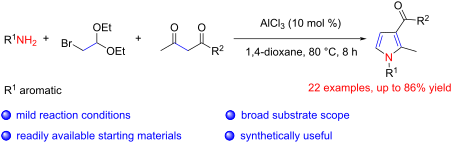
- to access the insect-growth regulators [44]. It is noteworthy that the sulfonamide group persisted during this transformation, and the desired pyrrole product 4r could be obtained in 69% yield. A high yield was also obtained when the phenyl group was replaced with a naphthyl group in 4s. Subsequently

Graphical Abstract

Figure 1: Representative biologically active N-(hetero)aryl-4,5-unsubstituted pyrrole scaffolds.
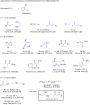
Scheme 1: Typical routes to N-(heteroaryl)-4,5-unsubstituted pyrroles.
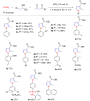
Scheme 2: Substrate scope of the pyrrole synthesis.

Scheme 3: Synthesis of N-heterocyclic pyrroles.

Scheme 4: Direct synthesis of pyrrole-3-carboxamide derivatives.

Scheme 5: Plausible mechanism of the three-component reaction.

Scheme 6: Synthesis of polysubstituted pyrazolo[3,4-b]pyridine derivatives.
A complementary approach to conjugated N-acyliminium formation through photoredox-catalyzed intermolecular radical addition to allenamides and allencarbamates
- Olusesan K. Koleoso,
- Matthew Turner,
- Felix Plasser and
- Marc C. Kimber
Beilstein J. Org. Chem. 2020, 16, 1983–1990, doi:10.3762/bjoc.16.165
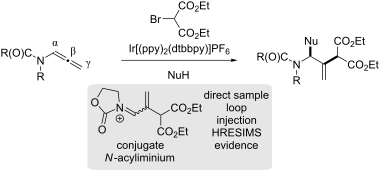
- product, with only a complex mixture, as identified by 1H NMR, being isolated. Significantly, in the 1H NMR spectra of this complex mixture we observed complete fragmentation of the sulfonamide unit. Two chiral allenamides (24 and 25) were exposed to the photoredox conditions with 2,4-dimethylaniline, and

Graphical Abstract

Scheme 1: Electrophilic activation of allenamides.

Scheme 2: The planned intramolecular radical addition to allenamides generating the conjugated N-acyliminium ...

Scheme 3: Photoredox Ir-catalyzed intermolecular addition of bromide 18 and aniline 16 to allenamide 15.
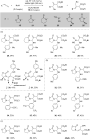
Scheme 4: Reaction scope (a) allenamide; (b) arylamine nucleophile; (c) alcohol nucleophile.

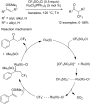
Scheme 5: (a) Tentative mechanism for the photoredox-catalyzed formation of the conjugated N-acyliminium inte...
Pauson–Khand reaction of fluorinated compounds
- Jorge Escorihuela,
- Daniel M. Sedgwick,
- Alberto Llobat,
- Mercedes Medio-Simón,
- Pablo Barrio and
- Santos Fustero
Beilstein J. Org. Chem. 2020, 16, 1662–1682, doi:10.3762/bjoc.16.138
- ). The cyclization of internal alkyne substrate 24b yielded pyrrolidine ring-fused cyclopentenone 25b in similar yield but lower diastereoselectivity. Finally, N-propargyl-N-[2-(trifluoromethyl)allyl] ether 24d, containing an ether linkage instead of the aforementioned sulfonamide linkage, gave furan

Graphical Abstract

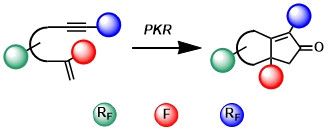
Scheme 1: Schematic representation of the Pauson–Khand reaction.

Scheme 2: Substrates included in this review.

Scheme 3: Commonly accepted mechanism for the Pauson–Khand reaction.

Scheme 4: Regioselectivity of the PKR.

Scheme 5: Variability at the acetylenic and olefinic counterpart.

Scheme 6: Pauson–Khand reaction of fluoroolefinic enynes reported by the group of Ishizaki [46].

Scheme 7: PKR of enynes bearing fluorinated groups on the alkynyl moiety, reported by the group of Ishizaki [46]....

Scheme 8: Intramolecular PKR of 1,7-enynes reported by the group of Billard [47].

Scheme 9: Intramolecular PKR of 1,7-enynes reported by the group of Billard [48].

Scheme 10: Intramolecular PKR of 1,7-enynes by the group of Bonnet-Delpon [49]. Reaction conditions: i) Co(CO)8 (1...

Scheme 11: Intramolecular PKR of 1,6-enynes reported by the group of Ichikawa [50].

Scheme 12: Intramolecular Rh(I)-catalyzed PKR reported by the group of Hammond [52].

Scheme 13: Intramolecular PKR of allenynes reported by the group of Osipov [53].

Scheme 14: Intramolecular PKR of 1,7-enynes reported by the group of Osipov [53].

Scheme 15: Intramolecular PKR of fluorine-containing 1,6-enynes reported by the Konno group [54].

Scheme 16: Diastereoselective PKR with enantioenriched fluorinated enynes 34 [55].

Scheme 17: Intramolecular PKR reported by the group of Martinez-Solorio [56].

Scheme 18: Fluorine substitution at the olefinic counterpart.

Scheme 19: Synthesis of fluorinated enynes 37 [59].

Scheme 20: Fluorine-containing substrates in PKR [59].
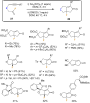
Scheme 21: Pauson Khand reaction for fluorinated enynes by the Fustero group: scope and limitations [59].

Scheme 22: Synthesis of chloro and bromo analogues [59].

Scheme 23: Dimerization pathway [59].

Scheme 24: Synthesis of fluorine-containing N-tethered 1,7-enynes [61].

Scheme 25: Intramolecular PKR of chiral N-tethered fluorinated 1,7-enynes [61].

Scheme 26: Examples of further modifications to the Pauson−Khand adducts [61].

Scheme 27: Asymmetric synthesis the fluorinated enynes 53.

Scheme 28: Intramolecular PKR of chiral N-tethered 1,7-enynes 53 [64].

Scheme 29: Intramolecular PKR of chiral N-tethered 1,7-enyne bearing a vinyl fluoride [64].

Scheme 30: Catalytic intramolecular PKR of chiral N-tethered 1,7-enynes [64].

Scheme 31: Model fluorinated alkynes used by Riera and Fustero [70].

Scheme 32: PKR with norbornadiene and fluorinated alkynes 58 [71].

Scheme 33: Nucleophilic addition/detrifluoromethylation and retro Diels-Alder reactions [70].

Scheme 34: Tentative mechanism for the nucleophilic addition/retro-aldol reaction sequence.

Scheme 35: Catalytic PKR with norbornadiene [70].

Scheme 36: Scope of the PKR of trifluoromethylalkynes with norbornadiene [72].

Scheme 37: DBU-mediated detrifluoromethylation [72].

Scheme 38: A simple route to enone 67, a common intermediate in the total synthesis of α-cuparenone.

Scheme 39: Effect of the olefin partner in the regioselectivity of the PKR with trifluoromethyl alkynes [79].

Scheme 40: Intermolecular PKR of trifluoromethylalkynes with 2-norbornene reported by the group of Konno [54].

Scheme 41: Intermolecular PKR of diarylalkynes with 2-norbornene reported by the group of Helaja [80].

Scheme 42: Intermolecular PKR reported by León and Fernández [81].

Scheme 43: PKR reported with cyclopropene 73 [82].
Fluorinated phenylalanines: synthesis and pharmaceutical applications
- Laila F. Awad and
- Mohammed Salah Ayoup
Beilstein J. Org. Chem. 2020, 16, 1022–1050, doi:10.3762/bjoc.16.91
- and 12b afforded ʟ-4-[sulfono(difluoromethyl)]phenylalanine derivatives 13a and 13b, respectively [39] (Scheme 3). 1.2. Alkylations of fluorinated aryl halides with a chiral auxiliary Alternatively, the coupling of the bis(dimethoxybenzyl)-protected sulfonamide 14, instead of the esters 10a and 10b

Graphical Abstract

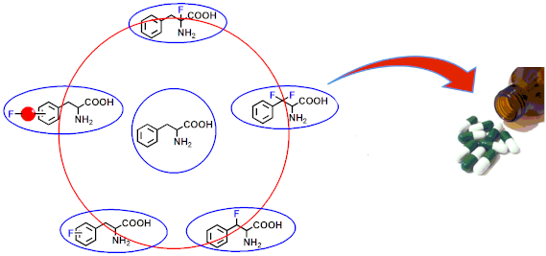
Figure 1: Categories I–V of fluorinated phenylalanines.

Scheme 1: Synthesis of fluorinated phenylalanines via Jackson’s method.

Scheme 2: Synthesis of all-cis-tetrafluorocyclohexylphenylalanines.

Scheme 3: Synthesis of ʟ-4-[sulfono(difluoromethyl)]phenylalanine (nPt: neopentyl, TCE: trichloroethyl).

Scheme 4: Synthesis of ʟ-4-[sulfono(difluoromethyl)]phenylalanine derivatives 17.

Scheme 5: Synthesis of fluorinated Phe analogues from Cbz-protected aminomalonates.

Scheme 6: Synthesis of tetrafluorophenylalanine analogues via the 3-methyl-4-imidazolidinone auxiliary 25.

Scheme 7: Synthesis of tetrafluoro-Phe derivatives via chiral auxiliary 31.

Scheme 8: Synthesis of 2,5-difluoro-Phe and 2,4,5-trifluoro-Phe via Schöllkopf reagent 34.

Scheme 9: Synthesis of 2-fluoro- and 2,6-difluoro Fmoc-Phe derivatives starting from chiral auxiliary 39.

Scheme 10: Synthesis of 2-[18F]FPhe via chiral auxiliary 43.

Scheme 11: Synthesis of FPhe 49a via photooxidative cyanation.

Scheme 12: Synthesis of FPhe derivatives via Erlenmeyer azalactone synthesis.

Scheme 13: Synthesis of (R)- and (S)-2,5-difluoro Phe via the azalactone method.

Scheme 14: Synthesis of 3-bromo-4-fluoro-(S)-Phe (65).

Scheme 15: Synthesis of [18F]FPhe via radiofluorination of phenylalanine with [18F]F2 or [18F]AcOF.

Scheme 16: Synthesis of 4-borono-2-[18F]FPhe.

Scheme 17: Synthesis of protected 4-[18F]FPhe via arylstannane derivatives.

Scheme 18: Synthesis of FPhe derivatives via intermediate imine formation.

Scheme 19: Synthesis of FPhe derivatives via Knoevenagel condensation.

Scheme 20: Synthesis of FPhe derivatives 88a,b from aspartic acid derivatives.

Scheme 21: Synthesis of 2-(2-fluoroethyl)phenylalanine derivatives 93 and 95.

Scheme 22: Synthesis of FPhe derivatives via Zn2+ complexes.

Scheme 23: Synthesis of FPhe derivatives via Ni2+ complexes.

Scheme 24: Synthesis of 3,4,5-trifluorophenylalanine hydrochloride (109).

Scheme 25: Synthesis of FPhe derivatives via phenylalanine aminomutase (PAM).

Scheme 26: Synthesis of (R)-2,5-difluorophenylalanine 115.

Scheme 27: Synthesis of β-fluorophenylalanine via 2-amino-1,3-diol derivatives.

Scheme 28: Synthesis of β-fluorophenylalanine derivatives via the oxazolidinone chiral auxiliary 122.

Scheme 29: Synthesis of β-fluorophenylalanine from pyruvate hemiketal 130.

Scheme 30: Synthesis of β-fluorophenylalanine (136) via fluorination of β-hydroxyphenylalanine (137).

Scheme 31: Synthesis of β-fluorophenylalanine from aziridine derivatives.

Scheme 32: Synthesis of β-fluorophenylalanine 136 via direct fluorination of pyruvate esters.

Scheme 33: Synthesis of β-fluorophenylalanine via fluorination of ethyl 3-phenylpyruvate enol using DAST.

Scheme 34: Synthesis of β-fluorophenylalanine derivatives using photosensitizer TCB.

Scheme 35: Synthesis of β-fluorophenylalanine derivatives using Selectflour and dibenzosuberenone.

Scheme 36: Synthesis of protected β-fluorophenylalanine via aziridinium intermediate 150.

Scheme 37: Synthesis of β-fluorophenylalanine derivatives via fluorination of α-hydroxy-β-aminophenylalanine d...

Scheme 38: Synthesis of β-fluorophenylalanine derivatives from α- or β-hydroxy esters 152a and 155.

Scheme 39: Synthesis of a series of β-fluoro-Phe derivatives via Pd-catalyzed direct fluorination of β-methyle...

Scheme 40: Synthesis of series of β-fluorinated Phe derivatives using quinoline-based ligand 162 in the Pd-cat...

Scheme 41: Synthesis of β,β-difluorophenylalanine derivatives from 2,2-difluoroacetaldehyde derivatives 164a,b....

Scheme 42: Synthesis of β,β-difluorophenylalanine derivatives via an imine chiral auxiliary.

Scheme 43: Synthesis of α-fluorophenylalanine derivatives via direct fluorination of protected Phe 174.

Figure 2: Structures of PET radiotracers of 18FPhe derivatives.

Figure 3: Structures of melfufen (179) and melphalan (180) anticancer drugs.

Figure 4: Structure of gastrazole (JB95008, 181), a CCK2 receptor antagonist.

Figure 5: Dual CCK1/CCK2 antagonist 182.

Figure 6: Structure of sitagliptin (183), an antidiabetic drug.

Figure 7: Structure of retaglpitin (184) and antidiabetic drug.

Figure 8: Structure of evogliptin (185), an antidiabetic drug.

Figure 9: Structure of LY2497282 (186) a DPP-4 inhibitor for the treatment of type II diabetes.

Figure 10: Structure of ulimorelin (187).

Figure 11: Structure of GLP1R (188).
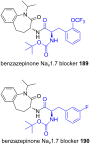
Figure 12: Structures of Nav1.7 blockers 189 and 190.
Recent advances in Cu-catalyzed C(sp3)–Si and C(sp3)–B bond formation
- Balaram S. Takale,
- Ruchita R. Thakore,
- Elham Etemadi-Davan and
- Bruce H. Lipshutz
Beilstein J. Org. Chem. 2020, 16, 691–737, doi:10.3762/bjoc.16.67
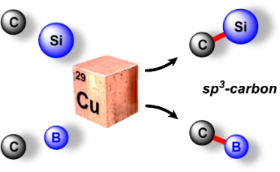
- aldimines 62, failing to use unactivated educts [40]. Likewise, the α-silylated sulfonamide 67 was obtained in modest ee, although the chemical yield of the transformation was very low (15%). Changing the protecting group from Ts to methyl (68) or Boc (70) in the aldimine series did not alter yields or ees

Graphical Abstract

Scheme 1: Pharmaceuticals possessing a silicon or boron atom.

Scheme 2: The first Cu-catalyzed C(sp3)–Si bond formation.

Scheme 3: Conversion of benzylic phosphate 6 to the corresponding silane.

Scheme 4: Conversion of alkyl triflates to alkylsilanes.

Scheme 5: Conversion of secondary alkyl triflates to alkylsilanes.

Scheme 6: Conversion of alkyl iodides to alkylsilanes.

Scheme 7: Trapping of intermediate radical through cascade reaction.

Scheme 8: Radical pathway for conversion of alkyl iodides to alkylsilanes.

Scheme 9: Conversion of alkyl ester of N-hydroxyphthalimide to alkylsilanes.

Scheme 10: Conversion of gem-dibromides to bis-silylalkanes.

Scheme 11: Conversion of imines to α-silylated amines (A) and the reaction pathway (B).

Scheme 12: Conversion of N-tosylimines to α-silylated amines.

Scheme 13: Screening of diamine ligands.

Scheme 14: Conversion of N-tert-butylsulfonylimines to α-silylated amines.

Scheme 15: Conversion of aldimines to nonracemic α-silylated amines.

Scheme 16: Conversion of N-tosylimines to α-silylated amines.

Scheme 17: Reaction pathway [A] and conversion of aldehydes to α-silylated alcohols [B].

Scheme 18: Conversion of aldehydes to benzhydryl silyl ethers.

Scheme 19: Conversion of ketones to 1,2-diols (A) and conversion of imines to 1,2-amino alcohols (B).

Scheme 20: Ligand screening (A) and conversion of aldehydes to α-silylated alcohols (B).

Scheme 21: Conversion of aldehydes to α-silylated alcohols.

Scheme 22: 1,4-Additions to α,β-unsaturated ketones.

Scheme 23: 1,4-Additions to unsaturated ketones to give β-silylated derivatives.

Scheme 24: Additions onto α,β-unsaturated lactones to give β-silylated lactones.

Scheme 25: Conversion of α,β-unsaturated to β-silylated lactams.

Scheme 26: Conversion of N-arylacrylamides to silylated oxindoles.

Scheme 27: Conversion of α,β-unsaturated carbonyl compounds to silylated tert-butylperoxides.

Scheme 28: Catalytic cycle for Cu(I) catalyzed α,β-unsaturated compounds.

Scheme 29: Conversion of p-quinone methides to benzylic silanes.

Scheme 30: Conversion of α,β-unsaturated ketimines to regio- and stereocontrolled allylic silanes.

Scheme 31: Conversion of α,β-unsaturated ketimines to enantioenriched allylic silanes.

Scheme 32: Regioselective conversion of dienedioates to allylic silanes.

Scheme 33: Conversion of alkenyl-substituted azaarenes to β-silylated adducts.

Scheme 34: Conversion of conjugated benzoxazoles to enantioenriched β-silylated adducts.

Scheme 35: Conversion of α,β-unsaturated carbonyl indoles to α-silylated N-alkylated indoles.

Scheme 36: Conversion of β-amidoacrylates to α-aminosilanes.

Scheme 37: Conversion of α,β-unsaturated ketones to enantioenriched β-silylated ketones, nitriles, and nitro d...

Scheme 38: Regio-divergent silacarboxylation of allenes.

Scheme 39: Silylation of diazocarbonyl compounds, (A) asymmetric and (B) racemic.

Scheme 40: Enantioselective hydrosilylation of alkenes.

Scheme 41: Conversion of 3-acylindoles to indolino-silanes.

Scheme 42: Proposed mechanism for the silylation of 3-acylindoles.

Scheme 43: Silyation of N-chlorosulfonamides.

Scheme 44: Conversion of acyl silanes to α-silyl alcohols.

Scheme 45: Conversion of N-tosylaziridines to β-silylated N-tosylamines.

Scheme 46: Conversion of N-tosylaziridines to silylated N-tosylamines.

Scheme 47: Conversion of 3,3-disubstituted cyclopropenes to silylated cyclopropanes.

Scheme 48: Conversion of conjugated enynes to 1,3-bis(silyl)propenes.

Scheme 49: Proposed sequence for the Cu-catalyzed borylation of substituted alkenes.

Scheme 50: Cu-catalyzed synthesis of nonracemic allylic boronates.

Scheme 51: Cu–NHC catalyzed synthesis of α-substituted allylboronates.
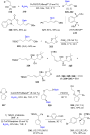
Scheme 52: Synthesis of α-chiral (γ-alkoxyallyl)boronates.

Scheme 53: Cu-mediated formation of nonracemic cis- or trans- 2-substituted cyclopropylboronates.

Scheme 54: Cu-catalyzed synthesis of γ,γ-gem-difluoroallylboronates.

Scheme 55: Cu-catalyzed hydrofunctionalization of internal alkenes and vinylarenes.

Scheme 56: Cu-catalyzed Markovnikov and anti-Markovnikov borylation of alkenes.

Scheme 57: Cu-catalyzed borylation/ortho-cyanation/Cope rearrangement.
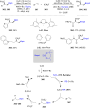
Scheme 58: Borylfluoromethylation of alkenes.

Scheme 59: Cu-catalyzed synthesis of tertiary nonracemic alcohols.

Scheme 60: Synthesis of densely functionalized and synthetically versatile 1,2- or 4,3-borocyanated 1,3-butadi...

Scheme 61: Cu-catalyzed trifunctionalization of allenes.

Scheme 62: Cu-catalyzed selective arylborylation of arenes.

Scheme 63: Asymmetric borylative coupling between styrenes and imines.

Scheme 64: Regio-divergent aminoboration of unactivated terminal alkenes.

Scheme 65: Cu-catalyzed 1,4-borylation of α,β-unsaturated ketones.

Scheme 66: Cu-catalyzed protodeboronation of α,β-unsaturated ketones.

Scheme 67: Cu-catalyzed β-borylation of α,β-unsaturated imines.

Scheme 68: Cu-catalyzed synthesis of β-trifluoroborato carbonyl compounds.

Scheme 69: Asymmetric 1,4-borylation of α,β-unsaturated carbonyl compounds.

Scheme 70: Cu-catalyzed ACB and ACA reactions of α,β-unsaturated 2-acyl-N-methylimidazoles.

Scheme 71: Cu-catalyzed diborylation of aldehydes.

Scheme 72: Umpolung pathway for chiral, nonracemic tertiary alcohol synthesis (top) and proposed mechanism for...

Scheme 73: Cu-catalyzed synthesis of α-hydroxyboronates.

Scheme 74: Cu-catalyzed borylation of ketones.

Scheme 75: Cu-catalyzed borylation of unactivated alkyl halides.

Scheme 76: Cu-catalyzed borylation of allylic difluorides.

Scheme 77: Cu-catalyzed borylation of cyclic and acyclic alkyl halides.

Scheme 78: Cu-catalyzed borylation of unactivated alkyl chlorides and bromides.

Scheme 79: Cu-catalyzed decarboxylative borylation of carboxylic acids.
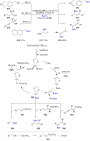
Scheme 80: Cu-catalyzed borylation of benzylic, allylic, and propargylic alcohols.
Aerobic synthesis of N-sulfonylamidines mediated by N-heterocyclic carbene copper(I) catalysts
- Faïma Lazreg,
- Marie Vasseur,
- Alexandra M. Z. Slawin and
- Catherine S. J. Cazin
Beilstein J. Org. Chem. 2020, 16, 482–491, doi:10.3762/bjoc.16.43

- ]. Based on these earlier results, the reactivity of these catalysts was investigated in the context of achieving formation of the challenging sulfonamide derivatives. Herein, we report the high efficiency of cationic copper(I) complexes for the formation of N-sulfonylamidines via a three-component

Graphical Abstract

Scheme 1: Formation of sulfonyltriazoles and sulfonamidines.

Figure 1: Catalytic systems used in this study.

Scheme 2: Synthetic access to complexes 4–6 [30].

Scheme 3: Variation of sulfonylazides. Reaction conditions: phenylacetylene (0.5 mmol), sulfonyl azide (0.6 m...
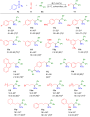
Scheme 4: Variation of alkynes. Reaction conditions: alkyne (0.5 mmol), tosyl azide (0.6 mmol), diisopropylam...

Scheme 5: Variation of the amine substrate. Reaction conditions: phenylacetylene (0.5 mmol), tosyl azide (0.6...

Scheme 6: Reactivity of “non-sulfonyl” azide [33]. Reaction conditions: phenylacetylene (0.5 mmol), benzyl azide ...

Scheme 7: Reactivity of diphenylphosphoryl azide. Reaction conditions: phenylacetylene (0.5 mmol), diphenylph...

Scheme 8: Proposed mechanism for the formation of sulfonamidine.

Scheme 9: Stoichiometric reaction between 6 and 8.

Scheme 10: Synthesis of copper-acetylide intermediate A via [Cu(Cl)(Triaz)].

Scheme 11: Catalytic reaction involving copper-acetylide complex A.
Archangelolide: A sesquiterpene lactone with immunobiological potential from Laserpitium archangelica
- Silvie Rimpelová,
- Michal Jurášek,
- Lucie Peterková,
- Jiří Bejček,
- Vojtěch Spiwok,
- Miloš Majdl,
- Michal Jirásko,
- Miloš Buděšínský,
- Juraj Harmatha,
- Eva Kmoníčková,
- Pavel Drašar and
- Tomáš Ruml
Beilstein J. Org. Chem. 2019, 15, 1933–1944, doi:10.3762/bjoc.15.189
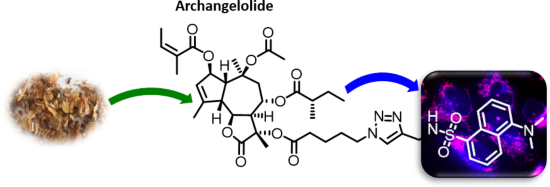
- fluorescent 5-(dimethylamino)-N-(prop-2-yn-1-yl)naphthalene-1-sulfonamide (synthesized according to [18]) using CuI and TBTA [19] catalysis. All of the synthesized compounds were thoroughly described by NMR (Supporting Information File 1, Table S1), IR, optical rotation (Supporting Information File 1, section
- . Synthesis of 11-(5-(4-((5-(dimethylamino)naphthalene-1-sulfonamido)methyl)-1H-1,2,3-triazol-1-yl)pentanoylarchangelolide (5) To a solution of azidovalerate 4 (40 mg, 0.063 mmol) and 5-(dimethylamino)-N-(prop-2-yn-1-yl)naphthalene-1-sulfonamide (20 mg, 0.07 mmol) in THF (3 mL), CuI (50 µL of 1 M water

Graphical Abstract

Figure 1: The structure of the sesquiterpene lactones archangelolide (1) and trilobolide (2).

Scheme 1: Reagents and conditions: a) MeOH, TEA, 48 h, yield 32%; b) (i) 5-azidopentanoic acid, DCC, DCM, 90 ...

Figure 2: Intracellular localization of archangelolide-dansyl (5) in human cells from osteosarcoma (U-2 OS). ...

Figure 3: Co-localization of dansylarchangelolide 5 with a marker of endoplasmic reticulum (top row) and with...
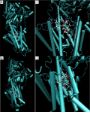
Figure 4: Cartoon representation of sarco/endoplasmic reticulum Ca2+ ATPase binding pocket with A, C) archang...

Figure 5: Molecular surface representation of sarco/endoplasmic reticulum Ca2+ ATPase binding pocket with A) ...

Figure 6: Structural formulae of (i) thapsigargin, (ii) trilobolide (2), and (iii) archangelolide (1). Red pa...

Figure 7: Viability of rat peritoneal cells treated with archangelolide (1), dansylarchangelolide 5 and dansy...

Figure 8: NO production in primary rat macrophages. The cells were treated with archangelolide (1) and dansyl...

Figure 9: Evaluation of cytokine TNF-α secretion in rat peritoneal cells. Stimulation of primary cells was in...

Figure 10: Structure of laserolide.
Robust perfluorophenylboronic acid-catalyzed stereoselective synthesis of 2,3-unsaturated O-, C-, N- and S-linked glycosides
- Madhu Babu Tatina,
- Xia Mengxin,
- Rao Peilin and
- Zaher M. A. Judeh
Beilstein J. Org. Chem. 2019, 15, 1275–1280, doi:10.3762/bjoc.15.125
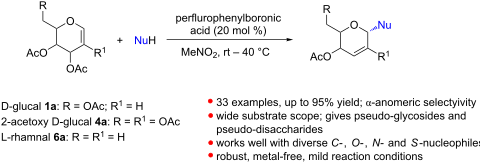
- and trimethyl(propargyl)silane), S-nucleophiles (using thiophenol and p-toluenethiol) and N-nucleophiles (methane sulfonamide and p-toluene sulfonamide) (Figure 1). In all the cases, the reactions successfully gave the respective 2,3-unsaturated glycosides 3a–u in up to 92% yield with mainly α

Graphical Abstract
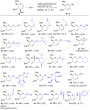
Figure 1: Perfluorophenylboronic acid-catalyzed reaction between 3,4,6-tri-O-acetyl-D-glucal 1a and O-, C-, S...

Figure 2: Perfluorophenylboronic acid-catalyzed reaction between 2,3,4,6-tetra-O-acetyl-D-glucal 4a and O- an...

Figure 3: Perfluorophenylboronic-acid-catalyzed reaction between 3,4-di-O-acetyl-L-rhamnal (6a) and O- and S-...

Figure 4: Plausible perfluorophenylboronic acid-catalyzed activation of glycal 1a.
Targeting the Pseudomonas quinolone signal quorum sensing system for the discovery of novel anti-infective pathoblockers
- Christian Schütz and
- Martin Empting
Beilstein J. Org. Chem. 2018, 14, 2627–2645, doi:10.3762/bjoc.14.241
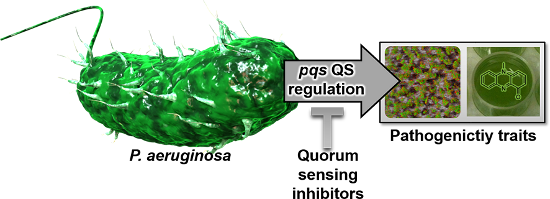
- mimetics More recently, Ji et al. published two classes of sulfonyladenosine inhibitors, more precisely the sulfamate/sulfamide inhibitors 5–9 and the vinyl sulfonamide inhibitors 10 and 11 (Figure 5). While the latter showed very low affinity for the protein, the former displayed Ki values between 88 nM

Graphical Abstract

Figure 1: The four quorum sensing systems in P. aeruginosa las, iqs, rhl, and pqs. Abbreviations: OdDHL, N-(3...

Figure 2: Schematic overview of the PQS biosynthesis and involvement of related metabolites and PqsE in virul...

Figure 3: Anthranilic acid (1) and derivatives thereof (2–4).

Figure 4: Crystal structure of 6-FABA-AMP in complex with PqsA.

Figure 5: Structures of substrate mimetic PqsA inhibitors.

Figure 6: Structures and characteristics of prominent classes of PqsD inhibitors.

Figure 7: Comparison of docking poses of three prototypic PqsD inhibitors: benzamidobenzoic acid derivative 12...

Figure 8: Structures and characteristics of hits against PqsD identified through different methods.

Figure 9: HHQ and PQS analogues as PqsD inhibitors and chemical probe used for screening.

Figure 10: Structure of PqsD-targeting biofilm inhibitor derived from linezolid.

Figure 11: Fragment-based PqsE-inhibitors 24–26.

Figure 12: PqsE co-crystal structures. (A) native product 2-ABA; (B–D) hit fragments 24–26.

Figure 13: Structurally diverse PqsBC-inhibitors 27–30.

Figure 14: Native PqsR ligand HHQ (31) which is converted into PQS (32) by PqsH and synthetic inhibitors 33 an...

Figure 15: Quinazolinone inhibitor 36 (QZN).

Figure 16: Crystal structure of QZN (36) in complex with PqsRCBD.

Figure 17: Structures of best fitting compounds 37–40 obtained from docking studies.

Figure 18: Initial hit 21 and optimized compound 42 (M64).

Figure 19: Co-crystal structure of M64 (42) with PqsRLBD.

Figure 20: M64 (42) as the starting point for further optimization leading to 43, which was further modified a...

Figure 21: Hit fragments from the benzamide (47–48) and oxadiazole class (49–51).

Figure 22: Structures of dual inhibitors 52–55.

Figure 23: Sulfonyl pyrimidines 56–58 acting as dual PqsD/PqsR inhibitors.
Pathoblockers or antivirulence drugs as a new option for the treatment of bacterial infections
- Matthew B. Calvert,
- Varsha R. Jumde and
- Alexander Titz
Beilstein J. Org. Chem. 2018, 14, 2607–2617, doi:10.3762/bjoc.14.239
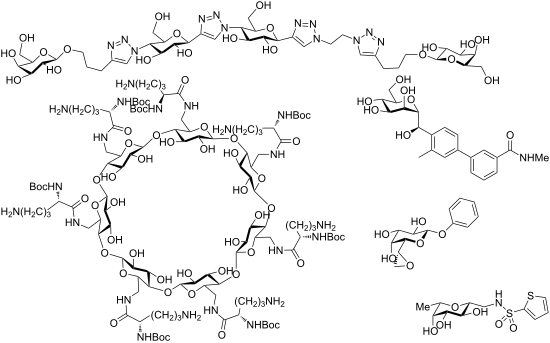
- , Titz et al. have developed small molecule LecB inhibitors derived from mannose and obtained potent monovalent inhibitors (compound 15) of LecB-mediated bacterial adhesion [47]. The sulfonamide 15 and cinnamide 16 were developed to take advantage of interactions with a nearby shallow pocket, and indeed

Graphical Abstract

Figure 1: Mannosides as inhibitors of the lectin FimH from uropathogenic Escherichia coli.

Figure 2: Galactosides targeting uropathogenic Escherichia coli FmlH (compounds 8 and 9) and Pseudomonas aeru...

Figure 3: Mannosides and fucosides as inhibitors of P. aeruginosa LecB.
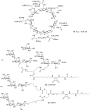
Figure 4: β-Cyclodextrin-based antitoxin 19 against S. aureus α-hemolysin and the decavalent Shiga toxin inhi...

Figure 5: The mechanism of quorum sensing and representative signaling molecules.

Figure 6: Inhibitors of bacterial quorum sensing.
Applications of organocatalysed visible-light photoredox reactions for medicinal chemistry
- Michael K. Bogdos,
- Emmanuel Pinard and
- John A. Murphy
Beilstein J. Org. Chem. 2018, 14, 2035–2064, doi:10.3762/bjoc.14.179
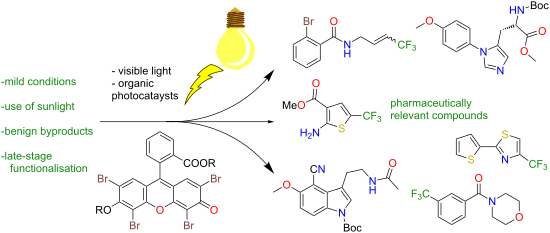
- . Considering that Ered*(cat/cat•−) is greater than +2 V (vs SCE) for acridinium salts, the limited oxidising power is not the most probable explanation. Instability of the heteroaromatic radical cation seems more plausible. The authors explore both aromatic and heteroaromatic pendant groups on the sulfonamide

Graphical Abstract

Figure 1: Depiction of the energy levels of a typical organic molecule and the photophysical processes it can...

Figure 2: General catalytic cycle of a photocatalyst in a photoredox organocatalysed reaction. [cat] – photoc...
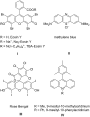
Figure 3: Structures and names of the most common photocatalysts encountered in the reviewed literature.

Figure 4: General example of a reductive quenching catalytic cycle. [cat] – photocatalyst, [cat]* – photocata...

Figure 5: General example of an oxidative quenching catalytic cycle. [cat] – photocatalyst, [cat]* – photocat...

Scheme 1: Oxidative coupling of aldehydes and amines to amides using acridinium salt photocatalysis.

Figure 6: Biologically active molecules containing a benzamide linkage.

Scheme 2: The photocatalytic reduction of amino acids to produce the corresponding free or protected amines.

Scheme 3: The organocatalysed photoredox base-mediated oxidation of thiols to disulfides.

Scheme 4: C-Terminal modification of peptides and proteins using organophotoredox catalysis.

Scheme 5: The reduction and aryl coupling of aryl halides using a doubly excited photocatalyst (PDI).

Figure 7: Mechanism for the coupling of aryl halides using PDI, which is excited sequentially by two photons.

Scheme 6: The arylation of five-membered heteroarenes using arenediazonium salts under organophotoredox condi...

Scheme 7: The C–H (hetero)arylation of five-membered heterocycles under Eosin Y photocatalysis.

Scheme 8: The C–H sulfurisation of imidazoheterocycles using Eosin B-catalyzed photochemical methods.

Scheme 9: The introduction of the thiocyanate group using Eosin Y photocatalysis.

Scheme 10: Sulfonamidation of pyrroles using oxygen as the terminal oxidant.

Scheme 11: DDQ-catalysed C–H amination of arenes and heteroarenes.

Scheme 12: Photoredox-promoted radical Michael addition reactions of allylic or benzylic carbons.

Figure 8: Proposed mechanistic rationale for the observed chemoselectivities.

Scheme 13: The photocatalytic manipulation of C–H bonds adjacent to amine groups.

Scheme 14: The perylene-catalysed organophotoredox tandem difluoromethylation–acetamidation of styrene-type al...

Figure 9: Examples of biologically active molecules containing highly functionalised five membered heterocycl...

Scheme 15: The [3 + 2]-cycloaddition leading to the formation of pyrroles, through the reaction of 2H-azirines...

Figure 10: Proposed intermediate that determines the regioselectivity of the reaction.

Figure 11: Comparison of possible pathways of reaction and various intermediates involved.

Scheme 16: The acridinium salt-catalysed formation of oxazoles from aldehydes and 2H-azirines.

Scheme 17: The synthesis of oxazolines and thiazolines from amides and thioamides using organocatalysed photor...

Figure 12: Biologically active molecules on the market containing 1,3,4-oxadiazole moieties.

Scheme 18: The synthesis of 1,3,4-oxadiazoles from aldehyde semicarbazones using Eosin Y organophotocatalysis.

Scheme 19: The dimerization of primary thioamides to 1,2,4-thiadiazoles catalysed by the presence of Eosin Y a...

Scheme 20: The radical cycloaddition of o-methylthioarenediazonium salts and substituted alkynes towards the f...

Scheme 21: The dehydrogenative cascade reaction for the synthesis of 5,6-benzofused heterocyclic systems.

Figure 13: Trifluoromethylated version of compounds which have known biological activities.

Scheme 22: Eosin Y-catalysed photoredox formation of 3-substituted benzimidazoles.

Scheme 23: Oxidation of dihydropyrimidines by atmospheric oxygen using photoredox catalysis.

Scheme 24: Photoredox-organocatalysed transformation of 2-substituted phenolic imines to benzoxazoles.

Scheme 25: Visible light-driven oxidative annulation of arylamidines.

Scheme 26: Methylene blue-photocatalysed direct C–H trifluoromethylation of heterocycles.

Scheme 27: Photoredox hydrotrifluoromethylation of terminal alkenes and alkynes.

Scheme 28: Trifluoromethylation and perfluoroalkylation of aromatics and heteroaromatics.

Scheme 29: The cooperative asymmetric and photoredox catalysis towards the functionalisation of α-amino sp3 C–...

Scheme 30: Organophotoredox-catalysed direct C–H amidation of aromatics.

Scheme 31: Direct C–H alkylation of heterocycles using BF3K salts. CFL – compact fluorescent lamp.

Figure 14: The modification of camptothecin, demonstrating the use of the Molander protocol in LSF.

Scheme 32: Direct C–H amination of aromatics using acridinium salts.

Scheme 33: Photoredox-catalysed nucleophilic aromatic substitution of nucleophiles onto methoxybenzene derivat...

Scheme 34: The direct C–H cyanation of aromatics with a focus on its use for LSF.
Recent advances in hypervalent iodine(III)-catalyzed functionalization of alkenes
- Xiang Li,
- Pinhong Chen and
- Guosheng Liu
Beilstein J. Org. Chem. 2018, 14, 1813–1825, doi:10.3762/bjoc.14.154
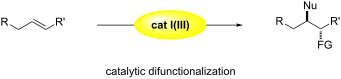
- of substrates bearing either two or four methylene groups between the alkene and sulfonamide failed to provide the fluoroheterocycles. Difluorination of alkenes Hara and co-workers reported a vicinal difluorination of unactivated alkenes in the presence of stoichiometric amounts of difluoro

Graphical Abstract

Figure 1: The structures of hypervalent iodine (III) reagents [8].

Scheme 1: Hypervalent iodine(III)-catalyzed functionalization of alkenes.

Scheme 2: Catalytic sulfonyloxylactonization of alkenoic acids [43].

Scheme 3: Catalytic diacetoxylation of alkenes [46].

Scheme 4: Intramolecular asymmetric dioxygenation of alkenes [48,50].

Scheme 5: Intermolecular asymmetric diacetoxylation of styrenes [52].

Scheme 6: Diacetoxylation of alkenes with ester groups containing catalysts 17 [55].

Scheme 7: Intramolecular diamination of alkenes [56].

Scheme 8: Intramolecular asymmetric diamination of alkenes [57].

Scheme 9: Intermolecular asymmetric diamination of alkenes [58].

Scheme 10: Iodoarene-catalyzed aminofluorination of alkenes [60,61].

Scheme 11: Iodoarene-catalyzed aminofluorination of alkenes [62].

Scheme 12: Catalytic difluorination of alkenes with Selectfluor [63].

Scheme 13: Iodoarene-catalyzed 1,2-difluorination of alkenes [64].

Scheme 14: Iodoarene-catalyzed asymmetric fluorination of styrenes [64,65].

Scheme 15: Gem-difluorination of styrenes [67].

Scheme 16: Asymmetric gem-difluorination of cinnamic acid derivatives [68].

Scheme 17: Oxyarylation of alkenes [71].

Scheme 18: Asymmetric oxidative rearrangements of alkenes [72].

Scheme 19: Bromolactonization of alkenes [75].

Scheme 20: Bromination of alkenes [77,78].

Scheme 21: Cooperative strategy for the carbonylation of alkenes [79].
Synthesis of spirocyclic scaffolds using hypervalent iodine reagents
- Fateh V. Singh,
- Priyanka B. Kole,
- Saeesh R. Mangaonkar and
- Samata E. Shetgaonkar
Beilstein J. Org. Chem. 2018, 14, 1778–1805, doi:10.3762/bjoc.14.152
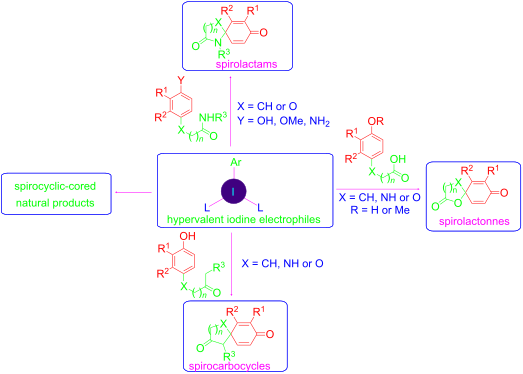
- systems. In 2015, Jain and Ciufolini [124] developed PIDA-mediated spirocyclization of 2-naphtholic sulfonamides 124 to spiropyrrolidine derivatives 125. The spirocyclization reactions were carried out by treating N-sulfonamide substrates 124 with (diacetoxyiodo)benzene (15) in trifluoroacetic acid (TFA
- electrophile. PIDA-mediated spirocyclization of phenolic sulfonamide 122 to spiroketones 123. Iodine(III)-mediated oxidative spirocyclization of 2-naphthol derivatives 124 to spiropyrrolidines 125. PIDA-mediated oxidative spirocyclization of m-substituted phenols 126 to tricyclic spiroketals 127. Iodine(III

Graphical Abstract

Figure 1: The structures of biologically active natural and synthetic products having spirocyclic moiety.

Scheme 1: Iodine(III)-mediated spirocyclization of substituted phenols 7 and 11 to 10 and 13, respectively.

Scheme 2: PIDA-mediated spirolactonization of N-protected tyrosine 14 to spirolactone 16.

Figure 2: The structures of polymer-supported iodine(III) reagents 17a and 17b.

Scheme 3: Spirolactonization of substrates 14 to spirolactones 16 using polymer-supported reagents 17a and 17b...

Scheme 4: PIDA-mediated spirolactonization of 1-(p-hydroxyaryl)cyclobutanols 18 to spirolactones 19.

Scheme 5: Iodine(III)-mediated spirocyclization of aryl alkynes 24 to spirolactones 26 by the reaction with b...

Scheme 6: Bridged iodine(III)-mediated spirocyclization of phenols 27 to spirodienones 29.

Scheme 7: Iodine(III)-mediated spirocyclization of arnottin I (30) to its spirocyclic analogue arnottin II (32...

Scheme 8: Iodine(III)-catalyzed spirolactonization of p-substituted phenols 27 to spirolactones 29 using iodo...

Scheme 9: Iodine(III)-catalyzed oxylactonization of ketocarboxylic acid 34 to spirolactone 36 using iodobenze...

Scheme 10: Iodine(III)-mediated asymmetric oxidative spirocyclization of naphthyl acids 37 to naphthyl spirola...

Scheme 11: Oxidative cyclization of L-tyrosine 14 to spirocyclic lactone 16 using PIDA (15).

Scheme 12: Oxidative cyclization of oxazoline derivatives 41 to spirolactams 42 using PIDA (15).

Scheme 13: Oxidative cyclization of oxazoline 43 to spirolactam 44 using PIDA 15 as oxidant.

Scheme 14: PIFA-mediated spirocyclization of amides 46 to N-spirolactams 47 using PIFA (31) as an electrophile....

Scheme 15: Synthesis of spirolactam 49 from phenolic enamide 48 using PIDA (15).

Scheme 16: Iodine(III)-mediated spirocyclization of alkyl hydroxamates 50 to spirolactams 51 using stoichiomet...

Scheme 17: PIFA-mediated cyclization of substrate 52 to spirocyclic product 54.

Scheme 18: Synthesis of spiro β-lactams 56 by oxidative coupling reaction of p-substituted phenols 55 using PI...

Scheme 19: Iodine(III)-mediated spirocyclization of para-substituted amide 58 to spirolactam 59 by the reactio...

Scheme 20: Iodine(III)-mediated synthesis of spirolactams 61 from anilide derivatives 60.

Scheme 21: PIFA-mediated oxidative cyclization of anilide 60 to bis-spirobisoxindole 61.

Scheme 22: PIDA-mediated spirocyclization of phenylacetamides 65 to spirocyclic lactams 66.

Scheme 23: Oxidative dearomatization of arylamines 67 with PIFA (31) to give dieniminium salts 68.

Scheme 24: PIFA-mediated oxidative spirocarbocyclization of 4-methoxybenzamide 69 with diphenylacetylene (70) ...

Scheme 25: Synthesis of spiroxyindole 75 using I2O5/TBHP oxidative system.

Scheme 26: Iodine(III)-catalyzed spirolactonization of functionalized amides 76 to spirolactones 77 using iodo...

Scheme 27: Intramolecular cyclization of alkenes 78 to spirolactams 80 using Pd(II) 79 and PIDA (15) as the ox...

Scheme 28: Iodine(III)-catalyzed spiroaminocyclization of amides 76 to spirolactam 77 using bis(iodoarene) 81 ...

Scheme 29: Iodine(III)-catalyzed spirolactonization of N-phenyl benzamides 82 to spirolactams 83 using iodoben...

Scheme 30: Iodine(III)-mediated asymmetric oxidative spirocyclization of phenols 84 to spirolactams 86 using c...

Scheme 31: Iodine(III)-catalyzed asymmetric oxidative spirocyclization of N-aryl naphthamides 87 to spirocycli...

Scheme 32: Cyclization of p-substituted phenolic compound 89 to spirolactam 90 using PIDA (15) in TFE.

Scheme 33: Iodine(III)-mediated synthesis of spirocyclic compound 93 from substrates 92 using PIDA (15) as an ...

Scheme 34: Iodine(III)-mediated spirocyclization of p-substituted phenol 48 to spirocyclic compound 49 using P...

Scheme 35: Bridged iodine(III)-mediated spirocyclization of O-silylated phenolic compound 96 in the synthesis ...

Scheme 36: PIFA-mediated approach for the spirocyclization of ortho-substituted phenols 98 to aza-spirocarbocy...

Scheme 37: Oxidative cyclization of para-substituted phenols 102 to spirocarbocyclic compounds 104 using Koser...

Scheme 38: Iodine(III)-mediated spirocyclization of aryl alkynes 105 to spirocarbocyclic compound 106 by the r...

Scheme 39: Iodine(III)-mediated spirocarbocyclization of ortho-substituted phenols 107 to spirocarbocyclic com...

Scheme 40: PIFA-mediated oxidative cyclization of substrates 110 to spirocarbocyclic compounds 111.

Scheme 41: Iodine(III)-mediated cyclization of substrate 113 to spirocyclic compound 114.

Scheme 42: Iodine(III)-mediated spirocyclization of phenolic substrate 116 to the spirocarbocyclic natural pro...

Scheme 43: Iodine(III)-catalyzed spirocyclization of phenols 117 to spirocarbocyclic products 119 using iodoar...

Scheme 44: PIFA-mediated spirocyclization of 110 to spirocyclic compound 111 using PIFA (31) as electrophile.

Scheme 45: PIDA-mediated spirocyclization of phenolic sulfonamide 122 to spiroketones 123.

Scheme 46: Iodine(III)-mediated oxidative spirocyclization of 2-naphthol derivatives 124 to spiropyrrolidines ...

Scheme 47: PIDA-mediated oxidative spirocyclization of m-substituted phenols 126 to tricyclic spiroketals 127.

Figure 3: The structures of chiral organoiodine(III) catalysts 129a and 129b.

Scheme 48: Iodine(III)-catalyzed oxidative spirocyclization of substituted phenols 128 to spirocyclic ketals 1...

Scheme 49: Oxidative spirocyclization of para-substituted phenol 131 to spirodienone 133 using polymer support...

Scheme 50: Oxidative cyclization of bis-hydroxynaphthyl ether 135 to spiroketal 136 using PIDA (15) as an elec...

Scheme 51: Oxidative spirocyclization of phenolic compound 139 to spirodienone 140 using polymer-supported PID...

Scheme 52: PIFA-mediated oxidative cyclization of catechol derived substrate 142 to spirocyclic product 143.

Scheme 53: Oxidative spirocyclization of p-substituted phenolic substrate 145 to aculeatin A (146a) and aculea...

Scheme 54: Oxidative spirocyclization of p-substituted phenolic substrate 147 to aculeatin A (146a) and aculea...

Scheme 55: Oxidative spirocyclization of p-substituted phenolic substrate 148 to aculeatin D (149) using elect...

Scheme 56: Cyclization of phenolic substrate 131 to spirocyclic product 133 using polymer-supported PIFA 150.

Scheme 57: Iodine(III)-mediated oxidative intermolecular spirocyclization of 7-methoxy-α-naphthol (152) to spi...

Scheme 58: Oxidative cyclization of phenols 155 to spiro-ketals 156 using electrophilic species PIDA (15).

Scheme 59: Iodine(III)-catalyzed oxidative spirocyclization of ortho-substituted phenols 158 to spirocyclic ke...
Cobalt-catalyzed C–H cyanations: Insights into the reaction mechanism and the role of London dispersion
- Eric Detmar,
- Valentin Müller,
- Daniel Zell,
- Lutz Ackermann and
- Martin Breugst
Beilstein J. Org. Chem. 2018, 14, 1537–1545, doi:10.3762/bjoc.14.130
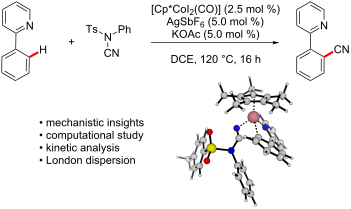
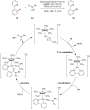
- the desired transformation. As the calculated rate-limiting transition state TS3 benefits from a stabilization of the developing negative charge on the sulfonamide, the relative rates of Scheme 3 provide further support for the migratory insertion representing the rate determining step [44]. As

Graphical Abstract

Scheme 1: Cycloaddition reaction of in situ generated benzynes resulting in the sterically more hindered addu...
Scheme 2: Recently developed cobalt-catalyzed C–H cyanation [30].
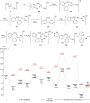
Figure 1: Calculated free-energy profile for the cobalt-catalyzed C–H cyanation of 2-phenylpyridine (1a) [in ...

Figure 2: Calculated structures, selected bond lengths (in Å), and imaginary frequencies for representative i...
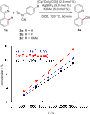
Scheme 3: Kinetic profile of the cobalt-catalyzed C–H cyanation with differently substituted cyanating agents ...

Figure 3: Noncovalent interaction (NCI) analysis for selected intermediates and transition states. The gradie...

Figure 4: Projected dispersion interaction density (DID) plots for selected intermediates and transition stat...
Nanoreactors for green catalysis
- M. Teresa De Martino,
- Loai K. E. A. Abdelmohsen,
- Floris P. J. T. Rutjes and
- Jan C. M. van Hest
Beilstein J. Org. Chem. 2018, 14, 716–733, doi:10.3762/bjoc.14.61
- between heteroaryl bromides, chlorides or iodides and carbamate, sulfonamide or urea derivatives to be successfully realized in water using palladium-loaded TPGS-750-M (dl-α-tocopherol methoxypolyethylene glycol succinate) micelles (Scheme 1). Moreover, this micellar catalytic system allowed for catalyst

Graphical Abstract

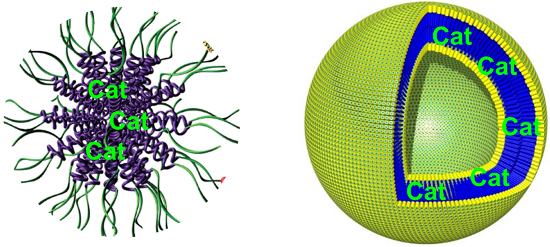
Figure 1: Assembly of catalyst-functionalized amphiphilic block copolymers into polymer micelles and vesicles...

Scheme 1: C–N bond formation under micellar catalyst conditions, no organic solvent involved. Adapted from re...

Scheme 2: Suzuki−Miyaura couplings with, or without, ppm Pd. Conditions: ArI 0.5 mmol 3a, Ar’B(OH)2 (0.75–1.0...

Figure 2: PQS (4a), PQS attached proline catalyst 4b. Adapted from reference [26]. Copyright 2012 American Chemic...

Figure 3: 3a) Schematic representation of a Pickering emulsion with the enzyme in the water phase (i), or wit...

Scheme 3: Cascade reaction with GOx and Myo. Adapted from reference [82].

Figure 4: Cross-linked polymersomes with Cu(OTf)2 catalyst. Reprinted with permission from [15].

Figure 5: Schematic representation of enzymatic polymerization in polymersomes. (A) CALB in the aqueous compa...

Figure 6: Representation of DSN-G0. Reprinted with permission from [100].

Figure 7: The multivalent esterase dendrimer 5 catalyzes the hydrolysis of 8-acyloxypyrene 1,3,6-trisulfonate...

Figure 8: Conversion of 4-NP in five successive cycles of reduction, catalyzed by Au@citrate, Au@PEG and Au@P...
Synthetic and semi-synthetic approaches to unprotected N-glycan oxazolines
- Antony J. Fairbanks
Beilstein J. Org. Chem. 2018, 14, 416–429, doi:10.3762/bjoc.14.30
- the GlcNAc acceptor has an azide or sulfonamide at position 2, rather than acetamide or N-phthalamide. Scheme 5 shows an example of the synthesis of a modified core N-glycan tetrasaccharide oxazoline from the several reported by Wang [77] using this approach. In this case following formation of the

Graphical Abstract

Scheme 1: The first ENGase-catalysed glycosylation of a GlcNAc acceptor using an N-glycan oxazoline as donor.

Scheme 2: Production of N-glycan oxazolines from peracetylated sugars using Lewis acids.

Scheme 3: Direct conversion of unprotected GlcNAc to a glycosyl oxazoline by treatment with DMC and Et3N in w...

Scheme 4: Total synthesis of a truncated complex biantennary N-glycan oxazoline via an epimerisation approach...

Scheme 5: Wangs’s total synthesis of an N-glycan oxazoline incorporating click handles, employing Crich direc...

Scheme 6: Wangs’s total synthesis of an N-glycan dodecasaccharide oxazoline employing final step oxazoline fo...

Scheme 7: Production of a phosphorylated N-glycan oxazoline, employing final step oxazoline formation with DM...
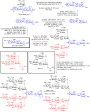
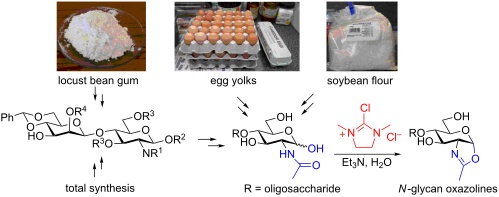
Scheme 8: Enzymatic degradation of locust bean gum, and chemical conversion into an N-glycan dodecasaccharide...
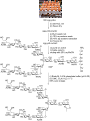
Scheme 9: Production of a complex biantennary N-glycan oxazoline from hens’ eggs by semi-synthesis via isolat...

Scheme 10: Production of a high mannose (Man-9) N-glycan oxazoline from soy bean flour.
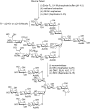
Scheme 11: Production of a triantennary N-glycan oxazoline from bovine feruin by semi-synthesis.
Novel amide-functionalized chloramphenicol base bifunctional organocatalysts for enantioselective alcoholysis of meso-cyclic anhydrides
- Lingjun Xu,
- Shuwen Han,
- Linjie Yan,
- Haifeng Wang,
- Haihui Peng and
- Fener Chen
Beilstein J. Org. Chem. 2018, 14, 309–317, doi:10.3762/bjoc.14.19
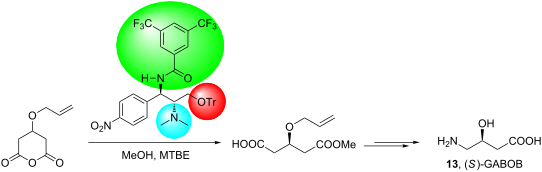
- development of chiral bifunctional urea 1 [35], thiourea 2 and 3 [36][37], sulfonamide 4 [38][39][40] and squaramide 5 [38][39][40] catalysts derived from chloramphenicol base (Figure 1), which showed excellent reactivity and enantioselectivity for this asymmetric transformation. A typical example of the

Graphical Abstract

Figure 1: Chloramphenicol-base-derived bifunctional organocatalysts.

Figure 2: Design of new chloramphenicol base amide organocatalysts.

Scheme 1: Synthesis of bifunctional amide catalysts 7a–q.

Scheme 2: Asymmetric synthesis of (S)-GABOB (13).
CF3SO2X (X = Na, Cl) as reagents for trifluoromethylation, trifluoromethylsulfenyl-, -sulfinyl- and -sulfonylation and chlorination. Part 2: Use of CF3SO2Cl
- Hélène Chachignon,
- Hélène Guyon and
- Dominique Cahard
Beilstein J. Org. Chem. 2017, 13, 2800–2818, doi:10.3762/bjoc.13.273
- nature of the substituents of the sulfonamide group showed little influence on the efficiency of the process. On the contrary, better results were obtained when realising the reaction on substrates featuring electron-donating groups on the phenyl ring directly bound to the nitrogen atom. It was also

Graphical Abstract
Scheme 1: Trifluoromethylation of silyl enol ethers.

Scheme 2: Continuous flow trifluoromethylation of ketones under photoredox catalysis.
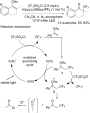
Scheme 3: Trifluoromethylation of enol acetates.

Scheme 4: Photoredox-catalysed tandem trifluoromethylation/cyclisation of N-arylacrylamides: a route to trifl...

Scheme 5: Tandem trifluoromethylation/cyclisation of N-arylacrylamides using BiOBr nanosheets catalysis.

Scheme 6: Photoredox-catalysed trifluoromethylation/desulfonylation/cyclisation of N-tosyl acrylamides (bpy: ...

Scheme 7: Photoredox-catalysed trifluoromethylation/aryl migration/desulfonylation of N-aryl-N-tosylacrylamid...

Scheme 8: Proposed mechanism for the trifluoromethylation/aryl migration/desulfonylation (/cyclisation) of N-...

Scheme 9: Photoredox-catalysed trifluoromethylation/cyclisation of N-methacryloyl-N-methylbenzamide derivativ...

Scheme 10: Photoredox-catalysed trifluoromethylation/cyclisation of N-methylacryloyl-N-methylbenzamide derivat...

Scheme 11: Photoredox-catalysed trifluoromethylation/dearomatising spirocyclisation of a N-benzylacrylamide de...

Scheme 12: Photoredox-catalysed trifluoromethylation/cyclisation of an unactivated alkene.

Scheme 13: Asymmetric radical aminotrifluoromethylation of N-alkenylurea derivatives using a dual CuBr/chiral ...

Scheme 14: Aminotrifluoromethylation of an N-alkenylurea derivative using a dual CuBr/phosphoric acid catalyti...

Scheme 15: 1,2-Formyl- and 1,2-cyanotrifluoromethylation of alkenes under photoredox catalysis.

Scheme 16: First simultaneous introduction of the CF3 moiety and a Cl atom onto alkenes.

Scheme 17: Chlorotrifluoromethylaltion of terminal, 1,1- and 1,2-substituted alkenes.

Scheme 18: Chorotrifluoromethylation of electron-deficient alkenes (DCE = dichloroethane).
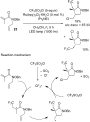
Scheme 19: Cascade trifluoromethylation/cyclisation/chlorination of N-allyl-N-(benzyloxy)methacrylamide.

Scheme 20: Cascade trifluoromethylation/cyclisation (/chlorination) of diethyl 2-allyl-2-(3-methylbut-2-en-1-y...

Scheme 21: Trifluoromethylchlorosulfonylation of allylbenzene derivatives and aliphatic alkenes.

Scheme 22: Access to β-hydroxysulfones from CF3-containing sulfonyl chlorides through a photocatalytic sequenc...
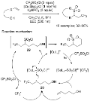
Scheme 23: Cascade trifluoromethylchlorosulfonylation/cyclisation reaction of alkenols: a route to trifluorome...

Scheme 24: First direct C–H trifluoromethylation of arenes and proposed mechanism.

Scheme 25: Direct C–H trifluoromethylation of five- and six-membered (hetero)arenes under photoredox catalysis....

Scheme 26: Alternative pathway for the C–H trifluoromethylation of (hetero)arenes under photoredox catalysis.

Scheme 27: Direct C–H trifluoromethylation of five- and six-membered ring (hetero)arenes using heterogeneous c...

Scheme 28: Trifluoromethylation of terminal olefins.

Scheme 29: Trifluoromethylation of enamides.

Scheme 30: (E)-Selective trifluoromethylation of β-nitroalkenes under photoredox catalysis.

Scheme 31: Photoredox-catalysed trifluoromethylation/cyclisation of an o-azidoarylalkynes.

Scheme 32: Regio- and stereoselective chlorotrifluoromethylation of alkynes.

Scheme 33: PMe3-mediated trifluoromethylsulfenylation by in situ generation of CF3SCl.

Scheme 34: (EtO)2P(O)H-mediated trifluoromethylsulfenylation of (hetero)arenes and thiols.

Scheme 35: PPh3/NaI-mediated trifluoromethylsulfenylation of indole derivatives.

Scheme 36: PPh3/n-Bu4NI mediated trifluoromethylsulfenylation of thiophenol derivatives.

Scheme 37: PPh3/Et3N mediated trifluoromethylsulfinylation of benzylamine.

Scheme 38: PCy3-mediated trifluoromethylsulfinylation of azaarenes, amines and phenols.

Scheme 39: Mono- and dichlorination of carbon acids.

Scheme 40: Monochlorination of (N-aryl-N-hydroxy)acylacetamides.

Scheme 41: Examples of the synthesis of heterocycles fused with β-lactams through a chlorination/cyclisation p...

Scheme 42: Enantioselective chlorination of β-ketoesters and oxindoles.

Scheme 43: Enantioselective chlorination of 3-acyloxazolidin-2-one derivatives (NMM = N-methylmorpholine).
Recent progress in the racemic and enantioselective synthesis of monofluoroalkene-based dipeptide isosteres
- Myriam Drouin and
- Jean-François Paquin
Beilstein J. Org. Chem. 2017, 13, 2637–2658, doi:10.3762/bjoc.13.262
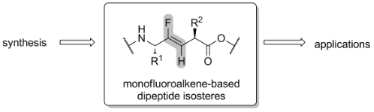
- using a chiral sulfonamide as chiral auxiliary afforded 99 (de > 98:2). Finally, group manipulations, i.e., deprotection of the amine, Fmoc reprotection and oxidation gave the isostere 100. Then, Pannecoucke’s group proposed a modified and more versatile approach where the monofluoroalkene 102 was

Graphical Abstract

Figure 1: Selected amide bond isosteres.

Figure 2: Monofluoroalkene as an amide bond isostere.

Scheme 1: Synthesis of Cbz-Gly-ψ[(Z)-CF=CH]-Gly using a HWE olefination by Sano and co-workers.

Scheme 2: Synthesis of Phth-Gly-ψ[CF=CH]-Gly using the Julia–Kocienski olefination by Lequeux and co-workers.

Scheme 3: Synthesis of Boc-Nva-ψ[(Z)-CF=CH]-Gly by Taguchi and co-workers.

Figure 3: Mutant tripeptide containing two different peptide bond isosteres.

Scheme 4: Chromium-mediated synthesis of Boc-Ser(PMB)-ψ[(Z)-CF=CH]-Gly-OMe by Konno and co-workers.

Scheme 5: Synthesis of Cbz-Gly-ψ[(E)-CF=C]-Pro by Sano and co-workers.

Scheme 6: Synthesis of Cbz-Gly-ψ[(Z)-CF=C]-Pro by Sano and co-workers.

Scheme 7: Stereoselective synthesis of Fmoc-Gly-ψ[(Z)-CF=CH]-Phe by Pannecoucke and co-workers.

Scheme 8: Ring-closure metathesis to prepare Gly-ψ[(E)-CF=CH]-Phg by Couve-Bonnaire and co-workers.

Scheme 9: Stereoselective synthesis of Fmoc-Gly-ψ[(Z)-CF=CH]-Phe by Dory and co-workers.

Scheme 10: Diastereoselective addition of Grignard reagents to sulfinylamines derived from α-fluoroenals by Pa...

Scheme 11: NHC-mediated synthesis of monofluoroalkenes by Otaka and co-workers.

Scheme 12: Stereoselective synthesis of Boc-Tyr-ψ[(Z)-CF=CH]-Gly by Altman and co-workers.

Scheme 13: Synthesis of the tripeptide Boc-Asp(OBn)-Pro-ψ[(Z)-CF=CH)-Val-CH2OH by Miller and co-workers.

Scheme 14: Copper-catalyzed synthesis of monofluoralkenes by Taguchi and co-workers.

Scheme 15: One-pot intramolecular redox reaction to access amide-type isosteres by Otaka and co-workers.

Scheme 16: Copper-mediated reduction, transmetalation and asymmetric alkylation by Fujii and co-workers.

Scheme 17: Synthesis of (E)-monofluoroalkene-based dipeptide isostere by Fujii and co-workers.

Scheme 18: Diastereoselective synthesis of MeOCO-Val-ψ[(Z)-CF=C]-Pro isostere by Chang and co-workers.

Scheme 19: Asymmetric synthesis of Fmoc-Ala-ψ[(Z)-CF=C]-Pro by Pannecoucke and co-workers.

Scheme 20: Synthesis of Fmoc-Val-ψ[(E)-CF=C]-Pro by Pannecoucke and co-workers.

Figure 4: BMS-790052 and its fluorinated analogue.

Figure 5: Bioactivities of pentapeptide analogues based on the relative maximum agonistic activity at 10 nM o...

Figure 6: Structures and affinities of the Leu-enkephalin and its fluorinated analogue. The affinity towards ...

Figure 7: Activation of the opioid receptor DOPr by Leu-enkephaline and a fluorinated analogue.
Synthesis of benzannelated sultams by intramolecular Pd-catalyzed arylation of tertiary sulfonamides
- Valentin A. Rassadin,
- Mirko Scholz,
- Anastasiia A. Klochkova,
- Armin de Meijere and
- Victor V. Sokolov
Beilstein J. Org. Chem. 2017, 13, 1932–1939, doi:10.3762/bjoc.13.187
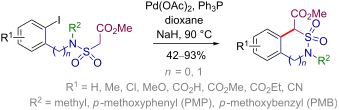
- formation of a 2,3-diarylindole was observed under the same conditions. Keywords: arylation; fused-ring systems; indole formation; palladium catalysis; sultams; Introduction The sulfonamide functional group stands out as one of the most important pharmacophores. At the same time, cyclic sulfonamides
- methyl iodide (Scheme 2). Unfortunately, this apparently simple transformation yielded a mixture of C-, N- and C,N-methylation products due to similar reactivities of the C- and N-nucleophilic centers in 3a. At best, the tertiary sulfonamide 5 was isolated in 32% yield. In contrast to the behavior of 3a
- problem in the alkylation of the sulfonamide 3a, the sequence of steps was reversed. Thus, 2-iodo-N-(4-methoxybenzyl)anilines 7a–g were prepared by reduction of the Schiff bases obtained from 2-iodoanilines 1a–g and 4-methoxybenzaldehyde with sodium cyanoborohydride in a mixture of glacial acetic acid and

Graphical Abstract

Scheme 1: A previous and a new approach to arene-annelated sultams.

Scheme 2: Pd-catalyzed cyclization of (2-iodophenyl)sulfonamides 3 and 5.
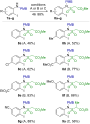
Scheme 3: Preparation of 4-methoxybenzyl-protected methyl 2-(N-o-iodoarylsulfamoyl)acetates 8. Reagents and c...
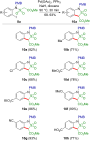
Scheme 4: Synthesis of arene-annelated sultams 10 by Pd-catalyzed intramolecular arylation of a C–H acidic me...

Figure 1: Structure of methyl 5-chloro-1-(4-methoxybenzyl)-1,3-dihydrobenzo[c]isothiazole-3-carboxylate-2,2-d...

Scheme 5: Palladium-catalyzed transformation of N-(2-iodophenyl)-N-(4-methoxybenzyl-benzylsulfonamide 12. Ar ...

Scheme 6: Palladium-catalyzed intramolecular arylation to yield a benzannelated six-membered sultam 21. Ar = ...

Scheme 7: An attempted and a successful removal of the PMB group from the sultam 10a.
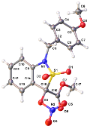
Figure 2: Structure of methyl 1-(4-methoxybenzyl)-3-(nitrooxy)-1,3-dihydrobenzo[c]isothiazole-3-carboxylate-2...
Mechanochemical synthesis of thioureas, ureas and guanidines
- Vjekoslav Štrukil
Beilstein J. Org. Chem. 2017, 13, 1828–1849, doi:10.3762/bjoc.13.178
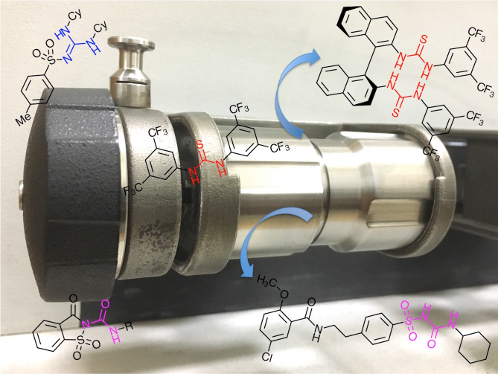
- potassium carbonate as the base was necessary to deprotonate the sulfonamide and thus increase its reactivity. After milling for 2 hours with the corresponding iso(thio)cyanate, the sulfonyl (thio)ureas 42a–c were isolated in excellent yields, for example the drug tolbutamide (1) in 92% (Scheme 17a
- sulfonamide–isocyanate coupling. The mechanochemical EDC-mediated amide bond formation [50] was successful and provided the intermediate 43 in 74% yield. In the second step, coupling of the sulfonamide intermediate 43 with 1.2 equivalents of cyclohexyl isocyanate in the presence of 5 mol % of CuCl and

Graphical Abstract

Scheme 1: a) Schematic representations of unsubstituted urea, thiourea and guanidine. b) Wöhler's synthesis o...

Figure 1: Antidiabetic (1–3) and antimalarial (4) drugs derived from ureas and guanidines currently available...

Scheme 2: The structures of some representative (thio)urea and guanidine organocatalysts 5–8 and anion sensor...

Scheme 3: Solid-state reactivity of isothiocyanates reported by Kaupp [30].
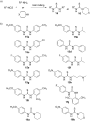
Scheme 4: a) Mechanochemical synthesis of aromatic and aliphatic di- and trisubstituted thioureas by click-co...

Figure 2: The supramolecular level of organization of thioureas in the solid-state.

Figure 3: The supramolecular level of organization of thioureas in the solid-state.

Scheme 5: Thiourea-based organocatalysts and anion sensors obtained by click-mechanochemical synthesis.

Scheme 6: Mechanochemical desymmetrization of ortho-phenylenediamine.

Scheme 7: Mechanochemical desymmetrization of para-phenylenediamine.

Scheme 8: a) Selected examples of a mechanochemical synthesis of aromatic isothiocyanates from anilines. b) O...

Scheme 9: In solution, aromatic N-thiocarbamoyl benzotriazoles 27 are unstable and decompose to isothiocyanat...
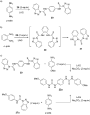
Scheme 10: Mechanosynthesis of a) bis-thiocarbamoyl benzotriazole 29 and b) benzimidazole thione 31. c) Synthe...

Figure 4: In situ Raman spectroscopy monitoring the synthesis of thiourea 28d in the solid-state. N-Thiocarba...

Scheme 11: a) The proposed synthesis of monosubstituted thioureas 32. b) Conversion of N-thiocarbamoyl benzotr...

Scheme 12: A few examples of mechanochemical amination of thiocarbamoyl benzotriazoles by in situ generated am...

Scheme 13: Mechanochemical synthesis of a) anion binding urea 33 by amine-isocyanate coupling and b) dialkylur...

Scheme 14: a) Solvent-free milling synthesis of the bis-urea anion sensor 35. b) Non-selective desymmetrizatio...

Scheme 15: a) HOMO−1 contours of mono-thiourea 19b and mono-urea 36. b) Mechanochemical synthesis of hybrid ur...

Scheme 16: Synthesis of ureido derivatives 38 and 39 from KOCN and hydrochloride salts of a) L-phenylalanine m...

Scheme 17: a) K2CO3-assisted synthesis of sulfonyl (thio)ureas. b) CuCl-catalyzed solid-state synthesis of sul...

Scheme 18: Two-step mechanochemical synthesis of the antidiabetic drug glibenclamide (2).

Scheme 19: Derivatization of saccharin by mechanochemical CuCl-catalyzed addition of isocyanates.

Scheme 20: a) Unsuccessful coupling of p-toluenesulfonamide and DCC in solution and by neat/LAG ball milling. ...

Scheme 21: a) Expansion of the saccharin ring by mechanochemical insertion of carbodiimides. b) Insertion of D...

Scheme 22: Synthesis of highly basic biguanides by ball milling.
Chiral phase-transfer catalysis in the asymmetric α-heterofunctionalization of prochiral nucleophiles
- Johannes Schörgenhumer,
- Maximilian Tiffner and
- Mario Waser
Beilstein J. Org. Chem. 2017, 13, 1753–1769, doi:10.3762/bjoc.13.170
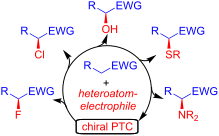
- conditions [90]. Key to success in this spectacular report was the use of the systematically optimized sulfonamide-containing phosphonium salt J1. With this catalyst, they were able to achieve high selectivities in the α-chlorination of 1 with N-chlorophthalimide (13) as the Cl-source under H2O-rich

Graphical Abstract

Scheme 1: Generally accepted ion-pairing mechanism between the chiral cation Q+ of a PTC and an enolate and s...

Scheme 2: Reported asymmetric α-fluorination of β-ketoesters 1 using different chiral PTCs.

Scheme 3: Asymmetric α-fluorination of benzofuranones 4 with phosphonium salt PTC F1.

Scheme 4: Asymmetric α-fluorination of 1 with chiral phosphate-based catalysts.

Scheme 5: Anionic PTC-catalysed α-fluorination of enamines 7 and ketones 10.

Scheme 6: PTC-catalysed α-chlorination reactions of β-ketoesters 1.

Scheme 7: Shioiri’s seminal report of the asymmetric α-hydroxylation of 15 with chiral ammonium salt PTCs.

Scheme 8: Asymmetric ammonium salt-catalysed α-hydroxylation using oxygen together with a P(III)-based reduct...

Scheme 9: Asymmetric ammonium salt-catalysed α-photooxygenations.

Scheme 10: Asymmetric ammonium salt-catalysed α-hydroxylations using organic oxygen-transfer reagents.

Scheme 11: Asymmetric triazolium salt-catalysed α-hydroxylation with in situ generated peroxy imidic acid 24.

Scheme 12: Phase-transfer-catalysed dearomatization of phenols and naphthols.

Scheme 13: Ishihara’s ammonium salt-catalysed oxidative cycloetherification.

Scheme 14: Chiral phase-transfer-catalysed α-sulfanylation reactions.

Scheme 15: Chiral phase-transfer-catalysed α-trifluoromethylthiolation of β-ketoesters 1.

Scheme 16: Chiral phase-transfer-catalysed α-amination of β-ketoesters 1 using diazocarboxylates 38.

Scheme 17: Asymmetric α-fluorination of benzofuranones 4 using diazocarboxylates 38 in the presence of phospho...

Scheme 18: Anionic phase-transfer-catalysed α-amination of β-ketoesters 1 with aryldiazonium salts 41.

Scheme 19: Triazolium salt L-catalysed α-amination of different prochiral nucleophiles with in situ activated ...

Scheme 20: Phase-transfer-catalysed Neber rearrangement.
Synthesis of alkynyl-substituted camphor derivatives and their use in the preparation of paclitaxel-related compounds
- M. Fernanda N. N. Carvalho,
- Rudolf Herrmann and
- Gabriele Wagner
Beilstein J. Org. Chem. 2017, 13, 1230–1238, doi:10.3762/bjoc.13.122
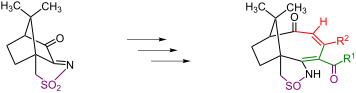
- ], or oxidised to oxaziridines used as efficient chiral oxidising reagents [13][17][18][19]. The reaction of the oxoimide 3 with two equivalents of the lithium salt of a terminal alkyne leads to compounds 4 where two alkynyl substituents, a sulfonamide and a hydroxy group are found in vicinal positions
- coincide in 13 but are approximately 2 ppm apart in 12. Compounds 12 show a signal for the C=O near 206 ppm and one for the sulfonamide carbon at about 65 ppm. In compounds 13, there is a signal for the C=N around 194 ppm and one for the tertiary alcohol carbon near 73 ppm. All other signals of the camphor
- in the presence of Zn/HOAc, as shown in Scheme 4. The product shows an IR stretching vibration at 1760 cm−1 and a 13C NMR signal at 209.7 ppm for the unreacted C=O group. The presence of the sultam can be deduced from the NH stretching vibration at 3180 cm−1, a 13C signal of the sulfonamide carbon at

Graphical Abstract

Scheme 1: Synthesis of 3-oxo-camphorsulfonylimine (3) [13,15] and its bis-alkynyl derivatives 4 from camphor-10-sulf...

Scheme 2: Reactions of bis-alkynyl camphor derivative 4a with TiCl4 and with Br2, respectively.
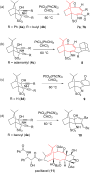
Scheme 3: Reactions of bis-alkynylcamphor derivatives 4a–e with catalytic amounts of PtCl2(PhCN)2.

Scheme 4: Attempted selective synthesis of 3-alkynyl derivatives via sulfonylimine reduction of oxoimide 3.

Scheme 5: Selective synthesis of 2-alkynyl derivatives by protection of the 3-oxo group as an acetal.

Scheme 6: Selective synthesis of 2-alkynyl derivatives by protection of the 3-oxo group as an imine.

Scheme 7: Synthesis of the bis-alkynyl derivatives bearing different alkyne substituents and their platinum-c...

Scheme 8: Proposed mechanism of the platinum-catalysed cycloisomerisation.
DMAP-assisted sulfonylation as an efficient step for the methylation of primary amine motifs on solid support
- Johnny N. Naoum,
- Koushik Chandra,
- Dorit Shemesh,
- R. Benny Gerber,
- Chaim Gilon and
- Mattan Hurevich
Beilstein J. Org. Chem. 2017, 13, 806–816, doi:10.3762/bjoc.13.81
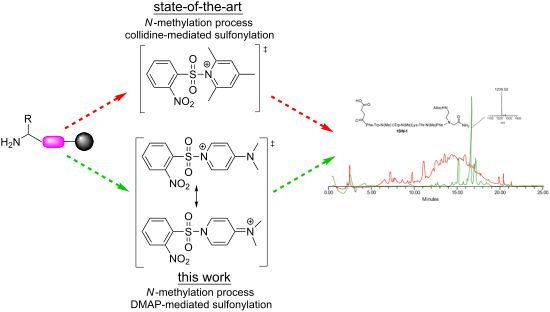
- introduction of the o- or p-nitrobenzenesulfonyl groups to primary amines in the first step. The semi-protected sulfonamides can then undergo a selective mono-methylation via Mitsunobu reaction or by direct methylation. The reaction is completed by the selective removal of the sulfonamide group. Miller and

Graphical Abstract
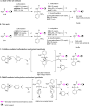
Figure 1: Collidine-assisted vs DMAP-assisted N-methylation process on solid support. (A) Collidine-assisted ...
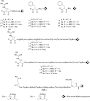
Figure 2: Motifs 1–5 were used as models for the optimization of the N-methylation process. i) Introduction o...

Figure 3: Sulfonylation optimization study. HPLC trace overlay that shows the sulfonylation of motif 4 to yie...

Figure 4: DFT calculations for the reaction of o-NBS-Cl with a) collidine and b) DMAP. The structure of the r...

Figure 5: Methylation of motif 3a to 3b using various reaction conditions. HPLC trace overlay presents the ef...

Figure 6: Optimization of o-NBS removal reaction conditions demonstrated on motif 5b. HPLC trace overlay of i...

Figure 7: HPLC trace overlay and MS analysis of the somatostatin analogue, 1SW-1, which was Nα-methylated on ...
Chromium(II)-catalyzed enantioselective arylation of ketones
- Gang Wang,
- Shutao Sun,
- Ying Mao,
- Zhiyu Xie and
- Lei Liu
Beilstein J. Org. Chem. 2016, 12, 2771–2775, doi:10.3762/bjoc.12.275
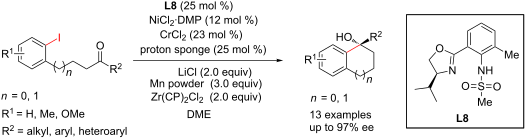
- ) was selected as the model reaction for optimization employing Kishi’s oxazoline/sulfonamides as the chiral ligands. A series of oxazoline/sulfonamide ligands (L1–L8) were tested and the results were summarized in Table 1. Four subgroups of R1 were studied (entries 1–4, Table 1) and isopropyl
- ) was used, enantiopure indan-1-ol was obtained in 70% yield and 82% ee. Conclusion In summary, we have developed the first Cr-catalyzed enantioselective arylation of ketones in an intramolecular version using oxazoline/sulfonamide L8 as the catalyst. Both aliphatic and arylaliphatic ketones proceeded

Graphical Abstract
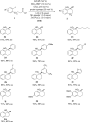
Scheme 1: Scope of the catalytic enantioselective Cr-mediated arylation of ketones.