


Abstract
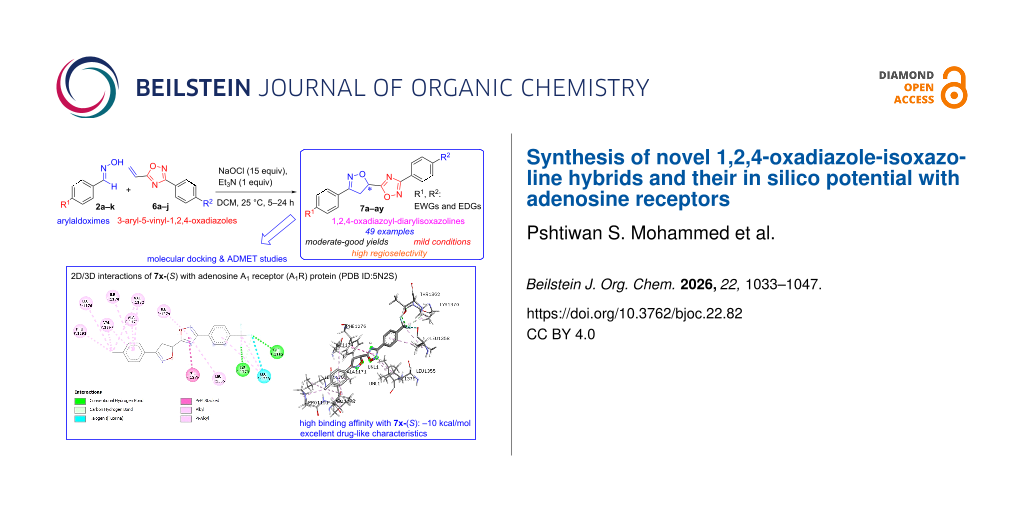
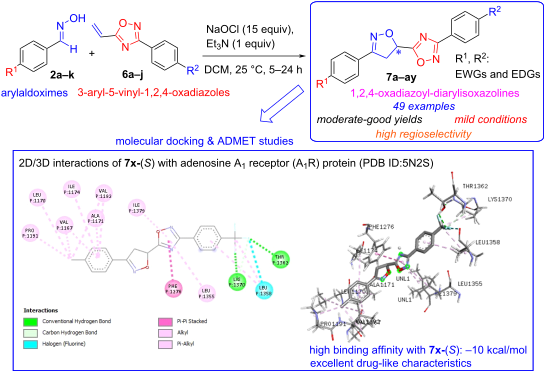
A concise and efficient synthetic route to novel 1,2,4-oxadiazole-isoxazoline hybrids 7 has been developed via regioselective 1,3-dipolar cycloaddition of in situ-generated nitrile oxides with 3-(p-substituted-aryl)-5-vinyl-1,2,4-oxadiazoles 6. The target compounds 7a–ay were obtained in moderate to excellent yields (16–97%) and fully characterized by IR, NMR, and HRMS analyses. The reactions exhibited high regioselectivity, exclusively affording 5-isoxazoline derivatives, while substituent effects played a decisive role in modulating reaction efficiency. In silico studies revealed that all hybrids 7a–ay display strong binding affinities toward the adenosine A₁ receptor (−10.0 to −8.3 kcal/mol), surpassing the co-crystallized ligand and engaging in key stabilizing interactions within the binding pocket. Furthermore, ADMET predictions indicated favorable drug-likeness, high gastrointestinal absorption, and suitable physicochemical properties. Overall, these findings identify 1,2,4-oxadiazole-isoxazoline hybrids as promising and tunable scaffolds for the development of adenosine A₁ receptor-targeted agents; however, further structural optimization and comprehensive biological evaluation are required to fully validate their therapeutic potential.
Graphical Abstract
Introduction
1,2,4-Oxadiazoles are pharmacologically significant five-membered heterocyclic rings, primarily recognized for their bioisosteric relationship with ester and amide functional groups [1-5]. 1,2,4-Oxadiazole derivatives interact with various receptors as agonists or antagonists, demonstrating a wide spectrum of biological activities including anti-inflammatory, anticancer, antidepressant, anti-HIV, antifungal, and anticonvulsant properties [6-13]. A notable therapeutic application is found in Ataluren®, a drug for for the treatment of Duchenne Muscular Dystrophy (DMD), which features a 1,2,4-oxadiazole scaffold [14] (Figure 1).
![[1860-5397-22-82-1]](/bjoc/content/figures/1860-5397-22-82-1.svg?scale=2.0&max-width=1024&background=FFFFFF)
Figure 1: General structure of isoxazoline, 1,2,4-oxadiazole and biologically active 1,2,4-oxadizole, isoxazole and isoxazoline-based molecules or drugs.
Figure 1: General structure of isoxazoline, 1,2,4-oxadiazole and biologically active 1,2,4-oxadizole, isoxazo...
In addition to oxadiazoles, numerous five-membered O,N-containing heterocycles have been developed as pharmacotherapeutic agents so far. Specifically, isoxazoline-based compounds have shown broad biological efficacy, including antimicrobial, anti-inflammatory, anticancer, and antidepressant effects [15-20] (Figure 1). Prominent drugs containing isoxazole or isoxazoline rings, such as sulfisoxazole, oxacillin, and acivicin, have been clinically utilized for many years [21-28] (Figure 1).
The synthesis of 1,2,4-oxadiazole derivatives can be achieved through various efficient methods, such as the cyclocondensation of amidoximes with carbonyl compounds, palladium-catalyzed reactions, anodic oxidations, transformations from other heterocycles or 1,3-dipolar cycloaddition [29-44].
For isoxazoline derivatives, the 1,3-dipolar cycloaddition (1,3-DC) of nitrile oxides serves as a fundamental synthetic tool. These reactions are generally governed by HOMO–LUMO orbital interactions between the dipole and dipolarophile. While substituent effects on the nitrile oxide dipole are minimal, monosubstituted alkenes typically yield 5-substituted isoxazolines with high regioselectivity due to steric and electronic factors. 5-Substituted isoxazolines (2-isoxazolines) have been synthesized in high to excellent yields (75–98%) through nitrile oxide cycloaddition reactions. These nitrile oxides are generated either from aldoximes using various oxidizing agents – such as NaOCl, t-BuOCl, NCS, oxone/NaCl, triflic acid–hypervalent iodine systems, oxone–silica, and chloramine-T – or from chloroaldoximes in the presence of bases including triethylamine, K2CO3, NaHCO3, and pyridine [45-54]. The combination of Et3N/NaOCl represents a particularly effective system for the in situ generation of nitrile oxides from aldoximes. In contrast to single-component oxidants such as NCS, oxone–NaCl, or chloramine-T, the Et3N/NaOCl system enables a stepwise and controlled formation of the reactive dipole via initial oxidation to the hydroxyimoyl chloride followed by rapid base-promoted dehydrohalogenation. This controlled release minimizes the accumulation of free nitrile oxide, thereby suppressing competitive furoxan dimerization, a common yield-limiting pathway in nitrile oxide cycloadditions. Moreover, the presence of triethylamine buffers the reaction medium and scavenges HCl, reducing over-oxidation and undesired chlorination that may occur with NCS or oxone-based systems. Compared with chloramine-T, which often requires elevated temperatures or longer reaction times, Et3N/NaOCl proceeds efficiently under milder conditions and displays improved tolerance toward sensitive or electron-rich dipolarophiles [54-57].
Despite the proven efficacy of both heterocyclic rings as pharmacophores, reports focusing on the synthesis of 1,2,4-oxadiazole-isoxazoline hybrids remain scarce. Previous studies have suggested that such hybrid structures may exhibit phosphodiesterase IV inhibitory activity or possess therapeutic potential against T-cell-mediated disorders, including rheumatoid arthritis and leukemia [58-60]. In this context, a series of 1,2,4-oxadiazole-indazolylisoxazoline derivatives were prepared as phosphodiesterase IV inhibitors via a multistep approach involving nitrile oxide cycloaddition of indazolyl nitrile oxides with methacrylic acid to afford indazolylisoxazoline esters, followed by cyclization with various aryl benzamidoximes [58]. In a related study, novel 1,2,4-oxadiazole-isoxazole hybrids were synthesized from isoxazoline esters generated through nitrile oxide cycloadditions of heterocyclic chlorooximes with methyl 2-propenoate [59]. Furthermore, sequential nitrile oxide cycloaddition reactions of benzonitrile and mesitonitrile oxides with cinnamonitrile were reported as an efficient route to structurally diverse 1,2,4-oxadiazole-isoxazole hybrids [60] (Scheme 1).
![[1860-5397-22-82-i1]](/bjoc/content/inline/1860-5397-22-82-i1.svg?scale=2.0&max-width=1024&background=FFFFFF)
Scheme 1: Recent studies for the synthesis of 1,2,4-oxadiazole-isoxazoline hybrids.
Scheme 1: Recent studies for the synthesis of 1,2,4-oxadiazole-isoxazoline hybrids.
On the other hand, adenosine receptor agonists and antagonists exert diverse physiological effects depending on the targeted subtype (A1, A2A, A2B, A3). For instance, adenosine antagonists are commonly used as stimulants like caffeine, and in neurodegenerative diseases, asthma, and immunotherapy [61-63]. Adenosine receptors are key players in diverse physiological systems. The A1 and A2A subtypes are vital for managing heart function – specifically myocardial oxygen demand and coronary blood flow – and A2A receptors additionally play a crucial role in reducing systemic inflammation [62]. Beyond these peripheral roles, both receptors are key regulators of neurotransmitter activity, particularly concerning dopamine and glutamate levels in the brain. [63-66]. In contrast, the A2B and A3 receptors are mainly found in peripheral tissues, where they are central to immune and inflammatory processes.
Technological progress has enabled the creation of highly potent and selective adenosine receptor agonists and antagonists. These refined tools allow researchers to isolate the effects of specific receptor subtypes, providing the foundation for next-generation, targeted therapies. While many of these agents rely on traditional adenosine or xanthine foundations, the discovery of structurally diverse ligands – such as FK-838 and SCH-420814 – has significantly broadened the landscape for future drug development (Figure 2) [67-71]. Although certain 1,2,4-oxadiazole analogs (BIA9-1067) have been explored as A2A antagonists for neurodegenerative diseases like Parkinson’s, there are currently no reported studies on isoxazoline derivatives functioning as adenosine receptor modulators (Figure 2) [72-74]. Consequently, identifying new lead compounds with hybrid structures presents a significant opportunity for drug development.
![[1860-5397-22-82-2]](/bjoc/content/figures/1860-5397-22-82-2.svg?scale=2.0&max-width=1024&background=FFFFFF)
Figure 2: Various adenosine receptor (AR) antagonists, catechol-O-methyltransferase (COMT) and 1,2,4-oxadiazole type inhibitors in clinical trials.
Figure 2: Various adenosine receptor (AR) antagonists, catechol-O-methyltransferase (COMT) and 1,2,4-oxadiazo...
In this study, we aimed to efficiently prepare novel 1,2,4-oxadiazole-isoxazole hybrids and evaluate their potential as adenosine receptor inhibitors through in silico analysis. Utilizing 1,3-dipolar cycloaddition reactions – a method previously established in our research for constructing diverse heterocycles – we synthesized target 3,5-diaryl-substituted isoxazoline-1,2,4-oxadiazole hybrids (4- and 5-isomer, Scheme 2) [75-79]. These hybrids were generated regioselectively via the cycloaddition of nitrile oxides derived from aryl aldoximes with aryl vinyl-1,2,4-oxadiazole derivatives in the presence of NaOCl/Et3N (Scheme 2). Finally, the binding affinities of these novel molecules were investigated in silico specifically regarding the A1 adenosine receptor.
![[1860-5397-22-82-i2]](/bjoc/content/inline/1860-5397-22-82-i2.svg?scale=2.0&max-width=1024&background=FFFFFF)
Scheme 2: Synthesis of novel 1,2,4-oxadiazole-isoxazoline lead compounds by 1,3-DC.
Scheme 2: Synthesis of novel 1,2,4-oxadiazole-isoxazoline lead compounds by 1,3-DC.
Results and Discussion
Chemistry
Firstly, a series of electron-rich and electron-poor benzaldoximes 2a–k were synthesized in excellent yields (86–98%) via the reaction of 4-substituted benzaldehydes 1a–k with hydroxylamine under basic conditions. Secondly, a three-step synthetic sequence was employed, involving the conversion of benzonitriles 3a–j to benzamidoximes 4a–j, subsequent transformation into the corresponding acrylamides 5a–j, and final cyclization to afford 3-(p-subsituted-aryl)-5-vinyl-1,2,4-oxadiazoles 6a–j bearing both electron-donating and electron-withdrawing groups. These compounds were obtained in moderate to good overall yields (51–75%), with the exception of 6i (Scheme 3, Table 1). The low yield of 6i is likely attributed to the amidoxime formation step, where the electron-rich dimethylamino group in benzonitrile 3i did not sufficiently facilitate amidoxime formation. Moreover, the final cyclization step, conducted under basic conditions at elevated temperature, may also contribute to reduced yields for compounds 6a–j.
![[1860-5397-22-82-i3]](/bjoc/content/inline/1860-5397-22-82-i3.svg?scale=2.0&max-width=1024&background=FFFFFF)
Scheme 3: Synthetic methods for accessing the starting compounds (2a–k, 6a–j). Reagents and conditions: a) NH2OH·HCl, NaOH, EtOH–H2O (5:1), 50–55 °C, 30 min; b) NH2OH·HCl, EtOH, Et3N, 80 °C, 24 h; c) acryloyl chloride, CH2Cl2, rt; d) K2CO3, 1,4-dioxane, 120 °C, 24 h.
Scheme 3: Synthetic methods for accessing the starting compounds (2a–k, 6a–j). Reagents and conditions: a) NH2...
Table 1: Precursor compounds (2a–k, 6a–j) and their yields.
| p-Substituted benzaldoximes 2a–k | 3-Aryl-5-vinyl-1,2,4-oxadiazoles 6a–j | ||||||
| Entry | Product | R1 | Yield (%) | Entry | Product | R2 | Yield (%) |
| 1 | 2a | OCH3 | 94 | 12 | 6a | CF3 | 54 |
| 2 | 2b | Cl | 92 | 13 | 6b | NO2 | 59 |
| 3 | 2c | CH(CH3)2 | 90a | 14 | 6c | F | 66 |
| 4 | 2d | OH | 98 | 15 | 6d | I | 51 |
| 5 | 2e | N(CH3)2 | 90 | 16 | 6e | Cl | 75 |
| 6 | 2f | CH3 | 94 | 17 | 6f | OCH3 | 58 |
| 7 | 2g | Br | 92 | 18 | 6g | H | 65 |
| 8 | 2h | F | 86 | 19 | 6h | SCH3 | 60 |
| 9 | 2i | CF3 | 90 | 20 | 6i | N(CH3)2 | 26 |
| 10 | 2j | NO2 | 94 | 21 | 6j | CH3 | 52 |
| 11 | 2k | CN | 88 | ||||
aSemi-solid.
The structures of benzaldoximes 2a–k were simply characterized by IR stretching peaks corresponding to O–H, C=N, aromatic C=C, aromatic C–H, oxime C–H, and N–O groups (approximately 3250, 1600, 1500, 3040, and 1005 cm−1) (see Experimental section). Similarly, the structures of p-substituted phenyl vinyl 1,2,4-oxadiazoles 6a–j were established primarily through IR absorptions attributed to C=N, C–O, and N–O stretching vibrations (approximately 1646, 1250, and 830 cm−1). Structural confirmation was further supported by the observation of vinylic proton signals at around 6.5, 5.9, and 6.7 ppm and aromatic proton resonances in the range of 7.0–8.5 ppm in the ¹H NMR spectra, as well as characteristic oxadiazole ring C=N carbon signals at approximately 168 and 175 ppm in the ¹³C NMR spectra. Furthermore, it was found that the obtained structural data for benzaldoximes (2a–k) and aryl vinyl 1,2,4-oxadiazoles (6a–j) are consistent with those reported in the literature [80-91].
Following the characterization of the precursors (2a–k and 6a–j), we proceeded to the synthesis of 1,2,4-oxadiazole-isoxazoline hybrids (7) via 1,3-dipolar cycloaddition reactions of nitrile oxides generated in situ. To this end, a model reaction was designed using p-(dimethylamino)benzaldoxime (2e) and 3-(p-iodophenyl)-5-vinyl-1,2,4-oxadiazole (6d) in the presence of sodium hypochlorite and triethylamine to determine the optimal reaction conditions. A series of experiments was carried out by varying the equivalents of 2e (1.2–1.5 equiv), 6d (1.0–1.5 equiv), sodium hypochlorite (1.6–20 equiv), and triethylamine (1.2–2.4 equiv) (Table 2). In addition, control reactions employing either triethylamine or sodium hypochlorite alone at different concentrations were examined. With the exception of a single trial (entry 3, Table 2), the desired cycloaddition product 7a was not obtained. Notably, when the equivalents of 2e, 6d, and triethylamine were kept constant and the amount of sodium hypochlorite was increased from 1.6 to 15 equivalents, a gradual improvement in the yield of 7a was observed (entries 6–10, Table 2). However, further increases in the equivalents of 6d, sodium hypochlorite, or triethylamine, as well as extended reaction times, did not lead to any additional enhancement in yield (entries 11 and 12, Table 2). As a result of these optimization studies, the target compound 7a was obtained in moderate yield under the optimized conditions using 1.0 equivalent of 2e, 1.5 equivalents of 6d, 15 equivalents of sodium hypochlorite, and 1.0 equivalent of triethylamine in dichloromethane at room temperature (entry 10, Table 2).
Table 2: Reaction optimizations for the synthesis of 7a.
![[Graphic 1]](/bjoc/content/inline/1860-5397-22-82-i5.svg?max-width=637&scale=1.0)
|
|||||||
| Entry |
2e
(equiv) |
6d
(equiv) |
NaOCl
(equiv) |
Et3N
(equiv) |
DCM
(mL) |
Time
(h) |
7a
Yield (%) |
| 1 | 1.2 | 1.0 | 1.6 | – | 10 | 8 | – |
| 2 | 1.2 | 1.0 | 3.2 | – | 10 | 16 | –a |
| 3 | 1.5 | 1.2 | 10 | – | 10 | 16 | 12 |
| 4 | 1.2 | 1.0 | – | 1.2 | 5 | 8 | – |
| 5 | 1.2 | 1.0 | – | 2.4 | 5 | 8 | – |
| 6 | 1.2 | 1.0 | 1.6 | 1.0 | 5 | 6 | – |
| 7 | 1.2 | 1.0 | 1.6 | 1.0 | 10 | 24 | – |
| 8 | 1.2 | 1.0 | 3.2 | 1.0 | 10 | 8 | 15 |
| 9 | 1.2 | 1.0 | 10 | 1.0 | 15 | 8 | 28 |
| 10 | 1.5 | 1.0 | 15 | 1.0 | 15 | 10 | 40 |
| 11 | 1.5 | 1.2 | 15 | 1.2 | 15 | 12 | 35 |
| 12 | 1.5 | 1.5 | 20 | 1.5 | 15 | 12 | 40b |
aTrace amount of product. bSome of 6d remained unreacted.
Initially, electron-rich benzaldoximes 2a–f were reacted with electron-poor vinyl-1,2,4-oxadiazoles 6a–e under the optimized reaction conditions. The targeted 1,2,4-oxadiazolyl diarylisoxazoline derivatives 7a–x were obtained within 7–16 h in moderate to good yields (32–96%) after purification by flash column chromatography using ethyl acetate/hexanes. Evaluation of the nitrile oxide cycloaddition results revealed that reactions involving p-chlorobenzaldoxime (2b), p-isopropylbenzaldoxime (2c), and p-tolylaldoxime (2f) proceeded with moderate to high efficiency, affording the corresponding products in 32–96% yields (Table 3). Notably, the highest yield (96%) was achieved in the cycloaddition of p-tolylaldoxime (2f) with 3-(p-fluorophenyl)-5-vinyl-1,2,4-oxadiazole (6c) (entry 15, Table 3). In contrast, cycloadditions of p-methoxybenzaldoxime (2a) with vinyl-1,2,4-oxadiazoles 6 displayed only moderate efficiency, providing yields of 44–60% (entries 3, 8, 13, 17, and 22, Table 3). All reactions involving N,N-dimethylaminobenzaldoxime (2e) and vinyl-1,2,4-oxadiazoles 6a–d predominantly afforded lower yields (32–40%) (entries 1, 7, 11, and 20, Table 3). Moreover, the cycloaddition of 2e with 3-(p-chlorophenyl)-5-vinyl-1,2,4-oxadiazole (6e) failed to yield any detectable product (entry 25, Table 3). Similarly, no cycloaddition products were observed in reactions of p-hydroxybenzaldoxime (2d) with any of the vinyl-1,2,4-oxadiazoles 6. The low yields or complete failure to obtain cycloaddition products in reactions involving N,N-dimethylaminobenzaldoxime (2e) and p-hydroxybenzaldoxime (2d) can be ascribed to side reactions induced by excess sodium hypochlorite in the aqueous medium, leading to the formation of chlorinated amine salts or chlorophenol byproducts, respectively. These competing processes are likely to suppress or prevent the in situ generation of nitrile oxide dipoles, thereby hindering efficient cycloaddition. [92,93].
Table 3: Reactions of electron-rich aldoximes with electron-poor vinyl-1,2,4-oxadiazoles and yields for 1,2,4-oxadiazoyl-diarylisoxazolines 7a–x.
![[Graphic 2]](/bjoc/content/inline/1860-5397-22-82-i6.svg?max-width=637&scale=1.0)
|
|||||
| Entry | Product | R1 (EDG) | R2 (EWG) | Time (h) | Yield (%)* |
| 1 | 7a | N(CH3)2 | I | 10 | 40a |
| 2 | 7b | Cl | I | 10 | 56 |
| 3 | 7c | OCH3 | I | 9 | 44 |
| 4 | 7d | CH(CH3)2 | I | 10 | 38 |
| 5 | 7e | CH3 | I | 14 | 40 |
| 6 | 7f | Cl | NO2 | 10 | 51 |
| 7 | 7g | N(CH3)2 | NO2 | 9 | 32 |
| 8 | 7h | OCH3 | NO2 | 9.5 | 49 |
| 9 | 7i | CH(CH3)2 | NO2 | 9 | 68 |
| 10 | 7j | CH3 | NO2 | 14 | 86 |
| 11 | 7k | N(CH3)2 | F | 8 | 37b |
| 12 | 7l | Cl | F | 9 | 58 |
| 13 | 7m | OCH3 | F | 9 | 60 |
| 14 | 7n | CH(CH3)2 | F | 7 | 77 |
| 15 | 7o | CH3 | F | 16 | 96 |
| 16 | 7p | Cl | Cl | 7.5 | 56 |
| 17 | 7q | OCH3 | Cl | 9.5 | 52 |
| 18 | 7r | CH(CH3)2 | Cl | 8 | 74 |
| 19 | 7s | CH3 | Cl | 15 | 66 |
| 20 | 7t | N(CH3)2 | CF3 | 8 | 38a |
| 21 | 7u | Cl | CF3 | 9 | 61 |
| 22 | 7v | OCH3 | CF3 | 10 | 48 |
| 23 | 7w | CH(CH3)2 | CF3 | 7 | 44 |
| 24 | 7x | CH3 | CF3 | 16 | 57 |
| 25 | 7y | N(CH3)2 | Cl | 16 | –c |
*Yield after CC; asemi-solid ; bliquid; cno product.
Secondly, electron-deficient benzaldoximes 2g–k were subjected to cycloaddition with electron-rich vinyl-1,2,4-oxadiazoles 6f–j under the optimized conditions for reaction times ranging from 5 to 24 h. The corresponding 1,2,4-oxadiazolyl-diarylisoxazoline derivatives 7aa–ay were isolated in moderate to good yields after purification by flash column chromatography. The highest yield (97%) was obtained from the cycloaddition of p-bromobenzaldoxime (2g) with 3-(p-(dimethylamino)phenyl)-5-vinyl-1,2,4-oxadiazole (6i) (entry 16, Table 4). Notably, all cycloaddition reactions involving p-bromobenzaldoxime afforded at least moderate to good yields (50–68%). In general, nitrile oxide cycloadditions with 3-(p-(dimethylamino)phenyl)-5-vinyl-1,2,4-oxadiazole (6i) proceeded efficiently, delivering good to high yields across the examined substrates (Table 4, entries 16–20). In addition, reactions of p-trifluoromethylbenzaldoxime (2i) with vinyl-1,2,4-oxadiazoles 6 provided the desired products in moderate to good yields (52–78%) (Table 4). Cycloadditions involving p-fluorobenzaldoxime (2h) exhibited a broader range of efficiencies, with yields varying from low to high (35–91%) (Table 4). By contrast, cycloadditions of strongly electron-withdrawing p-nitrobenzaldoxime (2j) and p-cyanobenzaldoxime (2k) with the vinyl-1,2,4-oxadiazoles 6 generally did not exceed moderate yields (16–57%) (Table 4). For example, reactions of p-NO2- and p-CN-benzaldoximes (2j and 2k) with 3-(p-(thiomethyl)phenyl)-5-vinyl-1,2,4-oxadiazole (6h) afforded the corresponding products 7an and 7ao in very low yields (16% and 22%, respectively; entries 14 and 15, Table 4). These reduced yields may be attributed to the strong electron-withdrawing p-cyano and p-nitro substituents, which decrease the nucleophilicity of the corresponding nitrile oxide dipoles through resonance effects, thereby diminishing cycloaddition efficiency. Prolonged reaction times of up to 24 hours may also contribute to the observed low yields.
Table 4: Reactions of electron-poor aldoximes with electron-rich vinyl-1,2,4-oxadiazoles and yields for 1,2,4-oxadiazoyl-diarylisoxazolines 7aa-ay.
![[Graphic 3]](/bjoc/content/inline/1860-5397-22-82-i7.svg?max-width=637&scale=1.0)
|
|||||
| Entry | Product | R1 (EWG) | R2 (EDG) | Time (h) | Yield (%)* |
| 1 | 7aa | Br | OCH3 | 7 | 50 |
| 2 | 7ab | F | OCH3 | 7 | 35 |
| 3 | 7ac | CF3 | OCH3 | 6 | 61 |
| 4 | 7ad | NO2 | OCH3 | 24 | 49 |
| 5 | 7ae | CN | OCH3 | 24 | 55 |
| 6 | 7af | Br | H | 5 | 54 |
| 7 | 7ag | F | H | 5 | 71 |
| 8 | 7ah | CF3 | H | 5 | 78 |
| 9 | 7ai | NO2 | H | 24 | 42 |
| 10 | 7aj | CN | H | 24 | 44 |
| 11 | 7ak | Br | SCH3 | 5 | 62 |
| 12 | 7al | F | SCH3 | 6 | 45 |
| 13 | 7am | CF3 | SCH3 | 5 | 52 |
| 14 | 7an | NO2 | SCH3 | 24 | 16 |
| 15 | 7ao | CN | SCH3 | 24 | 22 |
| 16 | 7ap | Br | N(CH3)2 | 7 | 97 |
| 17 | 7aq | F | N(CH3)2 | 7 | 91 |
| 18 | 7ar | CF3 | N(CH3)2 | 7 | 75 |
| 19 | 7as | NO2 | N(CH3)2 | 24 | 57 |
| 20 | 7at | CN | N(CH3)2 | 24 | 56 |
| 21 | 7au | Br | CH3 | 5 | 68 |
| 22 | 7av | F | CH3 | 6 | 62 |
| 23 | 7aw | CF3 | CH3 | 6 | 75 |
| 24 | 7ax | NO2 | CH3 | 24 | 51 |
| 25 | 7ay | CN | CH3 | 24 | 54 |
*Yield after CC.
The structures of all synthesized products 7a–ay were fully determined using IR, NMR, mass spectrometry, and relevant physical data. In the IR spectra of compounds 7a–ay, characteristic absorption bands were observed at approximately 3050, 2900, 1600, 1250, and 830 cm−1, corresponding to aromatic C–H, aliphatic C–H, C=N, C–O, and N–O stretching vibrations, respectively. In the 1H NMR spectra, the diastereotopic protons of the isoxazoline ring appeared as doublets of doublets (dd) at around 6.0, 4.0, and 3.9 ppm. The 13C NMR spectra further supported the proposed structures, displaying characteristic resonances for the 1,2,4-oxadiazole and isoxazoline ring carbons at approximately 175, 167, 156, 73, and 43 ppm. Analysis of the NMR data indicated that the cycloaddition products were formed predominantly as 5-regioisomers and isolated as racemic mixtures, demonstrating the high regioselectivity of the applied nitrile oxide cycloaddition reactions (Scheme 4). Moreover, the molecular masses of all compounds 7a–ay were unambiguously confirmed by high-resolution mass spectrometry, which showed the expected M+ or [M + H]+ ions. (See Experimental section for physical, spectroscopic data and spectra of all products in Supporting Information File 1).
![[1860-5397-22-82-i4]](/bjoc/content/inline/1860-5397-22-82-i4.svg?scale=2.0&max-width=1024&background=FFFFFF)
Scheme 4: Mechanism for the formation of novel 3,5-disubstituted 1,2,4-oxadiazolyl diarylisoxazolines 7a–ay (5-regioisomer).
Scheme 4: Mechanism for the formation of novel 3,5-disubstituted 1,2,4-oxadiazolyl diarylisoxazolines 7a–ay (...
A plausible reaction mechanism for the formation of products 7 via 1,3-dipolar cycloaddition of nitrile oxides 2 with vinyl-1,2,4-oxadiazoles 6 is outlined in Scheme 4. In this process, the nitrile oxide dipole is generated in situ in the presence of sodium hypochlorite and subsequently undergoes rapid cycloaddition with vinyl-1,2,4-oxadiazole 6. Although the dipolarophile can, in principle, react in two different orientations to afford two possible regioisomers, the present cycloaddition proceeds selectively to give only the 5-regioisomer as the observed product.
In silico studies
Molecular docking studies with adenosine receptor
A molecular docking study was performed to obtain a comprehensive insight into the binding modes of the 1,2,4-oxadiazole-isoxazoline hybrids (7a–ay) and the co-crystallized reference ligand (1-butyl-3-(3-hydroxypropyl)-8-((2R,3aS,5S,6aS)-octahydro-2,5-methanopentalen-3a-yl)-1H-purine-2,6(3H,7H)-dione) within the adenosine A1 receptor. The A1 adenosine receptor is a key regulator of numerous physiological processes. Its activation (A1 agonism) is associated with reduced heart rate, neuroprotection, and relief of chronic and neuropathic pain, whereas its inhibition (A1 antagonism) leads to increased alertness and modulation of renal blood flow [63,65]. The predicted binding affinities of the 7a–ay derivatives, evaluated in both possible enantiomeric forms (R and S), together with those of the co-crystallized reference ligand, against the A1 adenosine receptor, PDB ID 5N2S (https://doi.org/10.2210/pdb5N2S/pdb) [83], are summarized in Table 5 and Table 6.
Table 5: Binding affinities of 3,5-disubstituted 1,2,4-oxadiazolyl-diarylisoxazolines 7a–x in two enantiomeric forms with human A1 adenosine receptor (PDB ID: 5N2S).
| Product | Binding energy (kcal/mol) | Product |
Binding energy
(kcal/mol) |
|---|---|---|---|
| 7a-(R) | −8,7 | 7m-(R) | −9,1 |
| 7a-(S) | −8,7 | 7m-(S) | −9,1 |
| 7b-(R) | −9 | 7n-(R) | −9,5 |
| 7b-(S) | −9 | 7n-(S) | −9,5 |
| 7c-(R) | −8,7 | 7o-(R) | −9,2 |
| 7c-(S) | −8,6 | 7o-(S) | −9,8 |
| 7d-(R) | −9,2 | 7p-(R) | −9,2 |
| 7d-(S) | −9,5 | 7p-(S) | −9,1 |
| 7e-(R) | −9,2 | 7q-(R) | −9 |
| 7e-(S) | −9,2 | 7q-(S) | −8,7 |
| 7f-(R) | −8,8 | 7r-(R) | −9,4 |
| 7f-(S) | −8,8 | 7r-(S) | −9,4 |
| 7g-(R) | −9,2 | 7s-(R) | −9,1 |
| 7g-(S) | −8,8 | 7s-(S) | −9,7 |
| 7h-(R) | −8,5 | 7t-(R) | −9,6 |
| 7h-(S) | −8,7 | 7t-(S) | −9,2 |
| 7i-(R) | −8,7 | 7u-(R) | −9,7 |
| 7i-(S) | −9,4 | 7u-(S) | −9,5 |
| 7j-(R) | −9,1 | 7v-(R) | −9,4 |
| 7j-(S) | −9,9 | 7v-(S) | −9,1 |
| 7k-(R) | −8,8 | 7w-(R) | −9,8 |
| 7k-(S) | −8,8 | 7w-(S) | −9,6 |
| 7l-(R) | −9,1 | 7x-(R) | −9,8 |
| 7l-(S) | −9,4 | 7x-(S) | −10 |
| reference (co-cryst) | −8.3 | ||
Table 6: Binding affinities of 3,5-disubstituted 1,2,4-oxadiazolyl-diarylisoxazolines 7aa–ay in two enantiomeric forms with human A1 adenosine receptor (PDB ID: 5N2S).
| Product | Binding energy (kcal/mol) | Product |
Binding energy
(kcal/mol) |
|---|---|---|---|
| 7aa-(R) | −8,5 | 7an-(R) | −8,4 |
| 7aa-(S) | −8,7 | 7an-(S) | −8,3 |
| 7ab-(R) | −8,9 | 7ao-(R) | −8,8 |
| 7ab-(S) | −8,8 | 7ao-(S) | −9 |
| 7ac-(R) | −9,2 | 7ap-(R) | −8,7 |
| 7ac-(S) | −9,4 | 7ap-(S) | −8,8 |
| 7ad-(R) | −8,7 | 7aq-(R) | −8,9 |
| 7ad-(S) | −8,5 | 7aq-(S) | −8,9 |
| 7ae-(R) | −8,9 | 7ar-(R) | −9,4 |
| 7ae-(S) | −8,9 | 7ar-(S) | −9,2 |
| 7af-(R) | −8,8 | 7as-(R) | −8,5 |
| 7af-(S) | −8,9 | 7as-(S) | −8,6 |
| 7ag-(R) | −8,9 | 7at-(R) | −9 |
| 7ag-(S) | −9,2 | 7at-(S) | −9 |
| 7ah-(R) | −9,4 | 7au-(R) | −9,4 |
| 7ah-(S) | −9,6 | 7au-(S) | −9 |
| 7ai-(R) | −9 | 7av-(R) | −9,3 |
| 7ai-(S) | −8,8 | 7av-(S) | −9,2 |
| 7aj-(R) | −9,1 | 7aw-(R) | −9,7 |
| 7aj-(S) | −9,2 | 7aw-(S) | −9,8 |
| 7ak-(R) | −8,7 | 7ax-(R) | −8,9 |
| 7ak-(S) | −8,7 | 7ax-(S) | −9,4 |
| 7al-(R) | −8,7 | 7ay-(R) | −9,4 |
| 7al-(S) | −8,7 | 7ay-(S) | −9,4 |
| 7am-(R) | −9,4 | reference (co-cryst) | −8.3 |
| 7am-(S) | −9,4 | ||
All compounds 7a–ay exhibited high predicted binding affinities toward the adenosine A1 receptor, with binding energies ranging from −10.0 to −8.3 kcal/mol. Notably, the S-enantiomer of 7x showed the strongest interaction with the receptor, displaying the highest binding energy (−10.0 kcal/mol). Other derivatives with comparably high affinities included the S-enantiomers of 7j (−9.9 kcal/mol) and 7o (−9.8 kcal/mol); the R-enantiomers of 7w and 7x (−9.8 kcal/mol) and 7t (−9.6 kcal/mol); and the S-enantiomers of 7s (−9.7 kcal/mol) and 7w (−9.6 kcal/mol). In addition, both the R- and S-enantiomers of 7aw (−9.8 and −9.7 kcal/mol, respectively), as well as the S-enantiomer of 7ah (−9.6 kcal/mol), were predicted to bind strongly to the receptor. Overall, no substantial differences in binding affinity between the enantiomers of the same compounds were observed, with a few exceptions (7d, 7j, 7o, 7s, 7t, 7au, and 7ax). Furthermore, neither the R- nor the S-enantiomers showed a consistent preference or selectivity for receptor binding. The S- and R-enantiomers of 7x, the S-enantiomers of 7j, and the S-enantiomers of 7aw shared similar binding modes, dominated by strong alkyl, π-alkyl, and π–π stacking interactions. Specifically, the S-enantiomers of 7x and 7j formed conventional hydrogen bonds with Lys1370, whereas the R-enantiomer of 7x exhibited π–σ interactions with Ile1379, along with π–π stacking interactions between its oxadiazole ring and Phe1276. The S-enantiomers of 7aw engaged in π–π interactions with Tyr1376, while the R-enantiomers of 7aw and the S-enantiomers of 7ah formed C–H hydrogen bonding interactions with the Ala1341 residue. Additional alkyl and π-alkyl interactions were observed with Ile1174, Val1192, Val1167, Pro1191, and Leu1355 within hydrophobic regions of the binding pocket (Figure 3). Moreover, the S-enantiomer of 7aw formed a halogen bond with Leu1358 and displayed π-alkyl interactions with Ala1171, Val1192, Ile1174, and Val1167. Its oxadiazole ring also participated in π–π stacking with Tyr1376 and alkyl interactions with Ile1379. Similarly, the CF3 group on the benzene ring of the R-enantiomer of 7aw established a halogen bond with Ser1340, together with alkyl interactions involving Ile1153, Ile1206, and Ile1344, and π–σ interactions with Ile1397.
![[1860-5397-22-82-3]](/bjoc/content/figures/1860-5397-22-82-3.png?scale=2.0&max-width=1024&background=FFFFFF)
Figure 3: 3D and 2D binding interactions of best scoring compounds (7x-(S), 7x-(R), 7j-(S), 7aw-(S), 7aw-(R), 7ah-(S)) and reference (co-crystallized) ligand with A1 adenosine receptor. Green arrows: conventional hydrogen bonds; pink region: alkyl connections; light pink region: pi-alkyl connections; blue region: halogen interactions; light green region: carbon–hydrogen bond; dark-pink region: pi–pi stacked connections.
Figure 3: 3D and 2D binding interactions of best scoring compounds (7x-(S), 7x-(R), 7j-(S), 7aw-(S), 7aw-(R),...
Moreover, the co-crystallized reference ligand exhibited a lower binding affinity (−8.3 kcal/mol) compared with all synthesized 7a–ay derivatives. Its imidazolopyrimidine core was found to form conventional hydrogen bonds with the Ile1174 residue, along with π–π stacking interactions with Phe1276. In addition, several alkyl and π-alkyl interactions were observed with receptor residues Leu1379, Leu1355, Leu1358, Leu1170, Val1188, Val1192, and Ala1171.
Overall, these results demonstrate that four compounds (7x, 7j, 7aw, 7ah) in both enantiomeric forms, exhibit strong binding affinities and favorable interaction profiles with the adenosine A₁ receptor. In particular, the highest binding energies observed for both the R- and S-enantiomers of 7x suggest a more stable and robust interaction with the receptor compared to the other derivatives. Collectively, these in silico findings may contribute to drug discovery efforts by providing valuable insights for the design of more potent and selective inhibitors of the adenosine A1 receptor.
ADMET studies
An in silico ADMET analysis of the compounds with binding energy scores ≥ −9.5 kcal/mol (7d, 7j, 7n, 7o, 7s, 7t, 7u, 7w, 7x, 7ah, and 7aw) was performed using the SwissADME online tool [84] to evaluate their absorption, distribution, metabolism, excretion, and toxicity profiles. All selected derivatives complied with Lipinski’s Rule of Five, suggesting favorable drug-likeness and potential for good oral bioavailability. In addition, the compounds were predicted to exhibit high gastrointestinal (GI) absorption, indicating a strong likelihood of efficient uptake into systemic circulation following oral administration.
Lipophilicity, a key determinant of ADME behavior influencing membrane permeability and distribution, was also assessed. The predicted partition coefficients (iLOGP and XLOGP3) for all compounds were below the acceptable threshold of 5, supporting their suitability for oral drug development. Notably, only compound 7w showed a slightly elevated XLOGP3 value (5.24), although its iLOGP value (3.90) remained within acceptable limits, suggesting an overall balanced lipophilicity profile (Table 7).
Table 7: Druggability predictions of high scoring compounds (>9.5 kcal/mol).
| Product |
MW
(g/mol) |
ILogP | XLogP3 |
GI
absorption |
Lipinski |
Pains
alert |
Brenk
alert |
| 7d | 459.28 | 3.92 | 5.00 | high | yes | 0 | 1: I |
| 7j | 350.33 | 2.80 | 3.42 | high | yes | 0 | 2: NO2, N-O |
| 7n | 351.37 | 3.76 | 4.46 | high | yes | 0 | 0 |
| 7o | 323.32 | 3.36 | 3.69 | high | yes | 0 | 0 |
| 7s | 339.78 | 3.46 | 4.22 | high | yes | 0 | 0 |
| 7t | 402.37 | 3.55 | 4.24 | high | yes | 0 | 0 |
| 7u | 393.75 | 3.44 | 4.74 | high | yes | 0 | 0 |
| 7w | 401.38 | 3.90 | 5.24 | high | yes | 0 | 0 |
| 7x | 373.33 | 3.46 | 4.48 | high | yes | 0 | 0 |
| 7ah | 359.30 | 3.18 | 4.11 | high | yes | 0 | 0 |
| 7aw | 373.33 | 3.49 | 4.48 | high | yes | 0 | 0 |
All compounds showed no PAINS alerts, indicating a low probability of assay interference and false-positive biological activity. Similarly, most compounds exhibited no BRENK alerts, which is favorable as these alerts typically indicate the presence of potentially toxic, reactive, or metabolically unstable structural motifs. However, two exceptions were observed: 7d showed an iodine-related alert, while 7j displayed alerts associated with nitro and oxygen–nitrogen functionalities. The nitro group, in particular, is known to be associated with potential mutagenic and toxic effects, and therefore may require further evaluation.
Conclusion
The present study describes the regioselective synthesis of 49 novel 1,2,4-oxadiazole-isoxazoline derivatives 7a–ay via efficient 1,3-dipolar nitrile oxide cycloaddition reactions with various arylvinyl-1,2,4-oxadiazoles. The use of the Et3N/NaOCl system proved particularly advantageous, as it enabled controlled in situ generation of the nitrile oxide dipole, suppressed undesired furoxan formation, and provided mild and chemoselective reaction conditions, ultimately contributing to generally good yields. From a biological perspective, molecular docking studies identified several derivatives (7d, 7j, 7n, 7o, 7s, 7t, 7u, 7w, 7x, 7ah, and 7aw) exhibiting strong predicted binding affinities toward the adenosine A₁ receptor (A₁R), with docking scores ≥ −9.5 kcal/mol. In addition, in silico ADMET evaluations of these high-scoring compounds indicated generally favorable drug-like properties, including good oral bioavailability and acceptable physicochemical profiles, supporting their potential as orally active candidates. Overall, these computational findings suggest that the newly synthesized 1,2,4-oxadiazole-isoxazoline derivatives may serve as promising scaffolds for adenosine A₁ receptor modulation, with potential relevance to therapeutic applications such as cardiovascular regulation (e.g., heart rate control and contractility modulation) and central nervous system effects via neurotransmitter regulation. However, it is important to emphasize that these results are based on theoretical in silico predictions. While the synthetic methodology demonstrates efficiency and regioselectivity, and the computational results indicate promising bioactivity and drug-likeness, experimental validation remains essential. Future studies should therefore focus on in vitro and in vivo biological evaluation to confirm receptor activity, clarify agonist versus antagonist behavior, establish structure–activity relationships (SAR), and assess pharmacokinetic stability and toxicity profiles.
Supporting Information
| Supporting Information File 1: Experimental sections, general procedures, IR, NMR, HRMS data and spectra for precursors 2a–k, 6a–j and all products 7a–ay. | ||
| Format: PDF | Size: 16.0 MB | Download |
Acknowledgements
The authors would like to express their sincere gratitude to colleagues for providing the facilities and resources necessary for this research. Moreover, this work is based, in part, on the master's theses of Pshtiwan S. Mohammed, “Synthesis of Novel Isoxazolines Bearing 1,2,4-Oxadiazole Groups via Nitrile Oxide Cycloadditions” (Bolu Abant İzzet Baysal University, 2022), and Mohammed K. S. Dalo, “1,3-Dipolar Cycloadditions of Electron-Rich Nitrile Oxides with Some Vinylic Dipolarophiles” (Bolu Abant İzzet Baysal University, 2022).
Data Availability Statement
Data generated and analyzed during this study is available from the corresponding author upon reasonable request.
References
-
Rosa, M. F. Dissertation in Organic Chemistry (MSc), Federal University of Rio de Janeiro, Brasil, 1992.
Return to citation in text: [1] -
Macor, J. E.; Ordway, T.; Smith, R. L.; Verhoest, P. R.; Mack, R. A. J. Org. Chem. 1996, 61, 3228–3229. doi:10.1021/jo9603340
Return to citation in text: [1] -
Srivastava, R. M.; de Almeida Lima, A.; Viana, O. S.; da Costa Silva, M. J.; Catanho, M. T. J. A.; de Morais, J. O. F. Bioorg. Med. Chem. 2003, 11, 1821–1827. doi:10.1016/s0968-0896(03)00035-x
Return to citation in text: [1] -
Orlek, B. S.; Blaney, F. E.; Brown, F.; Clark, M. S. G.; Hadley, M. S.; Hatcher, J.; Riley, G. J.; Rosenberg, H. E.; Wadsworth, H. J.; Wyman, P. J. Med. Chem. 1991, 34, 2726–2735. doi:10.1021/jm00113a009
Return to citation in text: [1] -
Swain, C. J.; Baker, R.; Kneen, C.; Moseley, J.; Saunders, J.; Seward, E. M.; Stevenson, G.; Beer, M.; Stanton, J.; Watling, K. J. Med. Chem. 1991, 34, 140–151. doi:10.1021/jm00105a021
Return to citation in text: [1] -
Farooqui, M.; Bora, R.; Patil, C. R. Eur. J. Med. Chem. 2009, 44, 794–799. doi:10.1016/j.ejmech.2008.05.022
Return to citation in text: [1] -
Bezerra, N. M. M.; De Oliveira, S. P.; Srivastava, R. M.; Da Silva, J. R. Farmaco 2005, 60, 955–960. doi:10.1016/j.farmac.2005.08.003
Return to citation in text: [1] -
Kumar, D.; Patel, G.; Johnson, E. O.; Shah, K. Bioorg. Med. Chem. Lett. 2009, 19, 2739–2741. doi:10.1016/j.bmcl.2009.03.158
Return to citation in text: [1] -
Lankau, H.-J.; Unverferth, K.; Grunwald, C.; Hartenhauer, H.; Heinecke, K.; Bernöster, K.; Dost, R.; Egerland, U.; Rundfeldt, C. Eur. J. Med. Chem. 2007, 42, 873–879. doi:10.1016/j.ejmech.2006.12.022
Return to citation in text: [1] -
Sakamoto, T.; Cullen, M. D.; Hartman, T. L.; Watson, K. M.; Buckheit, R. W.; Pannecouque, C.; De Clercq, E.; Cushman, M. J. Med. Chem. 2007, 50, 3314–3321. doi:10.1021/jm070236e
Return to citation in text: [1] -
Sangshetti, J. N.; Nagawade, R. R.; Shinde, D. B. Bioorg. Med. Chem. Lett. 2009, 19, 3564–3567. doi:10.1016/j.bmcl.2009.04.134
Return to citation in text: [1] -
Ergün, Y.; Ergün, U. G. Ö. Eur. J. Pharmacol. 2007, 554, 150–154. doi:10.1016/j.ejphar.2006.09.067
Return to citation in text: [1] -
Suzuki, T.; Iwaoka, K.; Imanishi, N.; Nagakura, Y.; Miyata, K.; Nakahara, H.; Ohta, M.; Mase, T. Chem. Pharm. Bull. 1999, 47, 120–122. doi:10.1248/cpb.47.120
Return to citation in text: [1] -
Public Summary of Opinion on Orphan Designation. European Medicine Agency (EMA), 2015; https://www.ema.europa.eu/en/documents/orphan-designation/eu3151455-public-summary-positive-opinion-orphan-designation-human-plasma-derived-alpha-1-proteinase-inhibitor-treatment-graft-versus-host-disease_en.pdf.
Return to citation in text: [1] -
Dighade, S. R.; Patil, S. D.; Chincholkar, M. M.; Dighade, N. R. Asian J. Chem. 2003, 15, 450–454.
Return to citation in text: [1] -
Naik, V. R.; Naik, H. B. Asian J. Chem. 2000, 12, 1358.
Return to citation in text: [1] -
Lee, H. J.; You, Z.; Ko, D. H.; Yoon, K. J. Drugs Exp. Clin. Res. 1998, 24, 57–66.
Return to citation in text: [1] -
Shivkumar, B.; Nargund, L. V. G. Indian J. Heterocycl. Chem. 1998, 8, 27.
Return to citation in text: [1] -
Wong, P. C.; Quan, M. L.; Crain, E. J.; Watson, C. A.; Wexler, R. R.; Knabb, R. M. J. Pharmacol. Exp. Ther. 2000, 292, 351–357. doi:10.1016/s0022-3565(24)35299-1
Return to citation in text: [1] -
Chalquest, R. Materials and Methods for Killing Nematodes and Nematode Eggs. U.S. Pat. Appl. US20010049373A1, Dec 6, 2001.
Return to citation in text: [1] -
Devasia, G. M.; Shafi, P. M. Indian J. Chem., Sect. B: Org. Chem. Incl. Med. Chem. 1981, 20, 657–660.
Return to citation in text: [1] -
Miss, V. B.; Jamode, V. S. Asian J. Chem. 1998, 10, 1021.
Return to citation in text: [1] -
Tiwari, N.; Dwivedi, B. Boll. Chim. Farm. 1989, 128, 332–335.
Return to citation in text: [1] -
Desai, J. M.; Shah, V. H. Indian J. Chem., Sect. B: Org. Chem. Incl. Med. Chem. 2003, 42, 382–385.
Return to citation in text: [1] -
Nyati, A.; Rao, N. S.; Shrivastav, Y. K.; Verma, B. L. Indian J. Heterocycl. Chem. 2006, 15, 295–296.
Return to citation in text: [1] -
Agarkar, S. V.; Borul, S. B. Orient. J. Chem. 2007, 23, 1151.
Return to citation in text: [1] -
Basappa; Sadashiva, M. P.; Mantelingu, K.; Swamy, S. N.; Rangappa, K. S. Bioorg. Med. Chem. 2003, 11, 4539–4544. doi:10.1016/j.bmc.2003.08.007
Return to citation in text: [1] -
Quan, M. L.; DeLucca, I.; Boswell, G. A.; Chiu, A. T.; Wong, P. C.; Wexler, R. R.; Timmermans, P. B. M. W. M. Bioorg. Med. Chem. Lett. 1994, 4, 1527–1530. doi:10.1016/s0960-894x(01)80526-6
Return to citation in text: [1] -
Tiemann, F.; Krüger, P. Ber. Dtsch. Chem. Ges. 1884, 17, 1685–1698. doi:10.1002/cber.18840170230
Return to citation in text: [1] -
Amarasinghe, K. K. D.; Maier, M. B.; Srivastava, A.; Gray, J. L. Tetrahedron Lett. 2006, 47, 3629–3631. doi:10.1016/j.tetlet.2006.03.155
Return to citation in text: [1] -
Durden, J. A., Jr.; Heywood, D. L. J. Org. Chem. 1971, 36, 1306–1307. doi:10.1021/jo00808a034
Return to citation in text: [1] -
Augustine, J. K.; Vairaperumal, V.; Narasimhan, S.; Alagarsamy, P.; Radhakrishnan, A. Tetrahedron 2009, 65, 9989–9996. doi:10.1016/j.tet.2009.09.114
Return to citation in text: [1] -
Kaboudin, B.; Malekzadeh, L. Tetrahedron Lett. 2011, 52, 6424–6426. doi:10.1016/j.tetlet.2011.09.081
Return to citation in text: [1] -
Kaboudin, B.; Saadati, F. J. Heterocycl. Chem. 2005, 42, 699–701. doi:10.1002/jhet.5570420434
Return to citation in text: [1] -
Nicolaides, D. N.; Fylaktakidou, K. C.; Litinas, K. E.; Hadjipavlou-Litina, D. Eur. J. Med. Chem. 1998, 33, 715–724. doi:10.1016/s0223-5234(98)80030-5
Return to citation in text: [1] -
Young, J. R.; DeVita, R. J. Tetrahedron Lett. 1998, 39, 3931–3934. doi:10.1016/s0040-4039(98)00719-9
Return to citation in text: [1] -
Suyama, T.; Ozawa, N.; Suzuki, N. Bull. Chem. Soc. Jpn. 1994, 67, 307–308. doi:10.1246/bcsj.67.307
Return to citation in text: [1] -
Bencharif, L.; Tallec, A.; Tardivel, R. Electrochim. Acta 1997, 42, 3509–3512. doi:10.1016/s0013-4686(97)00047-9
Return to citation in text: [1] -
Neidlein, R.; Li, S. Synth. Commun. 1995, 25, 2379–2394. doi:10.1080/00397919508015441
Return to citation in text: [1] -
Nicolaides, D. N.; Fylaktakidou, K. C.; Litinas, K. E.; Hadjipavlou‐Litina, D. J. Heterocycl. Chem. 1996, 33, 967–971. doi:10.1002/jhet.5570330367
Return to citation in text: [1] -
Kmetiĉ, M.; Stanovnik, B. J. Heterocycl. Chem. 1995, 32, 1563–1565. doi:10.1002/jhet.5570320525
Return to citation in text: [1] -
Katritzky, A. R.; Rees, C. W.; Scriven, E. F. V., Eds. Comprehensive Heterocyclic Chemistry II, 2nd ed.; Pergamon Press: Oxford, UK, 1996.
Return to citation in text: [1] -
Quadrelli, P.; Mella, M.; Caramella, P. Tetrahedron Lett. 1999, 40, 797–800. doi:10.1016/s0040-4039(98)02416-2
Return to citation in text: [1] -
Dürüst, Y.; Yıldırım, M.; Aycan, A. J. Chem. Res. 2008, 235–239. doi:10.3184/030823408784549933
Return to citation in text: [1] -
Jeddeloh, M. R.; Holden, J. B.; Nouri, D. H.; Kurth, M. J. J. Comb. Chem. 2007, 9, 1041–1045. doi:10.1021/cc700117a
Return to citation in text: [1] -
Yang, K.-S.; Lain, J.-C.; Lin, C.-H.; Chen, K. Tetrahedron Lett. 2000, 41, 1453–1456. doi:10.1016/s0040-4039(99)02316-3
Return to citation in text: [1] -
Pitts, W. J.; Wityak, J.; Smallheer, J. M.; Tobin, A. E.; Jetter, J. W.; Buynitsky, J. S.; Harlow, P. P.; Solomon, K. A.; Corjay, M. H.; Mousa, S. A.; Wexler, R. R.; Jadhav, P. K. J. Med. Chem. 2000, 43, 27–40. doi:10.1021/jm9900321
Return to citation in text: [1] -
Bosanac, T.; Yang, J.; Wilcox, C. S. Angew. Chem. 2001, 113, 1927–1931. doi:10.1002/1521-3757(20010518)113:10<1927::aid-ange1927>3.0.co;2-#
Return to citation in text: [1] -
Minter, A. R.; Fuller, A. A.; Mapp, A. K. J. Am. Chem. Soc. 2003, 125, 6846–6847. doi:10.1021/ja0298747
Return to citation in text: [1] -
Bigdeli, M. A.; Mahdavinia, G. H.; Jafari, S. J. Chem. Res. 2007, 26–28. doi:10.3184/030823407780199621
Return to citation in text: [1] -
Jayashankar, B.; Lokanath Rai, K. M.; Baskaran, N.; Sathish, H. S. Eur. J. Med. Chem. 2009, 44, 3898–3902. doi:10.1016/j.ejmech.2009.04.006
Return to citation in text: [1] -
Mendelsohn, B. A.; Lee, S.; Kim, S.; Teyssier, F.; Aulakh, V. S.; Ciufolini, M. A. Org. Lett. 2009, 11, 1539–1542. doi:10.1021/ol900194v
Return to citation in text: [1] -
Fritsch, L.; Merlo, A. A. ChemistrySelect 2016, 1, 23–30. doi:10.1002/slct.201500044
Return to citation in text: [1] -
Zhao, G.; Liang, L.; Wen, C. H. E.; Tong, R. Org. Lett. 2019, 21, 315–319. doi:10.1021/acs.orglett.8b03829
Return to citation in text: [1] [2] -
Fang, R.-K.; Yin, Z.-C.; Chen, J.-S.; Wang, G.-W. Green Chem. Lett. Rev. 2022, 15, 519–528. doi:10.1080/17518253.2022.2107407
Return to citation in text: [1] -
Shao, Z.; Li, Y.; Wang, L.; Pan, T.; Liu, S.; Xue, M.; Zhao, L.; Zhang, Y. Org. Lett. 2024, 26, 10976–10981. doi:10.1021/acs.orglett.4c04146
Return to citation in text: [1] -
Plumet, J. ChemPlusChem 2020, 85, 2252–2271. doi:10.1002/cplu.202000448
Return to citation in text: [1] -
Palle, V.; Balachandran, S.; Baregama, L. K.; Chakladar, S.; Ramnani, S.; Muthukamal, N.; Ray, A.; Dastidar, S. G. Substituted Indazoles as Inhibitors of Phosphodiesterase Type-Iv.. Int. Pat. Appl. WO2007029077A1, March 15, 2007.
Return to citation in text: [1] [2] -
Freyne, E. J. E.; Andrés-Gil, J. I.; Deroose, F. D.; Petit, D. P. F. M.; Matesanz-Ballesteros, M. E.; Escobar, R. M. A. 4,5-Dihydro-Isoxazole Derivatives and Their Pharmaceutical Use. Int. Pat. Appl. WO2000021959A1, April 20, 2000.
Return to citation in text: [1] [2] -
Corsaro, A.; Chiacchio, U.; Perrini, G.; Caramella, P.; Purrello, G. J. Chem. Res., Synop. 1984, 402–403.
Return to citation in text: [1] [2] -
Gao, Z.-G.; Jacobson, K. A. Expert Opin. Emerging Drugs 2007, 12, 479–492. doi:10.1517/14728214.12.3.479
Return to citation in text: [1] -
Haskó, G.; Pacher, P. J. Leukocyte Biol. 2008, 83, 447–455. doi:10.1189/jlb.0607359
Return to citation in text: [1] [2] -
Kalda, A.; Yu, L.; Oztas, E.; Chen, J.-F. J. Neurol. Sci. 2006, 248, 9–15. doi:10.1016/j.jns.2006.05.003
Return to citation in text: [1] [2] [3] -
Cunha, R. A.; Ferré, S.; Vaugeois, J.-M.; Chen, J.-F. Curr. Pharm. Des. 2008, 14, 1512–1524. doi:10.2174/138161208784480090
Return to citation in text: [1] -
Fuxe, K.; Ferré, S.; Genedani, S.; Franco, R.; Agnati, L. F. Physiol. Behav. 2007, 92, 210–217. doi:10.1016/j.physbeh.2007.05.034
Return to citation in text: [1] [2] -
Schiffmann, S. N.; Fisone, G.; Moresco, R.; Cunha, R. A.; Ferré, S. Prog. Neurobiol. 2007, 83, 277–292. doi:10.1016/j.pneurobio.2007.05.001
Return to citation in text: [1] -
Baraldi, P. G.; Tabrizi, M. A.; Gessi, S.; Borea, P. A. Chem. Rev. 2008, 108, 238–263. doi:10.1021/cr0682195
Return to citation in text: [1] -
Belardinelli, L.; Olsson, R.; Baker, S.; Scammells, P. J. A1 Adenosine Receptor Agonists and Antagonists as Diuretics. U.S. Patent US5446046A, Aug 29, 1995.
Return to citation in text: [1] -
Kuroda, S.; Akahane, A.; Itani, H.; Nishimura, S.; Durkin, K.; Kinoshita, T.; Tenda, Y.; Sakane, K. Bioorg. Med. Chem. Lett. 1999, 9, 1979–1984. doi:10.1016/s0960-894x(99)00304-2
Return to citation in text: [1] -
Neustadt, B. R.; Hao, J.; Lindo, N.; Greenlee, W. J.; Stamford, A. W.; Tulshian, D.; Ongini, E.; Hunter, J.; Monopoli, A.; Bertorelli, R.; Foster, C.; Arik, L.; Lachowicz, J.; Ng, K.; Feng, K.-I. Bioorg. Med. Chem. Lett. 2007, 17, 1376–1380. doi:10.1016/j.bmcl.2006.11.083
Return to citation in text: [1] -
Cristalli, G.; Lambertucci, C.; Marucci, G.; Volpini, R.; Ben, D. Curr. Pharm. Des. 2008, 14, 1525–1552. doi:10.2174/138161208784480081
Return to citation in text: [1] -
Mahmood, A.; Iqbal, J. Med. Res. Rev. 2022, 42, 1661–1703. doi:10.1002/med.21888
Return to citation in text: [1] -
Zhong, Z.; He, X.; Ge, J.; Zhu, J.; Yao, C.; Cai, H.; Ye, X.-Y.; Xie, T.; Bai, R. Eur. J. Med. Chem. 2022, 237, 114378. doi:10.1016/j.ejmech.2022.114378
Return to citation in text: [1] -
Jacobson, K. A.; Gao, Z.-G.; Matricon, P.; Eddy, M. T.; Carlsson, J. Br. J. Pharmacol. 2022, 179, 3496–3511. doi:10.1111/bph.15103
Return to citation in text: [1] -
Yıldırım, M.; Dürüst, Y. Tetrahedron 2011, 67, 3209–3215. doi:10.1016/j.tet.2011.03.017
Return to citation in text: [1] -
Dürüst, Y.; Yıldırım, M.; Fronczek, C. F.; Fronczek, F. R. Monatsh. Chem. 2012, 143, 127–138. doi:10.1007/s00706-011-0618-z
Return to citation in text: [1] -
Dürüst, Y.; Yıldırım, M. Monatsh. Chem. 2010, 141, 961–973. doi:10.1007/s00706-010-0351-z
Return to citation in text: [1] -
Fronczek, C. F.; Dürüst, Y.; Yildirim, M.; Fronczek, F. R. Acta Crystallogr., Sect. E: Struct. Rep. Online 2009, 65, o3069. doi:10.1107/s1600536809046790
Return to citation in text: [1] -
Fronczek, C. F.; Dürüst, Y.; Yildirim, M.; Fronczek, F. R. Acta Crystallogr., Sect. E: Struct. Rep. Online 2009, 65, o3196–o3197. doi:10.1107/s1600536809049319
Return to citation in text: [1] -
Aakeröy, C. B.; Sinha, A. S.; Epa, K. N.; Spartz, C. L.; Desper, J. Chem. Commun. 2012, 48, 11289–11291. doi:10.1039/c2cc36315a
Return to citation in text: [1] -
Alam, A.; Pal, C.; Goyal, M.; Kundu, M. K.; Kumar, R.; Iqbal, M. S.; Dey, S.; Bindu, S.; Sarkar, S.; Pal, U.; Maiti, N. C.; Adhikari, S.; Bandyopadhyay, U. Bioorg. Med. Chem. 2011, 19, 7365–7373. doi:10.1016/j.bmc.2011.10.056
Return to citation in text: [1] -
Baláž, M.; Kudličková, Z.; Vilková, M.; Imrich, J.; Balážová, Ľ.; Daneu, N. Molecules 2019, 24, 3347. doi:10.3390/molecules24183347
Return to citation in text: [1] -
Cheng, R. K. Y.; Segala, E.; Robertson, N.; Deflorian, F.; Doré, A. S.; Errey, J. C.; Fiez-Vandal, C.; Marshall, F. H.; Cooke, R. M. Structure 2017, 25, 1275–1285.e4. doi:10.1016/j.str.2017.06.012
Return to citation in text: [1] [2] -
Daina, A.; Michielin, O.; Zoete, V. Sci. Rep. 2017, 7, 42717. doi:10.1038/srep42717
Return to citation in text: [1] [2] -
Fernandes, F. S.; Rodrigues, M. T., Jr.; Zeoly, L. A.; Conti, C.; Angolini, C. F. F.; Eberlin, M. N.; Coelho, F. J. Org. Chem. 2018, 83, 15118–15127. doi:10.1021/acs.joc.8b02402
Return to citation in text: [1] -
Hu, Q.-S.; Sheng, S.-R.; Liu, X.-L.; Hu, F.; Cai, M.-Z. J. Chin. Chem. Soc. 2008, 55, 768–771. doi:10.1002/jccs.200800115
Return to citation in text: [1] -
Kim, B. R.; Sung, G. H.; Kim, J.-J.; Yoon, Y.-J. J. Korean Chem. Soc. 2013, 57, 295–299. doi:10.5012/jkcs.2013.57.2.295
Return to citation in text: [1] -
Pitasse-Santos, P.; Sueth-Santiago, V.; Lima, M. E. F. J. Braz. Chem. Soc. 2018, 29, 435–456. doi:10.21577/0103-5053.20170208
Return to citation in text: [1] -
Safaei-Ghomi, J.; Masoomi, R. RSC Adv. 2014, 4, 2954–2960. doi:10.1039/c3ra44567d
Return to citation in text: [1] -
Yu, J.; Lu, M. Org. Biomol. Chem. 2015, 13, 7397–7401. doi:10.1039/c5ob00923e
Return to citation in text: [1] -
Zhang, L.; Chen, H.; Zha, Z.; Wang, Z. Chem. Commun. 2012, 48, 6574–6576. doi:10.1039/c2cc32800c
Return to citation in text: [1] -
Studziński, W.; Gackowska, A.; Przybyłek, M.; Gaca, J. Environ. Sci. Pollut. Res. 2017, 24, 8049–8061. doi:10.1007/s11356-017-8477-8
Return to citation in text: [1] -
Michałowicz, J.; Duda, W.; Stufka-Olczyk, J. Chemosphere 2007, 66, 657–663. doi:10.1016/j.chemosphere.2006.07.083
Return to citation in text: [1]
| 80. | Aakeröy, C. B.; Sinha, A. S.; Epa, K. N.; Spartz, C. L.; Desper, J. Chem. Commun. 2012, 48, 11289–11291. doi:10.1039/c2cc36315a |
| 81. | Alam, A.; Pal, C.; Goyal, M.; Kundu, M. K.; Kumar, R.; Iqbal, M. S.; Dey, S.; Bindu, S.; Sarkar, S.; Pal, U.; Maiti, N. C.; Adhikari, S.; Bandyopadhyay, U. Bioorg. Med. Chem. 2011, 19, 7365–7373. doi:10.1016/j.bmc.2011.10.056 |
| 82. | Baláž, M.; Kudličková, Z.; Vilková, M.; Imrich, J.; Balážová, Ľ.; Daneu, N. Molecules 2019, 24, 3347. doi:10.3390/molecules24183347 |
| 83. | Cheng, R. K. Y.; Segala, E.; Robertson, N.; Deflorian, F.; Doré, A. S.; Errey, J. C.; Fiez-Vandal, C.; Marshall, F. H.; Cooke, R. M. Structure 2017, 25, 1275–1285.e4. doi:10.1016/j.str.2017.06.012 |
| 84. | Daina, A.; Michielin, O.; Zoete, V. Sci. Rep. 2017, 7, 42717. doi:10.1038/srep42717 |
| 85. | Fernandes, F. S.; Rodrigues, M. T., Jr.; Zeoly, L. A.; Conti, C.; Angolini, C. F. F.; Eberlin, M. N.; Coelho, F. J. Org. Chem. 2018, 83, 15118–15127. doi:10.1021/acs.joc.8b02402 |
| 86. | Hu, Q.-S.; Sheng, S.-R.; Liu, X.-L.; Hu, F.; Cai, M.-Z. J. Chin. Chem. Soc. 2008, 55, 768–771. doi:10.1002/jccs.200800115 |
| 87. | Kim, B. R.; Sung, G. H.; Kim, J.-J.; Yoon, Y.-J. J. Korean Chem. Soc. 2013, 57, 295–299. doi:10.5012/jkcs.2013.57.2.295 |
| 88. | Pitasse-Santos, P.; Sueth-Santiago, V.; Lima, M. E. F. J. Braz. Chem. Soc. 2018, 29, 435–456. doi:10.21577/0103-5053.20170208 |
| 89. | Safaei-Ghomi, J.; Masoomi, R. RSC Adv. 2014, 4, 2954–2960. doi:10.1039/c3ra44567d |
| 90. | Yu, J.; Lu, M. Org. Biomol. Chem. 2015, 13, 7397–7401. doi:10.1039/c5ob00923e |
| 91. | Zhang, L.; Chen, H.; Zha, Z.; Wang, Z. Chem. Commun. 2012, 48, 6574–6576. doi:10.1039/c2cc32800c |
| 72. | Mahmood, A.; Iqbal, J. Med. Res. Rev. 2022, 42, 1661–1703. doi:10.1002/med.21888 |
| 73. | Zhong, Z.; He, X.; Ge, J.; Zhu, J.; Yao, C.; Cai, H.; Ye, X.-Y.; Xie, T.; Bai, R. Eur. J. Med. Chem. 2022, 237, 114378. doi:10.1016/j.ejmech.2022.114378 |
| 74. | Jacobson, K. A.; Gao, Z.-G.; Matricon, P.; Eddy, M. T.; Carlsson, J. Br. J. Pharmacol. 2022, 179, 3496–3511. doi:10.1111/bph.15103 |
| 75. | Yıldırım, M.; Dürüst, Y. Tetrahedron 2011, 67, 3209–3215. doi:10.1016/j.tet.2011.03.017 |
| 76. | Dürüst, Y.; Yıldırım, M.; Fronczek, C. F.; Fronczek, F. R. Monatsh. Chem. 2012, 143, 127–138. doi:10.1007/s00706-011-0618-z |
| 77. | Dürüst, Y.; Yıldırım, M. Monatsh. Chem. 2010, 141, 961–973. doi:10.1007/s00706-010-0351-z |
| 78. | Fronczek, C. F.; Dürüst, Y.; Yildirim, M.; Fronczek, F. R. Acta Crystallogr., Sect. E: Struct. Rep. Online 2009, 65, o3069. doi:10.1107/s1600536809046790 |
| 79. | Fronczek, C. F.; Dürüst, Y.; Yildirim, M.; Fronczek, F. R. Acta Crystallogr., Sect. E: Struct. Rep. Online 2009, 65, o3196–o3197. doi:10.1107/s1600536809049319 |
| 1. | Rosa, M. F. Dissertation in Organic Chemistry (MSc), Federal University of Rio de Janeiro, Brasil, 1992. |
| 2. | Macor, J. E.; Ordway, T.; Smith, R. L.; Verhoest, P. R.; Mack, R. A. J. Org. Chem. 1996, 61, 3228–3229. doi:10.1021/jo9603340 |
| 3. | Srivastava, R. M.; de Almeida Lima, A.; Viana, O. S.; da Costa Silva, M. J.; Catanho, M. T. J. A.; de Morais, J. O. F. Bioorg. Med. Chem. 2003, 11, 1821–1827. doi:10.1016/s0968-0896(03)00035-x |
| 4. | Orlek, B. S.; Blaney, F. E.; Brown, F.; Clark, M. S. G.; Hadley, M. S.; Hatcher, J.; Riley, G. J.; Rosenberg, H. E.; Wadsworth, H. J.; Wyman, P. J. Med. Chem. 1991, 34, 2726–2735. doi:10.1021/jm00113a009 |
| 5. | Swain, C. J.; Baker, R.; Kneen, C.; Moseley, J.; Saunders, J.; Seward, E. M.; Stevenson, G.; Beer, M.; Stanton, J.; Watling, K. J. Med. Chem. 1991, 34, 140–151. doi:10.1021/jm00105a021 |
| 21. | Devasia, G. M.; Shafi, P. M. Indian J. Chem., Sect. B: Org. Chem. Incl. Med. Chem. 1981, 20, 657–660. |
| 22. | Miss, V. B.; Jamode, V. S. Asian J. Chem. 1998, 10, 1021. |
| 23. | Tiwari, N.; Dwivedi, B. Boll. Chim. Farm. 1989, 128, 332–335. |
| 24. | Desai, J. M.; Shah, V. H. Indian J. Chem., Sect. B: Org. Chem. Incl. Med. Chem. 2003, 42, 382–385. |
| 25. | Nyati, A.; Rao, N. S.; Shrivastav, Y. K.; Verma, B. L. Indian J. Heterocycl. Chem. 2006, 15, 295–296. |
| 26. | Agarkar, S. V.; Borul, S. B. Orient. J. Chem. 2007, 23, 1151. |
| 27. | Basappa; Sadashiva, M. P.; Mantelingu, K.; Swamy, S. N.; Rangappa, K. S. Bioorg. Med. Chem. 2003, 11, 4539–4544. doi:10.1016/j.bmc.2003.08.007 |
| 28. | Quan, M. L.; DeLucca, I.; Boswell, G. A.; Chiu, A. T.; Wong, P. C.; Wexler, R. R.; Timmermans, P. B. M. W. M. Bioorg. Med. Chem. Lett. 1994, 4, 1527–1530. doi:10.1016/s0960-894x(01)80526-6 |
| 63. | Kalda, A.; Yu, L.; Oztas, E.; Chen, J.-F. J. Neurol. Sci. 2006, 248, 9–15. doi:10.1016/j.jns.2006.05.003 |
| 64. | Cunha, R. A.; Ferré, S.; Vaugeois, J.-M.; Chen, J.-F. Curr. Pharm. Des. 2008, 14, 1512–1524. doi:10.2174/138161208784480090 |
| 65. | Fuxe, K.; Ferré, S.; Genedani, S.; Franco, R.; Agnati, L. F. Physiol. Behav. 2007, 92, 210–217. doi:10.1016/j.physbeh.2007.05.034 |
| 66. | Schiffmann, S. N.; Fisone, G.; Moresco, R.; Cunha, R. A.; Ferré, S. Prog. Neurobiol. 2007, 83, 277–292. doi:10.1016/j.pneurobio.2007.05.001 |
| 15. | Dighade, S. R.; Patil, S. D.; Chincholkar, M. M.; Dighade, N. R. Asian J. Chem. 2003, 15, 450–454. |
| 16. | Naik, V. R.; Naik, H. B. Asian J. Chem. 2000, 12, 1358. |
| 17. | Lee, H. J.; You, Z.; Ko, D. H.; Yoon, K. J. Drugs Exp. Clin. Res. 1998, 24, 57–66. |
| 18. | Shivkumar, B.; Nargund, L. V. G. Indian J. Heterocycl. Chem. 1998, 8, 27. |
| 19. | Wong, P. C.; Quan, M. L.; Crain, E. J.; Watson, C. A.; Wexler, R. R.; Knabb, R. M. J. Pharmacol. Exp. Ther. 2000, 292, 351–357. doi:10.1016/s0022-3565(24)35299-1 |
| 20. | Chalquest, R. Materials and Methods for Killing Nematodes and Nematode Eggs. U.S. Pat. Appl. US20010049373A1, Dec 6, 2001. |
| 67. | Baraldi, P. G.; Tabrizi, M. A.; Gessi, S.; Borea, P. A. Chem. Rev. 2008, 108, 238–263. doi:10.1021/cr0682195 |
| 68. | Belardinelli, L.; Olsson, R.; Baker, S.; Scammells, P. J. A1 Adenosine Receptor Agonists and Antagonists as Diuretics. U.S. Patent US5446046A, Aug 29, 1995. |
| 69. | Kuroda, S.; Akahane, A.; Itani, H.; Nishimura, S.; Durkin, K.; Kinoshita, T.; Tenda, Y.; Sakane, K. Bioorg. Med. Chem. Lett. 1999, 9, 1979–1984. doi:10.1016/s0960-894x(99)00304-2 |
| 70. | Neustadt, B. R.; Hao, J.; Lindo, N.; Greenlee, W. J.; Stamford, A. W.; Tulshian, D.; Ongini, E.; Hunter, J.; Monopoli, A.; Bertorelli, R.; Foster, C.; Arik, L.; Lachowicz, J.; Ng, K.; Feng, K.-I. Bioorg. Med. Chem. Lett. 2007, 17, 1376–1380. doi:10.1016/j.bmcl.2006.11.083 |
| 71. | Cristalli, G.; Lambertucci, C.; Marucci, G.; Volpini, R.; Ben, D. Curr. Pharm. Des. 2008, 14, 1525–1552. doi:10.2174/138161208784480081 |
| 14. | Public Summary of Opinion on Orphan Designation. European Medicine Agency (EMA), 2015; https://www.ema.europa.eu/en/documents/orphan-designation/eu3151455-public-summary-positive-opinion-orphan-designation-human-plasma-derived-alpha-1-proteinase-inhibitor-treatment-graft-versus-host-disease_en.pdf. |
| 61. | Gao, Z.-G.; Jacobson, K. A. Expert Opin. Emerging Drugs 2007, 12, 479–492. doi:10.1517/14728214.12.3.479 |
| 62. | Haskó, G.; Pacher, P. J. Leukocyte Biol. 2008, 83, 447–455. doi:10.1189/jlb.0607359 |
| 63. | Kalda, A.; Yu, L.; Oztas, E.; Chen, J.-F. J. Neurol. Sci. 2006, 248, 9–15. doi:10.1016/j.jns.2006.05.003 |
| 6. | Farooqui, M.; Bora, R.; Patil, C. R. Eur. J. Med. Chem. 2009, 44, 794–799. doi:10.1016/j.ejmech.2008.05.022 |
| 7. | Bezerra, N. M. M.; De Oliveira, S. P.; Srivastava, R. M.; Da Silva, J. R. Farmaco 2005, 60, 955–960. doi:10.1016/j.farmac.2005.08.003 |
| 8. | Kumar, D.; Patel, G.; Johnson, E. O.; Shah, K. Bioorg. Med. Chem. Lett. 2009, 19, 2739–2741. doi:10.1016/j.bmcl.2009.03.158 |
| 9. | Lankau, H.-J.; Unverferth, K.; Grunwald, C.; Hartenhauer, H.; Heinecke, K.; Bernöster, K.; Dost, R.; Egerland, U.; Rundfeldt, C. Eur. J. Med. Chem. 2007, 42, 873–879. doi:10.1016/j.ejmech.2006.12.022 |
| 10. | Sakamoto, T.; Cullen, M. D.; Hartman, T. L.; Watson, K. M.; Buckheit, R. W.; Pannecouque, C.; De Clercq, E.; Cushman, M. J. Med. Chem. 2007, 50, 3314–3321. doi:10.1021/jm070236e |
| 11. | Sangshetti, J. N.; Nagawade, R. R.; Shinde, D. B. Bioorg. Med. Chem. Lett. 2009, 19, 3564–3567. doi:10.1016/j.bmcl.2009.04.134 |
| 12. | Ergün, Y.; Ergün, U. G. Ö. Eur. J. Pharmacol. 2007, 554, 150–154. doi:10.1016/j.ejphar.2006.09.067 |
| 13. | Suzuki, T.; Iwaoka, K.; Imanishi, N.; Nagakura, Y.; Miyata, K.; Nakahara, H.; Ohta, M.; Mase, T. Chem. Pharm. Bull. 1999, 47, 120–122. doi:10.1248/cpb.47.120 |
| 62. | Haskó, G.; Pacher, P. J. Leukocyte Biol. 2008, 83, 447–455. doi:10.1189/jlb.0607359 |
| 58. | Palle, V.; Balachandran, S.; Baregama, L. K.; Chakladar, S.; Ramnani, S.; Muthukamal, N.; Ray, A.; Dastidar, S. G. Substituted Indazoles as Inhibitors of Phosphodiesterase Type-Iv.. Int. Pat. Appl. WO2007029077A1, March 15, 2007. |
| 59. | Freyne, E. J. E.; Andrés-Gil, J. I.; Deroose, F. D.; Petit, D. P. F. M.; Matesanz-Ballesteros, M. E.; Escobar, R. M. A. 4,5-Dihydro-Isoxazole Derivatives and Their Pharmaceutical Use. Int. Pat. Appl. WO2000021959A1, April 20, 2000. |
| 60. | Corsaro, A.; Chiacchio, U.; Perrini, G.; Caramella, P.; Purrello, G. J. Chem. Res., Synop. 1984, 402–403. |
| 59. | Freyne, E. J. E.; Andrés-Gil, J. I.; Deroose, F. D.; Petit, D. P. F. M.; Matesanz-Ballesteros, M. E.; Escobar, R. M. A. 4,5-Dihydro-Isoxazole Derivatives and Their Pharmaceutical Use. Int. Pat. Appl. WO2000021959A1, April 20, 2000. |
| 83. | Cheng, R. K. Y.; Segala, E.; Robertson, N.; Deflorian, F.; Doré, A. S.; Errey, J. C.; Fiez-Vandal, C.; Marshall, F. H.; Cooke, R. M. Structure 2017, 25, 1275–1285.e4. doi:10.1016/j.str.2017.06.012 |
| 54. | Zhao, G.; Liang, L.; Wen, C. H. E.; Tong, R. Org. Lett. 2019, 21, 315–319. doi:10.1021/acs.orglett.8b03829 |
| 55. | Fang, R.-K.; Yin, Z.-C.; Chen, J.-S.; Wang, G.-W. Green Chem. Lett. Rev. 2022, 15, 519–528. doi:10.1080/17518253.2022.2107407 |
| 56. | Shao, Z.; Li, Y.; Wang, L.; Pan, T.; Liu, S.; Xue, M.; Zhao, L.; Zhang, Y. Org. Lett. 2024, 26, 10976–10981. doi:10.1021/acs.orglett.4c04146 |
| 57. | Plumet, J. ChemPlusChem 2020, 85, 2252–2271. doi:10.1002/cplu.202000448 |
| 60. | Corsaro, A.; Chiacchio, U.; Perrini, G.; Caramella, P.; Purrello, G. J. Chem. Res., Synop. 1984, 402–403. |
| 84. | Daina, A.; Michielin, O.; Zoete, V. Sci. Rep. 2017, 7, 42717. doi:10.1038/srep42717 |
| 45. | Jeddeloh, M. R.; Holden, J. B.; Nouri, D. H.; Kurth, M. J. J. Comb. Chem. 2007, 9, 1041–1045. doi:10.1021/cc700117a |
| 46. | Yang, K.-S.; Lain, J.-C.; Lin, C.-H.; Chen, K. Tetrahedron Lett. 2000, 41, 1453–1456. doi:10.1016/s0040-4039(99)02316-3 |
| 47. | Pitts, W. J.; Wityak, J.; Smallheer, J. M.; Tobin, A. E.; Jetter, J. W.; Buynitsky, J. S.; Harlow, P. P.; Solomon, K. A.; Corjay, M. H.; Mousa, S. A.; Wexler, R. R.; Jadhav, P. K. J. Med. Chem. 2000, 43, 27–40. doi:10.1021/jm9900321 |
| 48. | Bosanac, T.; Yang, J.; Wilcox, C. S. Angew. Chem. 2001, 113, 1927–1931. doi:10.1002/1521-3757(20010518)113:10<1927::aid-ange1927>3.0.co;2-# |
| 49. | Minter, A. R.; Fuller, A. A.; Mapp, A. K. J. Am. Chem. Soc. 2003, 125, 6846–6847. doi:10.1021/ja0298747 |
| 50. | Bigdeli, M. A.; Mahdavinia, G. H.; Jafari, S. J. Chem. Res. 2007, 26–28. doi:10.3184/030823407780199621 |
| 51. | Jayashankar, B.; Lokanath Rai, K. M.; Baskaran, N.; Sathish, H. S. Eur. J. Med. Chem. 2009, 44, 3898–3902. doi:10.1016/j.ejmech.2009.04.006 |
| 52. | Mendelsohn, B. A.; Lee, S.; Kim, S.; Teyssier, F.; Aulakh, V. S.; Ciufolini, M. A. Org. Lett. 2009, 11, 1539–1542. doi:10.1021/ol900194v |
| 53. | Fritsch, L.; Merlo, A. A. ChemistrySelect 2016, 1, 23–30. doi:10.1002/slct.201500044 |
| 54. | Zhao, G.; Liang, L.; Wen, C. H. E.; Tong, R. Org. Lett. 2019, 21, 315–319. doi:10.1021/acs.orglett.8b03829 |
| 92. | Studziński, W.; Gackowska, A.; Przybyłek, M.; Gaca, J. Environ. Sci. Pollut. Res. 2017, 24, 8049–8061. doi:10.1007/s11356-017-8477-8 |
| 93. | Michałowicz, J.; Duda, W.; Stufka-Olczyk, J. Chemosphere 2007, 66, 657–663. doi:10.1016/j.chemosphere.2006.07.083 |
| 29. | Tiemann, F.; Krüger, P. Ber. Dtsch. Chem. Ges. 1884, 17, 1685–1698. doi:10.1002/cber.18840170230 |
| 30. | Amarasinghe, K. K. D.; Maier, M. B.; Srivastava, A.; Gray, J. L. Tetrahedron Lett. 2006, 47, 3629–3631. doi:10.1016/j.tetlet.2006.03.155 |
| 31. | Durden, J. A., Jr.; Heywood, D. L. J. Org. Chem. 1971, 36, 1306–1307. doi:10.1021/jo00808a034 |
| 32. | Augustine, J. K.; Vairaperumal, V.; Narasimhan, S.; Alagarsamy, P.; Radhakrishnan, A. Tetrahedron 2009, 65, 9989–9996. doi:10.1016/j.tet.2009.09.114 |
| 33. | Kaboudin, B.; Malekzadeh, L. Tetrahedron Lett. 2011, 52, 6424–6426. doi:10.1016/j.tetlet.2011.09.081 |
| 34. | Kaboudin, B.; Saadati, F. J. Heterocycl. Chem. 2005, 42, 699–701. doi:10.1002/jhet.5570420434 |
| 35. | Nicolaides, D. N.; Fylaktakidou, K. C.; Litinas, K. E.; Hadjipavlou-Litina, D. Eur. J. Med. Chem. 1998, 33, 715–724. doi:10.1016/s0223-5234(98)80030-5 |
| 36. | Young, J. R.; DeVita, R. J. Tetrahedron Lett. 1998, 39, 3931–3934. doi:10.1016/s0040-4039(98)00719-9 |
| 37. | Suyama, T.; Ozawa, N.; Suzuki, N. Bull. Chem. Soc. Jpn. 1994, 67, 307–308. doi:10.1246/bcsj.67.307 |
| 38. | Bencharif, L.; Tallec, A.; Tardivel, R. Electrochim. Acta 1997, 42, 3509–3512. doi:10.1016/s0013-4686(97)00047-9 |
| 39. | Neidlein, R.; Li, S. Synth. Commun. 1995, 25, 2379–2394. doi:10.1080/00397919508015441 |
| 40. | Nicolaides, D. N.; Fylaktakidou, K. C.; Litinas, K. E.; Hadjipavlou‐Litina, D. J. Heterocycl. Chem. 1996, 33, 967–971. doi:10.1002/jhet.5570330367 |
| 41. | Kmetiĉ, M.; Stanovnik, B. J. Heterocycl. Chem. 1995, 32, 1563–1565. doi:10.1002/jhet.5570320525 |
| 42. | Katritzky, A. R.; Rees, C. W.; Scriven, E. F. V., Eds. Comprehensive Heterocyclic Chemistry II, 2nd ed.; Pergamon Press: Oxford, UK, 1996. |
| 43. | Quadrelli, P.; Mella, M.; Caramella, P. Tetrahedron Lett. 1999, 40, 797–800. doi:10.1016/s0040-4039(98)02416-2 |
| 44. | Dürüst, Y.; Yıldırım, M.; Aycan, A. J. Chem. Res. 2008, 235–239. doi:10.3184/030823408784549933 |
| 58. | Palle, V.; Balachandran, S.; Baregama, L. K.; Chakladar, S.; Ramnani, S.; Muthukamal, N.; Ray, A.; Dastidar, S. G. Substituted Indazoles as Inhibitors of Phosphodiesterase Type-Iv.. Int. Pat. Appl. WO2007029077A1, March 15, 2007. |
| 63. | Kalda, A.; Yu, L.; Oztas, E.; Chen, J.-F. J. Neurol. Sci. 2006, 248, 9–15. doi:10.1016/j.jns.2006.05.003 |
| 65. | Fuxe, K.; Ferré, S.; Genedani, S.; Franco, R.; Agnati, L. F. Physiol. Behav. 2007, 92, 210–217. doi:10.1016/j.physbeh.2007.05.034 |
© 2026 Mohammed et al.; licensee Beilstein-Institut.
This is an open access article licensed under the terms of the Beilstein-Institut Open Access License Agreement (https://www.beilstein-journals.org/bjoc/terms), which is identical to the Creative Commons Attribution 4.0 International License (https://creativecommons.org/licenses/by/4.0). The reuse of material under this license requires that the author(s), source and license are credited. Third-party material in this article could be subject to other licenses (typically indicated in the credit line), and in this case, users are required to obtain permission from the license holder to reuse the material.