

Search results
Search for "multiple chiral centers" in Full Text gives 9 result(s) in Beilstein Journal of Organic Chemistry.
Synthesis of heterocycles based on azomethine ylides from α-amino acids (or amines) and carbonyl compounds
- Ekaterina V. Berezhnaya,
- Alexander I. Ponyaev,
- Vitali M. Boitsov and
- Alexander V. Stepakov
Beilstein J. Org. Chem. 2026, 22, 705–741, doi:10.3762/bjoc.22.55
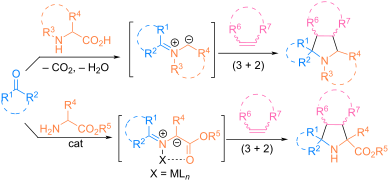
- derivatives with multiple chiral centers under high regio- and stereocontrol. Currently, strategies using azomethine ylides based on imino esters or α-amino acids with a variety of cyclic and acyclic carbonyl compounds dominate. Enantioselective (3 + 2) cycloaddition reactions of azomethine ylides obtained
- with a dipolarophile, such as an alkene or alkyne, to form a five-membered heterocycle in one step. Currently, this type of reaction allows for the efficient preparation of bi- and polycyclic fused or spiro-linked structures with multiple chiral centers and high regio- and stereocontrol [1][2][3][4

Graphical Abstract

Scheme 1: Strategies for the preparation of pyrrolidine derivatives by (3 + 2) cycloaddition of azomethine yl...

Scheme 2: (3 + 2) Cycloaddition of iminoesters to dimethylmaleate.

Scheme 3: Cycloaddition of 1 with various dipolarophiles catalyzed by Ag(I)-L1.

Scheme 4: Cycloaddition of 1 with tert-butyl acrylate catalyzed by Ag(I)-L2.

Scheme 5: Cycloaddition of 1 with dimethyl maleate catalyzed by Cu(I)-L3.

Scheme 6: Cycloaddition of 1 with alkenes catalyzed by Zn(II)-t-Bu-BOX (L4).

Scheme 7: (3 + 2) Cycloaddition of iminoesters to acrylates.

Scheme 8: Catalytic double (3 + 2) cycloaddition to form pyrrolizidine derivatives.

Scheme 9: (3 + 2) Cycloaddition of iminoethers to vinyl phenyl sulfone.

Scheme 10: Regiodivergent and enantioselective synthesis of pyrrolidines 16 and 17.

Scheme 11: Substrate-controlled regioreversible "normal" and "incomplete" 1,3-dipolar cycloaddition.

Scheme 12: Enantioselective synthesis of exo-/endo-pyrrolidines.

Scheme 13: (3 + 2) Cycloaddition of iminoethers 21 to dipolarophiles 22–24.

Scheme 14: Synthesis of bicyclic pyrrolidines 29 from cyclopentene-1,3-diones.

Scheme 15: (3 + 2) Cycloaddition of aldimine esters and allyl alcohols using copper-ruthenium catalysis.

Scheme 16: Synthesis of 3,3-difluoro- and 3,3,4-trifluoropyrrolidine derivatives.

Scheme 17: Use of iminoesters from natural compounds and pharmaceuticals for reactions with 1,1-difluoro- and ...

Scheme 18: Reaction of iminoesters with 1,3-enynes.

Scheme 19: Synthesis of pyrrolidines from iminoesters and vinyl(hetero)arenes.

Scheme 20: Synthesis of exo-pyrrolidines 42 and 43.

Scheme 21: Enantioselective synthesis of heteroarylpyrrolidines 45 and 46.

Scheme 22: Catalytic reaction of (3 + 2) cycloaddition of imines 12 to benzofulvenes 47.

Scheme 23: Fullerene as a dipolarophile in (3 + 2) cycloaddition reactions.

Scheme 24: Asymmetric synthesis of optically active tetrasubstituted pyrrolidines 54.

Scheme 25: (3 + 2) Cycloaddition reaction of imines 55 and α,β-unsaturated aldehydes.

Scheme 26: Probable mechanism of enantioselective (3 + 2) cycloaddition of azomethine ylides to α,β-unsaturate...

Scheme 27: Cycloaddition between iminoesters 12 and sulfinylimines 58.

Scheme 28: (3 + 2) Cycloaddition between triarylideneacetylacetone and azomethine ylides in the presence of ti...

Scheme 29: Stereoselective synthesis of decahydropyrrolo[2,1,5-cd]indolizine 66.

Scheme 30: Synthesis of policyclic derivatives 71 and 72.

Scheme 31: Catalytic аsymmetric (3 + 2) сycloaddition of 2-pyridylimines with N-methylmaleimide.

Scheme 32: Catalytic аsymmetric (3 + 2) сycloaddition of 2-pyridylimines 1 with other dipolarophiles.

Scheme 33: Enantioselective (3 + 2) cycloaddition of silylimine with various dipolarophiles.

Scheme 34: Proposed mechanism of formation of pyrrolidines 78.

Scheme 35: Synthesis of polyheterocyclic pyrrolidines 82–91.

Scheme 36: Synthesis of spirocyclic (95) and fused (96) pyrrolidines.

Scheme 37: (3 + 2) Cycloaddition involving aromatic aldehydes 97, N-propargylmaleimide (98) and α-amino acids ...

Scheme 38: Synthesis of pyrrolizidines 106 and by-product 107.

Scheme 39: Iridium-catalyzed three-component cascade (3 + 2) cycloaddition.

Scheme 40: Intramolecular (3 + 2) cycloaddition of N-alkenylpyrrole-2-carbaldehyde 110 and α-amino acids.

Scheme 41: Three-component (3 + 2) cycloaddition involving fullerene.

Scheme 42: Four-component stereoselective one-pot synthesis of spiro-cycloadducts 119–122.

Scheme 43: Reactions of azomethine ylide 123 with cyclopropenes.

Scheme 44: Three-component reactions involving ninhydrin, cyclopropenes and acyclic α-amino acids.

Scheme 45: Reaction of cyclopropenes 138 with the N-protonated form of Ruhemann purple 137.

Scheme 46: Enantioselective (3 + 2) cycloaddition of azomethine ylides generated in situ from isatins and amin...

Scheme 47: (3 + 2) Cycloaddition of cyclohexenone 143, isatins 140 and aminomalonic diesters 141, catalyzed by...

Scheme 48: Enantioselective (3 + 2) cycloaddition of azomethine ylides generated in situ from isatins and amin...

Scheme 49: Enantioselective (3 + 2) cycloaddition of azomethine ylides generated in situ from isatins and benz...

Scheme 50: (3 + 2) Cycloaddition involving isatins, azetidine-2-carboxylic acid, maleimides or itaconimides.

Scheme 51: (3 + 2) Cycloaddition involving isatins, amino acids and tetraethylvinylidenebis(phosphonate).

Scheme 52: Synthesis of spirooxindoles 156 from triarylideneacetylacetones 155.

Scheme 53: Synthesis of spirooxindole derivatives 157–160.

Scheme 54: Synthesis of hybrid spiro-heterocycles 164–166.

Scheme 55: Formation of azomethine ylide from isatin and sarcosine.

Scheme 56: (3 + 2) Cycloaddition involving isatins, amino acids and trans-3-benzoylacrylic acid.

Scheme 57: Regioselective synthesis of spirooxindoles 170.

Scheme 58: Synthesis of hybrid spiro-heterocycles 86.

Scheme 59: (3 + 2) Cycloaddition involving acenaphthenequinones, amino acids and cyclopropenes.

Scheme 60: Synthesis of hybrid glyco-3-nitrochromane cycloadducts 179.

Scheme 61: Synthesis of spiro[indenoquinoxaline-(thia)pyrrolizidines] 90a.

Scheme 62: Three-component reactions of cyclopropenes, 11H-indeno[1,2-b]quinoxalin-11-onesand α-amino acids, s...

Scheme 63: Synthesis of hybrid glyco-3-nitrochromane cycloadducts 92.

Scheme 64: (3 + 2) Cycloaddition of 11H-benzo[4,5]imidazo[1,2-a]indol-11-one (189) with cyclopropenes and male...

Scheme 65: Diastereoselective synthesis of spiro derivatives of barbituric acid from alloxan 193, α-amino acid...

Scheme 66: Probable mechanism of formation of azomethine ylide from alloxan and ʟ-proline.

Scheme 67: Three-component reactions involving tryptanthrin 196, α-amino acids and cyclopropenes.
Total syntheses of highly oxidative Ryania diterpenoids facilitated by innovations in synthetic strategies
- Zhi-Qi Cao,
- Jin-Bao Qiao and
- Yu-Ming Zhao
Beilstein J. Org. Chem. 2025, 21, 2553–2570, doi:10.3762/bjoc.21.198
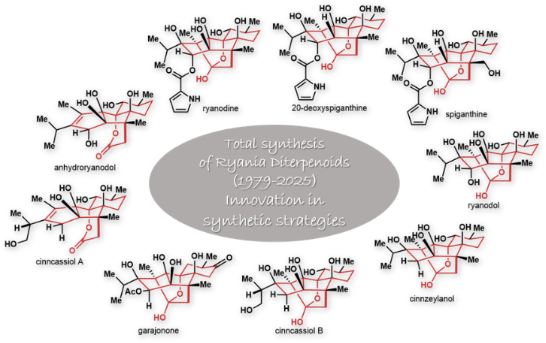
- of the non-naturally produced ryanodol (4) and its dehydrated derivative, anhydroryanodol (10) [30] (Scheme 2). Given the highly complex fused-ring system and the stereochemical challenges posed by multiple chiral centers, the author utilized the Diels–Alder reaction, a prominent representative of
- reaction – a powerful method for building five-membered rings. This single [2 + 2 + 1] cycloaddition step efficiently converted a simple linear precursor into a complex bicyclic system. Subsequent late-stage modifications of the enone skeleton introduced multiple chiral centers, significantly enhancing

Graphical Abstract

Scheme 1: Representative Ryania diterpenoids and their derivatives.
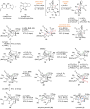
Scheme 2: Deslongchamps’s total synthesis of ryanodol (4).

Scheme 3: Deslongchamps’s total synthesis of 3-epi-ryanodol (5).
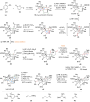
Scheme 4: Inoue’s total synthesis of ryanodol (4).

Scheme 5: Inoue’s total synthesis of ryanodine (1) from ryanodol (4).
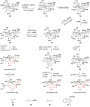
Scheme 6: Inoue’s total synthesis of cinncassiol A (9), cinncassiol B (7), cinnzeylanol (6), and 3-epi-ryanod...

Scheme 7: Reisman’s total synthesis of (+)-ryanodol (4).

Scheme 8: Reisman’s total synthesis of (+)-ryanodine (1) and (+)-20-deoxyspiganthine (2).

Scheme 9: Micalizio’s formal total synthesis of ryanodol (4).
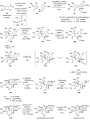
Scheme 10: Zhao’s total synthesis of garajonone (8).

Scheme 11: Zhao’s formal total synthesis of ryanodol (4) and ryanodine (1).
The application of desymmetric enantioselective reduction of cyclic 1,3-dicarbonyl compounds in the total synthesis of terpenoid and alkaloid natural products
- Dong-Xing Tan and
- Fu-She Han
Beilstein J. Org. Chem. 2025, 21, 2085–2102, doi:10.3762/bjoc.21.164
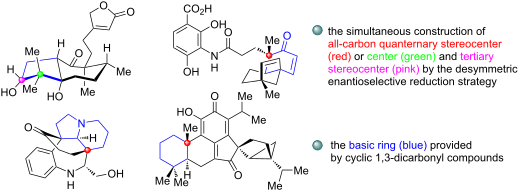
- cyclic 1,3-dicarbonyl compounds has invigorated the field of terpenoid and alkaloid natural products synthesis because of its multiple advantages. Specifically, such strategy allows for an efficient construction of multiple chiral centers by employing easily accessible or commercially available symmetric

Graphical Abstract

Figure 1: Several representative terpenoid and alkaloid natural products synthesized by applying desymmetric ...
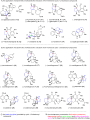
Figure 2: Selected terpenoid and alkaloid natural products synthesized by applying desymmetric enantioselecti...

Scheme 1: The total synthesis of (+)-aplysiasecosterol A (6) by Li [14].

Scheme 2: The total synthesis of (−)-cyrneine A by Han [31].

Scheme 3: The total syntheses of three cyrneine diterpenoids by Han [31,32].

Scheme 4: The total synthesis of (−)-hamigeran B and (−)-4-bromohamigeran B by Han [51].

Scheme 5: The total synthesis of (+)-randainin D by Baudoin [53].
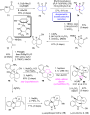
Scheme 6: The total synthesis of (−)-hunterine A and (−)-aspidospermidine by Stoltz [58].

Scheme 7: The total synthesis of (+)-toxicodenane A by Han [65,66].
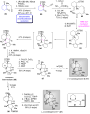
Scheme 8: The formal total synthesis of (−)-conidiogeone B and total synthesis of (−)-conidiogeone F by Lee a...

Scheme 9: The total syntheses of four conidiogenones natural products by Lee and Han [72].

Scheme 10: The total synthesis of (−)-platensilin by Lou and Xu [82].

Scheme 11: The total synthesis of (−)-platencin and (−)-platensimycin by Lou and Xu [82].

Scheme 12: The total synthesis of (+)-isochamaecydin and (+)-chamaecydin by Han [86].
Enantioselective desymmetrization strategy of prochiral 1,3-diols in natural product synthesis
- Lihua Wei,
- Rui Yang,
- Zhifeng Shi and
- Zhiqiang Ma
Beilstein J. Org. Chem. 2025, 21, 1932–1963, doi:10.3762/bjoc.21.151
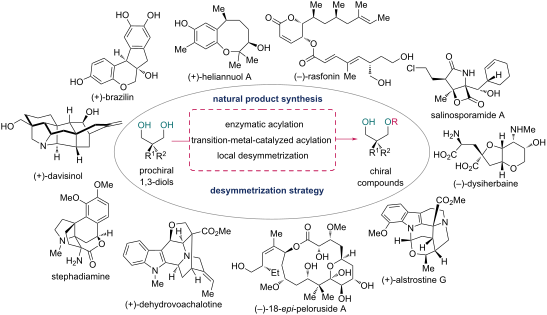
- group such as a chiral sulfinyl group is effective in local desymmetrization, while substrates bearing caged frameworks and multiple chiral centers can also realize the desymmetrization. The Cook group reported the first total synthesis of (−)-vincamajinine and (−)-11-methoxy-17-epivincamajine

Graphical Abstract

Scheme 1: General mechanism of a lipase-catalyzed esterification.

Scheme 2: Shishido’s synthesis of (−)-xanthorrhizol (4) and (+)-heliannuol D (8).

Scheme 3: Shishido’s synthesis of a) (−)-heliannuol A (15) and b) heliannuol G (20) and heliannuol H (21).

Scheme 4: Deska’s synthesis of hyperione A (30) and ent-hyperione B (31).

Scheme 5: Huang’s synthesis of (+)-brazilin (37).

Scheme 6: Shishido’s synthesis of (−)-heliannuol D (42) and (+)-heliannuol A (43).

Scheme 7: Chênevert’s synthesis of (S)-α-tocotrienol (49).

Scheme 8: Kita’s synthesis of monoester 53.

Scheme 9: Kita’s synthesis of fredericamycin A (60).

Scheme 10: Takabe’s synthesis of (E)-3,7-dimethyl-2-octene-1,8-diol (64).

Scheme 11: Takabe’s synthesis of (18S)-variabilin (70).

Scheme 12: Kawasaki’s synthesis of (S)-Rosaphen (74) and (R)-Rosaphen (75).
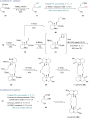
Scheme 13: Tokuyama’s synthesis of a) (−)-petrosin (84) and b) (+)-petrosin (86).

Scheme 14: Fukuyama’s synthesis of leustroducsin B (96).
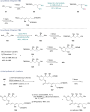
Scheme 15: Nanda’s synthesis of a) fragment 100, b) fragment 106 and c) (−)-rasfonin (109).

Scheme 16: Davies’ synthesis of (+)-pilocarpine (115) and (+)-isopilocarpine (116).

Scheme 17: Ōmura’s synthesis of salinosporamide A (125).

Scheme 18: Kang’s synthesis of ʟ-cladinose (124) and its derivative.

Scheme 19: Kang’s preparation of fragment 139.
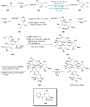
Scheme 20: Kang’s synthesis of azithromycin (149).

Scheme 21: Kang’s synthesis of (−)-dysiherbaine (156).

Scheme 22: Kang’s synthesis of (−)-kaitocephalin (166).
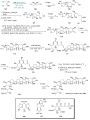
Scheme 23: Kang’s synthesis of laidlomycin (180).

Scheme 24: Snyder’s synthesis of arboridinine (190).
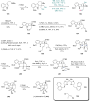
Scheme 25: Ma’s synthesis of (+)-alstrostine G (203).
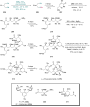
Scheme 26: Trost’s synthesis of (−)-18-epi-peloruside A (215).

Scheme 27: Lindel’s synthesis of (–)-dihydroraputindole (223).

Scheme 28: Iwata’s synthesis of a) (−)-talaromycin B (232) and b) (+)-talaromycin A (235).

Scheme 29: Cook’s synthesis of a) (−)-vincamajinine (240) and b) (−)-11-methoxy-17-epivincamajine (245).

Scheme 30: Cook’s synthesis of (+)-dehydrovoachalotine (249) and voachalotine (250).
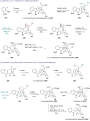
Scheme 31: Cook’s synthesis of a) (−)-12-methoxy-Nb-methylvoachalotine (257) and b) (+)-polyneuridine, macusin...

Scheme 32: Trauner’s synthesis of stephadiamine (273).

Scheme 33: Garg’s synthesis of (–)-ψ-akuammigine (285).

Scheme 34: Ding’s synthesis of (+)-18-benzoyldavisinol (293) and (+)-davisinol (294).
Construction of highly enantioenriched spirocyclopentaneoxindoles containing four consecutive stereocenters via thiourea-catalyzed asymmetric Michael–Henry cascade reactions
- Yonglei Du,
- Jian Li,
- Kerong Chen,
- Chenglin Wu,
- Yu Zhou and
- Hong Liu
Beilstein J. Org. Chem. 2017, 13, 1342–1349, doi:10.3762/bjoc.13.131
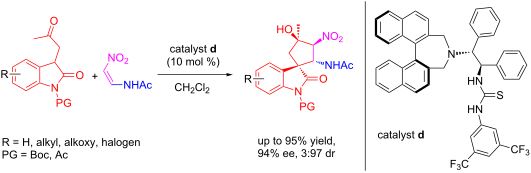
- stereocenters and a unique quaternary stereogenic center, with good yields, and excellent diastereoselectivity and enantioselectivity using thiourea-catalyzed Michael–Henry cascade reactions. We anticipate that this reaction will simplify the synthesis of complex spirooxindoles containing multiple chiral
- centers with potential pharmacological properties. Experimental General procedure for the synthesis of products (3a–j): To a mixture of 1a–j (0.11 mmol) and 2a (0.1 mmol) in CH2Cl2 (3 mL) was added catalyst d (0.01 mmol). Then the mixture was stirred at −20 °C for 12 h. After completion of the reaction

Graphical Abstract

Figure 1: Representative spirooxindole natural products.
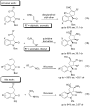
Scheme 1: Construction of spirocyclopentaneoxindole scaffolds.
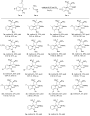
Scheme 2: Scope of enantioselective synthesis of spirooxindoles. Reaction conditions: catalyst d (0.01 mmol),...

Scheme 3: A plausible mechanism.
cis-Diastereoselective synthesis of chroman-fused tetralins as B-ring-modified analogues of brazilin
- Dimpee Gogoi,
- Runjun Devi,
- Pallab Pahari,
- Bipul Sarma and
- Sajal Kumar Das
Beilstein J. Org. Chem. 2016, 12, 2816–2822, doi:10.3762/bjoc.12.280
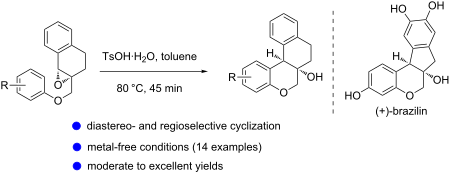
- of two or more privileged scaffolds leads to geometrically well-defined rigid polycyclic structures with enhanced receptor-binding selectivity. Thus, the design and synthesis of structurally diverse, privileged structure-based polycyclic molecules with multiple chiral centers has been intensely

Graphical Abstract

Figure 1: Chroman-based tetracyclic natural products 1–4 of the brazilin family and our designed, B-ring-modi...

Scheme 1: Retrosynthetic analysis of the designed B-ring-modified analogues of brazilin.

Scheme 2: The synthetic challenge associated with the synthesis of 5 by IFCEA of 6 (above) and recent literat...

Figure 2: Assessment of the IFCEA cyclization on additional substrates (±)-6b–n leading to (±)-5b–n. Reaction...

Figure 3: ORTEP diagram of 5k.

Scheme 3: Stereoselective conversion of (±)-5k into (±)-14.
Stereoselective amine-thiourea-catalysed sulfa-Michael/nitroaldol cascade approach to 3,4,5-substituted tetrahydrothiophenes bearing a quaternary stereocenter
- Sara Meninno,
- Chiara Volpe,
- Giorgio Della Sala,
- Amedeo Capobianco and
- Alessandra Lattanzi
Beilstein J. Org. Chem. 2016, 12, 643–647, doi:10.3762/bjoc.12.63
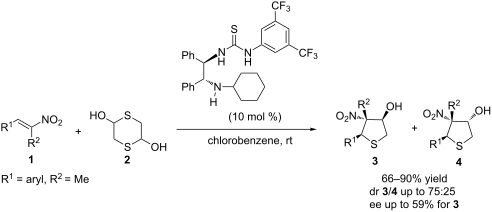
- bearing multiple chiral centers increased over the last years [1]. Indeed, chiral non-racemic functionalized tetrahydrothiophenes are endowed with different biological activities [2][3][4][5] and they are useful ligands in asymmetric catalysis [6]. However, few asymmetric approaches are available to

Graphical Abstract

Scheme 1: Organocatalysts screened in the cascade reaction.

Scheme 2: Synthesis of catalyst VIII.
(Thio)urea-mediated synthesis of functionalized six-membered rings with multiple chiral centers
- Giorgos Koutoulogenis,
- Nikolaos Kaplaneris and
- Christoforos G. Kokotos
Beilstein J. Org. Chem. 2016, 12, 462–495, doi:10.3762/bjoc.12.48
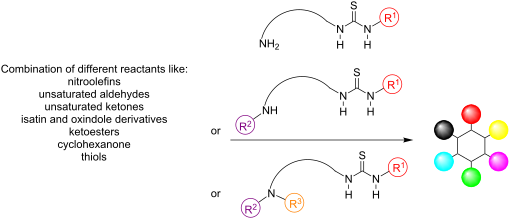
- main tools a synthetic chemist has to perform asymmetric catalysis. In this review the synthesis of six-membered rings, that contain multiple chiral centers, either by a ring closing process or by a functionalization reaction on an already existing six-membered ring, utilizing bifunctional (thio)ureas
- products, pharmaceuticals and agrochemicals, thus, a lot of effort has been put by the synthetic community to provide mild, reliable, robust and operationally simple methods to construct them. Of the vast variety of six-membered rings, those with multiple chiral centers pose the most difficult synthetic
- challenge, because not only the regiochemical outcome, but also the stereochemical outcome of the reaction must be carefully controlled. Since its rebirth, organocatalysis has made many contributions in the synthesis of six-membered rings with multiple chiral centers, this area has been reviewed in the past

Graphical Abstract

Scheme 1: Activation of carbonyl compounds via enamine and iminium intermediates [2].

Scheme 2: Electronic and steric interactions present in enamine activation mode [2].

Scheme 3: Electrophilic activation of carbonyl compounds by a thiourea moiety.

Scheme 4: Asymmetric synthesis of dihydro-2H-pyran-6-carboxylate 3 using organocatalyst 4 [16].

Scheme 5: Possible hydrogen-bonding for the reaction of (E)-methyl 2-oxo-4-phenylbut-3-enoate [16].

Scheme 6: Asymmetric desymmetrization of 4,4-cyclohexadienones using the Michael addition reaction with malon...

Scheme 7: The enantioselective synthesis of α,α-disubstituted cycloalkanones using catalyst 11 [18].

Scheme 8: The enantioselective synthesis of indolo- and benzoquinolidine compounds through aza-Diels–Alder re...

Scheme 9: Enantioselective [5 + 2] cycloaddition [20].

Scheme 10: Asymmetric synthesis of oxazine derivatives 26 [21].

Scheme 11: Asymmetric synthesis of bicyclo[3.3.1]nonadienone, core 30 present in (−)-huperzine [22].

Scheme 12: Asymmetric inverse electron-demand Diels-Alder reaction catalyzed by amine-thiourea 34 [23].

Scheme 13: Asymmetric entry to morphan skeletons, catalyzed by amine-thiourea 37 [24].

Scheme 14: Asymmetric transformation of (E)-2-nitroallyl acetate [25].

Scheme 15: Proposed way of activation.

Scheme 16: Asymmetric synthesis of nitrobicyclo[3.2.1]octan-2-one derivatives [26].

Scheme 17: Asymmetric tandem Michael–Henry reaction catalyzed by 50 [27].

Scheme 18: Asymmetric Diels–Alder reactions of 3-vinylindoles 51 [29].

Scheme 19: Proposed transition state and activation mode of the asymmetric Diels–Alder reactions of 3-vinylind...

Scheme 20: Desymmetrization of meso-anhydrides by Chin, Song and co-workers [30].

Scheme 21: Desymmetrization of meso-anhydrides by Connon and co-workers [31].

Scheme 22: Asymmetric intramolecular Michael reaction [32].

Scheme 23: Asymmetric addition of malonate to 3-nitro-2H-chromenes 67 [33].

Scheme 24: Intramolecular desymmetrization through an intramolecular aza-Michael reaction [34].

Scheme 25: Enantioselective synthesis of (−)-mesembrine [34].

Scheme 26: A novel asymmetric Michael–Michael reaction [35].

Scheme 27: Asymmetric three-component reaction catalyzed by Takemoto’s catalyst 77 [46].

Scheme 28: Asymmetric domino Michael–Henry reaction [47].

Scheme 29: Asymmetric domino Michael–Henry reaction [48].

Scheme 30: Enantioselective synthesis of derivatives of 3,4-dihydro-2H-pyran 89 [49].

Scheme 31: Asymmetric addition of α,α-dicyano olefins 90 to 3-nitro-2H-chromenes 91 [50].

Scheme 32: Asymmetric three-component reaction producing 2,6-diazabicyclo[2.2.2]octanones 95 [51].

Scheme 33: Asymmetric double Michael reaction producing substituted chromans 99 [52].

Scheme 34: Enantioselective synthesis of multi-functionalized spiro oxindole dienes 106 [53].

Scheme 35: Organocatalyzed Michael aldol cyclization [54].

Scheme 36: Asymmetric synthesis of dihydrocoumarins [55].

Scheme 37: Asymmetric double Michael reaction en route to tetrasubstituted cyclohexenols [56].

Scheme 38: Asymmetric synthesis of α-trifluoromethyl-dihydropyrans 121 [58].

Scheme 39: Tyrosine-derived tertiary amino-thiourea 123 catalyzed Michael hemiaketalization reaction [59].

Scheme 40: Enantioselective entry to bicyclo[3.2.1]octane unit [60].

Scheme 41: Asymmetric synthesis of spiro[4-cyclohexanone-1,3’-oxindoline] 126 [61].

Scheme 42: Kinetic resolution of 3-nitro-2H-chromene 130 [62].

Scheme 43: Asymmetric synthesis of chromanes 136 [63].

Scheme 44: Wang’s utilization of β-unsaturated α-ketoesters 87 [64,65].

Scheme 45: Asymmetric entry to trifluoromethyl-substituted dihydropyrans 144 [66].

Scheme 46: Phenylalanine-derived thiourea-catalyzed domino Michael hemiaketalization reaction [67].

Scheme 47: Asymmetric synthesis of α-trichloromethyldihydropyrans 149 [68].

Scheme 48: Takemoto’s thiourea-catalyzed domino Michael hemiaketalization reaction [69].

Scheme 49: Asymmetric synthesis of densely substituted cyclohexanes [70].

Scheme 50: Enantioselective synthesis of polysubstituted chromeno [4,3-b]pyrrolidine derivatines 157 [71].

Scheme 51: Enantioselective synthesis of spiro-fused cyclohexanone/5-oxazolone scaffolds 162 [72].

Scheme 52: Utilizing 2-mercaptobenzaldehydes 163 in cascade processes [73,74].

Scheme 53: Proposed transition state of the initial sulfa-Michael step [74].

Scheme 54: Asymmetric thiochroman synthesis via dynamic kinetic resolution [75].

Scheme 55: Enantioselective synthesis of thiochromans [76].

Scheme 56: Enantioselective synthesis of chromans and thiochromans synthesis [77].

Scheme 57: Enantioselective sulfa-Michael aldol reaction en route to spiro compounds [78].

Scheme 58: Enantioselective synthesis of 4-aminobenzo(thio)pyrans 179 [79].

Scheme 59: Asymmetric synthesis of tetrahydroquinolines [80].

Scheme 60: Novel asymmetric Mannich–Michael sequence producing tetrahydroquinolines 186 [81].

Scheme 61: Enantioselective synthesis of biologically interesting chromanes 190 and 191 [82].

Scheme 62: Asymmetric tandem Henry–Michael reaction [83].

Scheme 63: An asymmetric synthesis of substituted cyclohexanes via a dynamic kinetic resolution [84].

Scheme 64: Three component-organocascade initiated by Knoevenagel reaction [85].

Scheme 65: Asymmetric Michael reaction catalyzed by catalysts 57 and 211 [86].

Scheme 66: Proposed mechanism for the asymmetric Michael reaction catalyzed by catalysts 57 and 211 [86].

Scheme 67: Asymmetric facile synthesis of hexasubstituted cyclohexanes [87].

Scheme 68: Dual activation catalytic mechanism [87].

Scheme 69: Asymmetric Michael–Michael/aldol reaction catalyzed by catalysts 57, 219 and 214 [88].

Scheme 70: Asymmetric synthesis of substituted cyclohexane derivatives, using catalysts 57 and 223 [89].

Scheme 71: Asymmetric synthesis of substituted piperidine derivatives, using catalysts 223 and 228 [90].

Scheme 72: Asymmetric synthesis of endo-exo spiro-dihydropyran-oxindole derivatives catalyzed by catalyst 232 [91]....

Scheme 73: Asymmetric synthesis of carbazole spiroxindole derivatives, using catalyst 236 [92].

Scheme 74: Enantioselective formal [2 + 2] cycloaddition of enal 209 with nitroalkene 210, using catalysts 23 ...

Scheme 75: Asymmetric synthesis of polycyclized hydroxylactams derivatives, using catalyst 242 [94].

Scheme 76: Asymmetric synthesis of product 243, using catalyst 246 [95].

Scheme 77: Formation of the α-stereoselective acetals 248 from the corresponding enol ether 247, using catalys...

Scheme 78: Selective glycosidation, catalyzed by Shreiner’s catalyst 23 [97].
Synthesis and self-assembly of 1-deoxyglucose derivatives as low molecular weight organogelators
- Guijun Wang,
- Hao Yang,
- Sherwin Cheuk and
- Sherman Coleman
Beilstein J. Org. Chem. 2011, 7, 234–242, doi:10.3762/bjoc.7.31
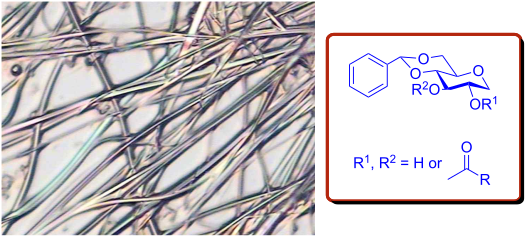
- because they are naturally abundant and possess multiple chiral centers that can be selectively functionalized [15][16][17][18][19][20][21][22][23][24][25][26][27][28][29][30][31][32][33][34][35][36][37]. Sugar-based supramolecular hydrogels are being explored as biocompatible soft materials and as

Graphical Abstract

Figure 1: Structures of three ester derivatives of compound 1.

Figure 2: Structures of ester analogs 5–7 and headgroup 8.

Scheme 1: Synthesis of a series of esters 9A–18C.
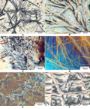
Figure 3: Optical micrographs of the gels formed by compound 9A in hexane at 15 mg/mL (A, B), 9B in DMSO/wate...

Figure 4: An ethanol gel formed by compound 18A at <10 mg/mL. a) A clear solution when heated above 70 °C; b)...

Figure 5: Optical micrographs under bright field (a, b) and scanning electron micrograph (c) of the gel forme...
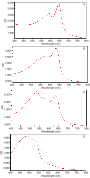
Figure 6: The UV–vis absorption spectra of the polymerized gel formed by compound 18A in ethanol (10 mg/mL): ...