

Search results
Search for "lanostane" in Full Text gives 3 result(s) in Beilstein Journal of Organic Chemistry.
Ring contraction and ring expansion reactions in terpenoid biosynthesis and their application to total synthesis
Beilstein J. Org. Chem. 2026, 22, 289–343, doi:10.3762/bjoc.22.21
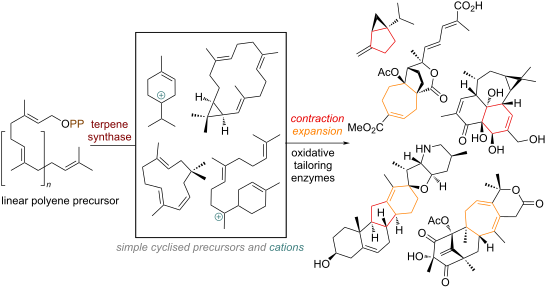
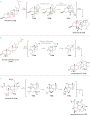
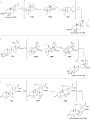
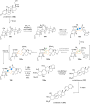
- carbaldehyde product atheronal B (113) with a contracted 5-membered B-ring. The rearranged triterpenoid neoabiestrine F (115), corresponds to a small family of C-ring-contracted spirocyclic terpenoids which are suspected to originate from a lanostane precursor, such as 114 (see Scheme 28B) [163][164][165]. By
- epoxidation of the 8,9-double bond present in a putative oxidised lanostane precursor 132. Meinwald (or semi-pinacol) rearrangement of epoxide 132a would then build up the 6/5/6-spiro system 132b for rings A, B and C. The final product is obtained following an oxidation at C-17, multiple 1,2-methyl shifts






Two new lanostanoid glycosides isolated from a Kenyan polypore Fomitopsis carnea
Beilstein J. Org. Chem. 2023, 19, 1161–1169, doi:10.3762/bjoc.19.84
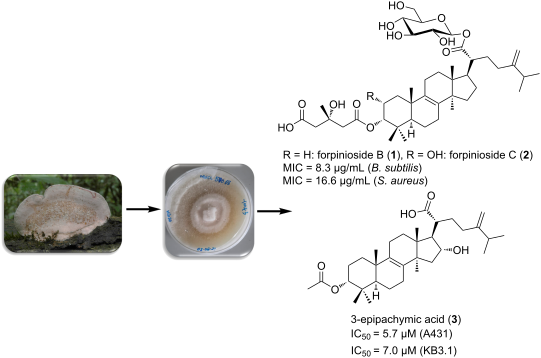
- Chemical exploration of solid-state cultures of the polypore Fomitopsis carnea afforded two new C31 lanostane-type triterpenoid glycosides, forpiniosides B (1) and C (2) together with two known derivatives, namely 3-epipachymic acid (3) and (3α,25S)-3-O-malonyl-23-oxolanost-8,24(31)-dien-26-oic acid (4
- against Staphylococcus aureus and Bacillus subtilis at MIC values comparable to gentamycin and oxytetracycline (positive controls), respectively. Keywords: antimicrobial activity; Fomitopsis carnea; lanostane glycosides; Polyporales; Introduction Great success was realized on antibiotic discovery
- well-known profuse production of bioactive molecules, Basidiomycota have already been proven to be a valuable source for new anti-infectives [4]. These include a myriad of triterpenoids which have been resourceful in the discovery of potent antimicrobials [5]. Specifically, lanostane triterpenoids are


Lanostane- and cycloartane-type triterpenoids from Abies balsamea oleoresin
Beilstein J. Org. Chem. 2013, 9, 1333–1339, doi:10.3762/bjoc.9.150
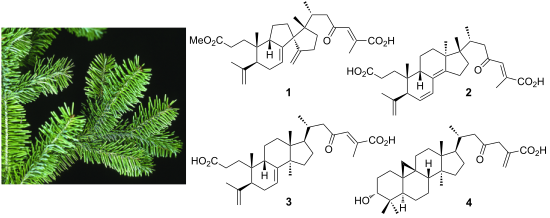
- -lanostane triterpenoids 1–3, one new cycloartane triterpenoid 4 along with fourteen known terpenoids. Structure determinations were based on extensive 1D/2D NMR, IR and MS spectroscopic analyses, and comparison with literature data. The isolated compounds were evaluated in vitro for their cytotoxicity
- ; lanostane; oleoresin; triterpenoids; Introduction The genus Abies (Pinaceae) comprises 46 species of evergreen conifers [1]. Most of them are found in temperate and boreal regions of the northern hemisphere. The first phytochemical investigation of Abies species was undertaken 75 years ago by Takahashi [2
- tetraterpenoids from the cortical oleoresin of the tree bark, featuring an unprecedented C40 scaffold [6]. Herein, we describe the further phytochemical study of A. balsamea oleoresin, which led to the isolation and structure elucidation of three 3,4-seco-lanostane-type triterpenoids 1–3, one cycloartane-type


Other Beilstein-Institut Open Science Activities