

Search results
Search for "immunoglobulins" in Full Text gives 4 result(s) in Beilstein Journal of Organic Chemistry.
Site-specific labelling of native peptides and proteins: chemical and enzymatic strategies
Beilstein J. Org. Chem. 2026, 22, 857–881, doi:10.3762/bjoc.22.67
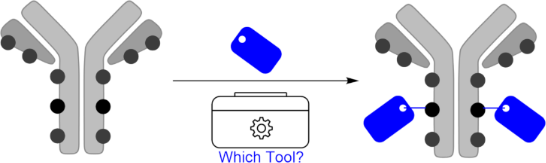
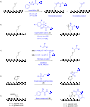
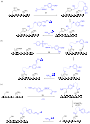
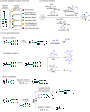
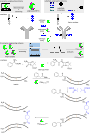
- proteins, including somatostatin, immunoglobulins (across all isotypes and subclasses), insulin and interleukin-10 naturally contain disulfide bridges. These can be selectively reduced to yield two nucleophilic thiols for reaction with bis-electrophilic reagents to rebridge the cysteines, while introducing








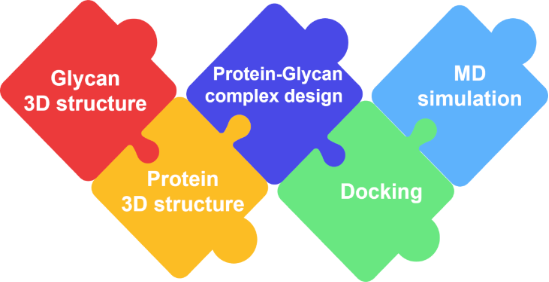
Computational toolbox for the analysis of protein–glycan interactions
Beilstein J. Org. Chem. 2024, 20, 2084–2107, doi:10.3762/bjoc.20.180


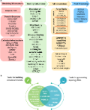
Introduction of a human- and keyboard-friendly N-glycan nomenclature
Beilstein J. Org. Chem. 2024, 20, 607–620, doi:10.3762/bjoc.20.53
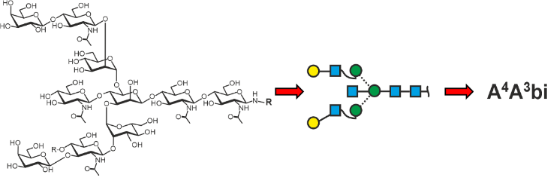
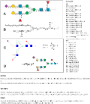
- -position. Therefore, superscripts should be used to define the type of core fucose (Figure 4). A structural element frequently occurring in mammalian glycoproteins, e.g., in immunoglobulins is the bisecting GlcNAc. This shall be added at the end of the abbreviation string by two lower case letters “bi”. In



Semiautomated glycoproteomics data analysis workflow for maximized glycopeptide identification and reliable quantification
Beilstein J. Org. Chem. 2020, 16, 3038–3051, doi:10.3762/bjoc.16.253
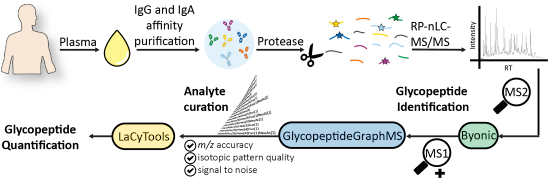
- digest from affinity-purified immunoglobulins G and A was analyzed on a nano-reversed-phase liquid chromatography–tandem mass spectrometry platform with a high-resolution mass analyzer and higher-energy collisional dissociation fragmentation. Initial glycopeptide identification based on MS/MS data was
- quantification. Keywords: bioinformatics; cysteine oxidation; glycoproteomics; immunoglobulins; mass spectrometry; Introduction Protein glycosylation mainly occurs in the form of N- and O-glycosylation. N-Glycans are attached to Asn within an amino acid consensus sequence (Asn-Xxx-Ser/Thr, Xxx ≠ Pro) and O
- this, a sample containing immunoglobulins G and A (IgG and IgA), simultaneously captured from human plasma, was chosen. This sample showed a considerable level of complexity due to the presence of multiple glycoproteins of interest and cocaptured (glyco)proteins from the plasma. The tools included


Other Beilstein-Institut Open Science Activities