

Search results
Search for "glycan microarray" in Full Text gives 4 result(s) in Beilstein Journal of Organic Chemistry.
Total synthesis of the capsular polysaccharide repeating unit towards the development of a glycoconjugate vaccine against Klebsiella pneumoniae ST512
Beilstein J. Org. Chem. 2026, 22, 821–827, doi:10.3762/bjoc.22.64
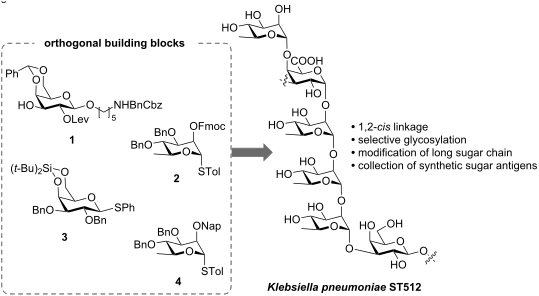
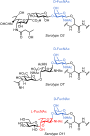
- conjugation-ready oligosaccharides, equipped with aminopentyl linkers, enables glycan microarray-based identification of minimal immunogenic epitopes. This work establishes a robust chemical foundation for the rational development of semi-synthetic glycoconjugate vaccines targeting K. pneumoniae ST512
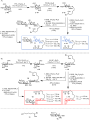
- (NIS) and trifluoromethanesulfonic acid (TfOH) to afford 7 in 86% yield, neighboring participation effect of the levulinoyl (Lev) group at C2 position provided only the β-product. The linker was introduced in anticipation of conjugation to a carrier protein or a glycan microarray surface [31
- 20, constitute a collection of well-defined synthetic oligosaccharide antigens resembling the surface of K. pneumoniae ST512. Glycan microarray analysis is currently underway to identify the lead antigens and key epitopes responsible for inducing specific immune responses against the native ST512 CPS


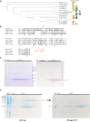
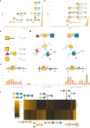
Elucidating the glycan-binding specificity and structure of Cucumis melo agglutinin, a new R-type lectin
Beilstein J. Org. Chem. 2024, 20, 306–320, doi:10.3762/bjoc.20.31
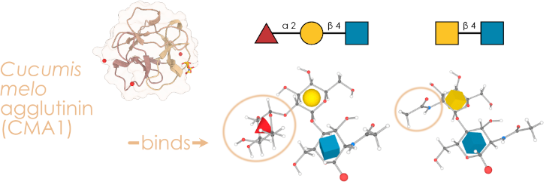
- : Supplementary glycan microarray document (MIRAGE) for the ICL glycan arrays. Acknowledgements We acknowledge support from the Mammalian Protein Expression core facility at the University of Gothenburg via the Protein Production Sweden (PPS) framework as well as the synchrotron SOLEIL (Saint Aubin, France) for
- glycan microarray studies were performed in the Carbohydrate Microarray Facility at the ICL Glycosciences Laboratory, which is supported by Wellcome Trust biomedical resource grants (099197/Z/12/Z, 108430/Z/15/Z, and 218304/Z/19/Z) and partially by the March of Dimes Prematurity research centre grant (22



Tools for generating and analyzing glycan microarray data
Beilstein J. Org. Chem. 2020, 16, 2260–2271, doi:10.3762/bjoc.16.187
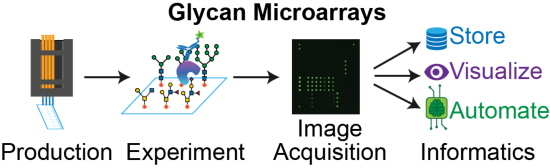
- the mammalian body. They play a vital role in a number of physiologic and pathologic conditions. Glycan microarrays allow a plethora of information to be obtained on protein–glycan binding interactions. In this review, we describe the intricacies of the generation of glycan microarray data and the
- experimental methods for studying binding. We highlight the importance of this knowledge before moving on to the data analysis. We then highlight a number of tools for the analysis of glycan microarray data such as data repositories, data visualization and manual analysis tools, automated analysis tools and
- structural informatics tools. Keywords: data analysis; glycan binding; glycan microarray; glycomics; informatics; Introduction Glycans represent a major type of biomolecule in all living things, along with DNA, RNA, lipids and proteins [1]. In mammals, glycans commonly occur as post-translational


De novo synthesis of D- and L-fucosamine containing disaccharides
Beilstein J. Org. Chem. 2013, 9, 332–341, doi:10.3762/bjoc.9.38
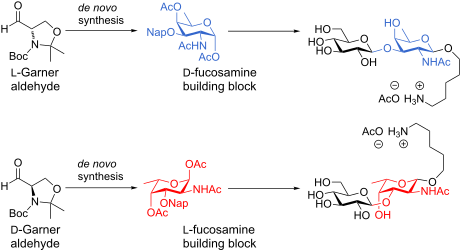
- (four steps, two chromatographic purifications) that after the direct oxidation–dihydroxylation–peracetylation protocol yielded the desired L-fucosamine building block L-8a (Scheme 5). Synthesis of fucosamine-containing disaccharides To facilitate the use of the bacterial monosaccharides in the glycan
- microarray platform and their conjugation to carrier proteins, an appropriate linker was required at the anomeric position [67]. Placement of a C3 naphthyl ether anticipated the site for further glycosylation at this position, which typically serves as the connection to the next sugar. Therefore, building



Other Beilstein-Institut Open Science Activities