

Search results
Search for "complanadine" in Full Text gives 2 result(s) in Beilstein Journal of Organic Chemistry.
Concept-driven strategies in target-oriented synthesis
Beilstein J. Org. Chem. 2026, 22, 451–454, doi:10.3762/bjoc.22.32
- -She Han and co-worker), bioinspired synthesis (review, Huilin Li, Xuegong She et al.), biosynthesis (fusicoccane diterpenoids, Yonghui Zhang, Ying Ye, Zheng Xiang et al.), chemoenzymatic synthesis (rhodexin A, Qianghui Zhou et al.)]; (ii) comparative analysis of target-oriented synthesis [complanadine


Comparative analysis of complanadine A total syntheses
Beilstein J. Org. Chem. 2025, 21, 2334–2344, doi:10.3762/bjoc.21.178
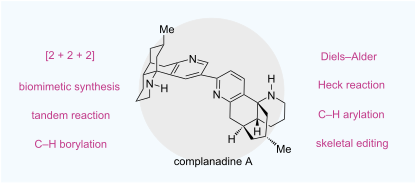
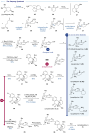
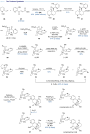
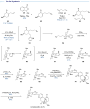
- compare four total syntheses of complanadine A, a complex and pseudo-dimeric lycopodium alkaloid with promising neurotrophic activity and potential for pain management. These four total syntheses are from the groups of Siegel, Sarpong, Tsukano, and Dai. Each of the four total syntheses contains innovative
- strategies and creative tactics, reflecting how emerging synthetic capabilities and concepts can positively impact natural product total synthesis. Keywords: biomimetic synthesis; C–H functionalization; complanadine; lycopodium alkaloid; skeletal editing; total synthesis; transition metal catalysis
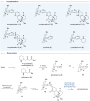
- molecules such as the huperzines have been discovered and advanced into human clinical trials as acetylcholinesterase inhibitors for treating Alzheimer’s disease [3]. Among the lycopodium family, complanadine A (1, Scheme 1) and its natural congeners such as complanadines B (2), D (3), and E (4) were



Other Beilstein-Institut Open Science Activities