

Search results
Search for "carbon dioxide adsorption" in Full Text gives 4 result(s) in Beilstein Journal of Organic Chemistry.
Novel macrocycles: from synthesis to supramolecular function
Beilstein J. Org. Chem. 2026, 22, 982–985, doi:10.3762/bjoc.22.76
- desymmetrized building blocks avoid the dense packing commonly observed in rigid planar systems. As a proof of concept, these precursors were converted into methylene-alternating copolymers that exhibit high solubility and measurable carbon dioxide adsorption, highlighting their potential for the development of
- versatile tools for the selective modulation of biologically relevant protein–protein interactions. The contributions collected in this thematic issue highlight the breadth and continued evolution of contemporary macrocyclic chemistry. From new ultracycle receptors to functional materials for carbon dioxide
- adsorption, separation science, environmental remediation, and biomedical applications, these studies demonstrate how advances in synthetic design continue to expand supramolecular function. As macrocyclic systems become increasingly integrated into materials science and chemical biology, their impact across
Selective monoformylation of naphthalene-fused propellanes for methylene-alternating copolymers
Beilstein J. Org. Chem. 2025, 21, 1183–1191, doi:10.3762/bjoc.21.95
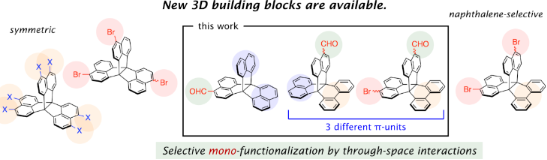
- followed by acid-mediated condensation. The linear copolymers show good solubility and carbon dioxide adsorption. Keywords: alternating copolymer; building block; formylation; gas adsorption; propellane; Introduction Combination of sp2- and sp3-hybridized atoms in core π-skeletons [1][2][3] is a key to


Selective formation of a zwitterion adduct and bicarbonate salt in the efficient CO2 fixation by N-benzyl cyclic guanidine under dry and wet conditions
Beilstein J. Org. Chem. 2018, 14, 2204–2211, doi:10.3762/bjoc.14.194
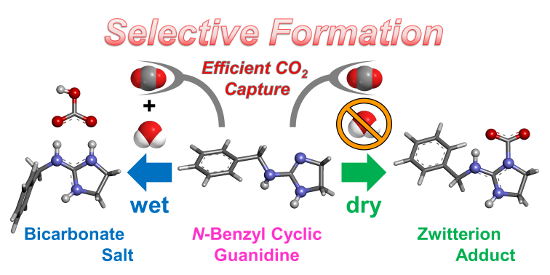
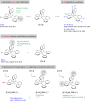
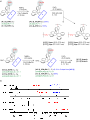
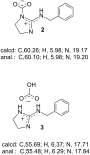
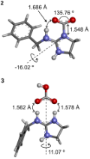
- derivative and CO2 was isolated and characterized for the first time. Keywords: bicarbonate salt; carbon dioxide adsorption; cyclic guanidine; repeatable capture and release; zwitterion adduct; Introduction Recently, various reactions with CO2 as a cheap and green carbon reagent have been developed not






Novel approach to hydroxy-group-containing porous organic polymers from bisphenol A
Beilstein J. Org. Chem. 2017, 13, 2131–2137, doi:10.3762/bjoc.13.211
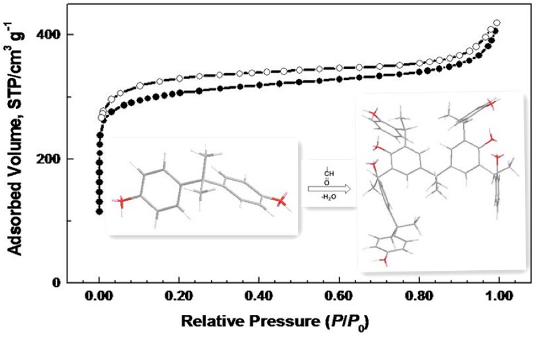
- lowest BET surface area and total pore volume and micropore volume, which may arise from the fact that interactions between the accessible surface area, micropore volume, and pore topology contribute predominantly to methane storage capacity in porous material [33][34]. The carbon dioxide adsorption
- isotherms for PPOPs are collected at 273 and 298 K, respectively (Figure 4b,c). PPOP-3 possesses a largest carbon dioxide adsorption capacity up to 15.0 wt % (273 K) and 8.8 wt % (298 K) at 1.0 bar, which is larger than that of the reported work [35]. As reported that apparent surface area is not the only




Other Beilstein-Institut Open Science Activities