

Search results
Search for "transition metals" in Full Text gives 232 result(s) in Beilstein Journal of Organic Chemistry. Showing first 200.
Synthesis and characterization of the cyanobenzene-ethylenedithio-TTF donor
- Sandrina Oliveira,
- Dulce Belo,
- Isabel C. Santos,
- Sandra Rabaça and
- Manuel Almeida
Beilstein J. Org. Chem. 2015, 11, 951–956, doi:10.3762/bjoc.11.106
- allows a possible 2D or 3D character to the electronic interactions. More recently there has been an increasing interest in TTF derivatives containing N atoms in their periphery which, while retaining the electroactive behaviour of TTF, could also be able to coordinate to transition metals [3][4][5][6][7

Graphical Abstract

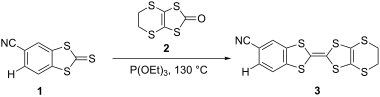
Scheme 1: Synthesis of cyanobenzene-ethylenedithio-tetrathiafulvalene (CNB-EDT-TTF) 3.

Figure 1: ORTEP diagrams of compound 3 drawn at 30% probability level with the atomic numbering scheme.

Figure 2: Crystal structure of compound 3 viewed along the b axis.

Figure 3: View of three neighbouring molecular stacks in 3.

Figure 4: Cyclic voltammogram of 3.
TTFs nonsymmetrically fused with alkylthiophenic moieties
- Rafaela A. L. Silva,
- Bruno J. C. Vieira,
- Marta M. Andrade,
- Isabel C. Santos,
- Sandra Rabaça,
- Dulce Belo and
- Manuel Almeida
Beilstein J. Org. Chem. 2015, 11, 628–637, doi:10.3762/bjoc.11.71
- analogous transition metals complexes, enabling their processing from solutions. Results and Discussion Synthesis The TTF donors fused non-symetrically with substituted thiophene moieties 1 and 2 were obtained by the cross coupling, in the presence of trimethyl phosphite, between compounds I and II and

Graphical Abstract

Scheme 1: Molecular diagrams of α-tbtdt (1) and α-mtdt (2), and related TTF-type donors.

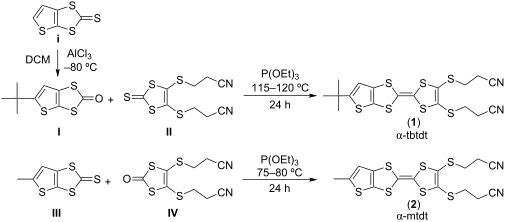
Scheme 2: Synthetic route for compounds 1 and 2.

Figure 1: Cyclic voltammogram of α-tbtdt (1) and α-mtdt (2) (10−3 M) in dichloromethane versus Ag/AgNO3, with ...

Figure 2: ORTEP view and atomic numbering scheme of I with thermal ellipsoids at 50% probability level.

Figure 3: Molecular herringbone bi-chains in the crystal structure of I: a) view along the molecular planes a...
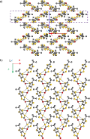
Figure 4: Crystal structure of I a) view along the b axis, b) Partial view of one layer of bi-chains in the a...

Figure 5: ORTEP views and atomic numbering scheme of α-tbtdt (1) with thermal ellipsoids at 50% probability l...
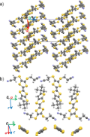
Figure 6: Crystal structure of 1 a) view along the b axis; b) Partial view of one chain in the b,c plane (top...

Figure 7: ORTEP views and atomic numbering scheme of a) (α-mtdt)+ and b) [Au(mnt)2 ]− in compound 3, with the...

Figure 8: Crystal structure of 3 a) viewed along the b axis and b) partial view showing the alternated A–D–A–...
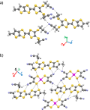
Figure 9: Detail of the crystal structure of 3 showing the short contacts between stacks.
Diastereoselective and enantioselective conjugate addition reactions utilizing α,β-unsaturated amides and lactams
- Katherine M. Byrd
Beilstein J. Org. Chem. 2015, 11, 530–562, doi:10.3762/bjoc.11.60
- of boron to α,β-unsaturated carbonyl compounds. Enantioenriched organoboron reagents are useful because they can be used in cross-coupling reactions [98][100] or they can be converted into the corresponding alcohol [101] while retaining the stereochemical information. Transition metals such as Cu
- [102][103][104][105][106][107][108][109][110][111][112], Rh [113][114][115], Ni [116][117], Pd [116][118] and Pt [119][120] have all been successfully used to catalyze the 1,4-additon of boron to α,β-unsaturated carbonyl compounds. Of the transition metals mentioned, copper is the most cost-effective
- -unsaturated amides and lactams, which remains an area that is underdeveloped. 2.3 Other transition-metal-catalyzed ECA reactions Though the majority of the reports on ECA of α,β-unsaturated amides and lactams utilize copper and rhodium as catalysts, other transition metals have also been used in these

Graphical Abstract

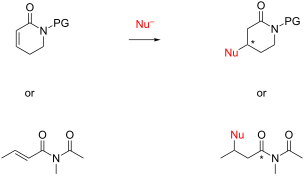
Scheme 1: Generic mechanism for the conjugate addition reaction.

Figure 1: Methods to activate unsaturated amide/lactam systems.

Scheme 2: DCA of Grignard reagents to an L-ephedrine derived chiral α,β–unsaturated amide.

Figure 2: Chiral auxiliaries used in DCA reactions.

Scheme 3: Comparison between auxiliary 5 and the Oppolzer auxiliary in a DCA reaction.

Scheme 4: Use of Evans auxiliary in a DCA reaction.
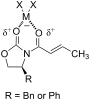
Figure 3: Lewis acid complex of the Evans auxiliary [43].

Scheme 5: DCA reactions of α,β-unsaturated amides utilizing (S,S)-(+)-pseudoephedrine and the OTBS-derivative...

Figure 4: Proposed model accounting for the diastereoselectivity observed in the 1,4-addition of Bn2NLi to α,...

Scheme 6: An example of a tandem conjugate addition–α-alkylation reaction of an α,β-unsaturated amide utilizi...

Scheme 7: Conjugate addition to an α,β-unsaturated bicyclic lactam leading to (+)-paroxetine and (+)-femoxeti...

Scheme 8: Intramolecular conjugate addition reaction to α,β-unsaturated amide.

Scheme 9: Conjugate addition to an α,β-unsaturated pyroglutamate derivative.

Scheme 10: Cu(I)–NHC-catalyzed asymmetric silylation of α,β-unsaturated lactams and amides.

Scheme 11: Asymmetric copper-catalyzed 1,4-borylation of an α,β-unsaturated amide.

Scheme 12: Asymmetric cross-coupling 49 to phenyl chloride.

Scheme 13: Rhodium-catalyzed asymmetric 1,4-arylation of an α,β-unsaturated lactam.

Scheme 14: Rhodium-catalyzed asymmetric 1,4-arylation of an α,β-unsaturated amide.

Scheme 15: Rhodium-catalyzed asymmetric 1,4-arylation of an α,β-unsaturated amide using a chiral bicyclic dien...

Scheme 16: Synthesis of (R)-(−)-baclofen through a rhodium-catalyzed asymmetric 1,4-arylation of lactam 58.

Scheme 17: Rhodium-catalyzed asymmetric 1,4-arylation of an α,β-unsaturated amide and lactam employing organo[...

Scheme 18: Rhodium-catalyzed asymmetric 1,4-arylation of an α,β-unsaturated lactam employing benzofuran-2-ylzi...

Figure 5: Further chiral ligands that have been used in rhodium-catalyzed 1,4-additions of α,β-unsaturated am...

Scheme 19: Palladium-catalyzed asymmetric 1,4-arylation of arylsiloxanes to a α,β-unsaturated lactam.

Scheme 20: SmI2-mediated cyclization of α,β-unsaturated Weinreb amides.

Figure 6: Chiral Lewis acid complexes used in the Mukaiyama–Michael addition of α,β-unsaturated amides.

Scheme 21: Mukaiyama–Michael addition of thioester silylketene acetal to α,β-unsaturated N-alkenoyloxazolidino...

Scheme 22: Asymmetric 1,4-addition of aryl acetylides to α,β-unsaturated thioamides.

Scheme 23: Asymmetric 1,4-addition of alkyl acetylides to α,β-unsaturated thioamides.

Scheme 24: Asymmetric vinylogous conjugate additions of unsaturated butyrolactones to α,β-unsaturated thioamid...

Scheme 25: Gd-catalyzed asymmetric 1,4-cyanation of α,β-unsaturated N-acylpyrroles [205].

Scheme 26: Lewis acid-catalyzed asymmetric 1,4-cyanation of α,β-unsaturated N-acylpyrazole 107.

Scheme 27: Lewis acid mediated 1,4-addition of dibenzyl malonate to α,β-unsaturated N-acylpyrroles.

Scheme 28: Chiral Lewis acid mediated 1,4-radical addition to α,β-unsaturated N-acyloxazolidinone [224].

Scheme 29: Aza-Michael addition of O-benzylhydroxylamine to an α,β-unsaturated N-acylpyrazole.

Scheme 30: An example of the aza-Michael addition of secondary aryl amines to an α,β-unsaturated N-acyloxazoli...

Scheme 31: Aza-Michael additions of anilines to a α,β-unsaturated N-alkenoyloxazolidinone catalyzed by palladi...

Scheme 32: Aza-Michael additions of aniline to an α,β-unsaturated N-alkenoylbenzamide and N-alkenoylcarbamate ...

Scheme 33: Difference between aza-Michael addition ran using the standard protocol versus the slow addition pr...

Scheme 34: Aza-Michael additions of aryl amines salts to an α,β-unsaturated N-alkenoyloxazolidinone catalyzed ...

Scheme 35: Aza-Michael addition of N-alkenoyloxazolidiniones catalyzed by samarium diiodide [244].

Scheme 36: Asymmetric aza-Michael addition of p-anisidine to α,β-unsaturated N-alkenoyloxazolidinones catalyze...

Scheme 37: Asymmetric aza-Michael addition of O-benzylhydroxylamine to N-alkenoyloxazolidinones catalyzed by i...

Scheme 38: Asymmetric 1,4-addition of purine to an α,β-unsaturated N-alkenoylbenzamide catalyzed by (S,S)-(sal...

Scheme 39: Asymmetric 1,4-addition of phosphites to α,β-unsaturated N-acylpyrroles.

Scheme 40: Asymmetric 1,4-addition of phosphine oxides to α,β-unsaturated N-acylpyrroles.

Scheme 41: Tandem Michael-aldol reaction catalyzed by a hydrogen-bonding organocatalyst.

Scheme 42: Examples of the sulfa-Michael–aldol reaction employing α,β-unsaturated N-acylpyrazoles.

Scheme 43: Example of the sulfa-Michael addition of α,β-unsaturated N-alkenoyloxazolidinones.

Figure 7: Structure of cinchona alkaloid-based squaramide catalyst.

Scheme 44: Asymmetric intramolecular oxa-Michael addition of an α,β-unsaturated amide.

Scheme 45: Formal synthesis atorvastatin.
Electrochemical selenium- and iodonium-initiated cyclisation of hydroxy-functionalised 1,4-dienes
- Philipp Röse,
- Steffen Emge,
- Jun-ichi Yoshida and
- Gerhard Hilt
Beilstein J. Org. Chem. 2015, 11, 174–183, doi:10.3762/bjoc.11.18

- ; Introduction The reaction of terminal alkenes with 1,3-dienes under cobalt catalysis results in 1,4-dienes in a 1,4-hydrovinylation reaction. Besides cobalt, also other transition metals were described to undergo such transformations [1][2][3][4]. However, only for the cobalt-catalysed reactions a regiodiverse

Graphical Abstract

Scheme 1: Cobalt-catalysed 1,4-hydrovinylation.

Scheme 2: Electrochemical selenoalkoxylation of 2.

Scheme 3: Electrochemical iodoalkoxylation of 2.
Lewis acid-catalyzed redox-neutral amination of 2-(3-pyrroline-1-yl)benzaldehydes via intramolecular [1,5]-hydride shift/isomerization reaction
- Chun-Huan Jiang,
- Xiantao Lei,
- Le Zhen,
- Hong-Jin Du,
- Xiaoan Wen,
- Qing-Long Xu and
- Hongbin Sun
Beilstein J. Org. Chem. 2014, 10, 2892–2896, doi:10.3762/bjoc.10.306
- : catalysis; C–H activation; hydride-shift; Lewis acid; redox reaction; Introduction The direct and selective functionalization of the inactive C(sp3)–H bond constitute an economically attractive strategy for organic syntheses [1][2][3][4][5][6][7][8][9][10]. Until now, a number of transition metals can be

Graphical Abstract

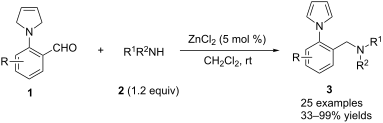
Scheme 1: Synthesis of N-substituted pyrroles via redox-neutral reaction.

Scheme 2: Substrate scope of aryl aldehydes 1. Reagents and conditions: 1 (0.3 mmol), 2a (1.2 equiv), ZnCl2 (...

Scheme 3: Substrate scope of amines 2. Reagents and conditions: 1a (0.5 mmol), 2 (1.2 equiv), ZnCl2 (5 mol %)...
Preparation of phosphines through C–P bond formation
- Iris Wauters,
- Wouter Debrouwer and
- Christian V. Stevens
Beilstein J. Org. Chem. 2014, 10, 1064–1096, doi:10.3762/bjoc.10.106
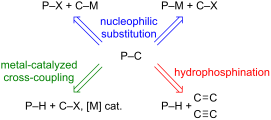
- hydrophosphinations. Metal complex-catalyzed hydrophosphinations Hydrophosphination catalysts are mainly based on transition metals. However, it has been shown that lanthanides and alkaline earth metals can offer a valid alternative. Palladium and nickel complexes were used to catalyze the addition of the P–H bond to

Graphical Abstract

Scheme 1: Synthesis of P-stereogenic phosphines 5 using menthylphosphinite borane diastereomers 2.

Scheme 2: Enantioselective synthesis of chiral phosphines 10 with ephedrine as a chiral auxiliary.

Scheme 3: Chlorophosphine boranes 11a as P-chirogenic electrophilic building blocks.

Scheme 4: Monoalkylation of phenylphosphine borane 15 with methyl iodide in the presence of Cinchona alkaloid...

Scheme 5: Preparation of tetraphosphine borane 19.

Scheme 6: Using chiral chlorophosphine-boranes 11b as phosphide borane 20 precursors.

Scheme 7: Nickel-catalyzed cross-coupling (dppe = 1,2-bis(diphenylphosphino)ethane).

Scheme 8: Pd-catalyzed cross-coupling reaction with organophosphorus stannanes 30.

Scheme 9: Copper iodide catalyzed carbon–phosphorus bond formation.

Scheme 10: Thermodynamic kinetic resolution as the origin of enantioselectivity in metal-catalyzed asymmetric ...

Scheme 11: Ru-catalyzed asymmetric phosphination of benzyl and alkyl chlorides 35 with HPPhMe (36a, PHOX = pho...

Scheme 12: Pt-catalyzed asymmetric alkylation of secondary phosphines 36b.

Scheme 13: Different adducts 43 can result from hydrophosphination.

Scheme 14: Pt-catalyzed asymmetric hydrophosphination.

Scheme 15: Intramolecular hydrophosphination of phosphinoalkene 47.

Scheme 16: Organocatalytic asymmetric hydrophosphination of α,β-unsaturated aldehydes 59.

Scheme 17: Preparation of phosphines using zinc organometallics.

Scheme 18: Preparation of alkenylphosphines 71a from alkenylzirconocenes 69 (dtc = N,N-diethyldithiocarbamate,...

Scheme 19: SNAr with P-chiral alkylmethylphosphine boranes 13c.

Scheme 20: Synthesis of QuinoxP 74 (TMEDA = tetramethylethylenediamine).

Scheme 21: Pd-Mediated couplings of a vinyl triflate 76 with diphenylphosphine borane 13e.

Figure 1: Menthone (83) and camphor (84) derived chiral phosphines.

Scheme 22: Palladium-catalyzed cross-coupling reaction of vinyl tosylates 85 and 87 with diphenylphosphine bor...

Scheme 23: Attempt for the enantioselective palladium-catalyzed C–P cross-coupling reaction between an alkenyl...

Scheme 24: Enol phosphates 88 as vinylic coupling partners in the palladium-catalyzed C–P cross-coupling react...

Scheme 25: Nickel-catalyzed cross-coupling in the presence of zinc (dppe = 1,2-bis(diphenylphosphino)ethane).

Scheme 26: Copper-catalyzed coupling of secondary phosphines with vinyl halide 94.

Scheme 27: Palladium-catalyzed cross-coupling of aryl iodides 97 with organoheteroatom stannanes 30.

Scheme 28: Synthesis of optically active phosphine boranes 100 by cross-coupling with a chiral phosphine boran...

Scheme 29: Palladium-catalyzed P–C cross-coupling reactions between primary or secondary phosphines and functi...

Scheme 30: Enantioselective synthesis of a P-chirogenic phosphine 108.

Scheme 31: Enantioselective arylation of silylphosphine 110 ((R,R)-Et-FerroTANE = 1,1'-bis((2R,4R)-2,4-diethyl...

Scheme 32: Nickel-catalyzed arylation of diphenylphosphine 25d.

Scheme 33: Nickel-catalyzed synthesis of (R)-BINAP 116 (dppe = 1,2-bis(diphenylphosphino)ethane, DABCO = 1,4-d...

Scheme 34: Nickel-catalyzed cross-coupling between aryl bromides 119 and diphenylphosphine (25d) (dppp = 1,3-b...

Scheme 35: Stereocontrolled Pd(0)−Cu(I) cocatalyzed aromatic phosphorylation.

Scheme 36: Preparation of alkenylphosphines by hydrophosphination of alkynes.

Scheme 37: Palladium and nickel-catalyzed addition of P–H to alkynes 125a.

Scheme 38: Palladium-catalyzed asymmetric hydrophosphination of an alkyne 128.

Scheme 39: Ruthenium catalyzed hydrophosphination of propargyl alcohols 132 (cod = 1,5-cyclooctadiene).

Scheme 40: Cobalt-catalyzed hydrophosphination of alkynes 134a (acac = acetylacetone).

Scheme 41: Tandem phosphorus–carbon bond formation–oxyfunctionalization of substituted phenylacetylenes 125c (...

Scheme 42: Organolanthanide-catalyzed intramolecular hydrophosphination/cyclization of phosphinoalkynes 143.

Scheme 43: Hydrophosphination of alkynes 134c catalyzed by ytterbium-imine complexes 145 (hmpa = hexamethylpho...

Scheme 44: Calcium-mediated hydrophosphanylation of alkyne 134d.

Scheme 45: Formation and substitution of bromophosphine borane 151.

Scheme 46: General scheme for a nickel or copper catalyzed cross-coupling reaction.

Scheme 47: Copper-catalyzed synthesis of alkynylphosphines 156.
Domino reactions of 2H-azirines with acylketenes from furan-2,3-diones: Competition between the formation of ortho-fused and bridged heterocyclic systems
- Alexander F. Khlebnikov,
- Mikhail S. Novikov,
- Viktoriia V. Pakalnis,
- Roman O. Iakovenko and
- Dmitry S. Yufit
Beilstein J. Org. Chem. 2014, 10, 784–793, doi:10.3762/bjoc.10.74

- -system (4.56, 4.68 ppm). Attempts to initiate the reaction by UV-irradiation (at 20 or 50 °C) or catalysis by compounds of transition metals (Cu(acac)2, Fe(acac)3, Pd(bzac)2, Rh2(AcO)4, Cu(OTf)2, Pd/C) at 20 or 40 °C failed. Benzene was found to be a solvent of choice, and a 1:1 molar ratio of reagents

Graphical Abstract

Scheme 1: Reactions of furan-2,3-diones 1 and azirines 2.

Figure 1: Molecular structures of compounds 3а, 4b.

Scheme 2: The route of formation of compounds 3 and possible intermediates in route to compounds 4 and 5.

Figure 2: Energy profiles for the reactions of azirines 2a,c and acylketene 6a, as well as acylketene 6a with...

Scheme 3: Possible intermediates in routes to compounds 4 and 5.

Figure 3: Energy profiles for the reactions of dihydropyrazine 11a with acylketene 6a, as well as acylketene ...

Figure 4: Energy profiles for the reactions of azirines 2a,c with protonated azirines 14a,c. Relative free en...

Scheme 4: Isodesmic equation for evaluation of relative basicity of azirines 2c,a.

Scheme 5: Reaction of furandione 1a with azirine 2d.

Figure 5: Molecular structure of compound 17.

Scheme 6: Reaction of furandione 1d with azirine 2a.

Scheme 7: Reactions of compounds 3d and 18a with methanol.
Isocyanide-based multicomponent reactions towards cyclic constrained peptidomimetics
- Gijs Koopmanschap,
- Eelco Ruijter and
- Romano V.A. Orru
Beilstein J. Org. Chem. 2014, 10, 544–598, doi:10.3762/bjoc.10.50

- these three steps simultaneously in one-pot, however, as isocyanides are also good ligands to transition metals, the Ugi products were only obtained in low yield (19%) without observing any triazole product. Even more interestingly was the copper-free procedure published by the group of Cai, especially

Graphical Abstract

Scheme 1: The proposed mechanism of the Passerini reaction.

Scheme 2: The PADAM-strategy to α-hydroxy-β-amino amide derivatives 7. An additional oxidation provides α-ket...

Scheme 3: The general accepted Ugi-mechanism.

Scheme 4: Three commonly applied Ugi/cyclization approaches. a) UDC-process, b) UAC-sequence, c) UDAC-combina...

Scheme 5: Ugi reaction that involves the condensation of Armstrong’s convertible isocyanide.

Scheme 6: Mechanism of the U-4C-3CR towards bicyclic β-lactams.

Scheme 7: The Ugi 4C-3CR towards oxabicyclo β-lactams.

Scheme 8: Ugi MCR between an enantiopure monoterpene based β-amino acid, aldehyde and isocyanide resulting in...

Scheme 9: General MCR for β-lactams in water.

Scheme 10: a) Ugi reaction for β-lactam-linked peptidomimetics. b) Varying the β-amino acid resulted in β-lact...

Scheme 11: Ugi-4CR followed by a Pd-catalyzed Sn2 cyclization.

Scheme 12: Ugi-3CR of dipeptide mimics from 2-substituted pyrrolines.

Scheme 13: Joullié–Ugi reaction towards 2,5-disubstituted pyrrolidines.

Scheme 14: Further elaboration of the Ugi-scaffold towards bicyclic systems.

Scheme 15: Dihydroxyproline derivatives from an Ugi reaction.

Scheme 16: Diastereoselective Ugi reaction described by Banfi and co-workers.

Scheme 17: Similar Ugi reaction as in Scheme 16 but with different acids and two chiral isocyanides.

Scheme 18: Highly diastereoselective synthesis of pyrrolidine-dipeptoids via a MAO-N/MCR-procedure.

Scheme 19: MAO-N/MCR-approach towards the hepatitis C drug telaprevir.

Scheme 20: Enantioselective MAO-U-3CR procedure starting from chiral pyrroline 64.

Scheme 21: Synthesis of γ-lactams via an UDC-sequence.

Scheme 22: Utilizing bifunctional groups to provide bicyclic γ-lactam-ketopiperazines.

Scheme 23: The Ugi reaction provided both γ- as δ-lactams depending on which inputs were used.

Scheme 24: The sequential Ugi/RCM with olefinic substrates provided bicyclic lactams.

Scheme 25: a) The structural and dipole similarities of the triazole unit with the amide bond. b) The copper-c...

Scheme 26: The Ugi/Click sequence provided triazole based peptidomimetics.

Scheme 27: The Ugi/Click reaction as described by Nanajdenko.

Scheme 28: The Ugi/Click-approach by Pramitha and Bahulayan.

Scheme 29: The Ugi/Click-combination by Niu et al.

Scheme 30: Triazole linked peptidomimetics obtained from two separate MCRs and a sequential Click reaction.

Scheme 31: Copper-free synthesis of triazoles via two MCRs in one-pot.

Scheme 32: The sequential Ugi/Paal–Knorr reaction to afford pyrazoles.

Scheme 33: An intramolecular Paal–Knorr condensation provided under basic conditions pyrazolones.

Scheme 34: Similar cyclization performed under acidic conditions provided pyrazolones without the trifluoroace...

Scheme 35: The Ugi-4CR towards 2,4-disubstituted thiazoles.

Scheme 36: Solid phase approach towards thiazoles.

Scheme 37: Reaction mechanism of formation of thiazole peptidomimetics containing an additional β-lactam moiet...

Scheme 38: The synthesis of the trisubstituted thiazoles could be either performed via an Ugi reaction with pr...

Scheme 39: Performing the Ugi reaction with DMB-protected isocyanide gave access to either oxazoles or thiazol...

Scheme 40: Ugi/cyclization-approach towards 2,5-disubstituted thiazoles. The Ugi reaction was performed with d...

Scheme 41: Further derivatization of the thiazole scaffold.

Scheme 42: Three-step procedure towards the natural product bacillamide C.

Scheme 43: Ugi-4CR to oxazoles reported by Zhu and co-workers.

Scheme 44: Ugi-based synthesis of oxazole-containing peptidomimetics.

Scheme 45: TMNS3 based Ugi reaction for peptidomimics containing a tetrazole.

Scheme 46: Catalytic cycle of the enantioselective Passerini reaction towards tetrazole-based peptidomimetics.

Scheme 47: Tetrazole-based peptidomimetics via an Ugi reaction and a subsequent sigmatropic rearrangement.

Scheme 48: Resin-bound Ugi-approach towards tetrazole-based peptidomimetics.

Scheme 49: Ugi/cyclization approach towards γ/δ/ε-lactam tetrazoles.

Scheme 50: Ugi-3CR to pipecolic acid-based peptidomimetics.

Scheme 51: Staudinger–Aza-Wittig/Ugi-approach towards pipecolic acid peptidomimetics.

Figure 1: The three structural isomers of diketopiperazines. The 2,5-DKP isomer is most common.

Scheme 52: UDC-approach to obtain 2,5-DKPs, either using Armstrong’s isocyanide or via ethylglyoxalate.

Scheme 53: a) Ugi reaction in water gave either 2,5-DKP structures or spiro compounds. b) The Ugi reaction in ...

Scheme 54: Solid-phase approach towards diketopiperazines.

Scheme 55: UDAC-approach towards DKPs.

Scheme 56: The intermediate amide is activated as leaving group by acid and microwave assisted organic synthes...

Scheme 57: UDC-procedure towards active oxytocin inhibitors.

Scheme 58: An improved stereoselective MCR-approach towards the oxytocin inhibitor.

Scheme 59: The less common Ugi reaction towards DKPs, involving a Sn2-substitution.

Figure 2: Spatial similarities between a natural β-turn conformation and a DKP based β-turn mimetic [158].

Scheme 60: Ugi-based syntheses of bicyclic DKPs. The amine component is derived from a coupling between (R)-N-...

Scheme 61: Ugi-based synthesis of β-turn and γ-turn mimetics.

Figure 3: Isocyanide substituted 3,4-dihydropyridin-2-ones, dihydropyridines and the Freidinger lactams. Bio-...

Scheme 62: The mechanism of the 4-CR towards 3,4-dihydropyridine-2-ones 212.

Scheme 63: a) Multiple MCR-approach to provide DHP-peptidomimetic in two-steps. b) A one-pot 6-CR providing th...

Scheme 64: The MCR–alkylation–MCR procedure to obtain either tetrapeptoids or depsipeptides.

Scheme 65: U-3CR/cyclization employing semicarbazone as imine component gave triazine based peptidomimetics.

Scheme 66: 4CR towards triazinane-diones.

Scheme 67: The MCR–alkylation–IMCR-sequence described by our group towards triazinane dione-based peptidomimet...

Scheme 68: Ugi-4CR approaches followed by a cyclization to thiomorpholin-ones (a) and pyrrolidines (b).

Scheme 69: UDC-approach for benzodiazepinones.

Scheme 70: Ugi/Mitsunobu sequence to BDPs.

Scheme 71: A UDAC-approach to BDPs with convertible isocyanides. The corresponding amide is cleaved by microwa...

Scheme 72: microwave assisted post condensation Ugi reaction.

Scheme 73: Benzodiazepinones synthesized via the post-condensation Ugi/ Staudinger–Aza-Wittig cyclization.

Scheme 74: Two Ugi/cyclization approaches utilizing chiral carboxylic acids. Reaction (a) provided the product...

Scheme 75: The mechanism of the Gewald-3CR includes three base-catalysed steps involving first a Knoevnagel–Co...

Scheme 76: Two structural 1,4-thienodiazepine-2,5-dione isomers by U-4CR/cyclization.

Scheme 77: Tetrazole-based diazepinones by UDC-procedure.

Scheme 78: Tetrazole-based BDPs via a sequential Ugi/hydrolysis/coupling.

Scheme 79: MCR synthesis of three different tricyclic BPDs.

Scheme 80: Two similar approaches both involving an Ugi reaction and a Mitsunobu cyclization.

Scheme 81: Mitsunobu–Ugi-approach towards dihydro-1,4-benzoxazepines.

Scheme 82: Ugi reaction towards hetero-aryl fused 5-oxo-1,4-oxazepines.

Scheme 83: a) Ugi/RCM-approach towards nine-membered peptidomimetics b) Sequential peptide-coupling, deprotect...

Scheme 84: Ugi-based synthesis towards cyclic RGD-pentapeptides.

Scheme 85: Ugi/MCR-approach towards 12–15 membered macrocycles.

Scheme 86: Stereoselective Ugi/RCM approach towards 16-membered macrocycles.

Scheme 87: Passerini/RCM-sequence to 22-membered macrocycles.

Scheme 88: UDAC-approach towards 12–18-membered depsipeptides.

Figure 4: Enopeptin A with its more active derivative ADEP-4.

Scheme 89: a) The Joullié–Ugi-approach towards ADEP-4 derivatives b) Ugi-approach for the α,α-dimethylated der...

Scheme 90: Ugi–Click-strategy for 15-membered macrocyclic glyco-peptidomimetics.

Scheme 91: Ugi/Click combinations provided macrocycles containing both a triazole and an oxazole moiety.

Scheme 92: a) A solution-phase procedure towards macrocycles. b) Alternative solid-phase synthesis as was repo...

Scheme 93: Ugi/cyclization towards cyclophane based macrocycles.

Scheme 94: PADAM-strategy towards eurystatin A.

Scheme 95: PADAM-approach for cyclotheanamide.

Scheme 96: A triple MCR-approach affording RGD-pentapeptoids.

Scheme 97: Ugi-MiBs-approach towards peptoid macrocycles.

Scheme 98: Passerini-based MiB approaches towards macrocycles 345 and 346.

Scheme 99: Macrocyclic peptide formation by the use of amphoteric aziridine-based aldehydes.
Silver and gold-catalyzed multicomponent reactions
- Giorgio Abbiati and
- Elisabetta Rossi
Beilstein J. Org. Chem. 2014, 10, 481–513, doi:10.3762/bjoc.10.46
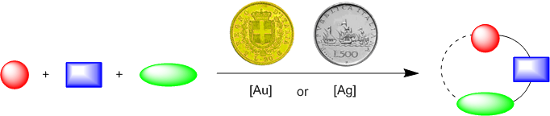
- involving higher oxidation states from Au(I) precatalysts have been achieved by the addition of a stoichiometric oxidant enabling two-electron redox cycles typically exhibited by other late transition metals. With respect to Ag(I)-mediated MCRs, less information can be found in the literature about the

Graphical Abstract

Scheme 1: General reaction mechanism for Ag(I)-catalyzed A3-coupling reactions.

Scheme 2: A3-coupling reaction catalyzed by polystyrene-supported NHC–silver halides.

Figure 1: Various NHC–Ag(I) complexes used as catalysts for A3-coupling.

Scheme 3: Proposed reaction mechanism for NHC–AgCl catalyzed A3-coupling reactions.

Scheme 4: Liu’s synthesis of pyrrole-2-carboxaldehydes 4.

Scheme 5: Proposed reaction mechanism for Liu’s synthesis of pyrrole-2-carboxaldehydes 4.

Scheme 6: Gold-catalyzed synthesis of propargylamines 1.

Scheme 7: A3-coupling catalyzed by phosphinamidic Au(III) metallacycle 6.

Scheme 8: Gold-catalyzed KA2-coupling.

Scheme 9: A3-coupling applied to aldehyde-containing oligosaccharides 8.

Scheme 10: A3-MCR for the preparation of propargylamine-substituted indoles 9.

Scheme 11: A3-coupling interceded synthesis of furans 12.

Scheme 12: A3/KA2-coupling mediated synthesis of functionalized dihydropyrazoles 13 and polycyclic dihydropyra...

Scheme 13: Au(I)-catalyzed entry to cyclic carbamimidates 17 via an A3-coupling-type approach.

Scheme 14: Proposed reaction mechanism for the Au(I)-catalyzed synthesis of cyclic carbamimidates 17.

Figure 2: Chiral trans-1-diphenylphosphino-2-aminocyclohexane–Au(I) complex 20.

Scheme 15: A3-coupling-type synthesis of oxazoles 21 catalyzed by Au(III)–salen complex.

Scheme 16: Proposed reaction mechanism for the synthesis of oxazoles 21.

Scheme 17: Synthesis of propargyl ethyl ethers 24 by an A3-coupling-type reaction.

Scheme 18: General mechanism of Ag(I)-catalyzed MCRs of 2-alkynylbenzaldehydes, amines and nucleophiles.

Scheme 19: General synthetic pathway to 1,3-disubstituted-1,2-dihydroisoquinolines.

Scheme 20: Synthesis of 1,3-disubstituted-1,2-dihydroisoquinolines 29.

Scheme 21: Synthesis of 1,3-disubstituted-1,2-dihydroisoquinolines 35 and 36.

Scheme 22: Rh(II)/Ag(I) co-catalyzed synthesis of 1,3-disubstituted-1,2-dihydroisoquinolines 40.

Scheme 23: General synthetic pathway to 2-amino-1,2-dihydroquinolines.

Scheme 24: Synthesis of 2-amino-1,2-dihydroquinolines 47.

Scheme 25: Synthesis of tricyclic H-pyrazolo[5,1-a]isoquinoline 48.

Scheme 26: Synthesis of tricyclic H-pyrazolo[5,1-a]isoquinolines 48.

Scheme 27: Cu(II)/Ag(I) catalyzed synthesis of H-pyrazolo[5,1-a]isoquinolines 48.

Scheme 28: Synthesis of 2-aminopyrazolo[5,1-a]isoquinolines 53.

Scheme 29: Synthesis of 1-(isoquinolin-1-yl)guanidines 55.

Scheme 30: Ag(I)/Cu(I) catalyzed synthesis of 2-amino-H-pyrazolo[5,1-a]isoquinolines 58.

Scheme 31: Ag(I)/Ni(II) co-catalyzed synthesis of 3,4-dihydro-1H-pyridazino[6,1-a]isoquinoline-1,1-dicarboxyla...

Scheme 32: Ag(I) promoted activation of the α-carbon atom of the isocyanide group.

Scheme 33: Synthesis of dihydroimidazoles 65.

Scheme 34: Synthesis of oxazoles 68.

Scheme 35: Stereoselective synthesis of chiral butenolides 71.

Scheme 36: Proposed reaction mechanism for the synthesis of butenolides 71.

Scheme 37: Stereoselective three-component approach to pirrolidines 77 by means of a chiral auxiliary.

Scheme 38: Stereoselective three-component approach to pyrrolidines 81 and 82 by means of a chiral catalyst.

Scheme 39: Synthesis of substituted five-membered carbocyles 86.

Scheme 40: Synthesis of regioisomeric arylnaphthalene lactones.

Scheme 41: Enantioselective synthesis of spiroacetals 96 by Fañanás and Rodríguez [105].

Scheme 42: Enantioselective synthesis of spiroacetals 101 by Gong [106].

Scheme 43: Synthesis of polyfunctionalized fused bicyclic ketals 103 and bridged tricyclic ketals 104.

Scheme 44: Proposed reaction mechanism for the synthesis of ketals 103 and 104.

Scheme 45: Synthesis of β-alkoxyketones 108.

Scheme 46: Synthesis of N-methyl-1,4-dihydropyridines 112.

Scheme 47: Synthesis of tetrahydrocarbazoles 115–117.

Scheme 48: Plausible reaction mechanism for the synthesis of tetrahydrocarbazoles 115–117.

Scheme 49: Carboamination, carboalkoxylation and carbolactonization of terminal alkenes.

Scheme 50: Oxyarylation of alkenes with arylboronic acids and Selectfluor as reoxidant.

Scheme 51: Proposed reaction mechanism for oxyarylation of alkenes.

Scheme 52: Oxyarylation of alkenes with arylsilanes and Selectfluor as reoxidant.

Scheme 53: Oxyarylation of alkenes with arylsilanes and IBA as reoxidant.
Garner’s aldehyde as a versatile intermediate in the synthesis of enantiopure natural products
- Mikko Passiniemi and
- Ari M.P. Koskinen
Beilstein J. Org. Chem. 2013, 9, 2641–2659, doi:10.3762/bjoc.9.300
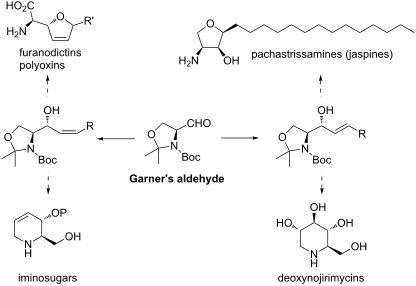
- nucleophiles seem to give a roughly 8:1 anti/syn-selectivity. The larger organovinyl reagents give slightly lower anti-selectivities of about 3:1 to 5:1. Highest selectivities are reached with transition metals, such as Rh and Ni (Table 1, entries 12, 18 and 19). The anti-selectivity can be enhanced either by

Graphical Abstract
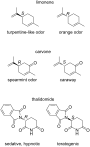
Figure 1: Structures of limonene, carvone and thalidomide.

Figure 2: Structure of Garner’s aldehyde.

Scheme 1: (a) i) Boc2O, 1.0 N NaOH (pH >10), dioxane, +5 °C → rt; ii) MeI, K2CO3, DMF, 0 °C → rt (86% over tw...

Scheme 2: (a) AcCl, MeOH, 0 °C → reflux (99%); (b) i) (Boc)2O, Et3N, THF, 0 °C → rt → 50 °C (89%); ii) Me2C(O...

Scheme 3: (a) LiAlH4, THF, rt (93–96%); (b) (COCl)2, DMSO, iPr2NEt, CH2Cl2, −78 °C → −55 °C (99%).

Scheme 4: The Koskinen procedure for the preparation of Garner’s aldehyde. (a) i) AcCl, MeOH, 0 °C → 50 °C (9...

Scheme 5: Burke’s synthesis of Garner’s aldehyde. BDP - bis(diazaphospholane).

Figure 3: Structures of some iminosugars (7, 9), peptide antibiotics (8) and sphingosine (10) and pachastriss...

Scheme 6: Use of Garner’s aldehyde 1 in multistep synthesis.

Scheme 7: Explanation of the anti- and syn-selectivity in the nucleophilic addition reaction.

Scheme 8: Herold’s method: (a) Lithium 1-pentadecyne, HMPT, THF, −78 °C (71%); (b) Lithium 1-pentadecyne, ZnBr...

Scheme 9: (a) Ethyl lithiumpropiolate, HMPT, THF, −78 °C; (b) (S)- or (R)-MTPA, DCC, DMAP, THF, rt (18, 81%) ...

Scheme 10: Coleman’s selectivity studies and their transition state model for the co-ordinated delivery of the...

Scheme 11: (a) PhMgBr, THF, −78 °C → 0 °C [62] or (a) PhMgBr, Et2O, 0 °C [63].

Scheme 12: (a) cat. RhCl3·3H2O, cat. 26, NaOMe, Ph-B(OH)2, aq DME, 80 °C (24, 71%); (b) cat. RhCl3·3H2O, cat. ...

Scheme 13: Lithiated dithiane (3 equiv), CuI (0.3 equiv), BF3·Et2O (6 equiv), THF, −50 °C, 12 h (70%).

Scheme 14: Addition reaction reported by Lam et al. (a) 1-Hexyne, n-BuLi, THF, −15 °C or −40 °C.

Scheme 15: (a) n-BuLi, HMPT, toluene, −78 °C → rt (85%); (b) n-BuLi, ZnCl2, toluene/Et2O, −78 °C → rt (65%).

Scheme 16: (a) n-BuLi, 34, THF, −40 °C [69]; (b) n-BuLi, 35, THF, −78 °C → rt (80%) [70]; (c) n-BuLi, 35, HMPT, THF, −...

Scheme 17: (a) cat. Rh(acac)(CO)2, 42, THF, 40 °C (74%).
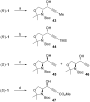
Scheme 18: (a) 1-PropynylMgBr, CuI, THF, Me2S, −78 °C (95%); (b) Ethynyltrimethylsilane, EtMgBr, CuI, THF, Me2...

Scheme 19: (a) cat. 50, toluene, 0 °C (52%); (b) cat. 51, toluene, 0 °C (51%); (c) cat. 52, toluene, 0 °C (50%...

Scheme 20: (a) (iPr)3SiH, cat. Ni(COD)2, dimesityleneimidazolium·HCl, t-BuOK, THF, rt.

Scheme 21: (a) Cp2Zr(H)Cl, cat. AgAsF6, CH2Cl2, rt; (b) Cp2Zr(H)Cl, 1-pentadecyne, cat. ZnBr2 in THF for anti-...

Scheme 22: (a) i) 31, n-BuLi, THF, −78 °C; ii) (S)-1, THF, −78 °C; (b) Red-Al, THF, 0 °C.

Scheme 23: (a) 61, n-BuLi, DMPU, toluene, −78 °C, then (S)-1, toluene, −95 °C (57%); (b) 61, n-BuLi, ZnCl2, to...

Scheme 24: Olefin A as an intermediate in natural product synthesis.

Scheme 25: (a) Ph3(Me)PBr, KH, benzene (66%, rac-64) or (b) AlMe3, Zn, CH2I2, THF (76%) [101]; (c) Ph3(Me)PBr, n-Bu...

Scheme 26: (a) Benzene, rt (82%) [108]; (b) K2CO3, MeOH (85%) [89]; (c) iPrOH, [Ir(COD)Cl]2, PPh3, THF, rt (81%) [114].

Scheme 27: Mechanism of the Still–Gennari modification of the HWE reaction leading to both olefin isomers.
New developments in gold-catalyzed manipulation of inactivated alkenes
- Michel Chiarucci and
- Marco Bandini
Beilstein J. Org. Chem. 2013, 9, 2586–2614, doi:10.3762/bjoc.9.294
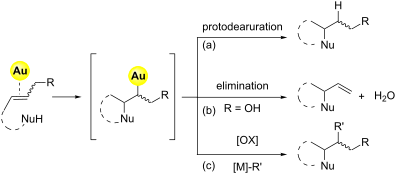
- strategies Differently from many transition metals, usually gold is not subjected to redox processes during the catalytic cycles. However, in recent years it has been demonstrated that both [Au(I)/Au(III)] (i.e. monometallic catalytic systems) and [Au(I)Au(I)/Au(II)Au(II)] (i.e. bimetallic catalytic systems

Graphical Abstract

Figure 1: Elementary steps in the gold-catalyzed nucleophilic addition to olefins.

Figure 2: Different approaches for the gold-catalyzed manipulation of inactivated alkenes.

Figure 3: Computed mechanistic cycle for the gold-catalyzed alkoxylation of ethylene with PhOH.

Scheme 1: [Au(I)]-catalyzed addition of phenols and carboxylic acids to alkenes.

Scheme 2: [Au(III)] catalyzed annulations of phenols and naphthols with dienes.

Scheme 3: [Au(III)]-catalyzed addition of aliphatic alcohols to alkenes.

Scheme 4: [Au(III)]-catalyzed carboalkoxylation of alkenes with dimethyl acetals 6.

Figure 4: Postulated mechanism for the [Au(I)]-catalyzed hydroamination of olefins.
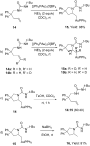
Scheme 5: Isolation and reactivity of alkyl gold intermediates in the intramolecular hydroamination of alkene...

Scheme 6: [Au(I)]-catalyzed intermolecular hydroamination of dienes.
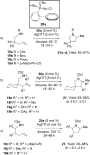
Scheme 7: Intramolecular [Au(I)]-catalyzed hydroamination of alkenes with carbamates.
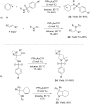
Scheme 8: [Au(I)]-catalyzed inter- as well as intramolecular addition of sulfonamides to isolated alkenes.

Scheme 9: Intramolecular hydroamination of N-alkenylureas catalyzed by gold(I) carbene complex.

Scheme 10: Enantioselective hydroamination of alkenyl ureas with biphenyl tropos ligand and chiral silver phos...

Scheme 11: Intramolecular [Au(I)]-catalyzed hydroamination of N-allyl-N’-aryl ureas. (PNP = pNO2-C6H4, PMP = p...

Scheme 12: [Au(I)]-catalyzed hydroamination of alkenes with ammonium salts.

Scheme 13: Enantioselective [Au(I)]-catalyzed intermolecular hydroamination of alkenes with cyclic ureas.

Scheme 14: Mechanistic proposal for the cooperative [Au(I)]/menthol catalysis for the enantioselective intramo...

Scheme 15: [Au(III)]-catalyzed addition of 1,3-diketones to alkenes.

Scheme 16: [Au(I)]-catalyzed intramolecular addition of β-keto amides to alkenes.

Scheme 17: Intermolecular [Au(I)]-catalyzed addition of indoles to alkenes.

Scheme 18: Intermolecular [Au(III)]-catalyzed hydroarylation of alkenes with benzene derivatives and thiophene....

Scheme 19: a) Intramolecular [Au(III)]-catalyzed hydroarylation of alkenes. b) A SEAr-type mechanism was hypot...

Scheme 20: Intramolecular [Au(I)]-catalyzed hydroalkylation of alkenes with simple ketones.

Scheme 21: Proposed reaction mechanism for the intramolecular [Au(I)]-catalyzed hydroalkylation of alkenes wit...

Scheme 22: Tandem Michael addition/hydroalkylation catalyzed by [Au(I)] and [Ag(I)] salts.

Scheme 23: Intramolecular [Au(I)]-catalyzed tandem migration/[2 + 2] cycloaddition of 1,7-enyne benzoates.

Scheme 24: Intramolecular [Au(I)]-catalyzed cyclopropanation of alkenes.

Scheme 25: Stereospecificity in [Au(I)]-catalyzed hydroalkoxylation of allylic alcohols.

Scheme 26: Mechanistic investigation on the intramolecular [Au(I)]-catalyzed hydroalkoxylation of allylic alco...

Scheme 27: Mechanistic investigation on the intramolecular enantioselective [Au(I)]-catalyzed alkylation of in...

Scheme 28: Synthesis of (+)-isoaltholactone via stereospecific intramolecular [Au(I)]-catalyzed alkoxylation o...

Scheme 29: Intramolecular enantioselective dehydrative amination of allylic alcohols catalyzed by chiral [Au(I...

Scheme 30: Enantioselective intramolecular hydroalkylation of allylic alcohols with aldehydes catalyzed by 20c...
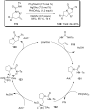
Scheme 31: Gold-catalyzed intramolecular diamination of alkenes.
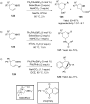
Scheme 32: Gold-catalyzed aminooxygenation and aminoarylation of alkenes.

Scheme 33: Gold-catalyzed carboamination, carboalkoxylation and carbolactonization of terminal alkenes with ar...
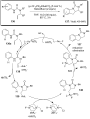
Scheme 34: Synthesis of tricyclic indolines via gold-catalyzed formal [3 + 2] cycloaddition.

Scheme 35: Gold(I) catalyzed aminoarylation of terminal alkenes in presence of Selectfluor [dppm = bis(dipheny...

Scheme 36: Mechanistic investigation on the aminoarylation of terminal alkenes by bimetallic gold(I) catalysis...

Scheme 37: Proposed mechanism for the aminoarylation of alkenes via [Au(I)-Au(I)]/[Au(II)-Au(II)] redox cataly...

Scheme 38: Oxyarylation of terminal olefins via redox gold catalysis.

Scheme 39: a) Intramolecular gold-catalyzed oxidative coupling reactions with aryltrimethylsilanes. b) Oxyaryl...
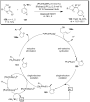
Scheme 40: Oxy- and amino-arylation of alkenes by [Au(I)]/[Au(III)] photoredox catalysis.
Recent advances in transition metal-catalyzed Csp2-monofluoro-, difluoro-, perfluoromethylation and trifluoromethylthiolation
- Grégory Landelle,
- Armen Panossian,
- Sergiy Pazenok,
- Jean-Pierre Vors and
- Frédéric R. Leroux
Beilstein J. Org. Chem. 2013, 9, 2476–2536, doi:10.3762/bjoc.9.287
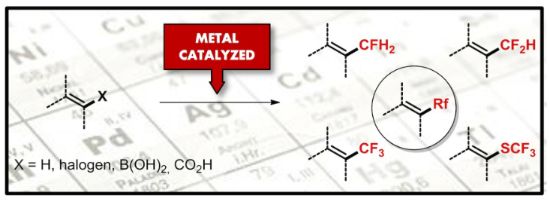
- moieties have been reported in the literature [27][33][34][35][36][37][38][39][40][41], the incorporation of partially fluorinated methyl groups is still underdeveloped [42][43]. In most cases transition metals have to be employed in stoichiometric amounts. 1.1 Palladium catalysis The first

Graphical Abstract

Scheme 1: Pd-catalyzed monofluoromethylation of pinacol phenylboronate [44].

Scheme 2: Cu-catalyzed monofluoromethylation with 2-PySO2CHFCOR followed by desulfonylation [49].

Scheme 3: Cu-catalyzed difluoromethylation with α-silyldifluoroacetates [57].

Figure 1: Mechanism of the Cu-catalyzed C–CHF2 bond formation of α,β-unsaturated carboxylic acids through dec...

Scheme 4: Fe-catalyzed decarboxylative difluoromethylation of cinnamic acids [62].

Scheme 5: Preliminary experiments for investigation of the mechanism of the C–H trifluoromethylation of N-ary...

Figure 2: Plausible catalytic cycle proposed by Z.-J. Shi et al. for the trifluoromethylation of acetanilides ...

Figure 3: Plausible catalytic cycle proposed by M. S. Sanford et al. for the perfluoroalkylation of simple ar...

Figure 4: Postulated reaction pathway for the Ag/Cu-catalyzed trifluoromethylation of aryl iodides by Z. Q. W...

Figure 5: Postulated reaction mechanism for Cu-catalyzed trifluoromethylation reaction using MTFA as trifluor...

Scheme 6: Formal Heck-type trifluoromethylation of vinyl(het)arenes by M. Sodeoka et al. [83].

Figure 6: Proposed catalytic cycle for the copper-catalyzed trifluoromethylation of (het)arenes in presence o...

Figure 7: Proposed catalytic cycle for the copper-catalyzed trifluoromethylation of N,N-disubstituted (hetero...

Figure 8: Proposed catalytic cycle by Y. Zhang and J. Wang et al. for the copper-catalyzed trifluoromethylati...

Figure 9: Mechanistic rationale for the trifluoromethylation of arenes in presence of Langlois’s reagent and ...

Scheme 7: Trifluoromethylation of 4-acetylpyridine with Langlois’s reagent by P. S. Baran et al. (* Stirring ...

Scheme 8: Catalytic copper-facilitated perfluorobutylation of benzene with C4F9I and benzoyl peroxide [90].

Figure 10: F.-L. Qing et al.’s proposed mechanism for the copper-catalyzed trifluoromethylation of (hetero)are...

Figure 11: Mechanism of the Cu-catalyzed/Ru-photocatalyzed trifluoromethylation and perfluoroalkylation of ary...

Figure 12: Proposed mechanism for the Cu-catalyzed trifluoromethylation of aryl- and vinyl boronic acids with ...

Figure 13: Possible mechanism for the Cu-catalyzed decarboxylative trifluoromethylation of cinnamic acids [62].

Scheme 9: Ruthenium-catalyzed perfluoroalkylation of alkenes and (hetero)arenes with perfluoroalkylsulfonyl c...

Figure 14: N. Kamigata et al.’s proposed mechanism for the Ru-catalyzed perfluoroalkylation of alkenes and (he...

Figure 15: Proposed mechanism for the Ru-catalyzed photoredox trifluoromethylation of (hetero)arenes with trif...

Figure 16: Late-stage trifluoromethylation of pharmaceutically relevant molecules with trifluoromethanesulfony...

Figure 17: Proposed mechanism for the trifluoromethylation of alkenes with trifluoromethyl iodide under Ru-bas...

Scheme 10: Formal perfluoroakylation of terminal alkenes by Ru-catalyzed cross-metathesis with perfluoroalkyle...

Figure 18: One-pot Ir-catalyzed borylation/Cu-catalyzed trifluoromethylation of complex small molecules by Q. ...

Figure 19: Mechanistic proposal for the Ni-catalyzed perfluoroalkylation of arenes and heteroarenes with perfl...

Scheme 11: Electrochemical Ni-catalyzed perfluoroalkylation of 2-phenylpyridine (Y. H. Budnikova et al.) [71].

Scheme 12: Fe(II)-catalyzed trifluoromethylation of arenes and heteroarenes with trifluoromethyl iodide (T. Ya...

Figure 20: Mechanistic proposal by T. Yamakawa et al. for the Fe(II)-catalyzed trifluoromethylation of arenes ...

Scheme 13: Ytterbium-catalyzed perfluoroalkylation of dihydropyran with perfluoroalkyl iodide (Y. Ding et al.) ...

Figure 21: Mechanistic proposal by A. Togni et al. for the rhenium-catalyzed trifluoromethylation of arenes an...

Figure 22: Mechanism of the Cu-catalyzed oxidative trifluoromethylthiolation of arylboronic acids with TMSCF3 ...

Scheme 14: Removal of the 8-aminoquinoline auxiliary [136].

Figure 23: Mechanism of the Cu-catalyzed trifluoromethylthiolation of C–H bonds with a trifluoromethanesulfony...
Gold(I)-catalyzed enantioselective cycloaddition reactions
- Fernando López and
- José L. Mascareñas
Beilstein J. Org. Chem. 2013, 9, 2250–2264, doi:10.3762/bjoc.9.264
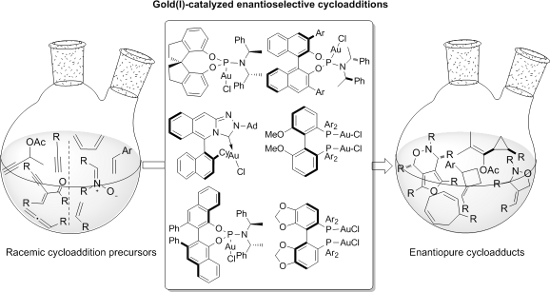
- core of frondosins (for example, 5a), in 68% yield and 90% ee (Scheme 4). Since this bicyclic enone was previously elaborated into frondosin A and B, the approach represented a streamlined formal enantioselective synthesis of both molecules. Analogous to other transition metals from groups eight to

Graphical Abstract

Figure 1: Gold-promoted 1,2-acyloxy migration on propargylic systems.

Scheme 1: Gold-catalyzed enantioselective intermolecular cyclopropanation.

Scheme 2: Gold-catalyzed enantioselective intramolecular cyclopropanation.

Scheme 3: Gold-catalyzed cyclohepta-annulation cascade.

Scheme 4: Application to the formal synthesis of frondosin A.

Scheme 5: Gold(I)-catalyzed enantioselective cyclopropenation of alkynes.

Scheme 6: Enantioselective cyclopropanation of diazooxindoles.

Figure 2: Proposed structures for gold-activated allene complexes.

Scheme 7: Gold-catalyzed enantioselective [2 + 2] cycloadditions of allenenes.

Scheme 8: Gold-catalyzed allenediene [4 + 3] and [4 + 2] cycloadditions.

Scheme 9: Gold-catalyzed enantioselective [4 + 2] cycloadditions of allenedienes.

Scheme 10: Gold-catalyzed enantioselective [4 + 3] cycloadditions of allenedienes.

Scheme 11: Gold-catalyzed enantioselective [4 + 2] cycloadditions of allenamides.

Scheme 12: Enantioselective [2 + 2] cycloadditions of allenamides.

Scheme 13: Mechanistic rational for the gold-catalyzed [2 + 2] cycloadditions.

Scheme 14: Enantioselective cascade cycloadditions between allenamides and oxoalkenes.

Scheme 15: Enantioselective [3 + 2] cycloadditions of nitrones and allenamides.

Scheme 16: Enantioselective formal [4 + 3] cycloadditions leading to 1,2-oxazepane derivatives.

Scheme 17: Enantioselective gold(I)-catalyzed 1,3-dipolar [3 + 3] cycloaddition between 2-(1-alkynyl)-2-alken-...

Scheme 18: Enantioselective [4 + 3] cycloaddition leading to 5,7-fused bicyclic furo[3,4-d][1,2]oxazepines.
Gold-catalyzed reaction of oxabicyclic alkenes with electron-deficient terminal alkynes to produce acrylate derivatives
- Yin-wei Sun,
- Qin Xu and
- Min Shi
Beilstein J. Org. Chem. 2013, 9, 1969–1976, doi:10.3762/bjoc.9.233
- ]. It is well known that gold catalysts have different catalytic abilities compared with other transition metals [24]. Moreover, gold-catalyzed chemical transformations have made significant progress during the last 5 years [25][26][27][28][29][30][31][32][33][34][35][36][37][38][39][40][41][42][43][44

Graphical Abstract

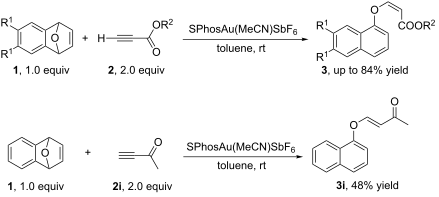
Scheme 1: Gold-catalyzed reactions of oxabicyclic alkenes with electron-deficient terminal alkynes.

Figure 1: Gold complexes used in this reaction.

Scheme 2: The reaction with terminal alkyne 2i as a substrate.

Scheme 3: The reaction with naphthalen-1-ol (5) as a substrate.

Scheme 4: The proposed mechanism for Au(I)-catalyzed reaction.
Homolytic substitution at phosphorus for C–P bond formation in organic synthesis
- Hideki Yorimitsu
Beilstein J. Org. Chem. 2013, 9, 1269–1277, doi:10.3762/bjoc.9.143

- . Advantageously, it requires neither highly basic conditions nor transition metals. Homolytic substitution at phosphorus is still in its infancy. In light of the rich chemistry of organophosphorus compounds, it will find wider application in organic synthesis in the future. Calculated reaction profile of

Graphical Abstract

Scheme 1: Representative C–P bond-forming reactions.

Scheme 2: General equation of homolytic substitution.

Scheme 3: Addition of diphenyl(triphenylstannyl)phosphine.

Scheme 4: Addition of diphenyl(trimethylstannyl)phosphine.

Scheme 5: Plausible mechanism of addition of R3Sn–PPh2.

Scheme 6: Addition of tetraorganodiphosphines to phenylacetylene.

Scheme 7: Plausible mechanism of anti-diphosphination.

Scheme 8: Radical diphosphination for synthesizing fluorescent material.

Scheme 9: Mechanism of thiophosphination with diphenyl(organosulfanyl)phosphine.

Scheme 10: Thiophosphination with S-thiophosphinyl O-ethyl dithiocarbonate.

Scheme 11: Photoinduced selenophosphination of allenes.

Scheme 12: Photoinduced tellurophosphination.

Scheme 13: Decarboxylative phosphorylation of carboxylic acid derivatives.

Scheme 14: Plausible mechanism of decarboxylative phosphorylation.

Scheme 15: Radical phosphination of PTOC esters with white phosphorus.

Scheme 16: Plausible mechanism of radical phosphination (Si = (Me3Si)3Si).

Scheme 17: Stereoselective phosphination leading to (S,S)-aminophosphine derivative.

Figure 1: Calculated reaction profile of homolytic substitution between Ph• and Me3Sn–PPh2 at the B2-PLYP-D/T...

Scheme 18: Phosphination with retention of axial chirality.

Scheme 19: Chemodivergent phosphination.

Scheme 20: Bis(phosphoryl)-bridged biphenyls by radical phosphination.

Scheme 21: Bis(phosphoryl)-bridged ladder triphenylene by radical phosphination.

Scheme 22: Photoinduced phosphination of perfluoroalkyl iodides with tetraphenyldiphosphine.

Scheme 23: Ti(III)-mediated radical phosphination of organic bromides with white phosphorus.
Transition-metal and organocatalysis in natural product synthesis
- David Yu-Kai Chen and
- Dawei Ma
Beilstein J. Org. Chem. 2013, 9, 1192–1193, doi:10.3762/bjoc.9.134
- modes of activation, which rival or at times surpass those exhibited by transition metals. Last but not least, the judiciary combination of transition-metal and organic mediators, together with tandem processes encompassing multiple reaction cycles in a programmed sequence, represents a new horizon with
Photoinduced synthesis of unsymmetrical diaryl selenides from triarylbismuthines and diaryl diselenides
- Yohsuke Kobiki,
- Shin-ichi Kawaguchi,
- Takashi Ohe and
- Akiya Ogawa
Beilstein J. Org. Chem. 2013, 9, 1141–1147, doi:10.3762/bjoc.9.127
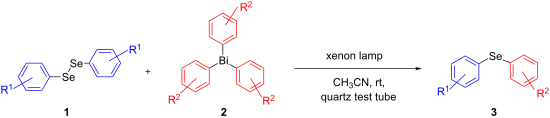
- ][24][25][26][27][28][29][30][31][32]. Most of these methods use coupling reactions catalyzed by transition-metal complexes. To avoid the contamination of product selenides with transition-metals, the development of synthetic methods for unsymmetrical diaryl selenides in the absence of transition-metal

Graphical Abstract

Scheme 1: Photoinduced radical reaction of diaryl diselenide with triphenylbismuthine.

Scheme 2: Photoinduced reaction of diphenyl disulfide with triphenylbismuthine.

Scheme 3: A plausible reaction pathway for the photoinduced reaction of diaryl diselenide with triarylbismuth...
Asymmetric Diels–Alder reaction with >C=P– functionality of the 2-phosphaindolizine-η1-P-aluminium(O-menthoxy) dichloride complex: experimental and theoretical results
- Rajendra K. Jangid,
- Nidhi Sogani,
- Neelima Gupta,
- Raj K. Bansal,
- Moritz von Hopffgarten and
- Gernot Frenking
Beilstein J. Org. Chem. 2013, 9, 392–400, doi:10.3762/bjoc.9.40
- chiral auxiliaries [3][4]. Chiral phosphines constitute a very important group of ligands as their coordination compounds with transition metals have been extensively employed in asymmetric catalysis to convert achiral compounds into enantio-enriched products with high efficiency and enantioselectivity

Graphical Abstract

Scheme 1: Diels–Alder reaction of 2-phosphaindolizines.

Scheme 2: Diels–Alder reaction of 2-phosphaindolizine-η1-P-aluminium(O-menthoxy) dichloride with 2,3-dimethyl...

Scheme 3: Formation of the cationic 1:1 complex of the dienophile and dialkylaluminium.

Scheme 4: Disproportionation of the 1:1 complex of 2-phosphaindolizine and Al(O-menthoxy)Cl2.

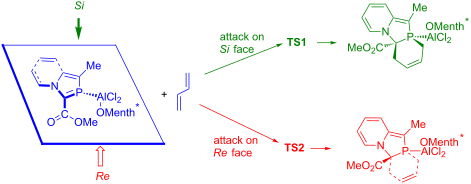
Scheme 5: Attack of 1,3-butadiene on Si and Re faces of >C=P– functionality of 2-phosphaindolizine complex.
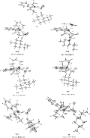
Figure 1: Geometries of 2-phosphaindolizine-η1-P-aluminium(O-menthoxy) dichloride, the transition structures,...
Recent advances in transition-metal-catalyzed intermolecular carbomagnesiation and carbozincation
- Kei Murakami and
- Hideki Yorimitsu
Beilstein J. Org. Chem. 2013, 9, 278–302, doi:10.3762/bjoc.9.34
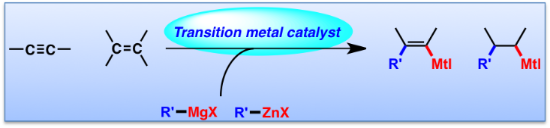
- reactions are efficient and direct routes to prepare complex and stereodefined organomagnesium and organozinc reagents. However, carbon–carbon unsaturated bonds are generally unreactive toward organomagnesium and organozinc reagents. Thus, transition metals were employed to accomplish the carbometalation
- hydroxymethyl group are also known [86][87][88][89]. Notably, Fox reported the enantio- and stereoselective carbomagnesiation of cyclopropenes without the addition of transition metals (Scheme 21) [90]. The key to successful reactions is the addition of aminoalcohol 3c and 1 equiv of methanol. In 2009, Fox et

Graphical Abstract

Scheme 1: Variation of substrates for carbomagnesiation and carbozincation in this article.

Scheme 2: Copper-catalyzed arylmagnesiation and allylmagnesiation of alkynyl sulfone.

Scheme 3: Copper-catalyzed four-component reaction of alkynyl sulfoxide with alkylzinc reagent, diiodomethane...

Scheme 4: Rhodium-catalyzed reaction of aryl alkynyl ketones with arylzinc reagents.

Scheme 5: Allylmagnesiation of propargyl alcohol, which provides the anti-addition product.

Scheme 6: Negishi’s total synthesis of (Z)-γ-bisabolene by allylmagnesiation.

Scheme 7: Iron-catalyzed syn-carbomagnesiation of propargylic or homopropargylic alcohol.

Scheme 8: Mechanism of iron-catalyzed carbomagnesiation.

Scheme 9: Regio- and stereoselective manganese-catalyzed allylmagnesiation.

Scheme 10: Vinylation and alkylation of arylacetylene-bearing hydroxy group.

Scheme 11: Arylmagnesiation of (2-pyridyl)silyl-substituted alkynes.

Scheme 12: Synthesis of tamoxifen from 2g.

Scheme 13: Controlling regioselectivity of carbocupration by attaching directing groups.

Scheme 14: Rhodium-catalyzed carbozincation of ynamides.

Scheme 15: Synthesis of 4-pentenenitriles through carbometalation followed by aza-Claisen rearrangement.

Scheme 16: Uncatalyzed carbomagnesiation of cyclopropenes.

Scheme 17: Iron-catalyzed carbometalation of cyclopropenes.

Scheme 18: Enantioselective carbozincation of cyclopropenes.

Scheme 19: Copper-catalyzed facially selective carbomagnesiation.

Scheme 20: Arylmagnesiation of cyclopropenes.

Scheme 21: Enantioselective methylmagnesiation of cyclopropenes without catalyst.

Scheme 22: Copper-catalyzed carbozincation.

Scheme 23: Enantioselective ethylzincation of cyclopropenes.

Scheme 24: Nickel-catalyzed ring-opening aryl- and alkenylmagnesiation of a methylenecyclopropane.

Scheme 25: Reaction mechanism.

Scheme 26: Nickel-catalyzed carbomagnesiation of arylacetylene and dialkylacetylene.

Scheme 27: Nickel-catalyzed carbozincation of arylacetylenes and its application to the synthesis of tamoxifen....

Scheme 28: Bristol-Myers Squibb’s nickel-catalyzed phenylzincation.

Scheme 29: Iron/NHC-catalyzed arylmagnesiation of aryl(alkyl)acetylene.

Scheme 30: Iron/copper-cocatalyzed alkylmagnesiation of aryl(alkyl)acetylenes.

Scheme 31: Iron-catalyzed hydrometalation.

Scheme 32: Iron/copper-cocatalyzed arylmagnesiation of dialkylacetylenes.

Scheme 33: Chromium-catalyzed arylmagnesiation of alkynes.

Scheme 34: Cobalt-catalyzed arylzincation of alkynes.

Scheme 35: Cobalt-catalyzed formation of arylzinc reagents and subsequent arylzincation of alkynes.

Scheme 36: Cobalt-catalyzed benzylzincation of dialkylacetylene and aryl(alkyl)acetylenes.

Scheme 37: Synthesis of estrogen receptor antagonist.

Scheme 38: Cobalt-catalyzed allylzincation of aryl-substituted alkynes.

Scheme 39: Silver-catalyzed alkylmagnesiation of terminal alkyne.

Scheme 40: Proposed mechanism of silver-catalyzed alkylmagnesiation.

Scheme 41: Zirconium-catalyzed ethylzincation of terminal alkenes.

Scheme 42: Zirconium-catalyzed alkylmagnesiation.

Scheme 43: Titanium-catalyzed carbomagnesiation.

Scheme 44: Three-component coupling reaction.

Scheme 45: Iron-catalyzed arylzincation reaction of oxabicyclic alkenes.

Scheme 46: Reaction of allenyl ketones with organomagnesium reagent.

Scheme 47: Regio- and stereoselective reaction of a 2,3-allenoate.

Scheme 48: Three-component coupling reaction of 1,2-allenoate, organozinc reagent, and ketone.

Scheme 49: Proposed mechanism for a rhodium-catalyzed arylzincation of allenes.

Scheme 50: Synthesis of skipped polyenes by iterative arylzincation/allenylation reaction.

Scheme 51: Synthesis of 1,4-diorganomagnesium compound from 1,2-dienes.

Scheme 52: Synthesis of tricyclic compounds.

Scheme 53: Manganese-catalyzed allylmagnesiation of allenes.

Scheme 54: Copper-catalyzed alkylmagnesiation of 1,3-dienes and 1,3-enynes.

Scheme 55: Chromium-catalyzed methallylmagnesiation of 1,6-diynes.

Scheme 56: Chromium-catalyzed allylmagnesiation of 1,6-enynes.

Scheme 57: Proposed mechanism of the chromium-catalyzed methallylmagnesiation.
Tandem aldehyde–alkyne–amine coupling/cycloisomerization: A new synthesis of coumarins
- Maddi Sridhar Reddy,
- Nuligonda Thirupathi and
- Madala Haribabu
Beilstein J. Org. Chem. 2013, 9, 180–184, doi:10.3762/bjoc.9.21

- in equivalence of reductive alkylation of amines while at the same time appending an alkyne, i.e., a highly useful moiety for further functionlization. This three-component coupling has been accomplished with a very broad range of transition metals, including copper, silver, gold, ruthenium/copper

Graphical Abstract

Scheme 1: Synthesis of various heterocycles by a tandem A3 coupling/cycloisomerization strategy.

Scheme 2: A plausible mechanistic pathway.
Palladium-catalyzed dual C–H or N–H functionalization of unfunctionalized indole derivatives with alkenes and arenes
- Gianluigi Broggini,
- Egle M. Beccalli,
- Andrea Fasana and
- Silvia Gazzola
Beilstein J. Org. Chem. 2012, 8, 1730–1746, doi:10.3762/bjoc.8.198
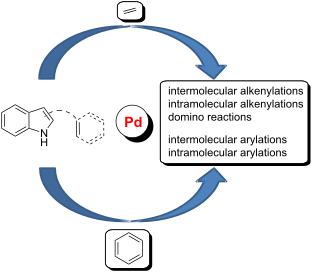
- transformations on the multiscale level paves the way to cheaper processes, resulting in minimal waste production and raising the possibility of application in multistep synthetic sequences. Many transition metals, including Pd, Au, Ru, Rh, Cu, and Pt, have been proven to be highly efficient for the formation of
- new bonds without prefunctionalized starting materials [4][5][6][7][8][9][10]. Among the transition metals suitable for this purpose, palladium plays a pivotal role due to its versatility in different synthetic protocols and tolerance towards many functional groups, often avoiding the need for

Graphical Abstract

Scheme 1: Typical catalytic cycle for Pd(II)-catalyzed alkenylation of indoles.

Scheme 2: Application of Fujiwara’s reaction to electron-rich heterocycles.

Scheme 3: Regioselective alkenylation of the unprotected indole.

Scheme 4: Plausible mechanism of the selective indole alkenylation, adapted from [49].

Scheme 5: Directing-group control in intermolecular indole alkenylation.

Scheme 6: Direct C–H alkenylation of N-(2-pyridyl)sulfonylindole.
Scheme 7: N-Prenylation of indoles with 2-methyl-2-butene.
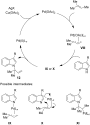
Scheme 8: Proposed mechanism of the N-indolyl prenylation.

Scheme 9: Regioselective arylation of indoles by dual C–H functionalization.

Scheme 10: Plausible mechanism of the selective indole arylation.

Scheme 11: Chemoselective cyclization of N-allyl-1H-indole-2-carboxamide derivatives.

Scheme 12: Intramolecular annulations of alkenylindoles.

Scheme 13: A mechanistic probe for intramolecular annulations of alkenylindoles, adapted from Ferreira et al. [66]....

Scheme 14: Asymmetric indole annulations catalyzed by chiral Pd(II) complexes.

Scheme 15: Aerobic Pd(II)-catalyzed endo cyclization and subsequent amide cleavage/ester formation.

Scheme 16: Synthesis of the pyrimido[3,4-a]indole skeleton by intramolecular C-2 alkenylation.

Scheme 17: Synthesis of azepinoindoles by oxidative Heck cyclization.

Scheme 18: Enantioselective synthesis of 4-vinyl-substituted tetrahydro-β-carbolines.

Scheme 19: Pd-catalyzed endo-cyclization of 3-alkenylindoles for the construction of carbazoles.

Scheme 20: Pd-catalyzed hydroamination of 2-indolyl allenamides.

Scheme 21: Amidation reaction of 1-allyl-2-indolecarboxamides.

Scheme 22: Intramolecular cyclization of N-benzoylindole.

Scheme 23: Intramolecular alkenylation/carboxylation of alkenylindoles.

Scheme 24: Intermolecular alkenylation/carboxylation of 2-substituted indoles.

Scheme 25: Mechanistic investigation of the cyclization/carboxylation reaction.

Scheme 26: Plausible catalytic cycle for the cyclization/carboxylation of alkenylindoles, adapted from Liu et ...

Scheme 27: Intramolecular domino reactions of indolylallylamides through alkenylation/halogenation or alkenyla...

Scheme 28: Proposed mechanism for the alkenylation/esterification process through iminium intermediates.

Scheme 29: Cyclization of 3-indolylallylcarboxamides involving 1,2-migration of the acyl group from spiro-inte...

Scheme 30: Domino reactions of 2-indolylallylcarboxamides involving N–H functionalization.

Scheme 31: Cyclization/acyloxylation reaction of 3-alkenylindoles.

Scheme 32: Doubly intramolecular C–H functionalization of a 2-indolylcarboxamide bearing two allylic groups.
Synthesis of conformationally restricted glutamate and glutamine derivatives from carbonylation of orthopalladated phenylglycine derivatives
- Esteban P. Urriolabeitia,
- Eduardo Laga and
- Carlos Cativiela
Beilstein J. Org. Chem. 2012, 8, 1569–1575, doi:10.3762/bjoc.8.179
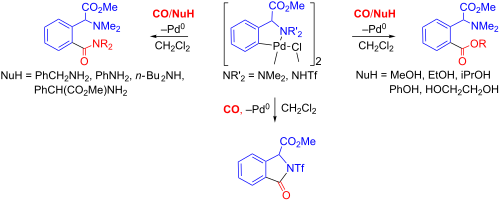
- selective functionalization of organic molecules is, at the present time, one of the most developed areas of organic and organometallic chemistry. Several factors have contributed to this spectacular growth. The main one is the use of transition metals, such as Rh, Ru, Pd, Pt or Au, with the capability of

Graphical Abstract

Scheme 1: Synthesis of methyl (1H)-isoindolin-1-one-3-carboxylates by carbonylation of phenylglycine derivati...

Scheme 2: Synthesis and NMR characterization of orthometallated complex 3.

Scheme 3: Carbonylation of 1 to afford glutamate and glutamine derivatives 2a–j.

Figure 1: Scope of the carbonylation reaction.

Scheme 4: Reaction of 1 and CO in CH2Cl2 [18].

Scheme 5: Reactivity of 3 with CO in the presence (left) and absence (right) of nucleophiles.
Metal–ligand multiple bonds as frustrated Lewis pairs for C–H functionalization
- Matthew T. Whited
Beilstein J. Org. Chem. 2012, 8, 1554–1563, doi:10.3762/bjoc.8.177
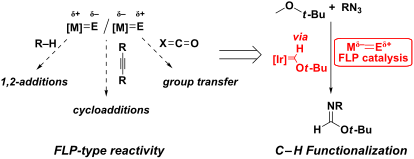
- number of unsaturated main-group compounds can exhibit electronic properties and reactivity reminiscent of transition metals [3]. A different approach was pioneered by Stephan, who demonstrated that appropriately encumbered (i.e., "frustrated") Lewis acids and bases could achieve synergistic heterolytic
- have extended the approach to include transition metals as Lewis acids and bases [7][8]. In this review, we show that the FLP concept may be extended to encompass certain metal–ligand multiply bonded species, provided that the metal retains an open coordination site to facilitate cooperative reactivity
- . Such complexes may activate various substrates through the combined action of filled and empty orbitals on adjacent atoms: a hybrid of the classical Dewar–Chatt–Duncanson paradigm and normal FLP reactivity [9][10]. M═E FLPs include two limiting scenarios: (1) early, electropositive transition metals in

Graphical Abstract

Scheme 1: Heterolytic cleavage of H2 by a phosphine/borane FLP by H2 polarization in the P–B cavity [5,11].

Scheme 2: Insertion of carbon dioxide into a phosphine/borane FLP [14].

Figure 1: Simplified frontier-molecular-orbital diagrams for (a) Mδ+═Eδ− and (b) Mδ−═Eδ+ FLPs (n = 1 for line...

Figure 2: Quenching of M═E FLPs by dimerization: (a) generic Mδ+═Eδ− case, and (b) Bergman's arylimido zircon...

Scheme 3: Oxygen-atom extrusion from CO2 by a Ta(V) neopentylidene [27].

Scheme 4: Oxygen-atom transfer from acetone at a Zr(IV) imide [28].

Scheme 5: Alkyne cycloaddition at a Zr(IV) imide [38].

Scheme 6: Nitrile-alkyne cross metathesis at a W(VI) nitride [40,41].

Scheme 7: C–H and H–H addition across a zirconium(IV) imide [42].

Scheme 8: Formal [2 + 2] cycloaddition of methyl isocyanate at a ruthenium silylene [58].

Scheme 9: Oxygen-atom transfer from phenyl isocyanate to a cationic terminal borylene [60].

Scheme 10: Coupling of a phosphorus ylide with an iridium methylene [62].

Scheme 11: Reactions of (PNP)Ir═C(H)Ot-Bu with oxygen-containing heterocumulenes [71].

Scheme 12: Reductive coupling of two CS2 units at (PNP)Ir═C(H)Ot-Bu [73].
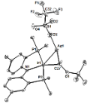
Figure 3: Single-crystal X-ray structure of a silver(I) triflate adduct of (PNP)Ir═C(H)Ot-Bu with most H atom...

Scheme 13: Possible routes to C–H functionalization by 1,2-addition across a polarized metal–element multiple ...

Scheme 14: Alkoxycarbene formation by double C–H activation at (PNP)Ir [88].

Scheme 15: Catalytic oxidation of MTBE by multiple C–H activations and nitrene-group transfer to a Mδ−═Eδ+ FLP ...
Highly enantioselective access to cannabinoid-type tricyles by organocatalytic Diels–Alder reactions
- Stefan Bräse,
- Nicole Volz,
- Franziska Gläser and
- Martin Nieger
Beilstein J. Org. Chem. 2012, 8, 1385–1392, doi:10.3762/bjoc.8.160
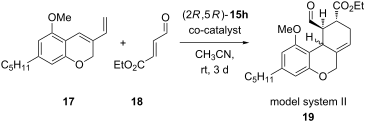
- metal-free, usually nontoxic, stable, moisture-insensitive, and often easy to obtain. Because of their inertness towards oxygen and moisture, the use of absolute solvents, inert atmosphere, low temperature, etc., is, in many instances, not required. Furthermore, due to the absence of transition metals

Graphical Abstract

Figure 1: An assortment of natural products synthesized by Diels–Alder reactions.

Figure 2: Intermediates towards the total synthesis of (−)-Δ9-tetrahydrocannabinol (4).

Scheme 1: Synthesis of thiourea catalysts 9a–l.

Scheme 2: Organocatalytic Diels–Alder reaction with thiourea-catalysis.

Figure 3: Formation of the iminium-ion.

Scheme 3: Synthesis of electron poor imidazolidinone catalysts.

Figure 4: Crystal structure of the side product from the reaction of 13.

Figure 5: Confirmation of the relative configuration with NOESY experiments and X-ray crystal structures of t...

Scheme 4: Co-catalyst screening.

Scheme 5: Screening of imidazolidinone catalysts 15.
Synthesis of new pyrrole–pyridine-based ligands using an in situ Suzuki coupling method
- Matthias Böttger,
- Björn Wiegmann,
- Steffen Schaumburg,
- Peter G. Jones,
- Wolfgang Kowalsky and
- Hans-Hermann Johannes
Beilstein J. Org. Chem. 2012, 8, 1037–1047, doi:10.3762/bjoc.8.116
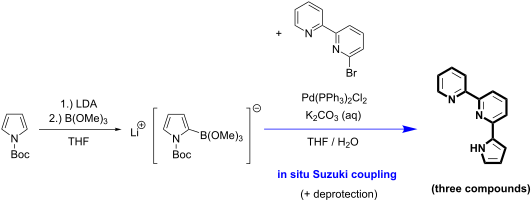
- of chemistry. The pyrrole–pyridine structural motif is featured in current studies, owing to its complexation properties towards first-row transition metals (Fe, Co, Ni, Cu, Zn) [18] and ruthenium [19]. The intramolecular proton transfer of these species is also of interest for vibrational

Graphical Abstract

Scheme 1: β-diketonate complexes (left), homoleptic complexes (middle) and planned homoleptic complexes of eu...

Scheme 2: Pyrrole–pyridine-based structures synthesized in this study.

Scheme 3: Retrosynthetic approach for structures 1–3.

Scheme 4: Synthesis of the heteroaryl bromides used in the coupling reaction.

Scheme 5: Generation of the borate intermediate 21/22.

Scheme 6: In situ Suzuki coupling reactions of the heteroaryl bromides 8–10.

Figure 1: The structure of compound 1 in the crystal. Ellipsoids correspond to 50% probability levels.

Figure 2: Packing diagram of compound 1, viewed parallel to the y-axis in the range y ≈ 1/4. Hydrogen bonds a...

Figure 3: The structure of compound 2·CH3OH in the crystal. Ellipsoids correspond to 50% probability levels. ...

Figure 4: Packing diagram of compound 2·CH3OH showing the formation of inversion-symmetric "stacked" dimers. ...

Figure 5: The structure of compound 3·C2H5OH in the crystal. Ellipsoids correspond to 50% probability levels....

Figure 6: Packing diagram of compound 3·C2H5OH. Hydrogen bonds are shown as thick dashed lines. Hydrogen atom...