
Search results
Search for "protecting groups" in Full Text gives 332 result(s) in Beilstein Journal of Organic Chemistry. Showing first 200.
Solution-phase automated synthesis of an α-amino aldehyde as a versatile intermediate
Beilstein J. Org. Chem. 2017, 13, 106–110, doi:10.3762/bjoc.13.13
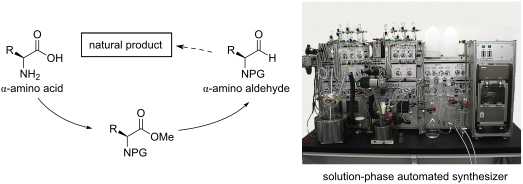
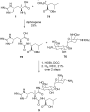
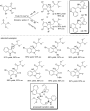
- synthesis of Garner’s aldehyde (4a) and its analogues. Results and Discussion Our synthetic route is shown in Scheme 1. We planned to synthesize 4a with various protecting groups from a commercially available amino ester through a three-step procedure utilizing the automated synthesizer, ChemKonzert (Figure


O-Alkylated heavy atom carbohydrate probes for protein X-ray crystallography: Studies towards the synthesis of methyl 2-O-methyl-L-selenofucopyranoside
Beilstein J. Org. Chem. 2016, 12, 2828–2833, doi:10.3762/bjoc.12.282

- observed. Therefore, the glycosylation of methyl selenol using the mixture of donors 9/10 was performed first. After Zemplén deprotection of the acetate protecting groups, separation of the unprotected pyranose/furanose isomers was achieved and seleno pyranosides 3 (3α/3β = 1:18, Scheme 2) as well as one


Orthogonal protection of saccharide polyols through solvent-free one-pot sequences based on regioselective silylations
Beilstein J. Org. Chem. 2016, 12, 2748–2756, doi:10.3762/bjoc.12.271
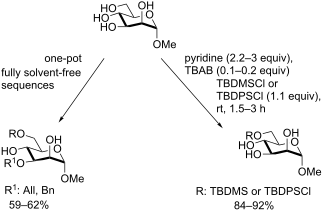
- Serena Traboni Emiliano Bedini Alfonso Iadonisi Department of Chemical Sciences, University of Naples Federico II, Via Cinthia 4, 80126, Naples, Italy 10.3762/bjoc.12.271 Abstract tert-Butyldimethylsilyl (TBDMS) and tert-butyldiphenylsilyl (TBDPS) are alcohol protecting groups widely employed in
- experimentally simple tool for the straightforward access to saccharide building-blocks useful in organic synthesis. Keywords: carbohydrates; one-pot synthesis; regioselective protection; silyl protecting group; solvent-free reaction; Introduction The application of an orthogonal set of protecting groups
- to a broad range of conditions and feasible removal under conditions compatible with many other used alcohol protecting groups [1][2][3]. For this reason, silyl protecting groups are often serving as temporary protecting groups with polyol and saccharide substrates. The most robust and adopted silyl


β-Amino functionalization of cinnamic Weinreb amides in ionic liquid
Beilstein J. Org. Chem. 2016, 12, 2372–2377, doi:10.3762/bjoc.12.231

- reaction conditions required for the removal of the N-protecting groups. With the aminochlorination developed in the past few years [31], we found that when the aminochlorination reactions of α,β-unsaturated ketones 3 were carried out in ionic liquid, [BMIM][NTf2] (1-n-butyl-3-methylimidazolium bis
- -protecting groups is relatively easier than those shown above; and 3) the ionic liquids are environmentally friendly and can be readily recycled. Results and Discussion The first attempt was to conduct the aminochlorination reaction of N-methoxy-N-methylcinnamoylamide (5a) in acetonitrile by using 2-NsNCl2
- achieved by the aminochlorination of α,β-unsaturated Weinreb amides. The new process has the advantages that the starting materials can be easily achieved and the N-protecting groups simply removed. Additionally, the reactions can be readily performed in the ionic liquid [BMIM][NTf2] at room temperature


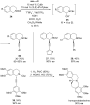
Useful access to enantiomerically pure protected inositols from carbohydrates: the aldohexos-5-uloses route
Beilstein J. Org. Chem. 2016, 12, 2343–2350, doi:10.3762/bjoc.12.227
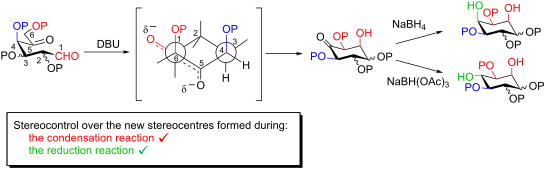
- precursors are employed as starting materials. As an example of application of the method, the indirect selective protection of secondary inositols’ hydroxy functions, by placing specific protecting groups on the aldohexos-5-ulose precursor has been presented. Keywords: aldohexos-5-uloses; inositols
- group (position 6). This 2,3,6-cis arrangement of the aldol products was observed irrespective to the stereochemistry of the other two positions (4 and 5), corresponding to the C-2 and C-3 of the parent dicarbonyl derivative. To determine the effect of additional protecting groups on the reaction, the
- stereoselectivity in accordance with the predicted stereo-outcome. In this way, the orthogonal protecting groups (allyl and naphthalenylmethyl) installed on aldohexos-5-ulose 20, differentiated the two 1,2-cis hydroxy couples (2,3 and 4,5 positions) of 22 which can be easily transformed further in a selective


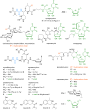
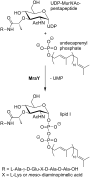
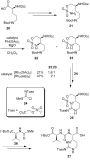
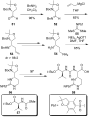
Enduracididine, a rare amino acid component of peptide antibiotics: Natural products and synthesis
Beilstein J. Org. Chem. 2016, 12, 2325–2342, doi:10.3762/bjoc.12.226
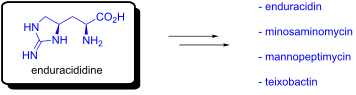
- -hydroxyenduracididine 52 using the same procedure. The new route proved more efficient than the previous report and provided access to both diastereomers suitably armed with orthogonal protecting groups. Synthesis of (±)-enduracididine and (±)-allo-enduracididine by Du Bois et al.: The synthesis of (±)-enduracididine
- protected linear precursor 115. Cleavage of the TBS and methyl ester protecting groups afforded seco-acid 116. However, during the hydrolysis step, two of the three Cbz groups were cleaved from the enduracididine residue, and the position of the remaining Cbz and CO2H could not be determined. It was decided
- that final deprotection of the remaining enduracididine protecting groups would take place after formation of the macrocycle. Treatment of linear precursor 116 with modified Shiina macrolactonisation conditions reported by Batey et al. [74] of 2-methyl-6-nitrobenzoic anhydride (MNBA), DMAP and Dy(OTf)3





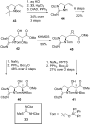
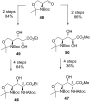


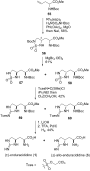

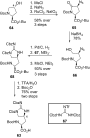




The direct oxidative diene cyclization and related reactions in natural product synthesis
Beilstein J. Org. Chem. 2016, 12, 2104–2123, doi:10.3762/bjoc.12.200
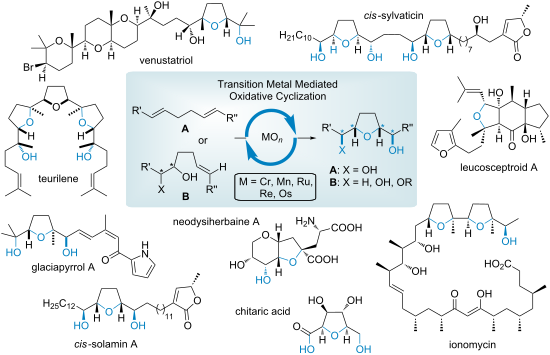
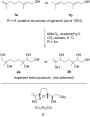
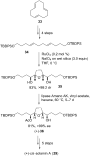
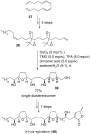
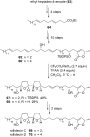
- protecting groups. The first total synthesis of membrarollin (62, Scheme 13) was finally disclosed by Brown and co-workers in 2009 [107]. Similarly starting from 1-dodecyne (56), triene system 61 was selectively oxidized using a permanganate-mediated oxidative cyclization affording two separable







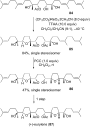


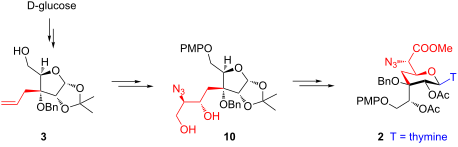
Synthesis of the C8’-epimeric thymine pyranosyl amino acid core of amipurimycin
Beilstein J. Org. Chem. 2016, 12, 1765–1771, doi:10.3762/bjoc.12.165
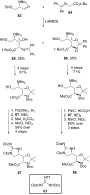
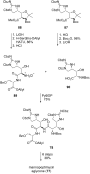
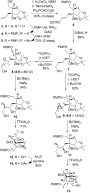
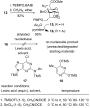
- including solvent, Lewis acid, and protecting groups on the nucleobase or sugar; we thought of synthesizing the peracylated anhydrosugar to alter its reactivity towards glycosylation [22]. In this regard, anhydrosugar 15 was subjected to 10% Pd/C and Et3SiH (for deprotection of the benzyl functionality and






Beta-hydroxyphosphonate ribonucleoside analogues derived from 4-substituted-1,2,3-triazoles as IMP/GMP mimics: synthesis and biological evaluation
Beilstein J. Org. Chem. 2016, 12, 1476–1486, doi:10.3762/bjoc.12.144
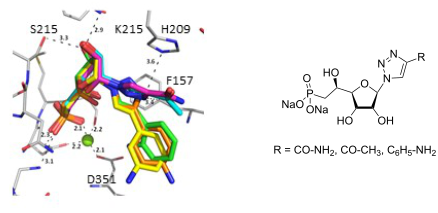
- -protected nucleotides 3a–o (Scheme 2) in moderate to good yields. Removal of the sugar protecting groups (acetyl and benzoyl) in basic conditions resulted in the formation of the nucleotides 4a–q (Scheme 2), which were then treated by trimethylsilyl bromide (TMSBr) to generate the corresponding phosphonic
- water and extracted with EtOAc, the organic layers were combined and dried over with MgSO4 and concentrated under reduced pressure. The crude material was purified by flash chromatography (CH2Cl2/EtOAc) to give the desired product. General procedure D for removal of sugar protecting groups: The


Automated glycan assembly of a S. pneumoniae serotype 3 CPS antigen
Beilstein J. Org. Chem. 2016, 12, 1440–1446, doi:10.3762/bjoc.12.139
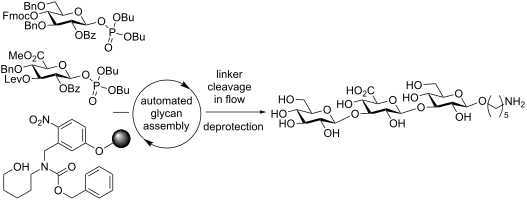
- step with the activator prior to each glycosylation cycle greatly increased the yields by neutralizing any residual base from deprotection steps in the synthetic cycle. This process improvement is applicable to AGA of many other oligosaccharides. Keywords: automation; glycosylation; protecting groups


Conjugate addition–enantioselective protonation reactions
Beilstein J. Org. Chem. 2016, 12, 1203–1228, doi:10.3762/bjoc.12.116
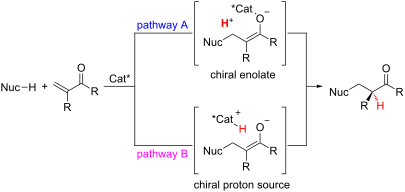
- led to low conversion. The use of potassium tert-butoxide was found to be essential to achieve good reactivity and enantioselectivity. Other amino-protecting groups (Boc, phthalimido) or tertiary N-methylated variants rendered the 1,4-acceptor unreactive. Glorius and co-workers proposed that an




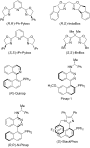
NeoPHOX – a structurally tunable ligand system for asymmetric catalysis
Beilstein J. Org. Chem. 2016, 12, 1185–1195, doi:10.3762/bjoc.12.114
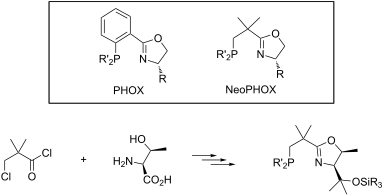
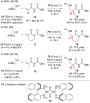
- determined by X-ray diffraction and compared with known phosphinooxazoline complexes. We were interested to see whether the differences in steric shielding of the coordination sphere by the protecting groups on the tertiary alcohol function correlated with the hydrogenation results. From the obtained crystal


Chiral cyclopentadienylruthenium sulfoxide catalysts for asymmetric redox bicycloisomerization
Beilstein J. Org. Chem. 2016, 12, 1136–1152, doi:10.3762/bjoc.12.110
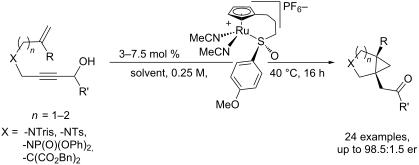
- reaction for the synthesis of Tris-protected [3.1.0] pyrrolidines, it occurred to us that protecting groups other than Tris may be equally effective for the [3.1.0] system. The Tris group was chosen during our optimization of the six-membered ring system (Table 5), which may have significantly different




Catalytic asymmetric synthesis of biologically important 3-hydroxyoxindoles: an update
Beilstein J. Org. Chem. 2016, 12, 1000–1039, doi:10.3762/bjoc.12.98
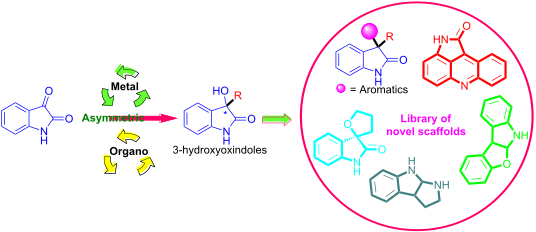
- (Scheme 1) [14]. 3-Allyl-3-hydroxyoxindoles were obtained in 89–98% yield and with 32–86% ee when the reactions were carried out at −60 °C using 5 mol % of CNN pincer Pd complex (cat. 1). Substituents attached to the isatin aromatic ring and N-protecting groups were important in controlling the




One-pot synthesis of enantiomerically pure N-protected allylic amines from N-protected α-amino esters
Beilstein J. Org. Chem. 2016, 12, 957–962, doi:10.3762/bjoc.12.94
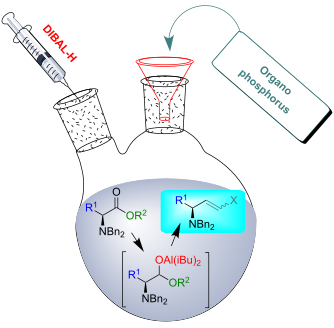
- is remarkable that this protocol avoids using O-protecting groups or the Garner aldehyde which have been used extensively in the synthesis of related compounds. Conclusion In summary, this simple protocol described herein enables a rapid access to a number of useful enantiopure allylic amines from


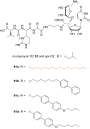
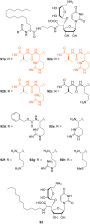
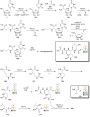
Muraymycin nucleoside-peptide antibiotics: uridine-derived natural products as lead structures for the development of novel antibacterial agents
Beilstein J. Org. Chem. 2016, 12, 769–795, doi:10.3762/bjoc.12.77
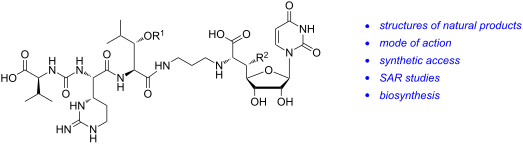
- guanidinylation reagent 55. With the protected epicapreomycidine precursor 56 in hand, the Boc and acetonide protecting groups were removed. Urea formation with the valine derivative 57 with final oxidation of the primary hydroxy function afforded the desired dipeptide 58 [78] (Scheme 7). Furthermore, Ducho et al
- (5'S)-configuration, contrary to the results of MIC value determination. Further studies were then carried out with (5'R)-derivatives only, i.e., with 5'-epimers of the parent natural products. The influence of protecting groups was examined applying a strategy of stepwise deprotection. This led to













Synthesis and in vitro cytotoxicity of acetylated 3-fluoro, 4-fluoro and 3,4-difluoro analogs of D-glucosamine and D-galactosamine
Beilstein J. Org. Chem. 2016, 12, 750–759, doi:10.3762/bjoc.12.75
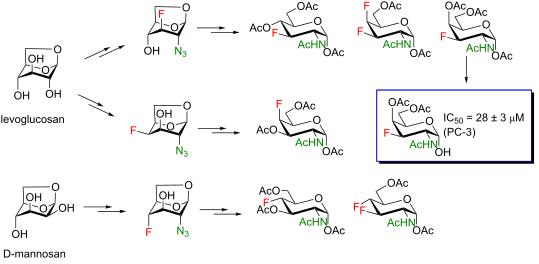
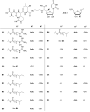
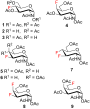
- -anhydrohexopyranoses were then converted into the target fluoro analogs of D-glucosamine and D-galactosamine (Scheme 1). Dual protection of the anomeric and primary hydroxy groups in the form of the 1,6-anhydro bridge reduced the number of protecting groups, and the rigid bicyclic skeleton of 1,6-anhydrohexopyranoses





Iridium/N-heterocyclic carbene-catalyzed C–H borylation of arenes by diisopropylaminoborane
Beilstein J. Org. Chem. 2016, 12, 654–661, doi:10.3762/bjoc.12.65

- derivatives by treatment with protecting groups in a one-pot reaction sequence. The reactivity of 1g has previously been well-exploited in catalytic borylation of aryl halides [22][23][24][25][26][27]. Herein, we report the C–H borylation of arenes using 1g catalyzed by an Ir/N-heterocyclic carbene (NHC
- ) complex bearing an ICy ligand was the most efficient catalyst. The initially formed aminoborylated products can readily be converted to the corresponding organoboron compounds bearing various boron-protecting groups. Experimental Procedure for the Ir-catalyzed borylation of heteroarenes using 1g In a


Studies on the synthesis of peptides containing dehydrovaline and dehydroisoleucine based on copper-mediated enamide formation
Beilstein J. Org. Chem. 2016, 12, 564–570, doi:10.3762/bjoc.12.55
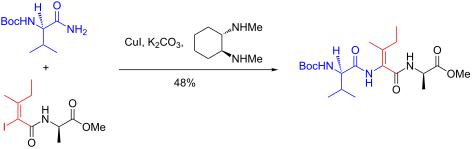
- total synthesis when the guanidine group has either to be liberated by the removal of the protecting groups or used for the introduction to the corresponding ornithine residue. These results demonstrate that the copper-mediated cross-coupling reaction depends on the functional groups present in the
- peptide containing the vinyl iodide moiety and on the chosen protecting groups. Vinyl iodides bearing an arginine moiety gave a significantly reduced yield of the desired cross-coupling product compared to the corresponding ornithine derivatives. Furthermore, it turned out that the Alloc and Pbf
- protecting groups are not compatible for this enamide forming protocol. The best results were obtained by using the Boc-protected amide 30 and ornithine-containing vinyl iodides 24 and 28 (Scheme 5). It needs to be noted that the presence of a Cbz protecting group in dehydrooligopeptides is problematic



A selective and mild glycosylation method of natural phenolic alcohols
Beilstein J. Org. Chem. 2016, 12, 524–530, doi:10.3762/bjoc.12.51
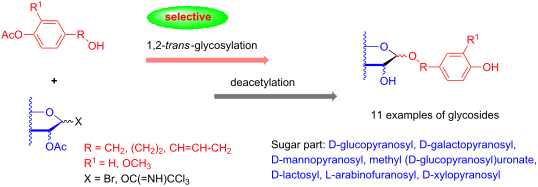
- Acetyl-protecting groups are the simplest choice also for the protection of the glycone part since the deprotection of both, sugar and aromatic moieties, can be accomplished in one step. Naturally occurring O-glycosides possess mostly 1,2-trans-glycosidic linkages. Therefore, neighbouring group


Diastereoselective synthesis of new O-alkylated and C-branched inositols and their corresponding fluoro analogues
Beilstein J. Org. Chem. 2016, 12, 353–361, doi:10.3762/bjoc.12.39
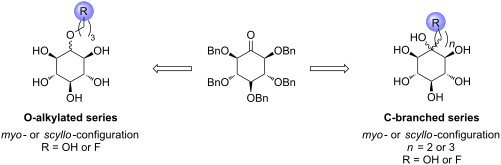
- case of the O-alkylated inositols a three carbon arm was envisioned whereas for the C-branched derivatives two and three carbon atom arms were used. For the fluorinated inositols, we developed a synthetic route with easily removing protecting groups, as acetates, suitable for PET imaging application
- the access to myo-10 and scyllo-10 in 78% and 75% yield, respectively. The O-alkylated inositol derivatives myo-1 and scyllo-1 were obtained quantitatively by removing of the benzyl protecting groups of compounds myo-10 and scyllo-10 by hydrogenation under pressure [45] using palladium hydroxide as
- and 92% yield, respectively [48]. All protecting groups of myo-13 and scyllo-13 were removed by the treatment with Na0 in MeOH [49], which gave quantitatively the fully deprotected fluorinated O-alkylated inositols myo-2 and scyllo-2. Synthesis of C-branched myo- and scyllo-inositol derivatives


Study on the synthesis of the cyclopenta[f]indole core of raputindole A
Beilstein J. Org. Chem. 2016, 12, 334–342, doi:10.3762/bjoc.12.36

- the use of Boc-protecting groups. Reduction of 6-iodoindole with NaBH3CN in HOAc afforded 6-iodoindoline (38, 90%) [47], which was subsequently TIPS-protected (39, Scheme 6). Hydroxyalkylation of 39 with β-cyclocitral (30) gave cyclization precursor 40 (68%). We were pleased to find that this time the




Application of 7-azaisatins in enantioselective Morita–Baylis–Hillman reaction
Beilstein J. Org. Chem. 2016, 12, 309–313, doi:10.3762/bjoc.12.33
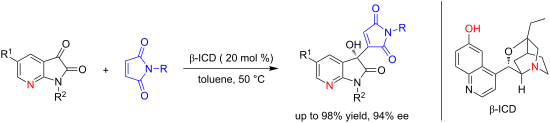
- enantioselectivity was observed for products 3h and 3i (Table 2, entries 8 and 9). 7-Azaisatins with different N-protecting groups were also applied to the MBH reaction with N-phenylmaleimide (2a), including methoxymethyl (MOM), benzyl (Bn) and 4-chlorophenyl substituents. All of them showed a lower reactivity and


Amino-functionalized (meth)acryl polymers by use of a solvent-polarity sensitive protecting group (Br-t-BOC)
Beilstein J. Org. Chem. 2016, 12, 245–252, doi:10.3762/bjoc.12.26
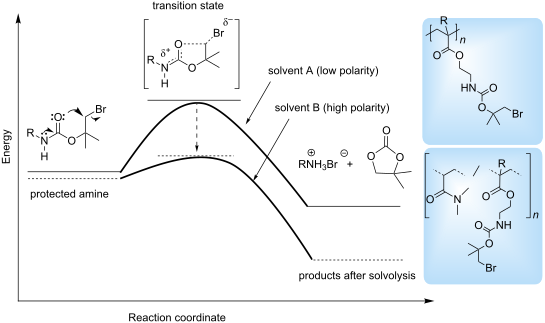
- )acrylates [2]. Therefore, for the synthesis of amino-containing (meth)acrylic monomers and polymers suitable amino-protecting groups are required. Classical protecting groups such as ammonium salts, F-MOC, Z- or t-BOC, respectively are readily available. Regarding to this aspect, we published some papers
- about polymer protecting groups about three decades ago [3][4][5][6][7]. However, they are limited in application by certain restrictions on the deprotection conditions. Therefore, there is a continued interest in developing new protecting groups which can be cleaved by different mechanisms. Keeping


Enantioselective additions of copper acetylides to cyclic iminium and oxocarbenium ions
Beilstein J. Org. Chem. 2015, 11, 2696–2706, doi:10.3762/bjoc.11.290
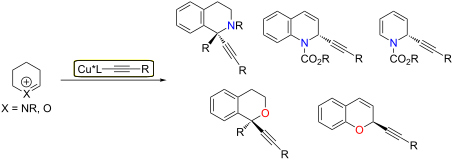
- , particularly for iminium ions, progress is on-going to determine stable precursors to the requisite iminium ion intermediates and to identify readily removed protecting groups. Given the potential of enantioselective, copper-catalyzed alkynylations to deliver important scaffolds, significant effort is still