
Search for "photoredox" in Full Text gives 182 result(s) in Beilstein Journal of Organic Chemistry.
Beilstein J. Org. Chem. 2014, 10, 163–193, doi:10.3762/bjoc.10.14
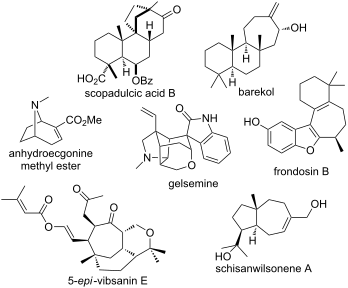
Graphical Abstract
Scheme 1: Vogel’s first approach towards the divinylcyclopropane rearrangement [4] and characterization of cis-d...
Scheme 2: Transition states for the Cope rearrangement and the related DVCPR. Ts = transition state.
Scheme 3: Two possible mechanisms of trans-cis isomerizations of divinylcyclopropanes.
Scheme 4: Proposed biosynthesic pathway to ectocarpene (21), an inactive degradation product of a sexual pher...
Scheme 5: Proposed biosynthesis of occidenol (25) and related natural compounds.
Scheme 6: Gaich’s bioinspired system using the DVCPR to mimick the dimethylallyltryptophan synthase. DMAPP = ...
Scheme 7: Iguchi’s total synthesis of clavubicyclone, part 1.
Scheme 8: Iguchi’s total synthesis of clavubicyclone, part 2.
Scheme 9: Wender’s syntheses of the two pseudoguainanes confertin (50) and damsinic acid (51) and Pier’s appr...
Scheme 10: Overman’s total synthesis of scopadulcic acid B.
Scheme 11: Davies’ total syntheses of tremulenolide A and tremulenediol A.
Scheme 12: Davies formal [4 + 3] cycloaddition approach towards the formal synthesis of frondosin B.
Scheme 13: Davies and Sarpongs formal [4 + 3]-cycloaddition approach towards barekoxide (106) and barekol (107...
Scheme 14: Davies formal [4 + 3]-cycloaddition approach to 5-epi-vibsanin E (115) containing an intermediate c...
Scheme 15: Echavarren’s total synthesis of schisanwilsonene A (126) featuring an impressive gold-catalzed casc...
Scheme 16: Davies early example of a formal [4 + 3]-cycloaddition in alkaloids synthesis.
Scheme 17: Fukuyama’s total synthesis of gelsemine, part 1.
Scheme 18: Fukuyama’s total synthesis of gelsemine, featuring a divinylcyclopropane rearrangement, part 2.
Scheme 19: Kende’s total synthesis of isostemofoline, using a formal [4 + 3]-cycloaddition, including an inter...
Scheme 20: Danishefsky’s total synthesis of gelsemine, part 1.
Scheme 21: Danishefsky’s total synthesis of gelsemine, part 2.
Scheme 22: Fukuyama’s total synthesis of gelsemoxonine.
Scheme 23: Wender’s synthetic access to the core skeleton of tiglianes, daphnanes and ingenanes.
Scheme 24: Davies’ approach towards the core skeleton of CP-263,114 (212).
Scheme 25: Wood’s approach towards actinophyllic acid.
Scheme 26: Takeda’s approach towards the skeleton of the cyanthins, utilitizing the divinylcyclopropane rearra...
Scheme 27: Donaldson’s organoiron route towards the guianolide skeleton.
Scheme 28: Stoltz’s tandem Wolff/DVCPR rearrangement.
Scheme 29: Stephenson’s tandem photocatalysis/arylvinylcyclopropane rearrangement.
Scheme 30: Padwa’s rhodium cascade involving a DVCPR.
Scheme 31: Matsubara’s version of a DVCPR.
Scheme 32: Toste’s tandem gold-catalyzed Claisen-rearrangement/DVCPR.
Scheme 33: Ruthenium- and gold-catalyzed versions of tandem reactions involving a DVCPR.
Scheme 34: Tungsten, platinum and gold catalysed cycloisomerizations leading to a DVCPR.
Scheme 35: Reisman’s total synthesis of salvileucalin B, featuring an (undesired) vinylcyclopropyl carbaldehyd...
Scheme 36: Studies on the divinylepoxide rearrangement.
Scheme 37: Studies on the vinylcyclopropanecarbonyl rearrangement.
Scheme 38: Nitrogen-substituted variants of the divinylcyclopropane rearrangement.
Beilstein J. Org. Chem. 2013, 9, 2778–2780, doi:10.3762/bjoc.9.312
Beilstein J. Org. Chem. 2013, 9, 2586–2614, doi:10.3762/bjoc.9.294
Graphical Abstract
Figure 1: Elementary steps in the gold-catalyzed nucleophilic addition to olefins.
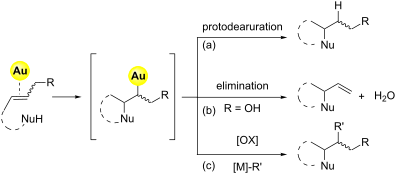
Figure 2: Different approaches for the gold-catalyzed manipulation of inactivated alkenes.
Figure 3: Computed mechanistic cycle for the gold-catalyzed alkoxylation of ethylene with PhOH.
Scheme 1: [Au(I)]-catalyzed addition of phenols and carboxylic acids to alkenes.
Scheme 2: [Au(III)] catalyzed annulations of phenols and naphthols with dienes.
Scheme 3: [Au(III)]-catalyzed addition of aliphatic alcohols to alkenes.
Scheme 4: [Au(III)]-catalyzed carboalkoxylation of alkenes with dimethyl acetals 6.
Figure 4: Postulated mechanism for the [Au(I)]-catalyzed hydroamination of olefins.
Scheme 5: Isolation and reactivity of alkyl gold intermediates in the intramolecular hydroamination of alkene...
Scheme 6: [Au(I)]-catalyzed intermolecular hydroamination of dienes.
Scheme 7: Intramolecular [Au(I)]-catalyzed hydroamination of alkenes with carbamates.
Scheme 8: [Au(I)]-catalyzed inter- as well as intramolecular addition of sulfonamides to isolated alkenes.
Scheme 9: Intramolecular hydroamination of N-alkenylureas catalyzed by gold(I) carbene complex.
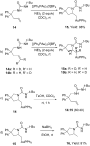
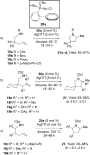
Scheme 10: Enantioselective hydroamination of alkenyl ureas with biphenyl tropos ligand and chiral silver phos...
Scheme 11: Intramolecular [Au(I)]-catalyzed hydroamination of N-allyl-N’-aryl ureas. (PNP = pNO2-C6H4, PMP = p...
Scheme 12: [Au(I)]-catalyzed hydroamination of alkenes with ammonium salts.
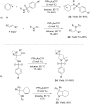
Scheme 13: Enantioselective [Au(I)]-catalyzed intermolecular hydroamination of alkenes with cyclic ureas.
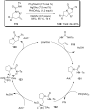
Scheme 14: Mechanistic proposal for the cooperative [Au(I)]/menthol catalysis for the enantioselective intramo...
Scheme 15: [Au(III)]-catalyzed addition of 1,3-diketones to alkenes.
Scheme 16: [Au(I)]-catalyzed intramolecular addition of β-keto amides to alkenes.
Scheme 17: Intermolecular [Au(I)]-catalyzed addition of indoles to alkenes.
Scheme 18: Intermolecular [Au(III)]-catalyzed hydroarylation of alkenes with benzene derivatives and thiophene....
Scheme 19: a) Intramolecular [Au(III)]-catalyzed hydroarylation of alkenes. b) A SEAr-type mechanism was hypot...
Scheme 20: Intramolecular [Au(I)]-catalyzed hydroalkylation of alkenes with simple ketones.
Scheme 21: Proposed reaction mechanism for the intramolecular [Au(I)]-catalyzed hydroalkylation of alkenes wit...
Scheme 22: Tandem Michael addition/hydroalkylation catalyzed by [Au(I)] and [Ag(I)] salts.
Scheme 23: Intramolecular [Au(I)]-catalyzed tandem migration/[2 + 2] cycloaddition of 1,7-enyne benzoates.
Scheme 24: Intramolecular [Au(I)]-catalyzed cyclopropanation of alkenes.
Scheme 25: Stereospecificity in [Au(I)]-catalyzed hydroalkoxylation of allylic alcohols.
Scheme 26: Mechanistic investigation on the intramolecular [Au(I)]-catalyzed hydroalkoxylation of allylic alco...
Scheme 27: Mechanistic investigation on the intramolecular enantioselective [Au(I)]-catalyzed alkylation of in...
Scheme 28: Synthesis of (+)-isoaltholactone via stereospecific intramolecular [Au(I)]-catalyzed alkoxylation o...
Scheme 29: Intramolecular enantioselective dehydrative amination of allylic alcohols catalyzed by chiral [Au(I...
Scheme 30: Enantioselective intramolecular hydroalkylation of allylic alcohols with aldehydes catalyzed by 20c...
Scheme 31: Gold-catalyzed intramolecular diamination of alkenes.
Scheme 32: Gold-catalyzed aminooxygenation and aminoarylation of alkenes.
Scheme 33: Gold-catalyzed carboamination, carboalkoxylation and carbolactonization of terminal alkenes with ar...
Scheme 34: Synthesis of tricyclic indolines via gold-catalyzed formal [3 + 2] cycloaddition.
Scheme 35: Gold(I) catalyzed aminoarylation of terminal alkenes in presence of Selectfluor [dppm = bis(dipheny...
Scheme 36: Mechanistic investigation on the aminoarylation of terminal alkenes by bimetallic gold(I) catalysis...
Scheme 37: Proposed mechanism for the aminoarylation of alkenes via [Au(I)-Au(I)]/[Au(II)-Au(II)] redox cataly...
Scheme 38: Oxyarylation of terminal olefins via redox gold catalysis.
Scheme 39: a) Intramolecular gold-catalyzed oxidative coupling reactions with aryltrimethylsilanes. b) Oxyaryl...
Scheme 40: Oxy- and amino-arylation of alkenes by [Au(I)]/[Au(III)] photoredox catalysis.
Beilstein J. Org. Chem. 2013, 9, 2476–2536, doi:10.3762/bjoc.9.287
Graphical Abstract
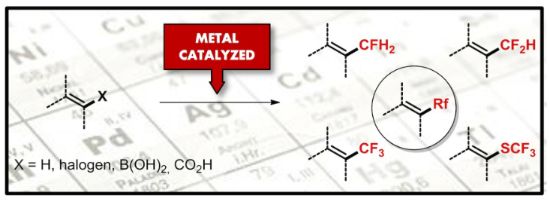
Scheme 1: Pd-catalyzed monofluoromethylation of pinacol phenylboronate [44].
Scheme 2: Cu-catalyzed monofluoromethylation with 2-PySO2CHFCOR followed by desulfonylation [49].
Scheme 3: Cu-catalyzed difluoromethylation with α-silyldifluoroacetates [57].
Figure 1: Mechanism of the Cu-catalyzed C–CHF2 bond formation of α,β-unsaturated carboxylic acids through dec...
Scheme 4: Fe-catalyzed decarboxylative difluoromethylation of cinnamic acids [62].
Scheme 5: Preliminary experiments for investigation of the mechanism of the C–H trifluoromethylation of N-ary...
Figure 2: Plausible catalytic cycle proposed by Z.-J. Shi et al. for the trifluoromethylation of acetanilides ...
Figure 3: Plausible catalytic cycle proposed by M. S. Sanford et al. for the perfluoroalkylation of simple ar...
Figure 4: Postulated reaction pathway for the Ag/Cu-catalyzed trifluoromethylation of aryl iodides by Z. Q. W...
Figure 5: Postulated reaction mechanism for Cu-catalyzed trifluoromethylation reaction using MTFA as trifluor...
Scheme 6: Formal Heck-type trifluoromethylation of vinyl(het)arenes by M. Sodeoka et al. [83].
Figure 6: Proposed catalytic cycle for the copper-catalyzed trifluoromethylation of (het)arenes in presence o...
Figure 7: Proposed catalytic cycle for the copper-catalyzed trifluoromethylation of N,N-disubstituted (hetero...
Figure 8: Proposed catalytic cycle by Y. Zhang and J. Wang et al. for the copper-catalyzed trifluoromethylati...
Figure 9: Mechanistic rationale for the trifluoromethylation of arenes in presence of Langlois’s reagent and ...
Scheme 7: Trifluoromethylation of 4-acetylpyridine with Langlois’s reagent by P. S. Baran et al. (* Stirring ...
Scheme 8: Catalytic copper-facilitated perfluorobutylation of benzene with C4F9I and benzoyl peroxide [90].
Figure 10: F.-L. Qing et al.’s proposed mechanism for the copper-catalyzed trifluoromethylation of (hetero)are...
Figure 11: Mechanism of the Cu-catalyzed/Ru-photocatalyzed trifluoromethylation and perfluoroalkylation of ary...
Figure 12: Proposed mechanism for the Cu-catalyzed trifluoromethylation of aryl- and vinyl boronic acids with ...
Figure 13: Possible mechanism for the Cu-catalyzed decarboxylative trifluoromethylation of cinnamic acids [62].
Scheme 9: Ruthenium-catalyzed perfluoroalkylation of alkenes and (hetero)arenes with perfluoroalkylsulfonyl c...
Figure 14: N. Kamigata et al.’s proposed mechanism for the Ru-catalyzed perfluoroalkylation of alkenes and (he...
Figure 15: Proposed mechanism for the Ru-catalyzed photoredox trifluoromethylation of (hetero)arenes with trif...
Figure 16: Late-stage trifluoromethylation of pharmaceutically relevant molecules with trifluoromethanesulfony...
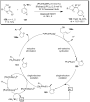
Figure 17: Proposed mechanism for the trifluoromethylation of alkenes with trifluoromethyl iodide under Ru-bas...
Scheme 10: Formal perfluoroakylation of terminal alkenes by Ru-catalyzed cross-metathesis with perfluoroalkyle...
Figure 18: One-pot Ir-catalyzed borylation/Cu-catalyzed trifluoromethylation of complex small molecules by Q. ...
Figure 19: Mechanistic proposal for the Ni-catalyzed perfluoroalkylation of arenes and heteroarenes with perfl...
Scheme 11: Electrochemical Ni-catalyzed perfluoroalkylation of 2-phenylpyridine (Y. H. Budnikova et al.) [71].
Scheme 12: Fe(II)-catalyzed trifluoromethylation of arenes and heteroarenes with trifluoromethyl iodide (T. Ya...
Figure 20: Mechanistic proposal by T. Yamakawa et al. for the Fe(II)-catalyzed trifluoromethylation of arenes ...
Scheme 13: Ytterbium-catalyzed perfluoroalkylation of dihydropyran with perfluoroalkyl iodide (Y. Ding et al.) ...
Figure 21: Mechanistic proposal by A. Togni et al. for the rhenium-catalyzed trifluoromethylation of arenes an...
Figure 22: Mechanism of the Cu-catalyzed oxidative trifluoromethylthiolation of arylboronic acids with TMSCF3 ...
Scheme 14: Removal of the 8-aminoquinoline auxiliary [136].
Figure 23: Mechanism of the Cu-catalyzed trifluoromethylthiolation of C–H bonds with a trifluoromethanesulfony...
Beilstein J. Org. Chem. 2013, 9, 2189–2193, doi:10.3762/bjoc.9.257
Graphical Abstract
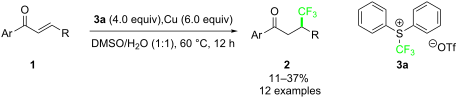
Scheme 1: Trifluoromethylation of α,β-unsaturated ketones.
Scheme 2: Proposed mechanism for the conjugate trifluoromethylation of α,β-unsaturated ketones by S-(trifluor...
Beilstein J. Org. Chem. 2013, 9, 1977–2001, doi:10.3762/bjoc.9.234
Graphical Abstract
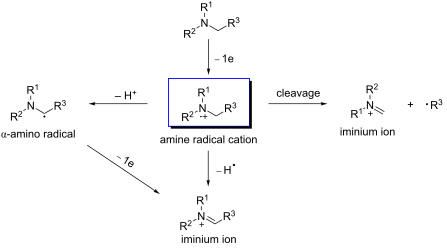
Scheme 1: Amine radical cations’ mode of reactivity.
Scheme 2: Reductive quenching of photoexcited Ru complexes by Et3N.
Scheme 3: Photoredox aza-Henry reaction.
Scheme 4: Formation of iminium ions using BrCCl3 as stoichiometric oxidant.
Scheme 5: Oxidative functionalization of N-aryltetrahydroisoquinolines using Eosin Y.
Scheme 6: Synthetic and mechanistic studies of Eosin Y-catalyzed aza-Henry reaction.
Scheme 7: Oxidative functionalization of N-aryltetrahydroisoquinolines using RB and GO.
Scheme 8: Merging Ru-based photoredox catalysis and Lewis base catalysis for the Mannich reaction.
Scheme 9: Merging Au-based photoredox catalysis and Lewis base catalysis for the Mannich reaction.
Scheme 10: Merging Ru-based photoredox catalysis and Cu-catalyzed alkynylation reaction.
Scheme 11: Merging Ru-based photoredox catalysis and NHC catalysis.
Scheme 12: 1,3-Dipolar cycloaddition of photogenically formed azomethine ylides.
Scheme 13: Plausible mechanism for photoredox 1,3-dipolar cycloaddition.
Scheme 14: Photoredox-catalyzed cascade reaction for the synthesis of fused isoxazolidines.
Scheme 15: Plausible mechanism for the photoredox-catalyzed cascade reaction.
Scheme 16: Photoredox-catalyzed α-arylation of glycine derivatives.
Scheme 17: Photoredox-catalyzed α-arylation of amides.
Scheme 18: Intramolecular interception of iminium ions by sulfonamides.
Scheme 19: Intramolecular interception of iminium ions by alcohols and sulfonamides.
Scheme 20: Intermolecular interception of iminium ions by phosphites.
Scheme 21: Photoredox-catalyzed oxidative phosphonylation by Eosin Y.
Scheme 22: Conjugated addition of α-amino radicals to Michael acceptors.
Scheme 23: Conjugated addition of α-amino radicals to Michael acceptors assisted by a Brønsted acid.
Scheme 24: Conjugated addition of α-amino radicals derived from anilines to Michael acceptors.
Scheme 25: Oxygen switch between two pathways involving α-amino radicals.
Scheme 26: Interception of α-amino radicals by azodicarboxylates.
Scheme 27: α-Arylation of amines.
Scheme 28: Plausible mechanism for α-arylation of amines.
Scheme 29: Photoinduced C–C bond cleavage of tertiary amines.
Scheme 30: Photoredox cleavage of C–C bonds of 1,2-diamines.
Scheme 31: Proposed mechanism photoredox cleavage of C–C bonds.
Scheme 32: Intermolecular [3 + 2] annulation of cyclopropylamines with olefins.
Scheme 33: Proposed mechanism for intermolecular [3 + 2] annulation.
Scheme 34: Photoinduced clevage of N–N bonds of aromatic hydrazines and hydrazides.
Beilstein J. Org. Chem. 2012, 8, 2025–2052, doi:10.3762/bjoc.8.229
Graphical Abstract
Figure 1: An immersion-well batch reactor with 125 W medium pressure Hg lamp.
Figure 2: Transmission profile of a 0.05 M solution, ε = 200 M−1 cm−1.
Figure 3: Schematic of a typical microflow photochemical reactor (above) and detail of a triple-channel micro...
Figure 4: Schematic of a typical macroflow photochemical reactor (above) and images of the FEP photochemical ...
Scheme 1: [2 + 2] photocycloadditions of enones with enol derivatives.
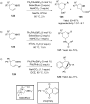
Scheme 2: Competing reactions in an intramolecular [2 + 2] photocycloaddition.
Scheme 3: Diastereocontrolled cycloaddition of a cyclic enone with cyclopentene.
Scheme 4: Comparison of yields and reaction times for a batch reactor with a microflow system.
Scheme 5: Intramolecular [2 + 2] photocycloaddition.
Scheme 6: Paterno–Büchi reaction of benzophenone with an allylic alcohol.
Scheme 7: Photooxygenation of cyclopentadiene.
Scheme 8: Preparation of the anthelmintic ascaridole 23.
Scheme 9: Production of rose oxide 27 from (−)-β-citronellol (24).
Scheme 10: Photocatalytic alkylation of benzylamine.
Scheme 11: Photocatalytic reduction of 4-nitroacetophenone.
Scheme 12: Conversion of L-lysine to L-pipecolinic acid.
Scheme 13: Photocatalytic hydrodehalogenation.
Scheme 14: Photocatalytic aza-Henry reactions.
Scheme 15: Photocatalytic α-alkylation of aliphatic ketones.
Scheme 16: Decarboxylative photochemical additions.
Scheme 17: Photochemical addition of isopropanol to furanones.
Scheme 18: Photochemical addition of methanol to limonene.
Scheme 19: Light-promoted reduction of flavone.
Scheme 20: Photoreduction of benzophenone with benzhydrol.
Scheme 21: Barton reaction in a microflow system.
Scheme 22: Microflow synthesis of vitamin D3.
Scheme 23: photochemical chlorination of cyclohexane.
Scheme 24: photochemical cyanation of pyrene.
Scheme 25: Intermolecular [2 + 2] cycloaddition of maleimide (76) and intramolecular [2 + 2] cycloaddition of ...
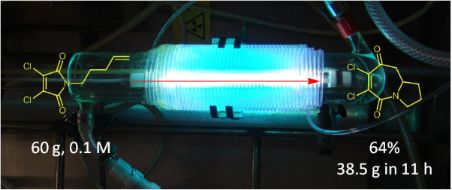
Scheme 26: Intramolecular [5 + 2] cycloaddition of maleimide under flow conditions.
Scheme 27: Intramolecular [5 + 2] cycloaddition as a key step in the synthesis of (±)-neostenine.
Scheme 28: In situ generation of a thioaldehyde by photolysis of a phenacyl sulfide.
Scheme 29: Photodimerisation of maleic anhydride.
Scheme 30: [2 + 2] cycloaddition of a chiral enone with ethylene.
Scheme 31: Intramolecular [2 + 2] cycloaddition of a cyclopentenone.
Scheme 32: Photochemical Wolff rearrangement and cyclisation to β-lactams.
Scheme 33: Photochemical rearrangement of aryl azides.
Scheme 34: Rearrangement of quinoline N-oxides to quinolones.
Scheme 35: Photochemical rearrangement of cyclobutenones.
Scheme 36: Photoisomerisation en route to a vitamin-D derivative.
Scheme 37: Schematic of the Seeberger photooxygenation apparatus and sensitised photooxygenation of citronello...
Scheme 38: Sensitised photooxygenation of dihydroartemisinic acid.
Scheme 39: Photochemical preparation of CpRu(MeCN)3PF6.
Scheme 40: In situ photochemical generation and reaction of a [CpRu]+ catalyst.
Scheme 41: Intermolecular alkene–alkyne coupling with photogenerated catalyst.
Scheme 42: PET deoxygenation of nucleosides.
Scheme 43: Photochemical defluorination of DABFT.
Scheme 44: Aromatic azide reduction by visible-light-mediated photocatalysis.
Scheme 45: Examples of visible-light-mediated reactions.
Scheme 46: Visible-light-mediated formation of iminium ions.
Scheme 47: Examples of visible-light-mediated photocatalytic reactions.
Scheme 48: Anhydride formation from a visible-light-mediated process.
Scheme 49: Light-mediated conjugate addition of glycosyl bromide 141 to acrolein.
Scheme 50: Visible-light-mediated photocyclisation to [5]helicene.