

Search results
Search for "crystallization" in Full Text gives 319 result(s) in Beilstein Journal of Organic Chemistry. Showing first 200.
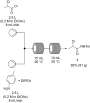
Development of a continuous process for α-thio-β-chloroacrylamide synthesis with enhanced control of a cascade transformation
Beilstein J. Org. Chem. 2016, 12, 2511–2522, doi:10.3762/bjoc.12.246
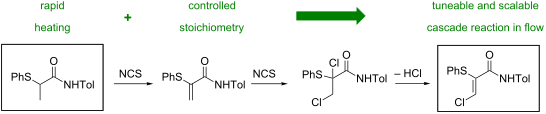
- pure material, with direct product precipitation/crystallization from the reaction solution (>99% pure by HPLC analysis), which has removed the requirements for isolation by extraction and subsequent chromatographic purification. HPLC analysis of the current process – in either batch or flow




A new protocol for the synthesis of 4,7,12,15-tetrachloro[2.2]paracyclophane
Beilstein J. Org. Chem. 2016, 12, 2443–2449, doi:10.3762/bjoc.12.237
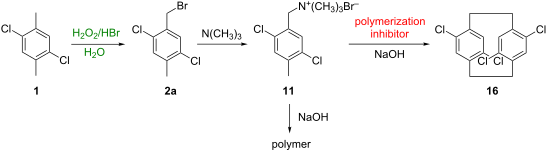
- prepare tetrachloroparacyclophane, but a pure polysubstituted product is difficult to obtain by electrophilic substitution without repeated crystallization or chromatographic purification [9]. Thus, we report an improved synthesis method using the Winberg dimerization of 2,5-dichloro-(4-methylbenzyl


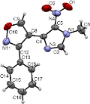
Combined experimental and theoretical studies of regio- and stereoselectivity in reactions of β-isoxazolyl- and β-imidazolyl enamines with nitrile oxides
Beilstein J. Org. Chem. 2016, 12, 2390–2401, doi:10.3762/bjoc.12.233

- , washed with EtOH and purified by silica gel (60–120) column chromatography (EtOAc/hexane, CHCl3/EtOH, CH2Cl2) or crystallization from EtOH to afford the desired isoxazole 4. 4-(1-Methyl-5-nitro-1H-imidazol-4-yl)-3-phenylisoxazole (4a). Colorless powder, yield 53%, mp 130–132 °С (column, CHCl3/EtOH 20:1




Efficient mechanochemical synthesis of regioselective persubstituted cyclodextrins
Beilstein J. Org. Chem. 2016, 12, 2364–2371, doi:10.3762/bjoc.12.230
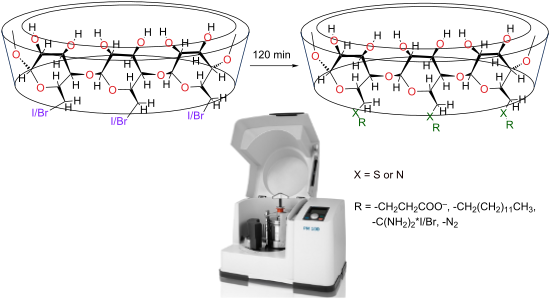
- and thioester compounds [8][30] and the CD thiouronium salt intermediates are not isolated [8] despite their good crystallization properties, while the excess/residual TU and used solvents are removed upon the conversion to thiols only. However, the easy crystallization of these salts is a nice


High performance p-type molecular electron donors for OPV applications via alkylthiophene catenation chromophore extension
Beilstein J. Org. Chem. 2016, 12, 2298–2314, doi:10.3762/bjoc.12.223
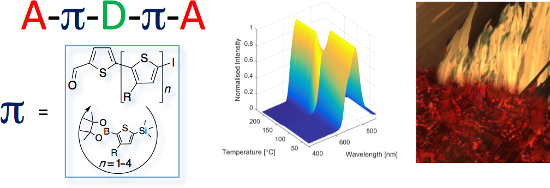
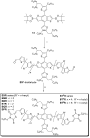
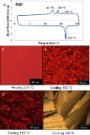
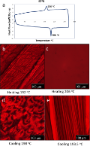
- single melt temperature recorded for BMR, BBR and BPR at 179 °C, 215 °C and 196 °C, respectively. Subsequent crystallization was observed at 154 °C, 175 °C and 174 °C for BMR, BBR and BPR, respectively. The phase behaviour for BTR has been previously reported and shows three phase transitions on heating
- transmitted spectrum during the phase change recorded at 164 °C, Figure 2, suggestive of significant structural rearrangements occurring during crystallization. The POM/heating stage apparatus was coupled to a fibre-optic based spectrometer to enable collection of variable temperature UV–vis and fluorescence
- heating/cooling impacts on the crystallization of the thin films, with the slower rates used for the fully enclosed, temperature ramped POM stage, leading to equilibrium phases, while rapid thermal quenching of isolated thin films on glass slides gives different results. To further probe this effect, the




Comparing blends and blocks: Synthesis of partially fluorinated diblock polythiophene copolymers to investigate the thermal stability of optical and morphological properties
Beilstein J. Org. Chem. 2016, 12, 2150–2163, doi:10.3762/bjoc.12.205
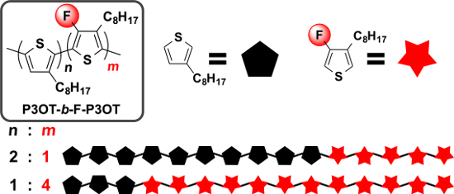
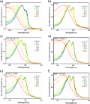
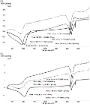
- likely indicates less inter- and intrachain coupling, and possibly a frustration of the crystallization and phase separation in the case of these block copolymers. Thermal behavior Differential scanning calorimetry Fluorination of P3OT has previously been shown to result in a 50–60 °C increase in the
- melting and crystallization temperatures, an effect that was predominantly attributed to the increased backbone planarity and rigidity in combination with the increased aggregation it engenders [42]. In order to probe the crystallization behavior of the block copolymers and blends in thin films, DSC was
- [42]), which could result in a masking of the P3OT melt in the baseline. However, the apparent suppression of the P3OT melt could also be explained by some degree of frustration of the P3OT crystallization, likely due to the earlier precipitation of the less soluble F-P3OT during the film formation




Synthesis and properties of fluorescent 4′-azulenyl-functionalized 2,2′:6′,2″-terpyridines
Beilstein J. Org. Chem. 2016, 12, 1812–1825, doi:10.3762/bjoc.12.171
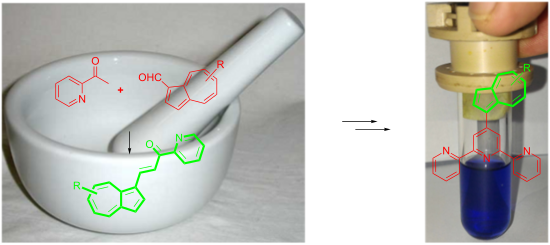
- 4b. These substituents are also responsible for the upfield shift of the azulene proton resonances, the most affected being the azulene protons at the 2- and 3-positions (Table 2). Crystals suitable for X-ray diffraction could be isolated for both compounds by crystallization from methanol


Synthesis of ferrocenyl-substituted 1,3-dithiolanes via [3 + 2]-cycloadditions of ferrocenyl hetaryl thioketones with thiocarbonyl S-methanides
Beilstein J. Org. Chem. 2016, 12, 1421–1427, doi:10.3762/bjoc.12.136
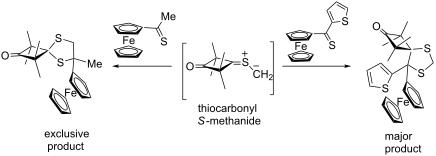
- crude products were purified by crystallization (hexane/CH2Cl2). Preparation of cycloaliphatic-substituted 1,3-dithiolanes (5h–l, 6h–m) – General procedure: To a solution of the corresponding ferrocenyl-substituted thioketone 1 (1 mmol) in THF (4 mL), 1,3,4-thiadiazoline 3c or 3d (1 mmol) was added. The


Biradical vs singlet oxygen photogeneration in suprofen–cholesterol systems
Beilstein J. Org. Chem. 2016, 12, 1196–1202, doi:10.3762/bjoc.12.115
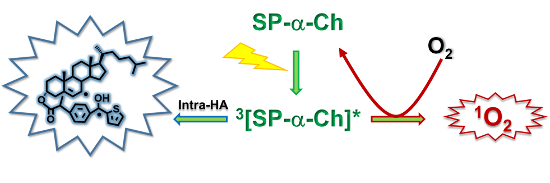
- ]. They were purified and resolved into the pure diastereoisomers by fractional crystallization from hexane/ethyl acetate. Ester 1 was obtained as a pure solid, while its diastereoisomer 2 remained as a viscous oil after elimination of the solvent from the filtered solution. In order to make an


Chiral cyclopentadienylruthenium sulfoxide catalysts for asymmetric redox bicycloisomerization
Beilstein J. Org. Chem. 2016, 12, 1136–1152, doi:10.3762/bjoc.12.110
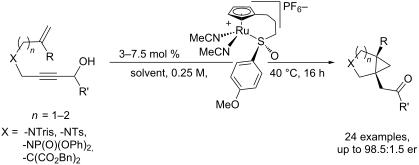
- these chiral sulfoxides needed to be explored, preferably one that did not rely on crystallization. In 2005, the Senanayake group described a process in which (+)-norephedrine-derived oxathiazolidine 2-oxides are used as sulfinyl transfer agents in the synthesis of optically pure sulfoxides and




Synthesis and in vitro cytotoxicity of acetylated 3-fluoro, 4-fluoro and 3,4-difluoro analogs of D-glucosamine and D-galactosamine
Beilstein J. Org. Chem. 2016, 12, 750–759, doi:10.3762/bjoc.12.75
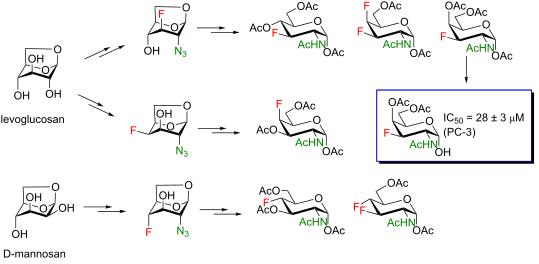
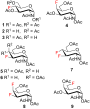
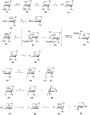
- in ca. 8% was observed in NMR spectra. The desired D-galacto-configured 2-azido derivative 31 was separated from 32 by crystallization in 74% yield. The D-galacto configuration of 31 is evidenced by the vicinal coupling values 3JH4,H3/5 = 4.5 Hz and the long range coupling between equatorial protons





Creating molecular macrocycles for anion recognition
Beilstein J. Org. Chem. 2016, 12, 611–627, doi:10.3762/bjoc.12.60
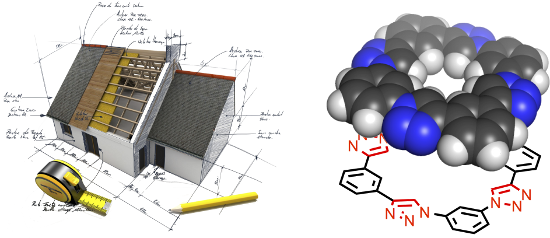
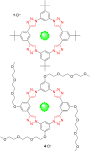
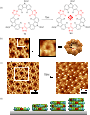
- their propensity to stack. This can be seen in the crystalline phase with dimer formation either around anionic guests like perchlorate [36] (Figure 14a) or, in the absence of an anion, around adventitious solvents of crystallization, like diglyme (Figure 14b) [37] . The π-surface was enhanced by






Biosynthesis of α-pyrones
Beilstein J. Org. Chem. 2016, 12, 571–588, doi:10.3762/bjoc.12.56
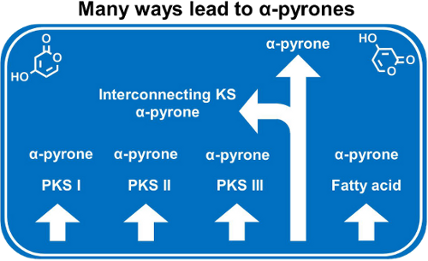
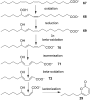
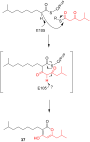
- cysteine as a result of substrate incubation prior to crystallization. This was only possible with a very short substrate mimic which renders more similarity to the eastern chain. Using the longer western chain mimic no suitable crystals for structure determination could be produced (neither for CorB, nor






My maize and blue brick road to physical organic chemistry in materials
Beilstein J. Org. Chem. 2016, 12, 229–238, doi:10.3762/bjoc.12.24
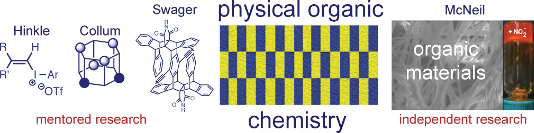
- different example, we hypothesized that polymeric additives, commonly utilized to alter crystallization processes, might be useful for lowering the cgc in gel formation. Graduate student Yash Adhia, working with undergraduates Tracy Schloemer and Maria Perez, screened a series of commercially available


Thermal and oxidative stability of Atlantic salmon oil (Salmo salar L.) and complexation with β-cyclodextrin
Beilstein J. Org. Chem. 2016, 12, 179–191, doi:10.3762/bjoc.12.20
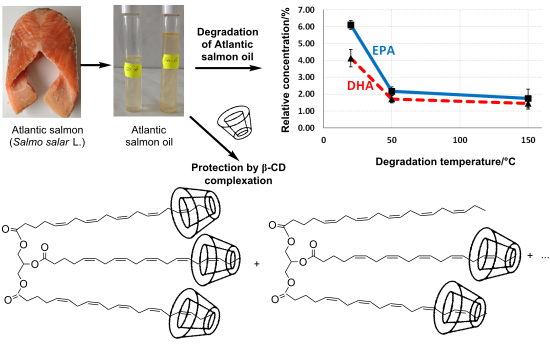
- saturated fatty acids remained constant or slightly increased by a few percent after degradation (e.g., from 10.7% to 12.9% for palmitic acid). Co-crystallization of ASO with β-CD at a host–guest ratio of 1:1 and 3:1 from an ethanol–water mixture and kneading methods has been used for the preparation of β
- and microencapsulation of fish oil is also used [43][44]. However, no CD complexation studies on ASO have been published up to now. The goal of this study was to evaluate the thermal and oxidative stability of ASO (Salmo salar L.) and the β-CD complexation by using co-crystallization and kneading
- degradation of ASO at low and high temperature degradation conditions. Preparation and analysis of β-CD/ASO complexes β-CD/ASO complexes were obtained by using two different methods: co-crystallization from an ethanol–water mixture and by kneading techniques. No literature data on β-CD/ASO complexes have been



Diastereoselective Ugi reaction of chiral 1,3-aminoalcohols derived from an organocatalytic Mannich reaction
Beilstein J. Org. Chem. 2016, 12, 139–143, doi:10.3762/bjoc.12.15

- , by additional crystallization, affording these key intermediates in high ee and de (syn relative configuration, see Supporting Information File 1). The tert-butyl urethane was then deblocked with trifluoroacetic acid. Neutralization and extraction afforded crude aminoalcohols 5a–e, that were directly


Synthesis and reactivity of aliphatic sulfur pentafluorides from substituted (pentafluorosulfanyl)benzenes
Beilstein J. Org. Chem. 2016, 12, 110–116, doi:10.3762/bjoc.12.12
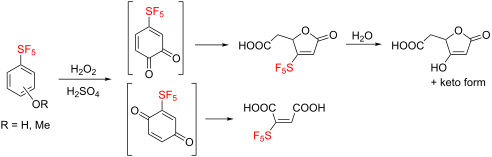
- . Maleic acid 4 was identified in the mixture (25% 19F NMR yield, Scheme 4) but chromatographic separation, crystallization or derivatization (CH2N2) attempts were not successful. Nevertheless, these results show that SF5-substituted para-benzoquinones are most likely intermediates in the formation of 4 by


Supramolecular polymer assembly in aqueous solution arising from cyclodextrin host–guest complexation
Beilstein J. Org. Chem. 2016, 12, 50–72, doi:10.3762/bjoc.12.7
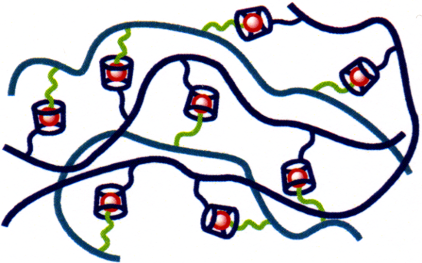
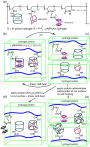
- form hydrogels [84][85]. In particular, hydrogels formed by PEG and cyclodextrins have been investigated intensively because of the biocompatibility of their components. Interestingly, local crystallization of the polyrotaxane threaded cyclodextrins, sometimes called molecular necklaces [86], may form
- studies were also consistent with the localized crystallization of α-CD/PEG pseudo-polyrotaxanes forming interchain cross-links in the hydrogel. Low molecular weight <2 kDa PEG forms crystalline precipitates in aqueous solutions in the presence of α-CD largely because multiple α-CD thread onto the PEG


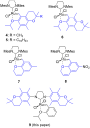
New metathesis catalyst bearing chromanyl moieties at the N-heterocyclic carbene ligand
Beilstein J. Org. Chem. 2015, 11, 2795–2804, doi:10.3762/bjoc.11.300
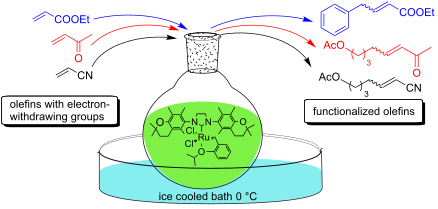
- were washed with brine and water, dried over Na2SO4 and evaporated to dryness. After crystallization from ethanol a white solid was obtained (480 mg, 90%). Mp 182–183 °C; IR (KBr) ν: 3369, 2968, 2925, 2779, 1450, 1420, 1265 cm−1; 1H NMR (400 MHz, CDCl3) δ 3.04 (s, 4H, -NCH2CH2N-), 2.64 (t, J = 6.8 Hz




Synthesis and photophysical characteristics of polyfluorene polyrotaxanes
Beilstein J. Org. Chem. 2015, 11, 2677–2688, doi:10.3762/bjoc.11.288
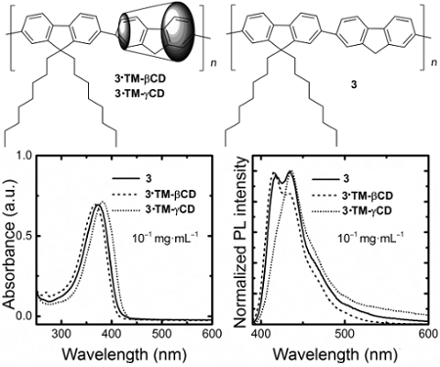
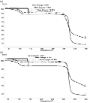
- analysis (TGA). All copolymers showed only glass-transitions (Tg) and not any exothermal crystallization peak characteristic of polymers containing 9,9-dioctyl-2,7-fluorene units (PFO) [49], Figure 2. The non-rotaxane copolymer 3 has a Tg at 88 °C. The Tg value increases for 3·TM-γCD and 3·TM-βCD to 96 °C


Bifunctional phase-transfer catalysis in the asymmetric synthesis of biologically active isoindolinones
Beilstein J. Org. Chem. 2015, 11, 2591–2599, doi:10.3762/bjoc.11.279
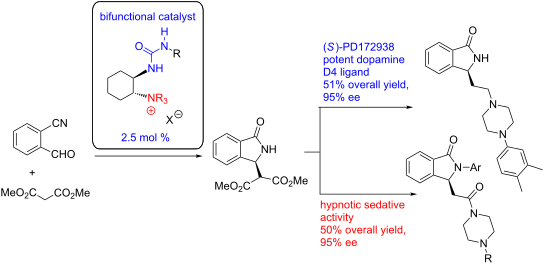
- reaction time (72 h) [21][22]. Readily available chiral ammonium salts (e.g., cinchona alkaloid-based or commercially available Maruoka catalysts) were also investigated, but the enantioselectivity was lower, reaching a maximum of 46% ee [23]. Gratifyingly, a very efficient heterochiral crystallization
- successfully scaled up to a practical 2 mmol scale with unchanged efficiency. After crystallization, we were able to obtain reasonable quantities of (S)-7 with 95% ee and an overall yield of 77%. The availability of both the enantiomers of the catalysts is another important advantage because of the possibility
- after crystallization overnight at −20 °C, the solid was filtered off and the solution containing the enantioenriched compound was evaporated and analyzed by chiral HPLC. The resulting enantioenriched product was obtained as a colourless oil in 77% overall yield (400 mg, 1.51 mmol, 95% ee). The


Stereoselective synthesis of hernandulcin, peroxylippidulcine A, lippidulcines A, B and C and taste evaluation
Beilstein J. Org. Chem. 2015, 11, 2117–2124, doi:10.3762/bjoc.11.228
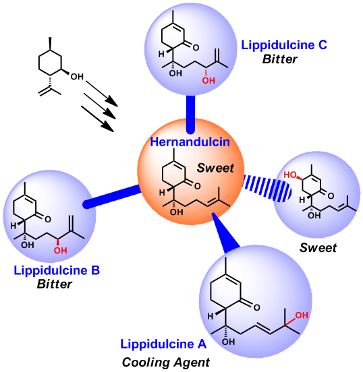
- ]. Indeed, the treatment of (–)-isopulegol with diisopropyl azodicarboxylate (DIAD) and p-nitrobenzoic acid in the presence of triphenylphosphine gave the corresponding ester in an almost quantitative yield. The latter was easily purified by crystallization from n-hexane, and then transesterificated with
- epoxidation of 5 with tert-butylhydroperoxide (TBHP) in toluene gave 6 ([α]D +34.2° (c 1.3, CHCl3)) in 95% yield [9][22]. Then, the diol 7 was obtained in 85% yield from the reduction of epoxide 6 with LiAlH4 in THF at 0 °C. The diol 7 was easily purified by crystallization (85% yield, n-hexane at −50 °C up



Effective ascorbate-free and photolatent click reactions in water using a photoreducible copper(II)-ethylenediamine precatalyst
Beilstein J. Org. Chem. 2015, 11, 1950–1959, doi:10.3762/bjoc.11.211
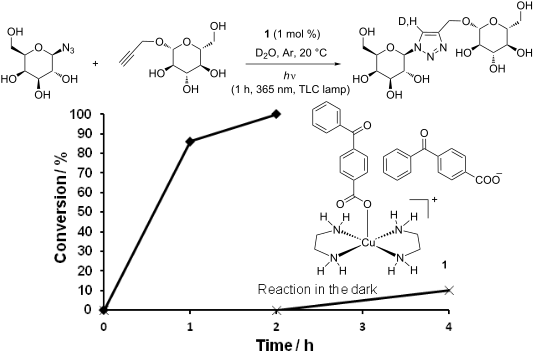
- vapour into the THF solution led to the crystallization of 1 as blue needles, which were recovered by filtration (71% yield). The proposed dinuclear and mononuclear structures of 4 and 1 were confirmed by single crystal X-ray diffraction (Figure 1). The crystal structure of 4 displays the typical “paddle


Cross-metathesis of polynorbornene with polyoctenamer: a kinetic study
Beilstein J. Org. Chem. 2015, 11, 1796–1808, doi:10.3762/bjoc.11.195

- measurements with PCOE are impossible since the solution is not filterable through a 220 nm porosity membrane. Taking into account that the melting temperature of PCOE is about 45 °C, we can relate aggregation in the PCOE solutions at 25 °C to the onset of crystallization. In any case, it makes no sense to


![[Graphic 2]](/bjoc/content/inline/1860-5397-11-195-i10.png?max-width=637&scale=1.18182) in CHCl3 on the (a) light ...
in CHCl3 on the (a) light ...


Synthesis and structures of ruthenium–NHC complexes and their catalysis in hydrogen transfer reaction
Beilstein J. Org. Chem. 2015, 11, 1786–1795, doi:10.3762/bjoc.11.194
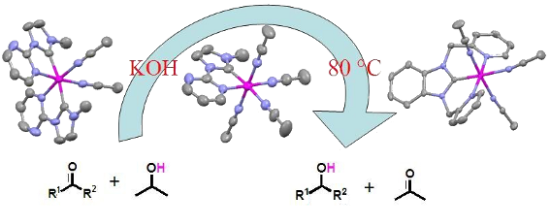
- -phenanthroline in heat acetonitrile solution afforded 4 and 5, respectively. Even excess triphenylphosphine and 1,10-phenanthroline were used, only one and two coordinated acetonitrile ligands were substituted in complexes 4 and 5. Crystallization by slow diffusion of diethyl ether into their acetonitrile
- crystallization by slow diffusion of Et2O into the CH3CN solution gave 4 as yellow solid. Yield: 75 mg, 40%. Anal. calcd for C32H32F12N7P3Ru: C, 41.04; H, 3.44; N, 10.47; found: C, 41.10; H, 3.40; N, 10.58; 1H NMR (DMSO-d6) δ 8.99 (s, 1H), 8.46 (s, 1H), 8.38 (s, 1H), 7.87 (s, 1H), 7.57(s, 13H), 7.42 (s, 2H), 7.25
- ). A mixture of 2 (142 mg, 0.2 mmol) and 1,10-phenanthroline·1H2O (198 mg, 1.0 mmol) in 5 mL CH3CN was stirred at 80 °C for 6 h. Then the mixture was filtered through Celite to afford a yellow solution. Crystallization by slow diffusion of Et2O into the CH3CN solution gave 5 as an orange yellow solid