
Search for "computational" in Full Text gives 604 result(s) in Beilstein Journal of Organic Chemistry. Showing first 200.
Beilstein J. Org. Chem. 2022, 18, 381–419, doi:10.3762/bjoc.18.43
Graphical Abstract
Figure 1: Natural bioactive naphthoquinones.
Figure 2: Chemical structures of vitamins K.
Figure 3: Redox cycle of menadione.
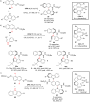
Scheme 1: Selected approaches for menadione synthesis using silver(I) as a catalyst.
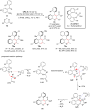
Scheme 2: Methylation approaches for the preparation of menadione from 1,4-naphthoquinone using tert-butyl hy...
Scheme 3: Methylation approach of 1,4-naphthoquinone using i) rhodium complexes/methylboronic acid and ii) bi...
Scheme 4: Synthesis of menadione (10) from itaconic acid.
Scheme 5: Menadione synthesis via Diels–Alder reaction.
Scheme 6: Synthesis of menadione (10) using p-cresol as a synthetic precursor.
Scheme 7: Synthesis of menadione (10) via demethoxycarbonylating annulation of methyl methacrylate.
Scheme 8: Furan 34 used as a diene in a Diels–Alder reaction for the synthesis of menadione (10).
Scheme 9: o-Toluidine as a dienophile in a Diels–Alder reaction for the synthesis of menadione (10).
Scheme 10: Representation of electrochemical synthesis of menadione.
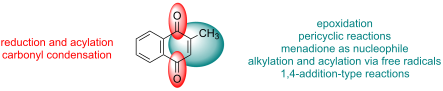
Figure 4: Reaction sites and reaction types of menadione as substrate.
Scheme 11: DBU-catalyzed epoxidation of menadione (10).
Scheme 12: Phase-transfer catalysis for the epoxidation of menadione.
Scheme 13: Menadione epoxidation using a hydroperoxide derived from (+)-norcamphor.
Scheme 14: Enantioselective Diels–Alder reaction for the synthesis of asymmetric quinone 50 catalyzed by a chi...
Scheme 15: Optimized reaction conditions for the synthesis of anthra[9,1-bc]pyranone.
Scheme 16: Synthesis of anthra[9,1-bc]furanone, anthra[9,1-bc]pyridine, and anthra[9,1-bc]pyrrole derivatives.
Scheme 17: Synthesis of derivatives employing protected trienes.
Scheme 18: Synthesis of cyclobutene derivatives of menadione.
Scheme 19: Menadione reduction reactions using sodium hydrosulfite.
Scheme 20: Green methodology for menadiol synthesis and pegylation.
Scheme 21: Menadione reduction by 5,6-O-isopropylidene-ʟ-ascorbic acid under UV light irradiation.
Scheme 22: Selected approaches of menadione hydroacetylation to diacetylated menadiol.
Scheme 23: Thiele–Winter reaction catalyzed by Bi(OTf)3.
Scheme 24: Carbonyl condensation of menadione using resorcinol and a hydrazone derivative.
Scheme 25: Condensation reaction of menadione with thiosemicarbazide.
Scheme 26: Condensation reaction of menadione with acylhydrazides.
Scheme 27: Menadione derivatives functionalized with organochalcogens.
Scheme 28: Synthesis of selenium-menadione conjugates derived from chloromethylated menadione 84.
Scheme 29: Menadione alkylation by the Kochi–Anderson method.
Scheme 30: Menadione alkylation by diacids.
Scheme 31: Menadione alkylation by heterocycles-substituted carboxylic acids.
Scheme 32: Menadione alkylation by bromoalkyl-substituted carboxylic acids.
Scheme 33: Menadione alkylation by complex carboxylic acids.
Scheme 34: Kochi–Anderson method variations for the menadione alkylation via oxidative decarboxylation of carb...
Scheme 35: Copper-catalyzed menadione alkylation via free radicals.
Scheme 36: Nickel-catalyzed menadione cyanoalkylation.
Scheme 37: Iron-catalyzed alkylation of menadione.
Scheme 38: Selected approaches to menadione alkylation.
Scheme 39: Menadione acylation by photo-Friedel–Crafts acylation reported by Waske and co-workers.
Scheme 40: Menadione acylation by Westwood procedure.
Scheme 41: Synthesis of 3-benzoylmenadione via metal-free TBAI/TBHP system.
Scheme 42: Michael-type addition of amines to menadione reported by Kallmayer.
Scheme 43: Synthesis of amino-menadione derivatives using polyalkylamines.
Scheme 44: Selected examples for the synthesis of different amino-substituted menadione derivatives.
Scheme 45: Selected examples of Michael-type addition of complex amines to menadione (10).
Scheme 46: Addition of different natural α-amino acids to menadione.
Scheme 47: Michael-type addition of amines to menadione using silica-supported perchloric acid.
Scheme 48: Indolylnaphthoquinone or indolylnaphthalene-1,4-diol synthesis reported by Yadav et al.
Scheme 49: Indolylnaphthoquinone synthesis reported by Tanoue and co-workers.
Scheme 50: Indolylnaphthoquinone synthesis from menadione by Escobeto-González and co-workers.
Scheme 51: Synthesis of menadione analogues functionalized with thiols.
Scheme 52: Synthesis of menadione-derived symmetrical derivatives through reaction with dithiols.
Scheme 53: Mercaptoalkyl acids as nucleophiles in Michael-type addition reaction to menadione.
Scheme 54: Reactions of menadione (10) with cysteine derivatives for the synthesis of quinoproteins.
Scheme 55: Synthesis of menadione-glutathione conjugate 152 by Michael-type addition.
Beilstein J. Org. Chem. 2022, 18, 293–302, doi:10.3762/bjoc.18.33
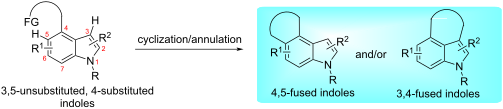
Graphical Abstract
Scheme 1: SEAr-based, CAr–C bond-forming cyclization or annulation of: (A) substituted arenes/heteroarenes an...
Scheme 2: Indole C3 regioselective intramolecular alkylation of indolyl allyl carbonates.
Scheme 3: Indole C3 regioselective Michael-type cyclization in the total synthesis of (−)-indolactam V.
Scheme 4: Synthesis of azepino[4,3,2-cd]indoles via indole C3 regioselective aza-Michael addition/cyclization...
Scheme 5: Indole C3 regioselective Pictet−Spengler reaction of 2-(1H-indol-4-yl)ethanamines.
Scheme 6: Indole C3 regioselective hydroindolation of cis-β-(α′,α′-dimethyl)-4′-methindolylstyrenes.
Scheme 7: Indole C3 regioselective cyclization leading to the formation of polycyclic azepino[5,4,3-cd]indole...
Scheme 8: Synthesis of azepino[3,4,5-cd]indoles via iridium-catalyzed asymmetric [4 + 3] cycloaddition of rac...
Scheme 9: Aldimine condensation/1,6-hydride transfer/Mannich-type cyclization cascade of indole-derived pheny...
Scheme 10: Indole C5 regioselective intramolecular FC acylation of 4-substituted indoles.
Scheme 11: Catalyst-dependent regioselectivity switching in the cyclization of ethyl 2-diazo-4-(4-indolyl)-3-o...
Scheme 12: Indole C5 regioselective cyclization of α-carbonyl sulfoxonium ylides.
Scheme 13: Indole C5 regioselective cyclization of an indole-tethered donor–acceptor cyclopropane.
Scheme 14: Indole C5 regioselective epoxide–arene cyclization.
Beilstein J. Org. Chem. 2022, 18, 251–261, doi:10.3762/bjoc.18.30
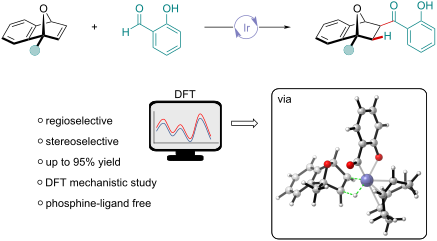
Graphical Abstract
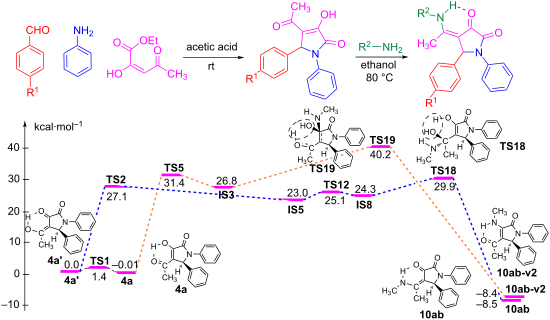
Scheme 1: Previously reported metal-catalyzed reactions of heterobicyclic alkenes and applications towards th...
Scheme 2: Iridium-catalyzed hydroacylation of C1-substituted OBDs 13a–k with salicylaldehyde 14.
Scheme 3: Competition reaction of different C1-substituted OBDs.
Figure 1: Potential energy profile of the PCM solvation model for the hydrometalation/reductive elimination p...
Figure 2: Potential energy profile of the PCM solvation model for the carbometalation/reductive elimination p...
Figure 3: Potential energy profile of the PCM solvation model for the endo hydrometalation/reductive eliminat...
Figure 4: Potential energy profile of the PCM solvation model for the Ir/diene-catalyzed hydroacylation of Me...
Beilstein J. Org. Chem. 2022, 18, 13–24, doi:10.3762/bjoc.18.2
Graphical Abstract
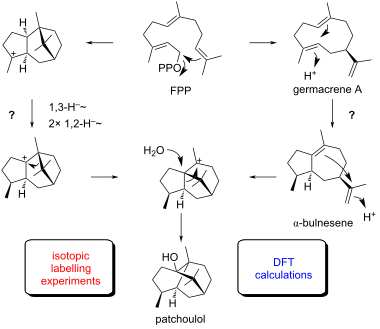
Figure 1: Initially assigned structures for patchoulol by Treibs (1) and by Büchi (2). Structures of patchoul...
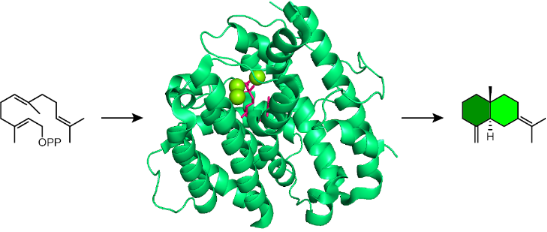
Scheme 1: Biosynthesis of patchoulol (part I). A) Cyclisation mechanism from FPP to 3 as suggested by Croteau...
Scheme 2: Biosynthesis of patchoulol (part II). A) Cyclisation mechanism from FPP to 3 as suggested by Akhila...
Scheme 3: Biosynthesis of patchoulol (part III). A) Cyclisation mechanism from FPP to 3 as suggested by Faral...
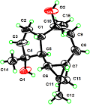
Figure 2: ORTEP representation of patchoulol (3). Cu Kα, Flack parameter: −0.1(2); P2(true) = 1.000, P3(false...
Scheme 4: Determination of the absolute configurations of compounds 3 and 12 through stereoselective labellin...
Scheme 5: Labelling experiments on the biosynthesis of patchoulol (3, part 1). Black dots indicate 13C-labell...
Scheme 6: Labelling experiments on the biosynthesis of patchoulol (3, part 2). Black dots indicate 13C-labell...
Figure 3: Energy profile from DFT calculations (Gibbs energies at 298 K, mPW1PW91/6-311 + G(d,p)//B97D3/6-31G...
Figure 4: Structure elucidation of (2S,3S,7S,10R)-guaia-1,11-dien-10-ol (17) and structure of its known stere...
Beilstein J. Org. Chem. 2021, 17, 2959–2967, doi:10.3762/bjoc.17.205
Graphical Abstract
Figure 1: Redox potentials of representative nitrogenated HAT catalysts and photocatalysts [9-12,21-23].
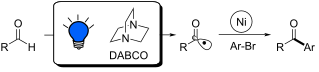
Figure 2: Previous reports of DABCO as hydrogen abstractor in HAT reactions and this work.
Scheme 1: Aryl bromide and aldehyde scope. Isolated yields. aYield determined by 1H NMR analysis with 1,3-ben...
Scheme 2: Mechanistic investigations of the HAT reaction using DABCO.
Scheme 3: Proposed mechanism for aldehyde arylation. PC = photocatalyst Ir[dF(CF3)ppy]2(dtbbpy)PF6. SET = sin...
Figure 3: Free energy profile for the HAT step reactions between isovaleraldehyde with (top) DABCO and (botto...
Figure 4: TS structure for the HAT reaction between the DABCO radical cation and isovaleraldehyde obtained at...
Beilstein J. Org. Chem. 2021, 17, 2894–2905, doi:10.3762/bjoc.17.197
Graphical Abstract
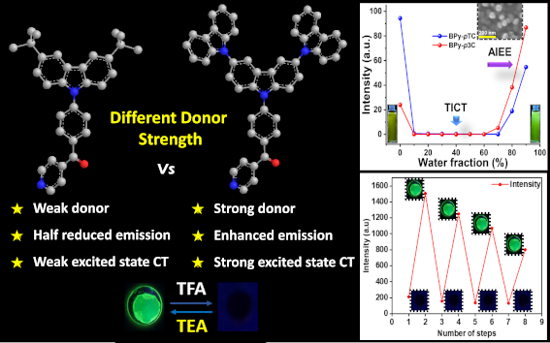
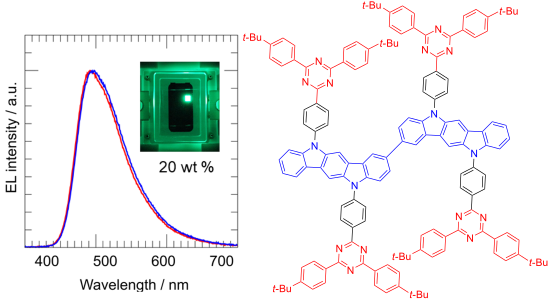
Figure 1: Molecular structures of emitters.
Figure 2: a) Molecular structure and b) optimized DFT-calculated geometry of DICzTRZ. Hydrogen atoms are omit...
Figure 3: HOMO, HOMO–1 (H–1), LUMO, and LUMO+1 (L+1) electron density distributions (isovalue: 0.02) and ener...
Figure 4: a) Cyclic voltammetry (CV) and differential pulse voltammetry (DPV) of DICzTRZ in DCM (scan rate = ...
Figure 5: a) Prompt and b) delayed time-resolved decay in spin-coated 20 wt % CzSi film of DICzTRZ (λexc = 37...
Figure 6: Angle-resolved photoluminescence measurement of a solution-processed film of 20 wt % DICzTRZ in CzS...
Figure 7: Device characteristics of 20 and 30 wt % DICzTRZ-based OLEDs, which are represented by red and blue...
Figure 8: Device efficiency simulation of the fabricated OLEDs depicting the variation in EQE with varied PL ...
Beilstein J. Org. Chem. 2021, 17, 2812–2821, doi:10.3762/bjoc.17.192
Graphical Abstract
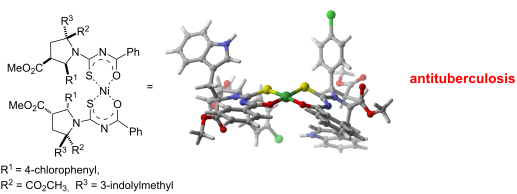
Scheme 1: Synthetic route for the preparation of L1-M, L2-M and L3-M complexes.
Figure 1: Main geometrical features and the relative energies (in kcal·mol–1) of (A) ligand L1, (B) nickel- a...
Figure 2: Main geometrical features and the relative energies (in kcal mol–1) of (A) ligand L3, (B) nickel- a...
Beilstein J. Org. Chem. 2021, 17, 2729–2764, doi:10.3762/bjoc.17.185
Graphical Abstract
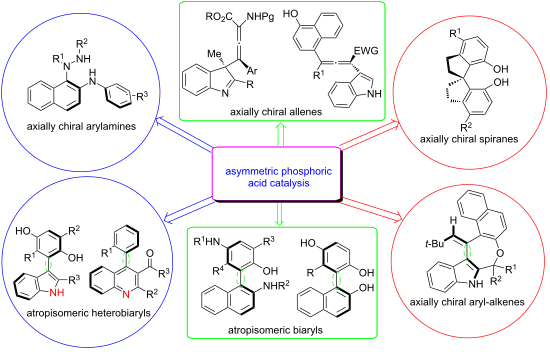
Figure 1: Representative examples of axially chiral biaryls, heterobiaryls, spiranes and allenes as ligands a...
Figure 2: Selected examples of axially chiral drugs and bioactive molecules.
Figure 3: Axially chiral functional materials and supramolecules.
Figure 4: Important chiral phosphoric acid scaffolds used in this review.
Scheme 1: Atroposelective aryl–aryl-bond formation by employing a facile [3,3]-sigmatropic rearrangement.
Scheme 2: Atroposelective synthesis of axially chiral biaryl amino alcohols 5.
Scheme 3: The enantioselective reaction of quinone and 2-naphthol derivatives.
Scheme 4: Enantioselective synthesis of multisubstituted biaryls.
Scheme 5: Enantioselective synthesis of axially chiral quinoline-derived biaryl atropisomers mediated by chir...
Scheme 6: Pd-Catalyzed atroposelective C–H olefination of biarylamines.
Scheme 7: Palladium-catalyzed directed atroposelective C–H allylation.
Scheme 8: Enantioselective synthesis of axially chiral (a) aryl indoles and (b) biaryldiols.
Scheme 9: Asymmetric arylation of indoles enabled by azo groups.
Scheme 10: Proposed mechanism for the asymmetric arylation of indoles.
Scheme 11: Enantioselective synthesis of axially chiral N-arylindoles [38].
Scheme 12: Enantioselective [3 + 2] formal cycloaddition and central-to-axial chirality conversion.
Scheme 13: Organocatalytic atroposelective arene functionalization of nitrosonaphthalene with indoles.
Scheme 14: Proposed reaction mechanism for the atroposelective arene functionalization of nitrosonaphthalenes.
Scheme 15: Asymmetric construction of axially chiral naphthylindoles [65].
Scheme 16: Enantioselective synthesis of axially chiral 3,3’-bisindoles [66].
Scheme 17: Atroposelective synthesis of 3,3’-bisiindoles bearing axial and central chirality.
Scheme 18: Enantioselective synthesis of axially chiral 3,3’-bisindoles bearing single axial chirality.
Scheme 19: Enantioselective reaction of azonaphthalenes with various pyrazolones.
Scheme 20: Enantioselective and atroposelective synthesis of axially chiral N-arylcarbazoles [73].
Scheme 21: Atroposelective cyclodehydration reaction.
Scheme 22: Atroposelective construction of axially chiral N-arylbenzimidazoles [78].
Scheme 23: Proposed reaction mechanism for the atroposelective synthesis of axially chiral N-arylbenzimidazole...
Scheme 24: Atroposelective synthesis of axially chiral arylpyrroles [21].
Scheme 25: Synthesis of axially chiral arylquinazolinones and its reaction pathway [35].
Scheme 26: Synthesis of axially chiral aryquinoline by Friedländer heteroannulation reaction and its proposed...
Scheme 27: Povarov cycloaddition–oxidative chirality conversion process.
Scheme 28: Atroposelective synthesis of oxindole-based axially chiral styrenes via kinetic resolution.
Scheme 29: Synthesis of axially chiral alkene-indole frame works [45].
Scheme 30: Proposed reaction mechanism for axially chiral alkene-indoles.
Scheme 31: Atroposelective C–H aminations of N-aryl-2-naphthylamines with azodicarboxylates.
Scheme 32: Synthesis of brominated atropisomeric N-arylquinoids.
Scheme 33: The enantioselective syntheses of axially chiral SPINOL derivatives.
Scheme 34: γ-Addition reaction of various 2,3-disubstituted indoles to β,γ-alkynyl-α-imino esters.
Scheme 35: Regio- and stereoselective γ-addition reactions of isoxazol-5(4H)-ones to β,γ-alkynyl-α-imino ester...
Scheme 36: Synthesis of chiral tetrasubstituted allenes and naphthopyrans.
Scheme 37: Asymmetric remote 1,8-conjugate additions of thiazolones and azlactones to propargyl alcohols.
Scheme 38: Synthesis of chiral allenes from 1-substituted 2-naphthols [107].
Beilstein J. Org. Chem. 2021, 17, 2726–2728, doi:10.3762/bjoc.17.184
Beilstein J. Org. Chem. 2021, 17, 2629–2641, doi:10.3762/bjoc.17.176
Graphical Abstract
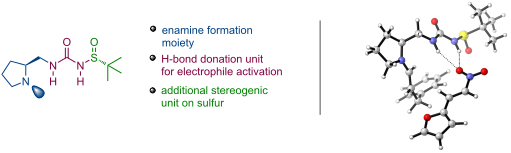
Figure 1: Catalyst design principles.
Scheme 1: Synthesis of isothiocyanate 3a and isocyanate 3b.
Scheme 2: Synthesis of sulfinylthioureas C1 and ureas C2.
Scheme 3: Synthesis of adducts 8a,d,f in solution.
Figure 2: DFT-calculated (PBEh-3c/def2-SV(P)//M06-2X/def2-TZVP) structures of catalyst (S,R) and (S,S)-C2, en...
Figure 3: a) Arrangements of reactants in the transition states; b) DFT-calculated (PBEh-3c/def2-SV(P)//M06-2...
Figure 4: DFT-calculated (PBEh-3c/def2-SV(P)//M06-2X/def2-TZVP) reaction profile for the Michael addition of ...
Beilstein J. Org. Chem. 2021, 17, 2270–2286, doi:10.3762/bjoc.17.145
Graphical Abstract
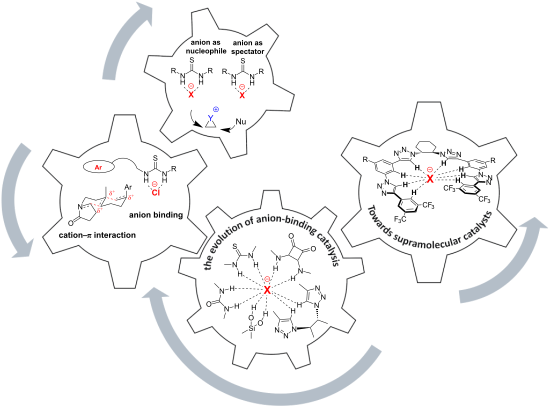
Figure 1: a) Binding interactions in the chloride channel of E. coli. and b) examples of chloride, cyanide, n...
Figure 2: a) H-bond vs anion-binding catalysis and b) activation modes in anion-binding catalysis.
Scheme 1: First proposed anion-binding mechanism in the thiourea-catalyzed acetalization of benzaldehyde.
Scheme 2: a) Thiourea-catalyzed enantioselective acyl-Pictet–Spengler reaction of tryptamine-derived imines 4...
Scheme 3: Proposed mechanism of the thiourea-catalyzed enantioselective Pictet–Spengler reaction of hydroxyla...
Scheme 4: a) Thiourea-catalyzed intramolecular Pictet–Spengler-type cyclization of hydroxylactam-derived N-ac...
Scheme 5: Enantioselective Reissert-type reactions of a) (iso)quinolines with silyl ketene acetals, and b) vi...
Figure 3: Role of the counter-anion: a) Anion acting as a spectator and b) anion participating directly as th...
Scheme 6: Enantioselective selenocyclization catalyzed by squaramide 28.
Scheme 7: Desymmetrization of meso-aziridines catalyzed by bifunctional thiourea catalyst 31.
Scheme 8: Anion-binding-catalyzed desymmetrization of a) meso-aziridines catalyzed by chiral triazolium catal...
Scheme 9: Bis-urea-catalyzed enantioselective fluorination of a) β-bromosulfides and b) β-haloamines by Gouve...
Scheme 10: a) Bifunctional thiourea anion-binding – basic/nucleophilic catalysts. Selected applications in b) ...
Scheme 11: Thiourea-catalyzed enantioselective polycyclization reaction of hydroxylactams 51 through cation–π ...
Scheme 12: Enantioselective aza-Sakurai cyclization of hydroxylactams 56 implicating additional cation–π and L...
Scheme 13: Enantioselective tail-to-head cyclization of neryl chloride derivatives.
Scheme 14: Cation–π interactions in anion binding-catalyzed asymmetric addition reactions: a) addition of indo...
Scheme 15: Bisthiourea catalyzed oxa-Pictet–Spengler reaction of indole-based alcohols and aromatic aldehydes ...
Scheme 16: Anion-binding catalyst development in the enantioselective addition of silyl ketene acetals to 1-ch...
Scheme 17: a) Macrocyclic bis-thiourea catalyst in a diastereoselective glycosylation reaction. b) Competing SN...
Scheme 18: a) Folding mechanism of oligotriazoles upon anion recognition. b) Representative tetratriazole 82 c...
Scheme 19: Switchable chiral tetratriazole catalyst 86 in the enantioselective addition of silyl ketene acetal...
Beilstein J. Org. Chem. 2021, 17, 2260–2269, doi:10.3762/bjoc.17.144
Graphical Abstract
Figure 1: Proposed structural modifications to obtain triazole derivatives 1a, b and 2a–j.
Scheme 1: Synthetic route of the triazole derivatives 1a,b, and 2a–j.
Figure 2: Asymmetric unit representation of the 1,2,3-triazole derivative 2b. Displacement ellipsoids are dra...
Figure 3: Screening of the triazole derivatives of imatinib 1a,b, and 2a–j at concentrations of 1 μM and 10 μ...
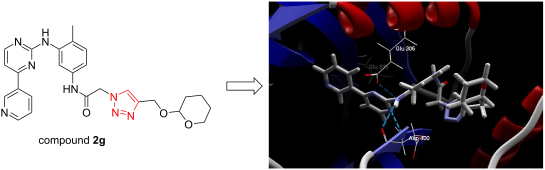
Figure 4: Interaction maps of IMT, 2c, 2d, and 2g with the BCR-Abl-1 structure (PDB code: 3PYY), showing ster...
Beilstein J. Org. Chem. 2021, 17, 2209–2259, doi:10.3762/bjoc.17.143
Graphical Abstract
Scheme 1: Nickel-catalyzed cross-coupling versus C‒H activation.
Figure 1: Oxidative and reductive quenching cycles of a photocatalyst. [PC] = photocatalyst, A = acceptor, D ...
Scheme 2: Photoredox nickel-catalyzed C(sp3)–H arylation of dimethylaniline (1a).
Scheme 3: Photoredox nickel-catalyzed arylation of α-amino, α-oxy and benzylic C(sp3)‒H bonds with aryl bromi...
Figure 2: Proposed catalytic cycle for the photoredox-mediated HAT and nickel catalysis enabled C(sp3)‒H aryl...
Scheme 4: Photoredox arylation of α-amino C(sp3)‒H bonds with aryl iodides.
Figure 3: Proposed mechanism for photoredox nickel-catalyzed α-amino C‒H arylation with aryl iodides.
Scheme 5: Nickel-catalyzed α-oxy C(sp3)−H arylation of cyclic and acyclic ethers.
Figure 4: Proposed catalytic cycle for the C(sp3)−H arylation of cyclic and acyclic ethers.
Scheme 6: Photochemical nickel-catalyzed C–H arylation of ethers.
Figure 5: Proposed catalytic cycle for the nickel-catalyzed arylation of ethers with aryl bromides.
Scheme 7: Nickel-catalyzed α-amino C(sp3)‒H arylation with aryl tosylates.
Scheme 8: Arylation of α-amino C(sp3)‒H bonds by in situ generated aryl tosylates from phenols.
Scheme 9: Formylation of aryl chlorides through redox-neutral 2-functionalization of 1,3-dioxolane (13).
Scheme 10: Photochemical C(sp3)–H arylation via a dual polyoxometalate HAT and nickel catalytic manifold.
Figure 6: Proposed mechanism for C(sp3)–H arylation through dual polyoxometalate HAT and nickel catalytic man...
Scheme 11: Photochemical nickel-catalyzed α-hydroxy C‒H arylation.
Scheme 12: Photochemical synthesis of fluoxetine (21).
Scheme 13: Photochemical nickel-catalyzed allylic C(sp3)‒H arylation with aryl bromides.
Figure 7: Proposed mechanism for the photochemical nickel-catalyzed allylic C(sp3)‒H arylation with aryl brom...
Scheme 14: Photochemical C(sp3)‒H arylation by the synergy of ketone HAT catalysis and nickel catalysis.
Figure 8: Proposed mechanism for photochemical C(sp3)‒H arylation by the synergy of ketone HAT catalysis and ...
Scheme 15: Benzophenone- and nickel-catalyzed photoredox benzylic C–H arylation.
Scheme 16: Benzaldehyde- and nickel-catalyzed photoredox C(sp3)–H arylation.
Scheme 17: Photoredox and nickel-catalyzed enantioselective benzylic C–H arylation.
Figure 9: Proposed mechanism for the photoredox and nickel-catalyzed enantioselective benzylic C–H arylation.
Scheme 18: Photoredox nickel-catalyzed α-(sp3)‒H arylation of secondary benzamides with aryl bromides.
Scheme 19: Enantioselective sp3 α-arylation of benzamides.
Scheme 20: Nickel-catalyzed decarboxylative vinylation/C‒H arylation of cyclic oxalates.
Figure 10: Proposed mechanism for the nickel-catalyzed decarboxylative vinylation/C‒H arylation of cyclic oxal...
Scheme 21: C(sp3)−H arylation of bioactive molecules using mpg-CN photocatalysis and nickel catalysis.
Figure 11: Proposed mechanism for the mpg-CN/nickel photocatalytic C(sp3)–H arylation.
Scheme 22: Nickel-catalyzed synthesis of 1,1-diarylalkanes from alkyl bromides and aryl bromides.
Figure 12: Proposed mechanism for photoredox nickel-catalyzed C(sp3)–H alkylation via polarity-matched HAT.
Scheme 23: Photoredox nickel-catalyzed C(sp3)‒H alkylation via polarity-matched HAT.
Scheme 24: Benzaldehyde- and nickel-catalyzed photoredox C(sp3)‒H alkylation of ethers.
Scheme 25: Benzaldehyde- and nickel-catalyzed photoredox C(sp3)‒H alkylation of amides and thioethers.
Scheme 26: Photoredox and nickel-catalyzed C(sp3)‒H alkylation of benzamides with alkyl bromides.
Scheme 27: CzIPN and nickel-catalyzed C(sp3)‒H alkylation of ethers with alkyl bromides.
Figure 13: Proposed mechanism for the CzIPN and nickel-catalyzed C(sp3)‒H alkylation of ethers.
Scheme 28: Nickel/photoredox-catalyzed methylation of (hetero)aryl chlorides and acid chlorides using trimethy...
Figure 14: Proposed catalytic cycle for the nickel/photoredox-catalyzed methylation of (hetero)aryl chlorides ...
Scheme 29: Photochemical nickel-catalyzed C(sp3)–H methylations.
Scheme 30: Photoredox nickel catalysis-enabled alkylation of unactivated C(sp3)–H bonds with alkyl bromides.
Scheme 31: Photochemical C(sp3)–H alkenylation with alkenyl tosylates.
Scheme 32: Photoredox nickel-catalyzed hydroalkylation of internal alkynes.
Figure 15: Proposed mechanism for the photoredox nickel-catalyzed hydroalkylation of internal alkynes.
Scheme 33: Photoredox nickel-catalyzed hydroalkylation of activated alkynes with C(sp3)−H bonds.
Scheme 34: Allylation of unactivated C(sp3)−H bonds with allylic chlorides.
Scheme 35: Photochemical nickel-catalyzed α-amino C(sp3)–H allylation of secondary amides with trifluoromethyl...
Scheme 36: Photoredox δ C(sp3)‒H allylation of secondary amides with trifluoromethylated alkenes.
Scheme 37: Photoredox nickel-catalyzed acylation of α-amino C(sp3)‒H bonds of N-arylamines.
Figure 16: Proposed mechanism for the photoredox nickel-catalyzed acylation of α-amino C(sp3)–H bonds of N-ary...
Scheme 38: Photocatalytic α‑acylation of ethers with acid chlorides.
Figure 17: Proposed mechanism for the photocatalytic α‑acylation of ethers with acid chlorides.
Scheme 39: Photoredox and nickel-catalyzed C(sp3)‒H esterification with chloroformates.
Scheme 40: Photoredox nickel-catalyzed dehydrogenative coupling of benzylic and aldehydic C–H bonds.
Figure 18: Proposed reaction pathway for the photoredox nickel-catalyzed dehydrogenative coupling of benzylic ...
Scheme 41: Photoredox nickel-catalyzed enantioselective acylation of α-amino C(sp3)–H bonds with carboxylic ac...
Scheme 42: Nickel-catalyzed C(sp3)‒H acylation with N-acylsuccinimides.
Figure 19: Proposed mechanism for the nickel-catalyzed C(sp3)–H acylation with N-acylsuccinimides.
Scheme 43: Nickel-catalyzed benzylic C–H functionalization with acid chlorides 45.
Scheme 44: Photoredox nickel-catalyzed benzylic C–H acylation with N-acylsuccinimides 84.
Scheme 45: Photoredox nickel-catalyzed acylation of indoles 86 with α-oxoacids 87.
Scheme 46: Nickel-catalyzed aldehyde C–H functionalization.
Figure 20: Proposed catalytic cycle for the photoredox nickel-catalyzed aldehyde C–H functionalization.
Scheme 47: Photoredox carboxylation of methylbenzenes with CO2.
Figure 21: Proposed mechanism for the photoredox carboxylation of methylbenzenes with CO2.
Scheme 48: Decatungstate photo-HAT and nickel catalysis enabled alkene difunctionalization.
Figure 22: Proposed catalytic cycle for the decatungstate photo-HAT and nickel catalysis enabled alkene difunc...
Scheme 49: Diaryl ketone HAT catalysis and nickel catalysis enabled dicarbofunctionalization of alkenes.
Figure 23: Proposed catalytic mechanism for the diaryl ketone HAT catalysis and nickel catalysis enabled dicar...
Scheme 50: Overview of photoredox nickel-catalyzed C–H functionalizations.
Beilstein J. Org. Chem. 2021, 17, 2194–2202, doi:10.3762/bjoc.17.141
Graphical Abstract
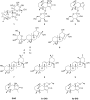
Figure 1: Structures of nomimicins A–D (4 and 1–3).
Figure 2: COSY and key HMBC correlations for 1.
Figure 3: Relative configuration of 1 determined by ROESY analysis.
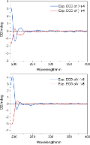
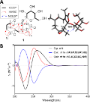
Figure 4: Experimental ECD spectra of 1, 2, and 4 and calculated ECD spectrum of 4.
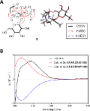
Figure 5: Four tautomers 4a–4d of the tetronic acid moiety of 4 and calculated ECD spectra.
Figure 6: COSY and key HMBC correlations for 3.
Figure 7: Relative configuration of 3 determined by NOESY analysis.
Beilstein J. Org. Chem. 2021, 17, 1981–2025, doi:10.3762/bjoc.17.129
Graphical Abstract
Figure 1: Overview of the methods available for the synthesis of polysaccharides. For each method, advantages...
Figure 2: Overview of the classes of polysaccharides discussed in this review. Each section deals with polysa...
Scheme 1: Enzymatic and chemical polymerization approaches provide cellulose oligomers with a non-uniform dis...
Scheme 2: AGA of a collection of cellulose analogues obtained using BBs 6–9. Specifically placed modification...
Figure 3: Chemical structure of the different branches G, X, L, F commonly found in XGs. Names are given foll...
Scheme 3: AGA of XG analogues with defined side chains. The AGA cycle includes coupling (TMSOTf), Fmoc deprot...
Figure 4: Synthetic strategies and issues associated to the formation of the β(1–3) linkage.
Scheme 4: Convergent synthesis of β(1–3)-glucans using a regioselective glycosylation strategy.
Scheme 5: DMF-mediated 1,2-cis glycosylation. A) General mechanism and B) examples of α-glucans prepared usin...
Scheme 6: Synergistic glycosylation strategy employing a nucleophilic modulation strategy (TMSI and Ph3PO) in...
Scheme 7: Different approaches to produce xylans. A) Polymerization techniques including ROP, and B) enzymati...
Scheme 8: A) Synthesis of arabinofuranosyl-decorated xylan oligosaccharides using AGA. Representative compoun...
Scheme 9: Chemoenzymatic synthesis of COS utilizing a lysozyme-catalyzed transglycosylation reaction followed...
Scheme 10: Synthesis of COS using an orthogonal glycosylation strategy based on the use of two different LGs.
Scheme 11: Orthogonal N-PGs permitted the synthesis of COS with different PA.
Scheme 12: AGA of well-defined COS with different PA using two orthogonally protected BBs. The AGA cycle inclu...
Scheme 13: A) AGA of β(1–6)-N-acetylglucosamine hexasaccharide and dodecasaccharide. AGA includes cycles of co...
Figure 5: ‘Double-faced’ chemistry exemplified for ᴅ-Man and ʟ-Rha. Constructing β-Man linkages is considerab...
Figure 6: Implementation of a capping step after each glycosylation cycle for the AGA of a 50mer oligomannosi...
Scheme 14: AGA enabled the synthesis of a linear α(1–6)-mannoside 100mer 93 within 188 h and with an average s...
Scheme 15: The 151mer branched polymannoside was synthesized by a [30 + 30 + 30 + 30 + 31] fragment coupling. ...
Figure 7: PG stereocontrol strategy to obtain β-mannosides. A) The mechanism of the β-mannosylation reaction ...
Scheme 16: A) Mechanism of 1,2-cis stereoselective glycosylation using ManA donors. Once the ManA donor is act...
Figure 8: A) The preferred 4H3 conformation of the gulosyl oxocarbenium ion favors the attack of the alcohol ...
Scheme 17: AGA of type I rhamnans up to 16mer using disaccharide BB 115 and CNPiv PG. The AGA cycle includes c...
Figure 9: Key BBs for the synthesis of the O-antigen of Bacteroides vulgatus up to a 128mer (A) and the CPS o...
Figure 10: Examples of type I and type II galactans synthesized to date.
Figure 11: A) The DTBS PG stabilizes the 3H4 conformation of the Gal oxocarbenium ion favoring the attack of t...
Figure 12: Homogalacturonan oligosaccharides synthesized to date. Access to different patterns of methyl-ester...
Figure 13: GlfT2 from Mycobacterium tuberculosis catalyzes the sequential addition of UPD-Galf donor to a grow...
Figure 14: The poor reactivity of acceptor 137 hindered a stepwise synthesis of the linear galactan backbone a...
Scheme 18: AGA of a linear β(1–5) and β(1–6)-linked galactan 20mer. The AGA cycle includes coupling (NIS/TfOH)...
Figure 15: The 92mer arabinogalactan was synthesized using a [31 + 31 + 30] fragment coupling between a 31mer ...
Scheme 19: Synthesis of the branched arabinofuranose fragment using a six component one-pot synthesis. i) TTBP...
Figure 16: A) Chemical structure and SNFG of the representative disaccharide units forming the GAG backbones, ...
Figure 17: Synthetic challenges associated to the H/HS synthesis.
Scheme 20: Degradation of natural heparin and heparosan generated valuable disaccharides 150 and 151 that can ...
Scheme 21: A) The one-step conversion of cyanohydrin 156 to ʟ-iduronamide 157 represent the key step for the s...
Scheme 22: A) Chemoenzymatic synthesis of heparin structures, using different types of UDP activated natural a...
Scheme 23: Synthesis of the longest synthetic CS chain 181 (24mer) using donor 179 and acceptor 180 in an iter...
Scheme 24: AGA of a collection of HA with different lengths. The AGA cycle includes coupling (TfOH) and Lev de...
Beilstein J. Org. Chem. 2021, 17, 1814–1827, doi:10.3762/bjoc.17.124
Graphical Abstract
Figure 1: Schematic overview of fungal interactions in the environment. Fungi can be found in essentially all...
Figure 2: Fungal derived bioactive natural compounds with ecological and/or economic relevance.
Figure 3: Gliotoxin biosynthetic gene cluster and it major biosynthetic transformations: Gliotoxin (5) is the...
Figure 4: Amoebicidal secondary metabolites trypacidin and fumagillin of Aspergillus fumigatus.
Figure 5: Intermediates of the DHN-melanin biosynthesis in Aspergillus fumigatus.
Figure 6: Intermediates and products of the fumigaclavine C biosynthesis.
Figure 7: Bioactive secondary metabolites of Aspergillus fumigatus.
Figure 8: Helvolic acid gene cluster of A. fumigatus.
Beilstein J. Org. Chem. 2021, 17, 1752–1813, doi:10.3762/bjoc.17.123
Graphical Abstract
Scheme 1: Fluorination with N-F amine 1-1.
Scheme 2: Preparation of N-F amine 1-1.
Scheme 3: Reactions of N-F amine 1-1.
Scheme 4: Synthesis of N-F perfluoroimides 2-1 and 2-2.
Scheme 5: Synthesis of 1-fluoro-2-pyridone (3-1).
Scheme 6: Fluorination with 1-fluoro-2-pyridone (3-1).
Figure 1: Synthesis of N-F sulfonamides 4-1a–g.
Scheme 7: Fluorination with N-F reagent 4-1b,c,f.
Scheme 8: Fluorination of alkenyllithiums with N-F 4-1h.
Scheme 9: Synthesis of N-fluoropyridinium triflate (5-4a).
Scheme 10: Synthetic methods for N-F-pyridinium salts.
Figure 2: Synthesis of various N-fluoropyridinium salts. Note: athis yield was the one by the improved method...
Scheme 11: Fluorination power order of N-fluoropyridinium salts.
Scheme 12: Fluorinations with N-F salts 5-4.
Scheme 13: Fluorination of Corey lactone 5-7 with N-F-bis(methoxymethyl) salt 5-4l.
Scheme 14: Fluorination with NFPy.
Scheme 15: Synthesis of the N-F reagent, N-fluoroquinuclidinium fluoride (6-1).
Scheme 16: Fluorinations achieved with N-F fluoride 6-1.
Scheme 17: Synthesis of N-F imides 7-1a–g.
Scheme 18: Fluorination with (CF3SO2)2NF, 7-1a.
Scheme 19: Fluorination reactions of various substrates with 7-1a.
Scheme 20: Synthesis of N-F triflate 8-1.
Scheme 21: Synthesis of chiral N-fluoro sultams 9-1 and 9-2.
Scheme 22: Fluorination with chiral N-fluoro sultams 9-1 and 9-2.
Scheme 23: Synthesis of saccharin-derived N-fluorosultam 10-2.
Scheme 24: Fluorination with N-fluorosultam 10-2.
Scheme 25: Synthesis of N-F reagent 11-2.
Scheme 26: Fluorination with N-F reagent 11-2.
Scheme 27: Synthesis and reaction of N-fluorolactams 12-1.
Scheme 28: Synthesis of NFOBS 13-2.
Scheme 29: Fluorination with NFOBS 13-2.
Scheme 30: Synthesis of NFSI (14-2).
Scheme 31: Fluorination with NFSI 14-2.
Scheme 32: Synthesis of N-fluorosaccharin (15-1) and N-fluorophthalimide (15-2).
Scheme 33: Synthesis of N-F salts 16-3.
Scheme 34: Fluorination with N-F salts 16-3.
Figure 3: Monofluorination with Selectfluor (16-3a).
Figure 4: Difluorination with Selectfluor (16-3a).
Scheme 35: Transfer fluorination of Selectfluor (16-3a).
Scheme 36: Fluorination of substrates with Selectfluor (16-3a).
Scheme 37: Synthesis of chiral N-fluoro-sultam 17-2.
Scheme 38: Asymmetric fluorination with chiral 17-2.
Figure 5: Synthesis of Zwitterionic N-fluoropyridinium salts 18-2a–h.
Scheme 39: Fluorinating power order of zwitterionic N-fluoropyridinium salts.
Scheme 40: Fluorination with zwitterionic 18-2.
Scheme 41: Activation of salt 18-2h with TfOH.
Scheme 42: Synthesis of NFTh, 19-2.
Scheme 43: Fluorination with NFTh, 19-2.
Scheme 44: Synthesis of 3-fluorobenzo-1,2,3-oxathiazin-4-one 2,2-dioxide (20-2).
Scheme 45: Fluorination with 20-2.
Scheme 46: Synthesis of N-F amide 21-3.
Scheme 47: Fluorination with N-F amide 21-2.
Scheme 48: Synthesis of N,N’-difluorodiazoniabicyclo[2.2.2]octane salts 22-1.
Scheme 49: One-pot synthesis of N,N’-difluoro-1,4-diazoniabicyclo[2.2.2]octane bistetrafluoroborate salt (22-1d...
Figure 6: Fluorination of anisole with 22-1a, d, e.
Scheme 50: Fluorination with N,N’-diF bisBF4 22-1d.
Scheme 51: Synthesis of bis-N-F reagents 23-1–5.
Scheme 52: Fluorination with 23-2, 4, 5.
Figure 7: Synthesis of N,N’-difluorobipyridinium salts 24-2.
Figure 8: Controlled fluorination of N,N’-diF 24-2.
Scheme 53: Fluorinating power of N,N’-diF salts 24-2 and N-F salt 5-4a.
Scheme 54: Fluorination reactions with SynfluorTM (24-2b).
Scheme 55: Additional fluorination reactions with SynfluorTM (24-2b).
Scheme 56: Synthesis of N-F 25-1.
Scheme 57: Fluorination of polycyclic aromatics with 25-1.
Scheme 58: Synthesis of 26-1 and dimethyl analog 26-2.
Scheme 59: Fluorination with reagents 26-1, 26-2, 1-1, and 26-3.
Scheme 60: Synthesis of N-F reagent 27-2.
Scheme 61: Synthesis of chiral N-F reagents 27-6.
Scheme 62: Synthesis of chiral N-F 27-7–9.
Scheme 63: Asymmetric fluorination with 27-6.
Scheme 64: Synthesis of chiral N-F reagents 28-3.
Scheme 65: Asymmetric fluorination with 28-3.
Scheme 66: Synthesis of chiral N-F reagents 28-7.
Figure 9: Asymmetric fluorination with 28-7.
Scheme 67: In situ formation of N-fluorinated cinchona alkaloids with SelectfluorTM.
Scheme 68: Asymmetric fluorination with N-F alkaloids formed in situ.
Scheme 69: Synthesis of N-fluorocinchona alkaloids with Selectfluor.
Scheme 70: Asymmetric fluorination with 30-1–4.
Scheme 71: Transfer fluorination from various N-F reagents.
Figure 10: Asymmetric fluorination of silyl enol ethers.
Scheme 72: Synthesis of N-fluoro salt 32-2.
Scheme 73: Reactivity of N-fluorotriazinium salt 32-2.
Scheme 74: Synthesis of bulky N-fluorobenzenesulfonimide NFBSI 33-3.
Scheme 75: Comparison of NFSI and NFBSI.
Scheme 76: Synthesis of p-substituted N-fluorobenzenesulfonimides 34-3.
Figure 11: Asymmetric fluorination with 34-3 and a chiral catalyst 34-4.
Scheme 77: 1,4-Fluoroamination with Selecfluor and a chiral catalyst.
Figure 12: Asymmetric fluoroamination with 35-5a, b.
Scheme 78: Synthesis of Selectfluor analogs 35-5a, b.
Scheme 79: Synthesis of chiral dicationic DABCO-based N-F reagents 36-5.
Scheme 80: Asymmetric fluorocyclization with chiral 36-5b.
Scheme 81: Synthesis of chiral 37-2a,b.
Scheme 82: Asymmetric fluorination with chiral 37-2a,b.
Scheme 83: Asymmetric fluorination with chiral 37-2b.
Scheme 84: Reaction of indene with chiral 37-2a,b.
Scheme 85: Synthesis of Me-NFSI, 38-2.
Scheme 86: Fluorination of active methine compounds with Me-NFSI.
Scheme 87: Fluorination of malonates with Me-NFSI.
Scheme 88: Fluorination of keto esters with Me-NFSI.
Scheme 89: Synthesis of N-F 39-3 derived from the ethylene-bridged Tröger’s base.
Scheme 90: Fluorine transfer from N-F 39-3.
Scheme 91: Fluorination with N-F 39-3.
Scheme 92: Synthesis of SelectfluorCN.
Scheme 93: Bistrifluoromethoxylation of alkenes using SelectfluorCN.
Figure 13: Synthesis of NFAS 41-2.
Scheme 94: Radical fluorination with different N-F reagents.
Scheme 95: Radical fluorination of alkenes with NFAS 41-2.
Scheme 96: Radical fluorination of alkenes with NFAS 41-2f.
Scheme 97: Decarboxylative fluorination with NFAS 41-2a,f.
Scheme 98: Fluorine plus detachment (FPD).
Figure 14: FPD values of representative N-F reagents in CH2Cl2 and CH3CN (in parentheses). Adapted with permis...
Scheme 99: N-F homolytic bond dissociation energy (BDE).
Figure 15: BDE values of representative N-F reagents in CH3CN. Adapted with permission from ref. [127]. Copyright 2...
Figure 16: Quantitative reactivity scale for popular N-F reagents. Adapted with permission from ref. [138], publish...
Scheme 100: SET and SN2 mechanisms.
Scheme 101: Radical clock reactions.
Scheme 102: Reaction of potassium enolate of citronellic ester with N-F reagents, 10-1, NFSI, and 8-1.
Scheme 103: Reaction of compound IV with Selectfluor (OTf) and NFSI.
Scheme 104: Reaction of TEMPO with Selecfluor.
Beilstein J. Org. Chem. 2021, 17, 1712–1724, doi:10.3762/bjoc.17.119
Graphical Abstract
Figure 1: A systems glycobiology framework to link multi-OMICs data. a) Cell signaling proceeds to trigger TF...
Figure 2: Analysis workflow: ChiP-Seq provides evidence of TF binding to promoter regions with 0 ≤ RP ≤ 1, qu...
Figure 3: Summary of TFs enriched to glycosylation pathways for luminal and basal breast cancer: The TFs foun...
Figure 4: Luminal breast cancer signaling pathway enrichment and glycogene connections. a) TF-to-glycogene co...
Figure 5: Basal breast cancer signaling pathway enrichments and glycogene connections. a) TF-to-glycogene com...
Figure 6: Summary of TF–glycopathway enrichments across all cancer types: TF enrichments to glycopathways acr...
Beilstein J. Org. Chem. 2021, 17, 1689–1697, doi:10.3762/bjoc.17.117
Graphical Abstract
Scheme 1: Mechanism for the phosphine-initiated oxa-Michael addition.
Figure 1: Above: Michael acceptors, Michael donors and catalysts used in this study; pKa (respectively pKa of...
Figure 2: Left: double-bond conversion of the polymerization of 4 initiated by 5 mol % TPP, MMTPP or TMTPP af...
Figure 3: Left: Oxidation stability of the phosphines. Phosphine oxide content in % as determined by 31P NMR ...
Beilstein J. Org. Chem. 2021, 17, 1352–1359, doi:10.3762/bjoc.17.94
Graphical Abstract
Scheme 1: Synthesis of alkynes from carbonyl compounds through one-carbon homologation.
Scheme 2: Reactions of magnesium alkylidene carbenoids 3, generated from sulfoxides 2 and iPrMgCl.
Scheme 3: Synthesis of sulfoxides 2 and 5–8 from carbonyl compounds 1.
Scheme 4: Reaction of sulfoxides 5 and 6 with isopropylmagnesium chloride.
Scheme 5: Reaction of sulfoxide 2c with isopropylmagnesium chloride.
Scheme 6: Reaction of 13C-labeled sulfoxides [13C]-(E)-2e and [13C]-(Z)-2e with iPrMgCl.
Scheme 7: A plausible reaction mechanism for the formation of alkynes 4. a) 1,2-Rearrangement readily takes p...
Figure 1: Optimized geometries of reactant (E)-3e, transition state (E)-3e‡, and product 4e·MgCl2 for the FBW...
Beilstein J. Org. Chem. 2021, 17, 1149–1170, doi:10.3762/bjoc.17.88
Graphical Abstract
Figure 1: 5-Halo-substituted porphyrins.
Figure 2: Expanded view (thermal ellipsoid) of compound 1 in the crystal showing (A) stacking, (B) tilted edg...
Figure 3: Expanded view (ball and stick) of compound 2 in the crystal showing (A) stacking, (B) bromine atoms...
Figure 4: Expanded view (ball and stick) of compound 3 in the crystal showing (A) stacking and (B) edge-on in...
Figure 5: Hirshfeld surfaces of compounds 1–3.
Figure 6: Contact percentages of compounds 1–3.
Figure 7: NSD charts for compounds 1–3.
Figure 8: Expanded view (thermal ellipsoid plot) of compound 2A showing (A) the edge-on and stacking interact...
Figure 9: 5-Halo-15-phenyl-substituted porphyrins.
Figure 10: Expanded view (thermal ellipsoid plot) of compound 4 showing (A) tilted alignment of porphyrin ring...
Figure 11: Expanded view (thermal ellipsoid plot) of compound 5 showing (A) porphyrin stacking and (B) Br···H ...
Figure 12: Expanded view (thermal ellipsoid plot) of compounds 6 (A and C) and 7 (B and D) showing (A) Br···H ...
Figure 13: 5,15-Di-halo-substituted porphyrins.
Figure 14: Expanded view (thermal ellipsoid plot) of compound 9 showing the Br···H interactions with (A) pyrro...
Figure 15: Expanded view (thermal ellipsoid plot) of compound 10 showing the (A) Br···H interactions with toly...
Figure 16: Expanded view (thermal ellipsoid plot) of compound 11 showing the (A) edge-on interactions, (B) edg...
Figure 17: Expanded view (thermal ellipsoid plot) of compound 13 showing (A) Br···H interactions with pyrrole ...
Figure 18: Expanded view (ball and stick) of compound 13A showing (A) Br···H interactions with pyrrole units a...
Figure 19: 5,10-Di-halo-substituted porphyrins.
Figure 20: Expanded view (ball and stick) of compound 16 showing (A) stacking, (B) head-to-tail alignment, (C)...
Figure 21: Honorable mentions of halogen-substituted porphyrins taken from the CSD database.
Figure 22: Series 1 – 5,15-di-halo-substituted porphyrins.
Figure 23: Series 2 – increasing number of halogen substituents.
Figure 24: Series 3 – 5,10-di-halo-substituted porphyrins.
Beilstein J. Org. Chem. 2021, 17, 1096–1140, doi:10.3762/bjoc.17.86
Graphical Abstract
Scheme 1: General strategy for the enantioselective synthesis of N-containing heterocycles from N-tert-butane...
Scheme 2: Methodologies for condensation of aldehydes and ketones with tert-butanesulfinamides (1).
Scheme 3: Transition models for cis-aziridines and trans-aziridines.
Scheme 4: Mechanism for the reduction of N-tert-butanesulfinyl imines.
Scheme 5: Transition models for the addition of organomagnesium and organolithium compounds to N-tert-butanes...
Scheme 6: Synthesis of 2,2-dibromoaziridines 15 from aldimines 14 and bromoform, and proposed non-chelation-c...
Scheme 7: Diastereoselective synthesis of aziridines from tert-butanesulfinyl imines.
Scheme 8: Synthesis of vinylaziridines 22 from aldimines 14 and 1,3-dibromopropene 23, and proposed chelation...
Scheme 9: Synthesis of vinylaziridines 27 from aldimines 14 and α-bromoesters 26, and proposed transition sta...
Scheme 10: Synthesis of 2-chloroaziridines 28 from aldimines 14 and dichloromethane, and proposed transition s...
Scheme 11: Synthesis of cis-vinylaziridines 30 and 31 from aldimines 14 and bromomethylbutenolide 29.
Scheme 12: Synthesis of 2-chloro-2-aroylaziridines 36 and 32 from aldimines 14, arylnitriles 34, and silyldich...
Scheme 13: Synthesis of trifluoromethylaziridines 39 and proposed transition state of the aziridination.
Scheme 14: Synthesis of aziridines 42 and proposed state transition.
Scheme 15: Synthesis of 1-substituted 2-azaspiro[3.3]heptanes, 1-phenyl-2-azaspiro[3.4]octane and 1-phenyl-2-a...
Scheme 16: Synthesis of 1-substituted 2,6-diazaspiro[3.3]heptanes 48 from chiral imines 14 and 1-Boc-azetidine...
Scheme 17: Synthesis of β-lactams 52 from chiral imines 14 and dimethyl malonate (49).
Scheme 18: Synthesis of spiro-β-lactam 57 from chiral (RS)-N-tert-butanesulfinyl isatin ketimine 53 and ethyl ...
Scheme 19: Synthesis of β-lactam 60, a precursor of (−)-batzelladine D (61) and (−)-13-epi-batzelladine D (62)...
Scheme 20: Rhodium-catalyzed asymmetric synthesis of 3-substituted pyrrolidines 66 from chiral imine (RS)-63 a...
Scheme 21: Asymmetric synthesis of 1,3-disubstituted isoindolines 69 and 70 from chiral imine 67.
Scheme 22: Asymmetric synthesis of cis-2,5-disubstituted pyrrolidines 73 from chiral imine (RS)-71.
Scheme 23: Asymmetric synthesis of 3-hydroxy-5-substituted pyrrolidin-2-ones 77 from chiral imine (RS)-74.
Scheme 24: Asymmetric synthesis of 4-hydroxy-5-substituted pyrrolidin-2-ones 80 from chiral imines 79.
Scheme 25: Asymmetric synthesis of 3-pyrrolines 82 from chiral imines 14 and ethyl 4-bromocrotonate (81).
Scheme 26: Asymmetric synthesis of γ-amino esters 84, and tetramic acid derivative 86 from chiral imines (RS)-...
Scheme 27: Asymmetric synthesis of α-methylene-γ-butyrolactams 90 from chiral imines (Z,SS)-87 and ethyl 2-bro...
Scheme 28: Asymmetric synthesis of methylenepyrrolidines 92 from chiral imines (RS)-14 and 2-(trimethysilylmet...
Scheme 29: Synthesis of dibenzoazaspirodecanes from cyclic N-tert-butanesulfinyl imines.
Scheme 30: Stereoselective synthesis of cyclopenta[c]proline derivatives 103 from β,γ-unsaturated α-amino acid...
Scheme 31: Stereoselective synthesis of alkaloids (−)-angustureine (107) and (−)-cuspareine (108).
Scheme 32: Stereoselective synthesis of alkaloids (−)-pelletierine (112) and (+)-coniine (117).
Scheme 33: Synthesis of piperidine alkaloids (+)-dihydropinidine (122a), (+)-isosolenopsin (122b) and (+)-isos...
Scheme 34: Stereoselective synthesis of the alkaloids(+)-sedamine (125) from chiral imine (SS)-119.
Scheme 35: Stereoselective synthesis of trans-5-hydroxy-6-substituted-2-piperidinones 127 and 129 from chiral ...
Scheme 36: Stereoselective synthesis of trans-5-hydroxy-6-substituted ethanone-2-piperidinones 132 from chiral...
Scheme 37: Stereoselective synthesis of trans-3-benzyl-5-hydroxy-6-substituted-2-piperidinones 136 from chiral...
Scheme 38: Stereoselective synthesis of trans-5-hydroxy-6-substituted 2-piperidinones 139 from chiral imine 138...
Scheme 39: Stereoselective synthesis of ʟ-hydroxypipecolic acid 145 from chiral imine 144.
Scheme 40: Synthesis of 1-substituted isoquinolones 147, 149 and 151.
Scheme 41: Stereoselective synthesis of 3-substituted dihydrobenzo[de]isoquinolinones 154.
Scheme 42: Enantioselective synthesis of alkaloids (S)-1-benzyl-6,7-dimethoxy-1,2,3,4-tetrahydroisoquinoline (...
Scheme 43: Enantioselective synthesis of alkaloids (−)-cermizine B (171) and (+)-serratezomine E (172) develop...
Scheme 44: Stereoselective synthesis of (+)-isosolepnosin (177) and (+)-solepnosin (178) from homoallylamine d...
Scheme 45: Stereoselective synthesis of tetrahydroquinoline derivatives 184, 185 and 187 from chiral imines (RS...
Scheme 46: Stereoselective synthesis of pyridobenzofuran and pyridoindole derivatives 193 from homopropargylam...
Scheme 47: Stereoselective synthesis of 2-substituted 1,2,5,6-tetrahydropyridines 196 from chiral imines (RS)-...
Scheme 48: Stereoselective synthesis of 2-substituted trans-2,6-disubstituted piperidine 199 from chiral imine...
Scheme 49: Stereoselective synthesis of cis-2,6-disubstituted piperidines 200, and alkaloid (+)-241D, from chi...
Scheme 50: Stereoselective synthesis of 6-substituted piperidines-2,5-diones 206 and 1,7-diazaspiro[4.5]decane...
Scheme 51: Stereoselective synthesis of spirocyclic oxindoles 210 from chiral imines (RS)-53.
Scheme 52: Stereoselective synthesis of azaspiro compound 213 from chiral imine 211.
Scheme 53: Stereoselective synthesis of tetrahydroisoquinoline derivatives from chiral imines (RS)-214.
Scheme 54: Stereoselective synthesis of (−)-crispine A 223 from chiral imine (RS)-214.
Scheme 55: Synthesis of (−)-harmicine (228) using tert-butanesulfinamide through haloamide cyclization.
Scheme 56: Stereoselective synthesis of tetraponerines T1–T8.
Scheme 57: Stereoselective synthesis of phenanthroindolizidines 246a and (−)-tylophorine (246b), and phenanthr...
Scheme 58: Stereoselective synthesis of indoline, tetrahydroquinoline and tetrahydrobenzazepine derivatives 253...
Scheme 59: Stereoselective synthesis of (+)-epohelmin A (258) and (+)-epohelmin B (260) from aldimine (RS)-79.
Scheme 60: Stereoselective synthesis of (−)-epiquinamide (266) from chiral aldimine (SS)-261.
Scheme 61: Synthesis synthesis of (–)-hippodamine (273) and (+)-epi-hippodamine (272) using chiral sulfinyl am...
Scheme 62: Stereoselective synthesis of (+)-grandisine D (279) and (+)-amabiline (283).
Scheme 63: Stereoselective synthesis of (−)-epiquinamide (266) and (+)-swaisonine (291) from aldimine (SS)-126....
Scheme 64: Stereoselective synthesis of (+)-C(9a)-epi-epiquinamide (294).
Scheme 65: Stereoselective synthesis of (+)-lasubine II (298) from chiral aldimine (SS)-109.
Scheme 66: Stereoselective synthesis of (−)-epimyrtine (300a) and (−)-lasubine II (ent-302) from β-amino keton...
Scheme 67: Stereoselective synthesis of (−)-tabersonine (310), (−)-vincadifformine (311), and (−)-aspidospermi...
Scheme 68: Stereoselective synthesis of (+)-epohelmin A (258) and (+)-epohelmin B (260) from aldehyde 313 and ...
Scheme 69: Total synthesis of (+)-lysergic acid (323) from N-tert-butanesulfinamide (RS)-1.
Beilstein J. Org. Chem. 2021, 17, 964–976, doi:10.3762/bjoc.17.78
Graphical Abstract
Scheme 1: Scope of glycosyl acceptors for glycosylation with pivaloyl-protected mannosyl fluoride α-1a in liq...
Scheme 2: Glycosylation of binucleophiles 7a,b in liquid SO2.
Scheme 3: Pivaloyl-protected glucosyl fluoride β-9 as a glycosyl donor in liquid SO2.
Scheme 4: Benzyl protected manno- and glucopyranosyl fluorides α-15 and 16 as glycosyl donors in liquid SO2. ...
Scheme 5: 2-Deoxy glycosyl fluoride α-19 as a glycosyl donor in liquid SO2.
Figure 1: Detection of the FSO2− species by 19F NMR (471 MHz, D2O).
Figure 2: Computational study of reaction mechanism α-11 + MeOH → α-13c in the presence of and in absence of ...
Beilstein J. Org. Chem. 2021, 17, 800–804, doi:10.3762/bjoc.17.68
Graphical Abstract
Scheme 1: Overview about established methods to access enantioenriched 2 and the herein investigated kinetic ...
Scheme 2: Use of alternative acylating agents 4 for the kinetic resolution of rac-2.
Beilstein J. Org. Chem. 2021, 17, 671–677, doi:10.3762/bjoc.17.56
Graphical Abstract
Figure 1: Benzonaphthophosphindoles.
Scheme 1: Synthesis of benzo[f]naphtho[2,3-b]phosphoindoles.
Figure 2: Crystal structure of 2: different views.
Figure 3: a) Absorption spectra and b) normalized fluorescence spectra for selected compounds in CHCl3.
Figure 4: The spatial plots of the HOMO−3 to LUMO of compounds 3 and 4. The calculations were performed at th...