

Search results
Search for "TEMPO" in Full Text gives 184 result(s) in Beilstein Journal of Organic Chemistry.
On the proposed structures and stereocontrolled synthesis of the cephalosporolides
Beilstein J. Org. Chem. 2012, 8, 1287–1292, doi:10.3762/bjoc.8.146
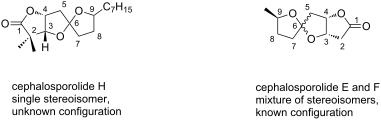
- internal alkyne 6, which was submitted to gold-catalyzed cycloisomerization [33] to afford spiroketals 7a and 7b (the silyl ether is concomitantly hydrolyzed) as a 1:1 mixture of isomers. Exposure of this mixture to zinc chloride promoted isomerization to provide 7a in >20:1 dr. TEMPO oxidation then
- completed the synthesis of 1, the reported structure of cephalosporolide H. The opposite spiroketal isomer 1a was prepared from 6 by palladium-catalyzed cycloisomerization (steric control), desilylation and TEMPO oxidation. In neither case did the characterization data match that of the natural material
- subjected to TEMPO oxidation to afford spiroketal lactones 1b and 1c. Spectroscopic data of 1b and 1c were similar to 1a and 1, respectively. Attempts to secure an authentic sample and/or copies of original NMR spectra for the natural material were unsuccessful, but two candidates emerged as good fits to


Reduction of benzylic alcohols and α-hydroxycarbonyl compounds by hydriodic acid in a biphasic reaction medium
Beilstein J. Org. Chem. 2012, 8, 330–336, doi:10.3762/bjoc.8.36
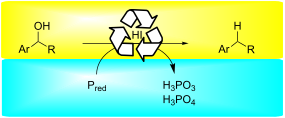
- a trapping experiment, using HI without phosphorous, diphenylcarbinol as the substrate and TEMPO as a trapping agent for radical intermediates, the TEMPO adduct of diphenylcarbinol was detected by mass analysis. This indicates a radical mechanism of the redox comproportionation. We suggest a
- stepwise reduction by single electron transfer (SET) accompanied by the oxidation of I− to I2. The iodine, generated in the second step, is recycled by reduction with red phosphorous, regenerating hydriodic acid. Admittedly, the above-mentioned TEMPO adduct could also be generated by nucleophilic
- substitution of the alkyl iodide with reduced TEMPO. At least this would be another proof for the first reaction step. According to the redox equations of the reaction between iodine and red phosphorous, each mole of red phosphorous is able to reduce at least 1.5 mol of iodine. Catalytic amounts of hydriodic


Convergent synthesis of the tetrasaccharide repeating unit of the O-antigen of Shigella boydii type 9
Beilstein J. Org. Chem. 2011, 7, 1182–1188, doi:10.3762/bjoc.7.137
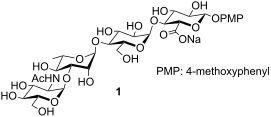
- achieved in excellent yield using a [2 + 2] block glycosylation strategy. TEMPO-mediated selective oxidation of the primary alcohol of the tetrasaccharide derivative 8 to the carboxylic group followed by deprotection of the functional groups furnished target tetrasaccharide 1 as its 4-methoxyphenyl
- conversion of O-acetyl group to O-benzyl group [22], (iv) activation of glycosyl trichloroacetimidate and thioglycoside donors by perchloric acid supported on silica (HClO4–SiO2) [23][24][25][26], and late stage TEMPO mediated selective oxidation [27][28][29] of the primary hydroxy group to the carboxylic
- subjected to a reaction sequence involving (a) deacetylation using 0.1 M sodium methoxide in methanol; (b) TEMPO mediated selective oxidation [27][28][29] of the primary hydroxy group leaving secondary hydroxy groups unaffected in a phase transfer reaction condition and (c) removal of benzyl groups for


A gold-catalyzed alkyne-diol cycloisomerization for the synthesis of oxygenated 5,5-spiroketals
Beilstein J. Org. Chem. 2011, 7, 570–577, doi:10.3762/bjoc.7.66
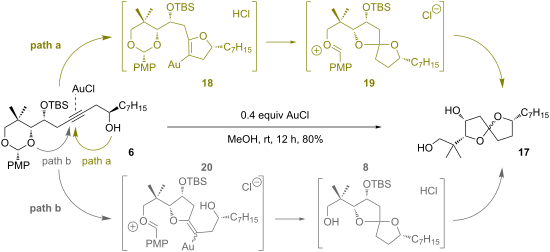
- single diastereomer upon chelation with zinc chloride. TEMPO oxidation gave lactone 1, which corresponds to the reported structure of cephalosporolide H. A more detailed discussion is found in our earlier report [28]. Two mechanistic alternatives (Scheme 7) are proposed for the conversion of 6 → 17 in


Thermal rearrangement of tert-butylsulfinamide
Beilstein J. Org. Chem. 2011, 7, 9–12, doi:10.3762/bjoc.7.2

- TEMPO a radical initiator (entries 22 and 23) or by a radical inhibitor 2,6-di-tert-butylphenol (entry 24). When the reagent 1 alone was subjected to thermal rearrangement (entry 1), complete consumption of starting material was observed. Only 27% product was isolated and 73% of the material was lost by


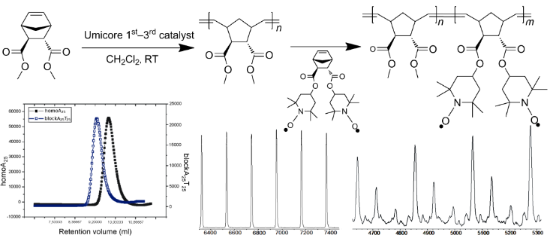
Synthesis and crossover reaction of TEMPO containing block copolymer via ROMP
Beilstein J. Org. Chem. 2010, 6, No. 59, doi:10.3762/bjoc.6.59


Synthesis of gem-difluoromethylenated analogues of boronolide
Beilstein J. Org. Chem. 2010, 6, No. 37, doi:10.3762/bjoc.6.37
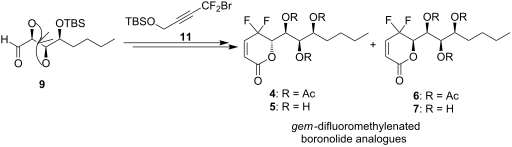
- aldehyde 9 with the fluorine-containing building block 11 and the efficient construction of α,β-unsaturated-δ-lactones 15a–b via BAIB/TEMPO-procedure. Keywords: boronolide; gem-difluoromethylenated analogues; gem-difluoropropargylation; α,β-unsaturated-δ-lactones; Introduction (+)-Boronolide (1
- –quinoline system [26], leading to the expected alcohol 13a in 96% yield. Subsequent selective removal of the primary TBS group in 13a with D-camphor-10-sulfonic acid (CSA) yielded the diol 14a in 80% yield. As expected, treatment of compound 14a with 0.2 equiv of 2,2,6,6-tetramethyl-1-piperidinyloxy (TEMPO
- and the efficient construction of α,β-unsaturated-δ-lactones 15a–b via the BAIB/TEMPO-procedure. Boronolide (1), boronolide analogues 2–3 and gem-difluoromethylenated analogues 4–7. Retrosynthetic analysis of target molecules 4–7. Synthesis of target molecules 4–5. Synthesis of target molecules 6–7


Green oxidations: Titanium dioxide induced tandem oxidation coupling reactions
Beilstein J. Org. Chem. 2009, 5, No. 24, doi:10.3762/bjoc.5.24

- . Herein, we describe the application of titanium dioxide in conjunction with 2,2,6,6-tetramethylpiperidine-1-oxyl radical (TEMPO) as an oxidant in the synthesis of quinoxalines, via the tandem oxidation process (TOP) (Scheme 1). Results and Discussion Titanium dioxide in the anatase phase is a
- positive holes to the surface and subsequent hydroxyl radical formation [24]. It is believed that a similar interaction is taking place in our system and in conjunction with TEMPO lead to the formation of keto-aldehydes or diketones, which are trapped in situ to produce the required products. In an attempt
- TEMPO for the selective oxidation of alcohols to aldehydes and ketones. In our studies we have been examining similar systems with a view to incorporating them into tandem type processes. Conclusion In summary, we have reported the use of titanium dioxide as a tandem oxidation catalyst, demonstrated by


A biphasic oxidation of alcohols to aldehydes and ketones using a simplified packed- bed microreactor
Beilstein J. Org. Chem. 2009, 5, No. 17, doi:10.3762/bjoc.5.17
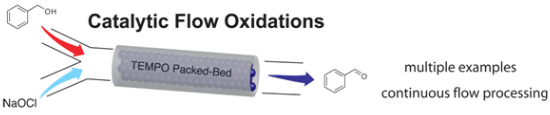
- characterization of a simplified packed-bed microreactor using an immobilized TEMPO catalyst shown to oxidize primary and secondary alcohols via the biphasic Anelli-Montanari protocol. Oxidations occurred in high yields with great stability over time. We observed that plugs of aqueous oxidant and organic alcohol
- 100 trials without showing any loss of catalytic activity. Keywords: alcohol oxidation; flow chemistry; heterogeneous catalysis; microreactors; TEMPO; Introduction Microreactors have gained attention because they can help run chemical transformations more efficiently, more selectively, and with a
- leaching nor the need for catalyst regeneration [22]. Nitroxyl radicals, such as 2,2,6,6-tetramethylpiperidine-1-oxyl (TEMPO), immobilized on silicates [23][24][25][26][27][28][29][30][31][32], fluorous supports [33], soluble and insoluble polymers [22][34][35][36], magnetic nanoparticles [37], and ionic




Other Beilstein-Institut Open Science Activities