
Search results
Search for "simulations" in Full Text gives 164 result(s) in Beilstein Journal of Organic Chemistry.
Peptides presenting the binding site of human CD4 for the HIV-1 envelope glycoprotein gp120
Beilstein J. Org. Chem. 2012, 8, 1858–1866, doi:10.3762/bjoc.8.214
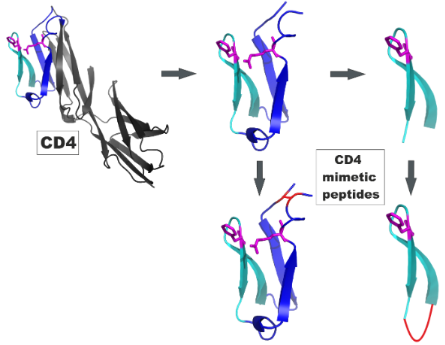
- through cyclization, as evidenced by binding assays, as well as through molecular-dynamics simulations of peptide–gp120 complexes. The specificity of the peptide–gp120 interaction was demonstrated by using peptide variants, in which key residues for the interaction with gp120 were replaced by alanine or D
- binding properties of CD4-M1 and CD4-M2, molecular dynamics (MD) simulations of the peptides in complex with gp120 were carried out and compared to a simulation of the CD4–gp120 complex. Analysis confirmed that the linear peptide CD4-M1 is more flexible than the respective region in CD4 (Figure 5A
- the stable interactions with gp120 that are present in the gp120–CD4 complex (Figure 1), while R58 does not significantly contribute to binding in any of the simulations. The importance of F43 and R59 for peptide binding also supports the notion that both peptides bind specifically to the CD4 binding


Evaluation of a chiral cubane-based Schiff base ligand in asymmetric catalysis reactions
Beilstein J. Org. Chem. 2012, 8, 1814–1818, doi:10.3762/bjoc.8.207
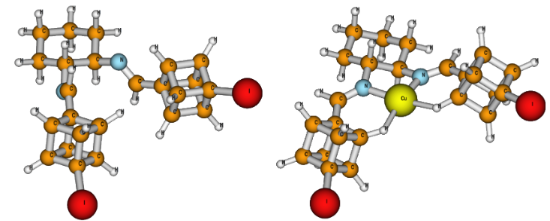
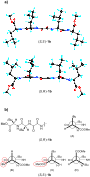
- increasing stereoselectivity. Appropriate crystals for X-ray analysis were not obtained, thus we decided to look into computational simulations. On the basis of earlier assessment studies [23][24], we chose the M06L [25] density functional theory method (and B3LYP [26] for comparison) to locate the global


The use of glycoinformatics in glycochemistry
Beilstein J. Org. Chem. 2012, 8, 915–929, doi:10.3762/bjoc.8.104
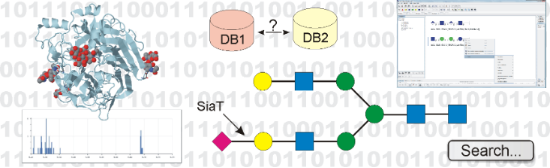
- adopt several conformations with different populations. The conformational space of a glycan can be analyzed by molecular dynamics (MD) simulations (see in the following) [100]. For this purpose the models generated by the GLYCAM Biomolecules Builder are convenient, as this tool already provides the
- input files for AMBER simulations. The list of residues that are available, however, is more limited than in Sweet-2. Sulfated residues, which frequently occur in glycosaminoglycans [101], for example, are only supported by Sweet-2 at the moment. GlycanReader [96] as part of the CHARMM-GUI [102] creates
- synthetic glycan mimetics [117][118][119]. Results can be improved by combinations of different modeling approaches, such as docking and MD simulations [101]. To run reliable MD simulations of carbohydrate 3D structures, force fields are necessary that contain parameters for carbohydrates. In the case of

An easily accessible sulfated saccharide mimetic inhibits in vitro human tumor cell adhesion and angiogenesis of vascular endothelial cells
Beilstein J. Org. Chem. 2012, 8, 787–803, doi:10.3762/bjoc.8.89
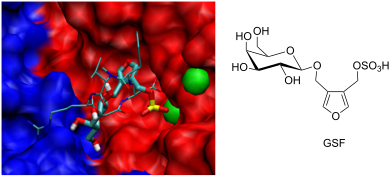
- [17]. Molecular dynamics simulations have shown that furans with two saccharides bound to hydroxymethyl groups show a nearly perfect alignment with each of the three terminal saccharides in Lewisy [15], another member of the Lewis histo blood group family, which is involved in tumor cell adhesion [18
- , 2H, CH2OSO3), 7.65 (s, 1H, H5), 7.68 (s, 1H, H2); 13C NMR (63 MHz, DMSO-d6) δ 58.4, 60.5, 60.6 (CH2OSO3, CH2OGal, C6´), 68.2, 70.6, 73.4, 75.2 (C2´, C3´, C4´, C5´), 102.6 (C1´), 121.3, 121.7 (C3, C4), 141.49, 141.52 (C2, C5). In silico blind-docking and molecular dynamics simulations A flexible
- by using AMBER [53]. The atomic partial charges and the topology files for GSF were prepared with antechamber. The final input files for sander were built with tleap. The MD simulations were run at 300 K in explicit water, by using periodic boundary conditions and following established standard


Enantioselective supramolecular devices in the gas phase. Resorcin[4]arene as a model system
Beilstein J. Org. Chem. 2012, 8, 539–550, doi:10.3762/bjoc.8.62
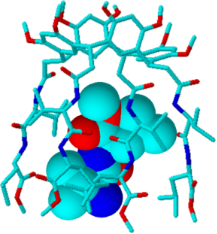
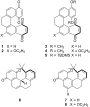
- well as in water: The skew-boat conformation of catharanthine is about 1 kcal mol−1 more stable than the chair conformation (Figure 5). The skew-boat structure of both T and TH+ is persistent during all the MD simulations, while the chair→skew-boat interconversion very easily occurs in aqueous TH
- +. Furthermore, in all simulations the position of the CO2Me function oscillates between two orientations differing by 180°, except for TH+ in vacuum, while the ethyl group is invariably free to rotate in the three-dimensional space [49]. The computational results indicated that the chair conformation is better




On the mechanism of action of gated molecular baskets: The synchronicity of the revolving motion of gates and in/out trafficking of guests
Beilstein J. Org. Chem. 2012, 8, 90–99, doi:10.3762/bjoc.8.9
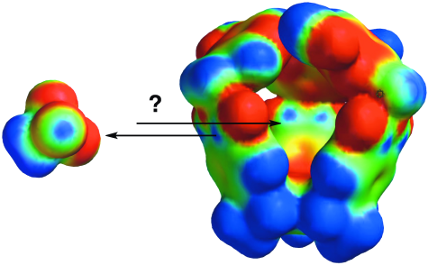
- steered molecular dynamics (SMD) simulations using the AMBER 10.0 suite of programs [29][30][31][32]. Without applying any external force on the entrapped CH3CCl3, we first found that this guest would, within 10 ns, adopt many positions inside host 1, although the one depicted in Figure 6A is obtained


(How) does 1,3,5-triethylbenzene scaffolding work? Analyzing the abilities of 1,3,5-triethylbenzene- and 1,3,5-trimethylbenzene-based scaffolds to preorganize the binding elements of supramolecular hosts and to improve binding of targets
Beilstein J. Org. Chem. 2012, 8, 1–10, doi:10.3762/bjoc.8.1
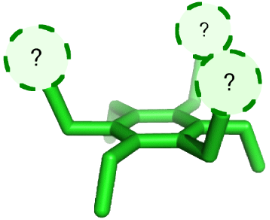
- rotational barriers Although kinetics has no bearing on binding thermodynamics, we sought also to understand computationally the dynamics of these different hosts. Molecular-dynamics simulations carried out at 300 K showed little or no dynamic exchange of conformations. Simulations carried out at the
- period. Faced with evidence that the barriers to exchange of “up” and “down” conformers in the sterically congested 1,3,5-triethylbenzene and 1,3,5-trimethylbenzene systems are too high to examine conveniently by MD simulations, we turned instead to a calculation of the barriers to bond rotation for a
- 7. The calculated rotation barriers for ethyl directed hosts are in the same range as previously reported values for related systems, which were determined by variable temperature NMR to be 9.3–11.8 kcal/mol [6][20]. As with the MD simulations, these results indicate that both ethyl and methyl ortho


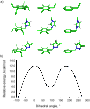
Catalysis: transition-state molecular recognition?
Beilstein J. Org. Chem. 2010, 6, 1026–1034, doi:10.3762/bjoc.6.117
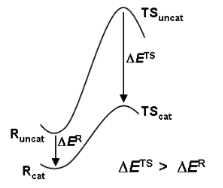
- transferase are described and compared with those for a model reaction in water, as computed by hybrid quantum-mechanical/molecular-mechanical molecular dynamics simulations. The case is discussed of molecular recognition in a xylanase enzyme that stabilises its sugar substrate in a (normally unfavourable
- AM1/OPLS/TIP3P simulations [19] with ensemble averaging to include the effect of thermal fluctuations in the enzyme and solvent environments to obtain a value for the α-D3 KIE = 0.82 ± 0.05, which is in excellent accord with the experimental value [11] of VCH3 /VCD3 = 0.83 ± 0.05 for methylation of
- for the COMT-catalysed reaction were computed as 2.06 ± 0.02 Å and 2.11 ± 0.01 Å, the sum of which is scarcely different from the sum of the corresponding average bond lengths, 2.18 ± 0.04 Å and 2.00 ± 0.04 Å, for the uncatalysed reaction. Thus the simulations did not provide any structural evidence


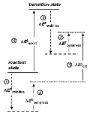



Oxalyl retro-peptide gelators. Synthesis, gelation properties and stereochemical effects
Beilstein J. Org. Chem. 2010, 6, 945–959, doi:10.3762/bjoc.6.106
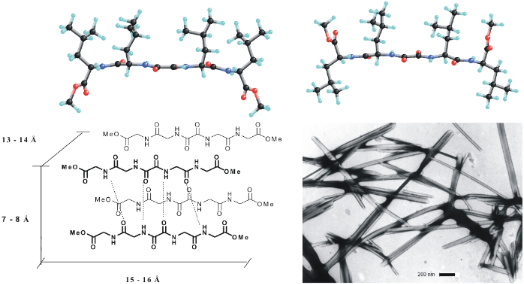
- promising biomedicinal properties, very little is known about the self-assembly potential of this class of compounds in solution. Computer simulations of some malonamide retro-peptides have shown that the extended conformations are less stable than the helical ones [48][49]. Nevertheless, the crystal





EPR and pulsed ENDOR study of intermediates from reactions of aromatic azides with group 13 metal trichlorides
Beilstein J. Org. Chem. 2010, 6, 713–725, doi:10.3762/bjoc.6.84
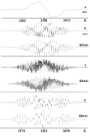
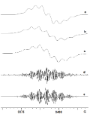
- appear different at first sight, the hfs derived from the simulations (Table 1) are actually quite similar. The contrasts in the spectral appearances are mainly the result of different line widths with consequently different resolutions. It is evident that the main species in each case is the radical
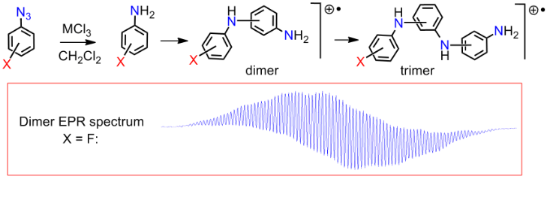
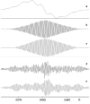
- , gave essentially the same strong spectrum, see Figure 5a and Supporting Information. The hfs derived from the simulations (Table 1) suggest that this is also a dimer type radical cation 17b+•. However, with the passage of time a central peak began to appear in this spectrum. When 5 was treated with
- intensity were obtained at around 300 K. Most of the EPR spectra were recorded with 2.0 mW power, 1.0–0.2 Gpp modulation intensity and a gain of ~106. In all cases where spectra were obtained, hfs were assigned with the aid of computer simulations using the Bruker SimFonia and NIEHS Winsim2002 software








Symmetry breaking and structure of a mixture of nematic liquid crystals and anisotropic nanoparticles
Beilstein J. Org. Chem. 2010, 6, No. 74, doi:10.3762/bjoc.6.74
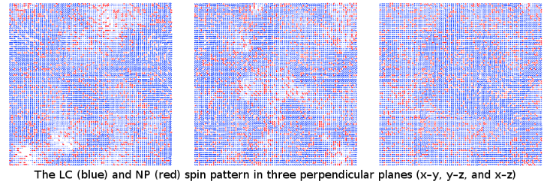
- align parallel. By contrast, we set JLC–NP < 0, tending to orient LC molecules and NP perpendicularly. In the simulations we take JLC–LC = JNP–NP = 1, and JLC–NP is either set to −1, −2 or −4. The exponent a is equal to 1 for magnetic–magnetic coupling while for nematic–nematic or nematic–magnetic
- results of numerical simulations, we find that G is indeed equal in cases with the same r, except for small unimportant statistical variations which are subsequently annulled by averaging G for data pairs (r, G) with the same r. To extract structural details from a calculated G(r) dependence, we fit it
- finite value of s. However, with increasing x the value of s decreases monotonously. Our numerical simulations suggest, that above a threshold value x = xc long range ordering is replaced by short range ordering. Therefore, for a sufficiently large concentration the degree of disorder introduced by



(Pseudo)amide-linked oligosaccharide mimetics: molecular recognition and supramolecular properties
Beilstein J. Org. Chem. 2010, 6, No. 20, doi:10.3762/bjoc.6.20
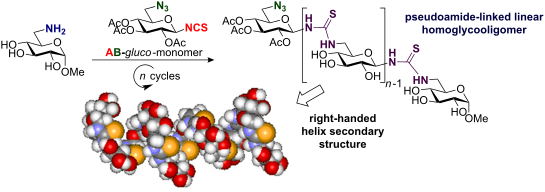
- , temperature coefficient (Δδ/ΔT) measurements of amide protons and constrained MD simulations revealed that all the cyclic oligomers had symmetrical structures, although none of the unprotected cyclic oligomers displayed any ability to transport ions across model membranes according to ion flux studies. Cyclic



Competition between local disordering and global ordering fields in nematic liquid crystals
Beilstein J. Org. Chem. 2010, 6, No. 2, doi:10.3762/bjoc.6.2
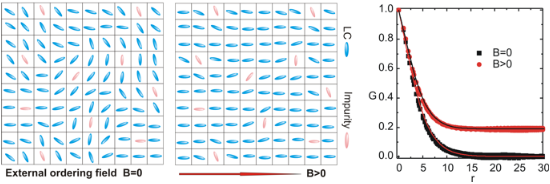
- temperature). In simulations we either originate from randomly distributed orientations of directors, or from homogeneously aligned samples along a symmetry breaking direction. In the latter case the directors are initially homogeneously aligned along ex. We henceforth refer to these cases as the i) random
- . The ii) homogeneous case can be realized by applying first a strong homogeneous external field B along a symmetry breaking direction. After a well enough alignment is achieved the field is switched off. In order to diminish the influence of statistical variations we carry out several simulations
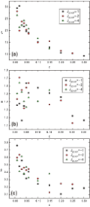
- simulations for 2D systems which demand less computational time. A typical G(r) dependence in 2D and 3D is shown in Figure 1a and Figure 1b, respectively. We plot G(r) for both homogeneous and random initial configuration in the presence of external field and without it. For B = 0 it holds ξ(hom) > ξ(ran


Chiral amplification in a cyanobiphenyl nematic liquid crystal doped with helicene-like derivatives
Beilstein J. Org. Chem. 2009, 5, No. 50, doi:10.3762/bjoc.5.50
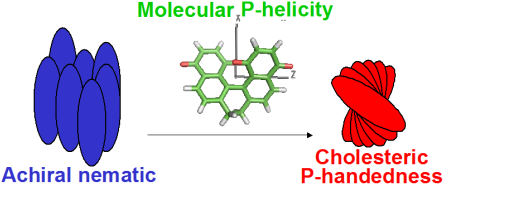
- intermolecular interactions and opposes director distortions [24]. Different theories [25][26][27] have contributed to elucidate the molecular mechanism behind cholesteric induction, as well as Molecular Dynamics simulations [28][29][30]; for the connection between structure of the chiral dopant and cholesteric