

Search results
Search for "nitrophenyl" in Full Text gives 163 result(s) in Beilstein Journal of Organic Chemistry.
Kinetic studies and predictions on the hydrolysis and aminolysis of esters of 2-S-phosphorylacetates
Beilstein J. Org. Chem. 2010, 6, 732–741, doi:10.3762/bjoc.6.87
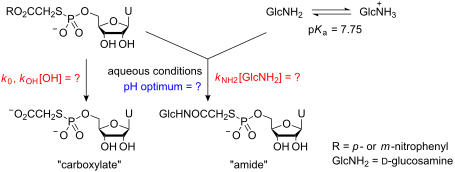
- shortfalls, 2-S-(5′-thiophosphoryluridine)acetic acid esters were prepared using p-nitrophenyl bromoacetate or m-nitrophenyl bromoacetate in combination with uridine-5′-monophosphorothioate. Kinetics of hydrolysis and aminolysis of the resulting p- and m-nitrophenyl 2-S-(5′-thiophosphoryluridine)acetates
- were determined by monitoring the formation of phenolate ions spectrophotometrically as a function of pH. The p- and m-nitrophenyl 2-S-(5′-thiophosphoryluridine)acetates showed similar reactivity profiles despite the significant difference in the pKaH values of their nitrophenolate leaving groups. Both
- were used to predict leaving group pKa values that could lead to improved selectivity towards aminolysis while retaining reasonable reaction times. Conclusions: Both p- and m-nitrophenyl 2-S-(5′-thiophosphoryluridine)acetates show some selectivity towards aminolysis over hydrolysis, with the m


Suzuki–Miyaura cross-coupling reaction of 1-aryltriazenes with arylboronic acids catalyzed by a recyclable polymer-supported N-heterocyclic carbene–palladium complex catalyst
Beilstein J. Org. Chem. 2010, 6, No. 70, doi:10.3762/bjoc.6.70
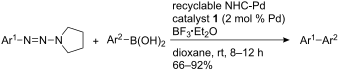
- coupling of 1-(3-nitrophenyl)-2-(pyrrolidin-1-yl)diazene and phenylboronic acid as a model reaction (Scheme 2). As described for the homogeneous catalytic conditions [29], a Lewis acid was essential for the formation of the biphenyl products. Without BF3·OEt2, no diaryl product was observed whatsoever
- improved yields (Table 2, entry 6). Table 3 shows the effect of the molar ratio of phenylboronic acid to 1-(3-nitrophenyl)-2-(pyrrolidin-1-yl)diazene on the reaction yield. A yield of 77% was obtained when the molar ratio was 1.25 (Table 3, entry 1). The yield of the corresponding biaryl product increased
- Suzuki–Miyaura cross-coupling reactions of 1-(3-nitrophenyl)-2-(pyrrolidin-1-yl)diazene and phenylboronic acid was investigated (Table 4). The catalyst could be re-used eight times and still retained high activity after separation, washing and drying under vacuum, under the same reaction conditions. To


Shelf-stable electrophilic trifluoromethylating reagents: A brief historical perspective
Beilstein J. Org. Chem. 2010, 6, No. 65, doi:10.3762/bjoc.6.65
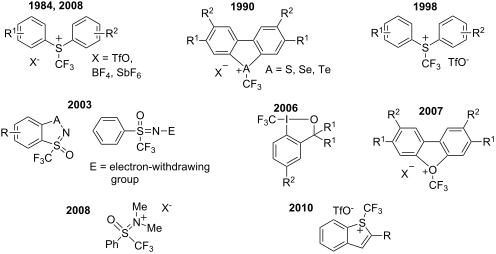
- ). Interestingly, the method was developed for the synthesis of heteroaromatic diarylsulfonium salts. Thus, p-nitrophenyl trifluoromethyl sulfide was reacted first with xenon difluoride in the absence of solvent and then with boron trifluoride. The addition of an electron-rich heterocycle gave products 28 and 29


Chemical synthesis using enzymatically generated building units for construction of the human milk pentasaccharides sialyllacto-N-tetraose and sialyllacto-N-neotetraose epimer
Beilstein J. Org. Chem. 2010, 6, No. 18, doi:10.3762/bjoc.6.18
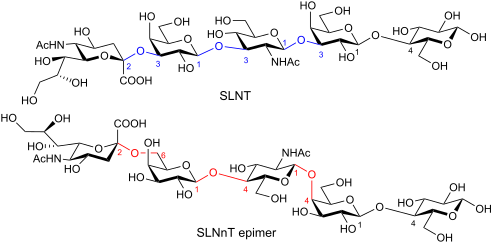
- p-nitrophenyl β-galactopyranoside and β-galactosidase (Bovin testes). The subsequent transsialylation was carried out with p-nitrophenyl sialoside (pNp-αNeu5Ac) and either sialidase from Salmonella typhimurium or from Newcastle disease virus [7]. Recently, a more effective higher yielding transfer
- a down field shifted doublet for H-4′ at δ 5.37 (J3′4′ = 2.9 Hz). A similar approach was employed for the synthesis of the protected epimer of sialyllacto-N-neotetraose 14. β-Galactosylation of 2-azidothioglucoside with p-nitrophenyl β-galactopyranoside and β-galactosidase (Bacillus circulans) gave


Synthesis of indolo[3,2-b]carbazole-based new colorimetric receptor for anions: A unique color change for fluoride ions
Beilstein J. Org. Chem. 2010, 6, No. 12, doi:10.3762/bjoc.6.12
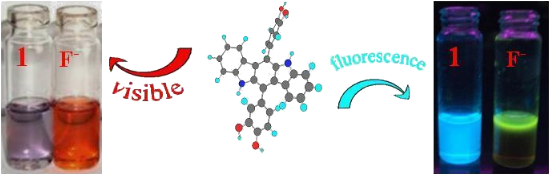
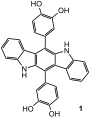
- ][24][25][26][27][28], there is a paucity of reports on selective naked-eye chemosensors for fluoride [29][30][31]. Nitrophenyl, nitronaphthalene urea [32][33][34], naphthalene triphenyl-phosphonium [35], benzimidazolyl pyridine [36][37] and oxidized bis(indolyl)methane [38] as signal units for




Synthesis of rigidified flavin–guanidinium ion conjugates and investigation of their photocatalytic properties
Beilstein J. Org. Chem. 2009, 5, No. 26, doi:10.3762/bjoc.5.26
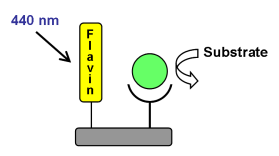
- the presence of sacrificial electron donor substrates, such as aliphatic amines, flavins can photoreduce nitro arenes to anilines under blue light irradiation (Scheme 4). 4-Nitrophenyl phosphate was used as a substrate for photoreduction in water and in acetonitrile. The results summarized in Table 2
- )2, mono-Boc guanidine, CH2Cl2, rt, 20 h, 58–82%, (iii) HCl/Et2O, CH2Cl2/CHCl3, rt, 24 h, 83–90%. Oxidative photocleavage of dibenzyl phosphate. Photoreduction of 4-nitrophenyl phosphate. Photo Diels–Alder-reaction of anthracene with N-methyl-maleinimide. Oxidative photocleavage of dibenzyl phosphate




New diarylmethanofullerene derivatives and their properties for organic thin- film solar cells
Beilstein J. Org. Chem. 2009, 5, No. 7, doi:10.3762/bjoc.5.7
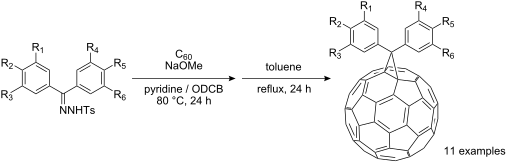
- the electron-withdrawing nature of the (methoxycarbonyl)phenyl, cyanophenyl, nitrophenyl, (methylsulfonyl)phenyl, and (trifluoromethylsulfonyl)phenyl groups attached to the cyclopropane ring, enough to compensate the opposite effect of the electron-donating mono-, bis-, or tris(octyloxy)phenyl group
- -nitrophenyl, (methylsulfonyl)phenyl, and (trifluoromethylsulfonyl)phenyl groups, taking a P3HT:PCBM-blended cell as a reference, were examined. Table 2 shows the current density–voltage (J–V) characteristic parameters of the devices structured from P3HT:diarylmethanofullerene derivatives 1a–1k, 2 and
- work as acceptors, probably because of their low solubility in ODCB. The bis(methoxycarbonyl)phenyl- and cyanophenyl-substituted methanofullerenes 1f and 1g showed good PCE, whereas nitrophenyl-substituted methanofullerenes 1h and 1i did not work as acceptors. (Methoxycarbonyl)phenylmethano-C70




Reduction of arenediazonium salts by tetrakis(dimethylamino)ethylene (TDAE): Efficient formation of products derived from aryl radicals
Beilstein J. Org. Chem. 2009, 5, No. 1, doi:10.3762/bjoc.5.1
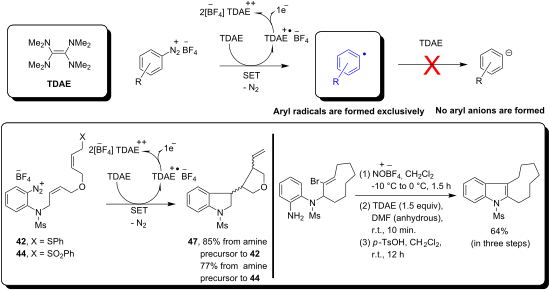
- %; (d) N-(2-nitrophenyl)methanesulfonamide (25a), DIAD, PPh3, THF, 0 °C to r.t., 1 h, 98%; (e) TBAF, THF, r.t., 20 min, 90%; (f) NBS, PPh3, CH2Cl2, −25 °C, 20 min, then 37, −25 °C to r.t., 40 min, 96%; (g) PhSH, NaH, THF, 0 °C to r.t., 1 h, then 38, r.t., 12 h, 86%; (h) NaIO4, H2O, MeOH, r.t., 76 h, 73


The role of an aromatic group in remote chiral induction during conjugate addition of α-sulfonylallylic carbanions to ethyl crotonate
Beilstein J. Org. Chem. 2008, 4, No. 32, doi:10.3762/bjoc.4.32
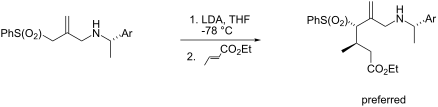
- cyanoborohydride in an acidic medium. Phenyl-, (4-nitrophenyl)- and (1-naphthyl)ethylamines 6a, c, e are commercial. Interestingly, the 9-anthryl nucleus in both primary amine 6h and its allyl sulfone congener 1h shows a peculiar 1H NMR spectrum: a broad signal representing both protons 1 and 8 in the first


New acylides: synthesis of 3-O-[γ-(4-oxo-2-aryl- thiazolidin- 3-yl)butyryl]erythromycin A derivatives
Beilstein J. Org. Chem. 2008, 4, No. 14, doi:10.3762/bjoc.4.14
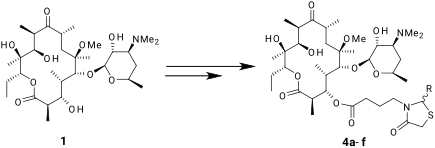
- -aryl-thiazolidin-3-yl)butyryl]-6-O-methylerythromycin A derivatives 4a–f (Method A); R = 4a: phenyl, 4b: 4-chlorophenyl, 4c: 4-fluorophenyl, 4d: 4-methoxyphenyl, 4e: 4-nitrophenyl and 4f: 4-quinolyl. Synthesis of 3-O-[γ-(4-oxo-2-aryl-thiazolidin-3-yl)butyryl]erythromycin A derivatives 4a–f (Method B


Microwave assisted synthesis of triazoloquinazolinones and benzimidazoquinazolinones
Beilstein J. Org. Chem. 2007, 3, No. 11, doi:10.1186/1860-5397-3-11
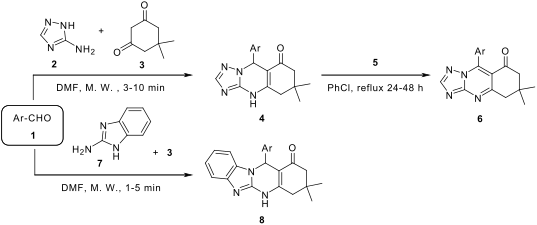
- ] Other triazoloquinazolines were obtained from 2'-azidoacetophenone and as well as 2-azidobenzonitrile. [11] Quinazolines were also obtained in moderate yields by an intermolecular reductive N-heterocyclization of 2-nitro-benzaldehydes or 2-nitrophenyl ketones with formamide catalyzed by a combination of


The Elbs and Boyland- Sims peroxydisulfate oxidations
Beilstein J. Org. Chem. 2006, 2, No. 22, doi:10.1186/1860-5397-2-22
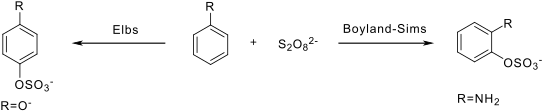
- , although they obtained evidence for a peroxide, isolated only phenol (in substantial yield). Heller and Weiler [18] investigated a more stable analog, namely p-nitrophenyl hydroperoxide formed by ipso displacement of a nitro group from p-dinitrobenzene by the hydrogen peroxide anion.p-Nitrophenyl


Asymmetric aza-Diels- Alder reaction of Danishefsky's diene with imines in a chiral reaction medium
Beilstein J. Org. Chem. 2006, 2, No. 18, doi:10.1186/1860-5397-2-18
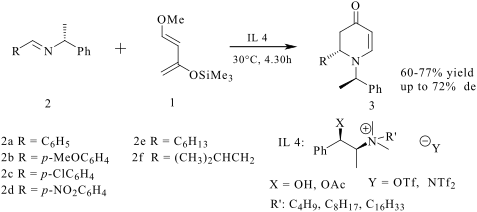
- was observed in the case of p-nitrophenyl (Table 3, entry 4, R = p-NO2C6H4,). This is due to hydrogen bond formation between the OH group of the chiral ionic liquid and the NO2 function of the substrate. A similar decrease in asymmetric induction was observed by our group in the mechanistically