

Search results
Search for "isolation" in Full Text gives 1001 result(s) in Beilstein Journal of Organic Chemistry. Showing first 200.
Identification of the p-coumaric acid biosynthetic gene cluster in Kutzneria albida: insights into the diazotization-dependent deamination pathway
Beilstein J. Org. Chem. 2024, 20, 1–11, doi:10.3762/bjoc.20.1
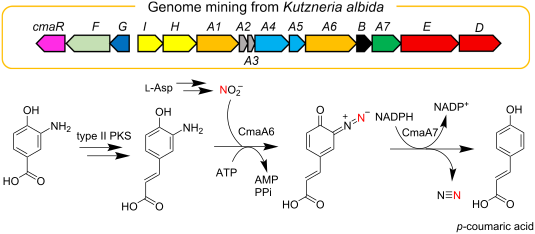
- product produced by K. albida [30]. Although rare actinomycetes have been expected to be a source of novel natural products, reports of natural product isolation from rare actinomycetes are limited because of the difficulty in cultivation and genetic manipulation. This study demonstrates that heterologous
- 2.6C18 Packed column (2.1 mm ID × 100 mm, Nacalai Tesque) coupled with a model LCMS-8040 liquid chromatography–mass spectrometer (LC–MS) (Shimazu Corp.). The compounds were eluted with a linear gradient of water/acetonitrile containing 0.1% formic acid. Isolation and structural determination of compound


Long oligodeoxynucleotides: chemical synthesis, isolation via catching-by-polymerization, verification via sequencing, and gene expression demonstration
Beilstein J. Org. Chem. 2023, 19, 1957–1965, doi:10.3762/bjoc.19.146

- have difficulty to produce sequences containing stable secondary structures. Here, we report a direct de novo chemical synthesis of 400 nt ODNs, and their isolation from the complex reaction mixture using the catching-by-polymerization (CBP) method. To determine the authenticity of the ODNs, 399 and
- , the GFP gene was expressed in E. coli. The long ODN synthesis and isolation method presented here provides a pathway to the production of genes and genomes containing long repeats or stable secondary structures that cannot be produced or are highly challenging to produce using existing technologies
- to address all the aforementioned problems, such as generating sequences having highly stable secondary structures [18]. In this paper, we report a method to access long ODNs involving automated direct de novo chemical synthesis and isolation of full-length sequences using the catching-by


Aldiminium and 1,2,3-triazolium dithiocarboxylate zwitterions derived from cyclic (alkyl)(amino) and mesoionic carbenes
Beilstein J. Org. Chem. 2023, 19, 1947–1956, doi:10.3762/bjoc.19.145
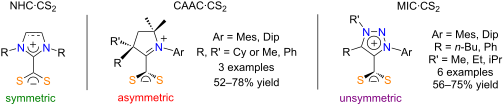
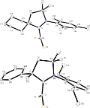
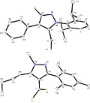
- NHC·CS2 zwitterions relies on the deprotonation of an azolium salt with a strong base, typically potassium tert-butoxide or potassium bis(trimethylsilyl)amide (also known as potassium hexamethyldisilazide, KHMDS) followed by the addition of carbon disulfide either in one pot or after the isolation of the


Controlling the reactivity of La@C82 by reduction: reaction of the La@C82 anion with alkyl halide with high regioselectivity
Beilstein J. Org. Chem. 2023, 19, 1858–1866, doi:10.3762/bjoc.19.138
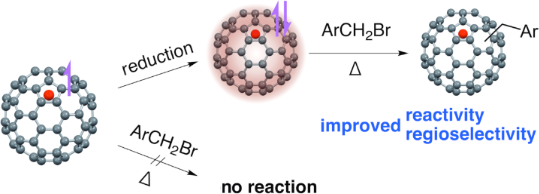
- -electron reduction of Gd@C2v-C82 for the addition reaction to occur at room temperature [22]. Supporting Information File 1, Figure S1 depicts the three HPLC separation steps including recycling for the isolation. The matrix-assisted laser desorption/ionization time-of-flight (MALDI–TOF) mass spectra of 2a


N-Boc-α-diazo glutarimide as efficient reagent for assembling N-heterocycle-glutarimide diads via Rh(II)-catalyzed N–H insertion reaction
Beilstein J. Org. Chem. 2023, 19, 1841–1848, doi:10.3762/bjoc.19.136
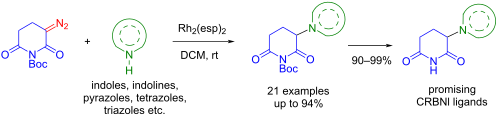
- product 6b in high yield. The reaction with methyl pyrrole-2-carboxylate resulted in the isolation of only the C–H insertion product 9c in low yield. Similar reaction progress was observed in the case with imidazole, the product N–H insertion was observed only in trace amounts (according to NMR data of




Synthetic approach to 2-alkyl-4-quinolones and 2-alkyl-4-quinolone-3-carboxamides based on common β-keto amide precursors
Beilstein J. Org. Chem. 2023, 19, 1804–1810, doi:10.3762/bjoc.19.132
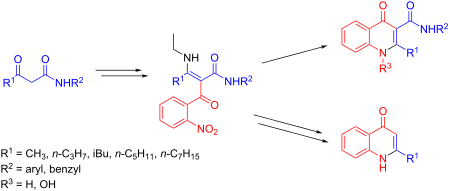
- -substitution in R1 drove the yields of 3 below 50% and for this reason isolation and further elaboration of such products were considered impractical. Once prepared, the key intermediates 3 could be transformed either directly to 2-alkyl-4-quinolone-3-carboxamides 5 or to 2-alkyl-4-quinolones 8, after an
- preferential isolation of N-hydroxy derivatives 7. Further experiments for palladium-catalyzed hydrogenation with H2 at atmospheric pressure did not show any advantage over the transfer hydrogenation conditions. Overall, the described synthetic approach (Scheme 1 and Scheme 2) allowed us to prepare in an


Active-metal template clipping synthesis of novel [2]rotaxanes
Beilstein J. Org. Chem. 2023, 19, 1776–1784, doi:10.3762/bjoc.19.130
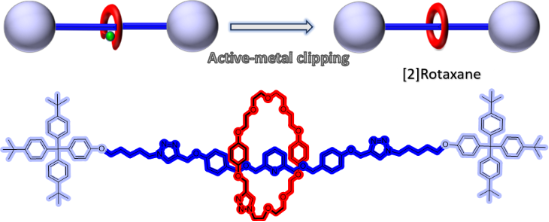
- [2]rotaxanes was further confirmed by MS2 experiments, i.e., isolation of the peaks corresponding to the [2]rotaxanes followed by collision-induced dissociation (CID) yielded the protonated molecular ions of the axle 6 and macrocycles M1 and M2, respectively (Figures S18 and S28 in Supporting


Unprecedented synthesis of a 14-membered hexaazamacrocycle
Beilstein J. Org. Chem. 2023, 19, 1728–1740, doi:10.3762/bjoc.19.126
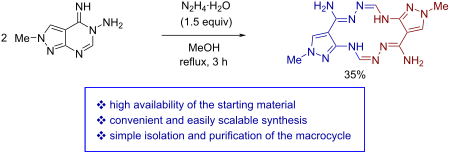
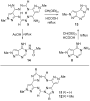
- isolation allows to remove residual impurities that arose from long-time reflux of aminopyrazole 3 in triethyl orthoformate (see the Experimental section). According to the DFT B3LYP/6-311++G(d,p) calculations in DMSO solution, the polyunsaturated 14-membered ring in 5 is almost planar with a maximum atom
- -pyrazolo[3,4-d]pyrimidin-5-amine (8) was developed. Under the optimized conditions (1.5 equiv of N2H4·H2O, MeOH, reflux, 3 h), the macrocycle 5 was obtained in a 35% isolated yield after crystallization. We believe that, despite the moderate yield of the macrocycle, the ease of its isolation and


Decarboxylative 1,3-dipolar cycloaddition of amino acids for the synthesis of heterocyclic compounds
Beilstein J. Org. Chem. 2023, 19, 1677–1693, doi:10.3762/bjoc.19.123
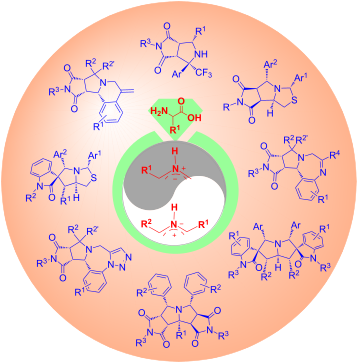
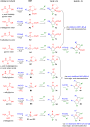
- for 6 h to afford the monocycloaddition compounds. Without isolation, the reaction mixtures were then used for the N-propargylation in the presence of K2CO3 under microwave heating at 110 °C for 1 h to give triazolobenzodiazepines 21a–f in 35–65% yields with 2:1 to 7:1 dr (Scheme 13). Other than 2




Sulfur-containing spiroketals from Breynia disticha and evaluations of their anti-inflammatory effect
Beilstein J. Org. Chem. 2023, 19, 1604–1614, doi:10.3762/bjoc.19.117
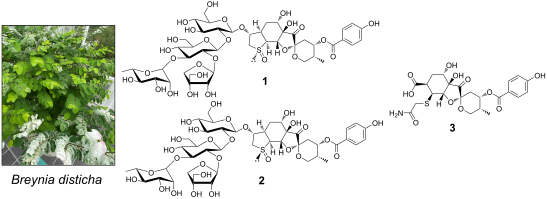
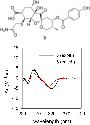
- four known spiroketals – probreynin I (4) [13], phyllaemblic acid (5) [10], breynin B (6) [2], and epibreynin B (7) [2] – from the roots of B. disticha, a species that has not previously been chemically investigated (Figure 1). Herein, we describe the isolation and structural elucidation of new
- expert botanist, Ms. Hiroko Murata (Setsunan University, retired). A voucher specimen (GPU-0812) has been deposited at the Gifu Pharmaceutical University for future reference. Extraction and isolation The dried roots (767 g) of B. disticha were extracted with MeOH (5 L × 3 times) at room temperature, and



Secondary metabolites of Diaporthe cameroonensis, isolated from the Cameroonian medicinal plant Trema guineensis
Beilstein J. Org. Chem. 2023, 19, 1555–1561, doi:10.3762/bjoc.19.112
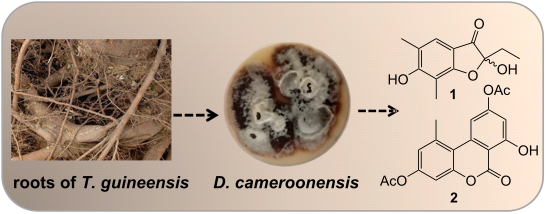
- chemical constituents of another new species of Diaporthe. This genus contains many plant pathogenic, endophytic, and saprobic species [7]. So far, the investigations of chemical constituents of Diaporthe species, have led to the isolation and characterization of a myriad of potent natural products with
- takes preference over Phomopsis. Regarding the potent talents of Diaporthe, we are on the quest to the exploration of structure–activity relationships of cytochalasins to establish their trends for various medical applications [5]. Along the same lines, we herein report the isolation and structural
- acetic acid (data not shown), we can exclude that it is an isolation artefact. The fifteen known compounds isolated from Diaporthe cameroonensis extract, which included alternariol (3) [14], 2-hydroxyalternariol (4) [15], 4-hydroxyalternariol (5) [16][17], 2,5-dimethyl-7-hydroxychromone (6) [18


Synthesis and biological evaluation of Argemone mexicana-inspired antimicrobials
Beilstein J. Org. Chem. 2023, 19, 1511–1524, doi:10.3762/bjoc.19.108
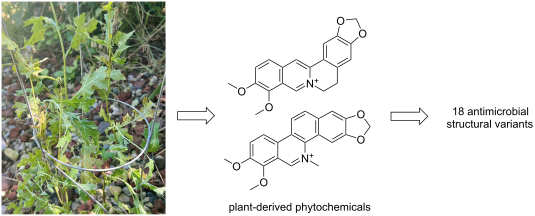
- tumor cytotoxicity effects for a number of the berberine derivatives. Keywords: benzylisoquinoline; berberine; chelerythrine; drug discovery; plant-derived antimicrobials; Introduction The isolation, or creation of novel antimicrobial agents is currently at the forefront of modern healthcare due to
- these optimized conditions still resulted in exclusive isolation of B2 with no evidence of the product lacking the oxygen at position-13. Subsequent variants B7 and B8 were synthesized as the expected berberine derivatives, without formation of the oxidation byproduct. Of this initial set of berberine
- cell lines. Conclusion Motivated by our prior isolation of three phytochemicals from the extracts of the Argemone mexicana plant, a library of structural variants of berberine and chelerythrine were prepared. Due to a greater synthetic ease, a larger number of berberine derivatives were explored. The


Cyclization of 1-aryl-4,4,4-trichlorobut-2-en-1-ones into 3-trichloromethylindan-1-ones in triflic acid
Beilstein J. Org. Chem. 2023, 19, 1460–1470, doi:10.3762/bjoc.19.105
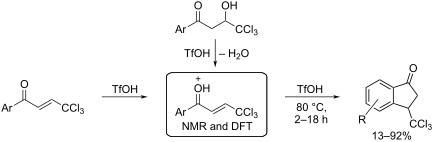
- , which are subsequently cyclized into indanones 3. From a synthetic point of view, the use of hydroxy ketones 1 as starting compounds for the cyclization without additional preparation and isolation of the corresponding enones 2 is more economical as it reduces the number of steps in the synthesis. Other


Functions of enzyme domains in 2-methylisoborneol biosynthesis and enzymatic synthesis of non-natural analogs
Beilstein J. Org. Chem. 2023, 19, 1452–1459, doi:10.3762/bjoc.19.104
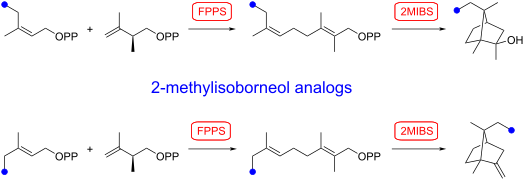
- allowed for the isolation of the 2-methylisoborneol homolog 3 (Scheme 2B, Supporting Information File 1, Table S3 and Figures S12–S19). Furthermore, two inseparable hydrocarbons were obtained as a mixture (8:3) whose structures were tentatively assigned based on the NMR spectra (Supporting Information


Application of N-heterocyclic carbene–Cu(I) complexes as catalysts in organic synthesis: a review
Beilstein J. Org. Chem. 2023, 19, 1408–1442, doi:10.3762/bjoc.19.102
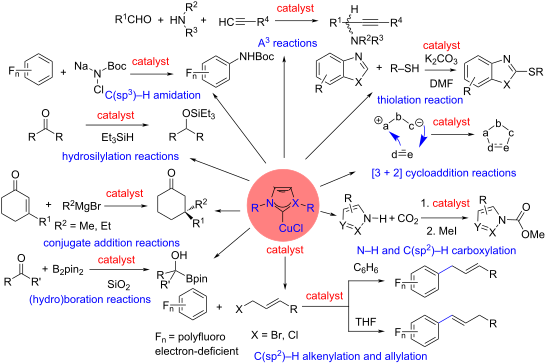
- amidating reagent leading to the isolation of copper–arylcarbamato species and the desired product. The developed amidation protocol works highly efficiently and selectively over a broad range of substrates including polyfluorobenzenes, azoles, and quinoline N-oxides (Scheme 74). 2.10 C(sp2)–H thiolation










One-pot nucleophilic substitution–double click reactions of biazides leading to functionalized bis(1,2,3-triazole) derivatives
Beilstein J. Org. Chem. 2023, 19, 1399–1407, doi:10.3762/bjoc.19.101
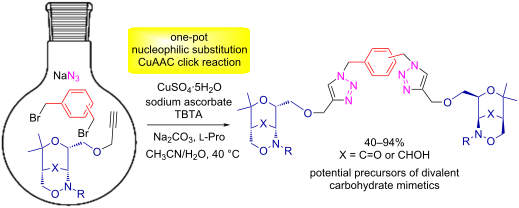
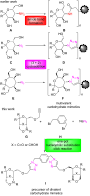
- aminopyrans [54], should be converted into divalent compounds via coupling of the terminal propynyl group with benzylic biazides. Since biazides are potentially explosive [22] it was very desirable to avoid their isolation and to generate these reactive species in situ from the corresponding benzylic halides



Functional characterisation of twelve terpene synthases from actinobacteria
Beilstein J. Org. Chem. 2023, 19, 1386–1398, doi:10.3762/bjoc.19.100
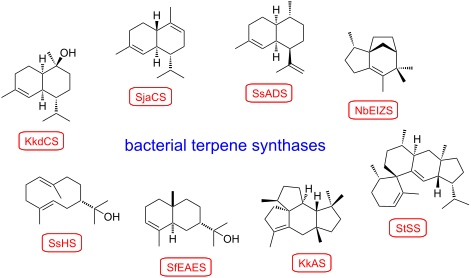
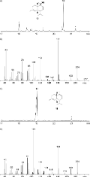
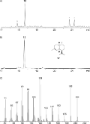
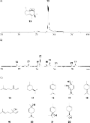
- accepted. A preparative scale incubation of FPP (80 mg, 185 μmol) allowed for the isolation of 10 (5.5 mg, 25 μmol, 14%) for structure elucidation through NMR spectroscopy (Table S2, Figures S3–S10, Supporting Information File 1), confirming the structure of δ-cadinol. The optical rotation of [α]D25




Consecutive four-component synthesis of trisubstituted 3-iodoindoles by an alkynylation–cyclization–iodination–alkylation sequence
Beilstein J. Org. Chem. 2023, 19, 1379–1385, doi:10.3762/bjoc.19.99
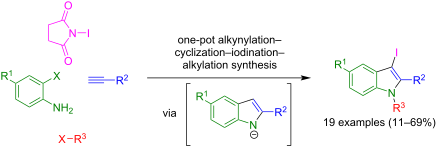
- isolation) accounts for an average yield of 55–90% per bond-forming step which can be considered to be relative efficient, also because only a single terminal purification step is required. However, noteworthy, the 3-iodoindoles are sensitive to light and prolonged storage at room temperature, even under




Unravelling a trichloroacetic acid-catalyzed cascade access to benzo[f]chromeno[2,3-h]quinoxalinoporphyrins
Beilstein J. Org. Chem. 2023, 19, 1216–1224, doi:10.3762/bjoc.19.89
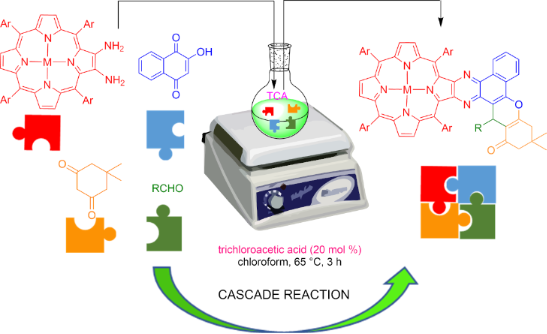
- afford copper(II) benzo[f]chromeno[2,3-h]quinoxalinoporphyrin 3 in 65% yield (Scheme 2). The successful isolation of intermediate 17 and its conversion to copper(II) benzo[f]chromeno[2,3-h]quinoxalinoporphyrin 3 as shown in Scheme 2 clearly support the proposed mechanism for the formation of the desired


Exploring the role of halogen bonding in iodonium ylides: insights into unexpected reactivity and reaction control
Beilstein J. Org. Chem. 2023, 19, 1171–1190, doi:10.3762/bjoc.19.86
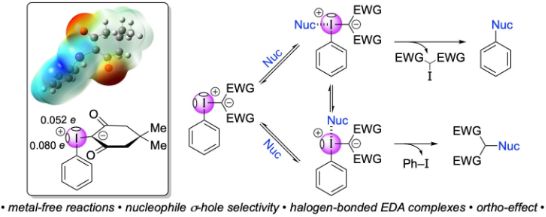
- ]. The authors discounted a free carbene-based C–H insertion because conducting the reaction in the presence of the radical trap phenyl N-tert-butyl nitrone (PBN) and the radical scavenger TEMPO resulted in decreased yields and isolation of their iodonium ylide adducts. Additional kinetic isotope effect








Two new lanostanoid glycosides isolated from a Kenyan polypore Fomitopsis carnea
Beilstein J. Org. Chem. 2023, 19, 1161–1169, doi:10.3762/bjoc.19.84
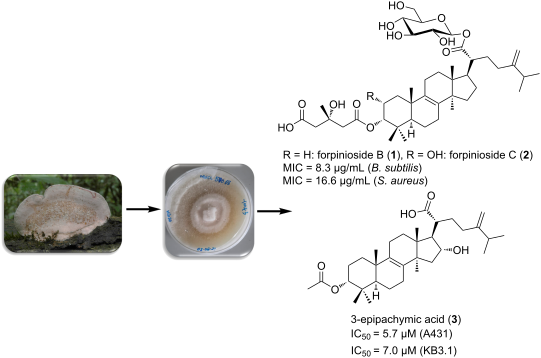
- ]. Chemical investigations of F. pinicola or F. betulina revealed their cytotoxic [21][23] and antidiabetic propensities [19]. In addition, the recent review on F. officinalis, elaborated the potential use of its compounds as antibiotic leads [19]. In this study we report the isolation and structure
- incubation following the aforementioned established procedures to afford 0.5 g (mycelial) and 1.5 g (supernatant) ethyl acetate extracts for Q6/2 cultures and 3.44 g ethyl acetate extract for rice cultures. Isolation of compounds 1–4 Purification of the rice and Q6/2 media cultures was achieved by using a


New one-pot synthesis of 4-arylpyrazolo[3,4-b]pyridin-6-ones based on 5-aminopyrazoles and azlactones
Beilstein J. Org. Chem. 2023, 19, 1155–1160, doi:10.3762/bjoc.19.83
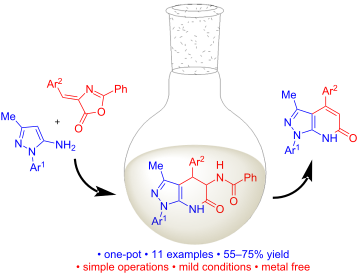
- carried out as one-pot synthesis, without isolation of the intermediate dihydro derivative 3а. In this case, the solvent (DMSO) could be added at the stage of obtaining dihydro derivative 3a or introduced into the reaction together with t-BuOK. We have explored both variants. When intermediate 3a was


Synthesis of imidazo[4,5-e][1,3]thiazino[2,3-c][1,2,4]triazines via a base-induced rearrangement of functionalized imidazo[4,5-e]thiazolo[2,3-c][1,2,4]triazines
Beilstein J. Org. Chem. 2023, 19, 1047–1054, doi:10.3762/bjoc.19.80
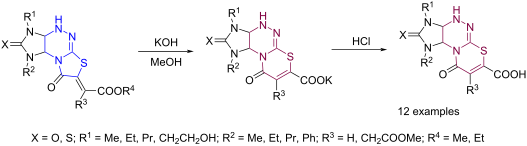
- ][1,3]thiazino[2,3-c][1,2,4]triazines 3a–i as a result of ester group hydrolysis and thiazolidine ring expansion to the corresponding thiazine (Scheme 3). The potassium salts 3a,b were isolated in 81 and 63% yield, respectively. Compounds 3c–i were used in further transformations without isolation. 1H



Linker, loading, and reaction scale influence automated glycan assembly
Beilstein J. Org. Chem. 2023, 19, 1015–1020, doi:10.3762/bjoc.19.77
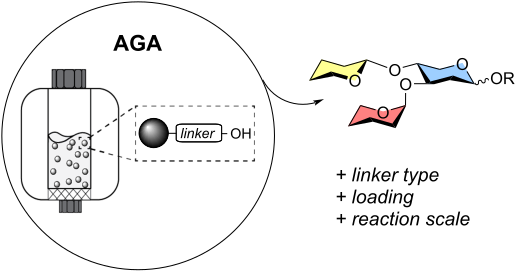
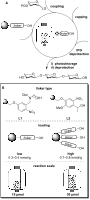
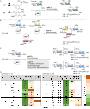
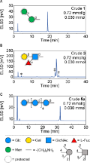
- light (λ = 360 nm), L1 releases the glycan equipped with an aminoalkyl spacer at the reducing end, whereas L2 affords the free reducing sugar (α/β mixture). Previous data suggested that UV cleavage of L1 and L2 was equally efficient, permitting the isolation of a tetramannoside in around 60% yield [3

Synthesis of tetrahydrofuro[3,2-c]pyridines via Pictet–Spengler reaction
Beilstein J. Org. Chem. 2023, 19, 991–997, doi:10.3762/bjoc.19.74
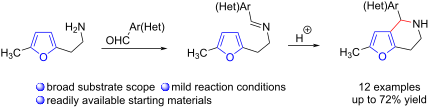
- . In most cases, we observed the abundant tarring of the reaction mixture and we could not achieve the full conversion of the starting tetrahydrofuro[3,2-c]pyridine 4a in any experiment. The best results were achieved when HCl in 1,4-dioxane was used (Scheme 3). However, upon isolation and purification
- , without isolation of the intermediate 3-(2-oxopropyl)piperidin-4-one 5a, the reaction mixture after acid hydrolysis was treated with aniline and the desired tetrahydro-1H-pyrrolo[3,2-с]pyridine 6а was isolated in 19% yield only (Scheme 4). Finally, we studied some reactions of the obtained tetrahydrofuro