
Search results
Search for "conjugation" in Full Text gives 446 result(s) in Beilstein Journal of Organic Chemistry. Showing first 200.
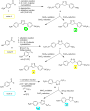
Cation-induced ring-opening and oxidation reaction of photoreluctant spirooxazine–quinolizinium conjugates
Beilstein J. Org. Chem. 2020, 16, 904–916, doi:10.3762/bjoc.16.82
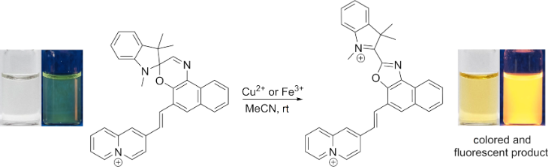
- have shown that depending on the nature of the metal ion, the adopted position relative to the nitrogen and oxygen atoms may vary [82]. In 3a and 3b, the electron density of the phenolate oxygen atom was significantly reduced due to the direct conjugation with the strong electron-accepting


Preparation of 2-phospholene oxides by the isomerization of 3-phospholene oxides
Beilstein J. Org. Chem. 2020, 16, 818–832, doi:10.3762/bjoc.16.75
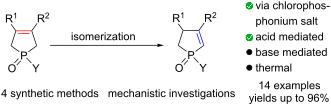
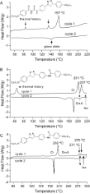
- , entries 3–7). In contrast, there is no benefit for the ethylphospholene oxides (1h or 4h) (Table 5, entry 8). The olefinicity concept and the olefinicity value (OL%) was developed to measure and describe quantitatively the degree of conjugation of an alkene group with the neighboring functional groups




One-pot synthesis of dicyclopenta-fused peropyrene via a fourfold alkyne annulation
Beilstein J. Org. Chem. 2020, 16, 791–797, doi:10.3762/bjoc.16.72
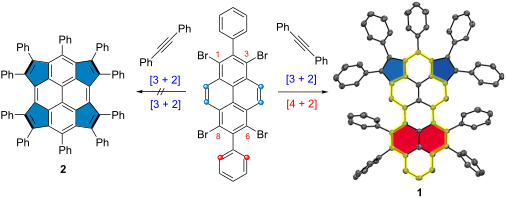
- extended conjugation of 1 after the annulation. Compound 1 shows a broad absorption band in the range of 449–690 nm with the absorption maximum at 537 nm, which also displays a large red-shift (70 nm) compared with the reported peropyrene derivative [32]. The optical energy gap of 1 is determined to be


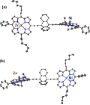
Towards triptycene functionalization and triptycene-linked porphyrin arrays
Beilstein J. Org. Chem. 2020, 16, 763–777, doi:10.3762/bjoc.16.70
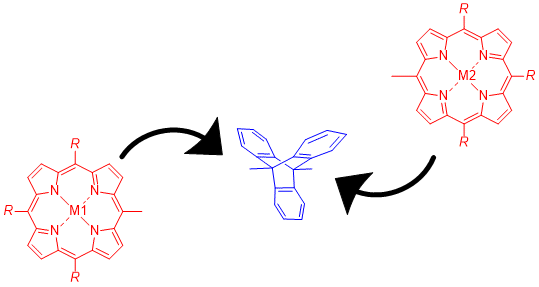
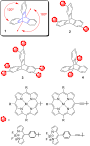
- were not connected through efficient electronic conjugation/delocalization. Two Q bands were observed in all cases, which is characteristic of zinc porphyrins due to the increased symmetry in the compound as compared to the free base derivatives, which ordinarily feature four Q bands [46]. While the Q
- -known in the literature [4] and results in two distinct Soret bands seen at 418 (23923) and 455 (21978) nm (cm−1) as each porphyrin is electronically isolated due to the lack of orbital overlap between the two units. In stark contrast, the linearly linked butadiyne dimer 20 maintains conjugation between
- emission at 617 nm (16207 cm−1) with two equally intense bands (a characteristic of symmetric porphyrins). The nearly similar λmax of both these dimers reinforces the lack of extended π-conjugation or communication that is present in these molecules. Comparatively, the zinc dimer 9 has an increased





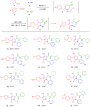
Microwave-assisted efficient and facile synthesis of tetramic acid derivatives via a one-pot post-Ugi cascade reaction
Beilstein J. Org. Chem. 2020, 16, 663–669, doi:10.3762/bjoc.16.63
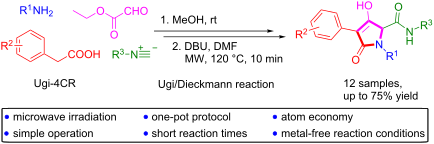
- compound 6, which would be quickly converted into 7, a more stable enol form due to its conjugation to the phenyl ring. Conclusion In summary, we have developed a new method for the construction of tetramic acid derivatives by using a one-pot Ugi/Dieckmann cyclization protocol. In comparison with the



Direct borylation of terrylene and quaterrylene
Beilstein J. Org. Chem. 2020, 16, 621–627, doi:10.3762/bjoc.16.58
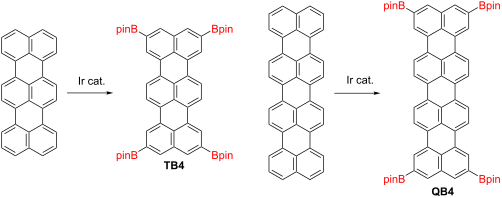
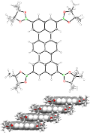
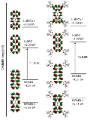
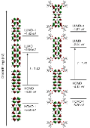
- tetra-borylated quaterrylene despite a low yield. The post modification of rylenes enables us to prepare their borylated products as versatile units after creating the rylene skeletons. Keywords: borylation; π-conjugation; oligorylene; single crystal X-ray structure; solubility; Introduction Compared






Preparation and in situ use of unstable N-alkyl α-diazo-γ-butyrolactams in RhII-catalyzed X–H insertion reactions
Beilstein J. Org. Chem. 2020, 16, 607–610, doi:10.3762/bjoc.16.55
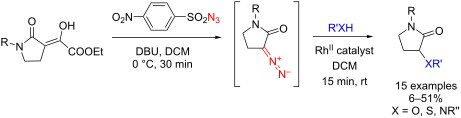
- -withdrawing character of the lactam carbonyl group in the former compared to the latter. This assumption is further supported by the fact that ortho-substituted N-aryl derivatives 1 (in which the conjugation of the aromatic ring with the lone pair of the lactam nitrogen atom is reduced due to the sterically



Regioselectively α- and β-alkynylated BODIPY dyes via gold(I)-catalyzed direct C–H functionalization and their photophysical properties
Beilstein J. Org. Chem. 2020, 16, 587–595, doi:10.3762/bjoc.16.53
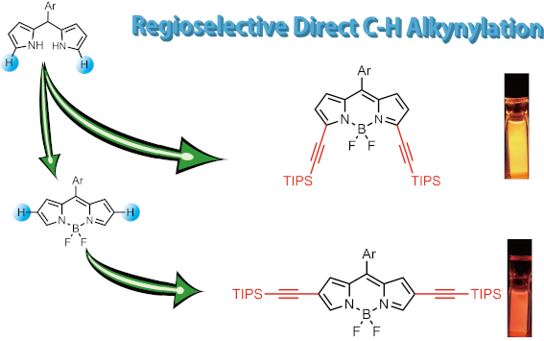
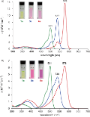
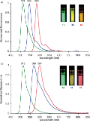
- comparative NMR analysis and mass spectrometry (see Supporting Information File 1). Optical properties The α- and β-ethynyl-substituted BODIPYs exhibit large bathochromic shifts in the absorption and fluorescence spectra relative to the unsubstituted 1a with extended π-conjugation (Figure 4 and Figure 5). The



Copper-catalyzed remote C–H arylation of polycyclic aromatic hydrocarbons (PAHs)
Beilstein J. Org. Chem. 2020, 16, 530–536, doi:10.3762/bjoc.16.49
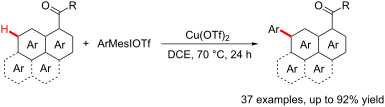
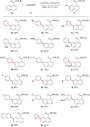
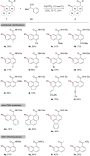
- fluorescence, and have been widely applied in many scientific areas including chemistry, biomedicine and materials science [1][2][3][4][5][6]. The arylation reaction of PAHs is an important strategy to further extend the π-conjugation length, which can effectively adjust the photophysical properties of




Formal preparation of regioregular and alternating thiophene–thiophene copolymers bearing different substituents
Beilstein J. Org. Chem. 2020, 16, 317–324, doi:10.3762/bjoc.16.31
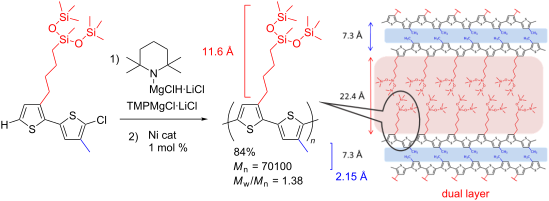
- copolymer; nickel(II) catalyst; oligosiloxane; regioregular polythiophene; solubility; Introduction Polythiophenes attract much attention in materials science because of their extended π-conjugation, which is applied for a wide range of electronic materials. In particular, the regioregular polymers with a


Combination of multicomponent KA2 and Pauson–Khand reactions: short synthesis of spirocyclic pyrrolocyclopentenones
Beilstein J. Org. Chem. 2020, 16, 200–211, doi:10.3762/bjoc.16.23
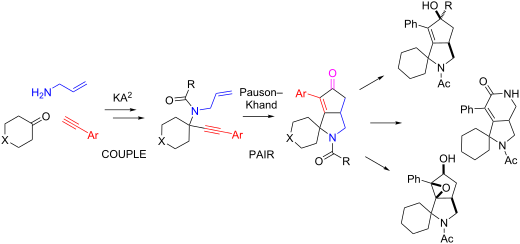
- consistent 8-dimensional map of structural characteristics [65]. In particular, the first and the second dimensions (PC1 and PC2) are the most interesting ones, being associated respectively with size, shape, and polarizability and with aromatic and conjugation related properties. The analysis of PC1 vs PC2
- that shows good overlap with drugs like levaquin, which is characterized by a complex tricyclic skeleton. The addition of a second aromatic ring, as the benzoyl or tosyl group of compounds 30–32, 34 and 35, increased the aromatic- and conjugation-related character of the structure, thus resulting in




The use of isoxazoline and isoxazole scaffolding in the design of novel thiourea and amide liquid-crystalline compounds
Beilstein J. Org. Chem. 2020, 16, 175–184, doi:10.3762/bjoc.16.20
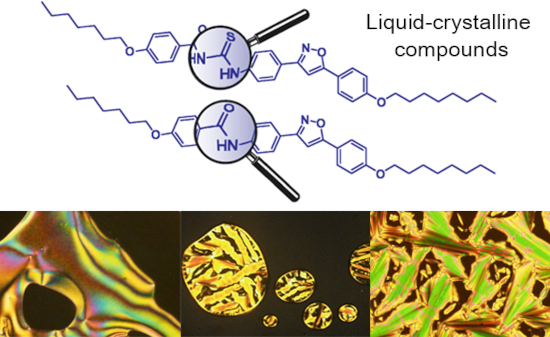
- the segregation effect of perfluorinated and hydrogenated chains present in 17b. For 17c the absence of LC properties could be related to the disrupt the planarity and electronic conjugation between the phenyl rings caused by the inversion of isoxazoline ring – its isomer 17a, despite is monotropic




[1,3]/[1,4]-Sulfur atom migration in β-hydroxyalkylphosphine sulfides
Beilstein J. Org. Chem. 2020, 16, 88–105, doi:10.3762/bjoc.16.11
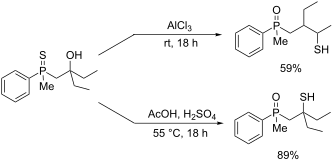
- retained its nucleophilic character. This allowed the coordination of an AlCl3 molecule to the C=C bond, which then became susceptible to an intramolecular nucleophilic attack by a sulfur atom. For α,β-alkenylphosphine sulfide 35, the conjugation of the double bond with thiophosphoryl fragment made the


Synthesis of C-glycosyl phosphonate derivatives of 4-amino-4-deoxy-α-ʟ-arabinose
Beilstein J. Org. Chem. 2020, 16, 9–14, doi:10.3762/bjoc.16.2
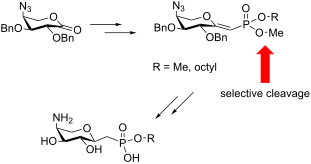
- carbon atom as well as signals of two upfield-shifted deoxy protons at 2.72 and 2.55 ppm, respectively, to the anomeric carbon atom. In addition, for compound 10, lacking the conjugation to the phosphorus atom, a significant downfield shift of the 31P NMR signal was observed (17.97 ppm in 10 versus 10.95


Synthesis and optoelectronic properties of benzoquinone-based donor–acceptor compounds
Beilstein J. Org. Chem. 2019, 15, 2914–2921, doi:10.3762/bjoc.15.285

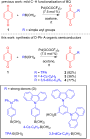
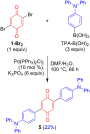
- , 4 and 5, respectively. The small ΔEST values for 3 and 4 could facilitate efficient ISC/RISC, mediated by a TADF mechanism. The relatively large ΔEST values for 2 and 5 were the result of an increased conjugation of the diarylamine donors with the BQ acceptor in these compounds, leading to the
- -shifted compared to those found for 2 and 5. Charge-transfer was expected to be weaker in compound 4, where the donor groups were meta disposed with respect to the acceptor. Indeed, there was only a very poorly absorptive CT band at 370 nm for this compound, which reflected the poor conjugation between





Chemical tuning of photoswitchable azobenzenes: a photopharmacological case study using nicotinic transmission
Beilstein J. Org. Chem. 2019, 15, 2812–2821, doi:10.3762/bjoc.15.274
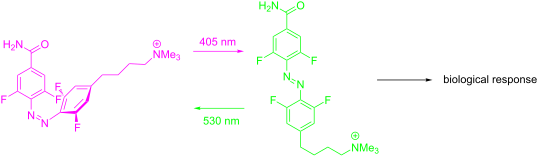
- ). This result was expected as these receptors have no cysteine available for drug conjugation. Surprisingly, similar results were seen with α4β2E61C mutant receptors (Figure 4c,d). We surmise from these data that the mysterious antagonism of cis-MAHoCh when conjugated to same mutant receptor is




Fluorinated maleimide-substituted porphyrins and chlorins: synthesis and characterization
Beilstein J. Org. Chem. 2019, 15, 2704–2709, doi:10.3762/bjoc.15.263
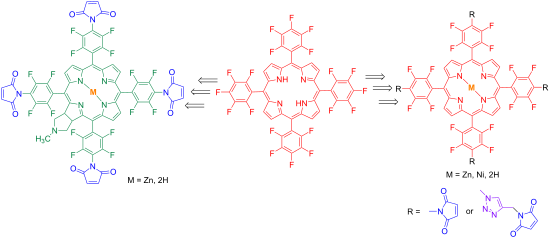
- covalently conjugates thiol groups of cysteine residues in proteins or peptides by the thio-Michael addition to the double bond of the maleimide to form a corresponding succinimidyl thioether. Conjugation of the cysteine sulfhydryl group with maleimide moieties allows us to prepare the bioconjugates


Plasma membrane imaging with a fluorescent benzothiadiazole derivative
Beilstein J. Org. Chem. 2019, 15, 2644–2654, doi:10.3762/bjoc.15.257
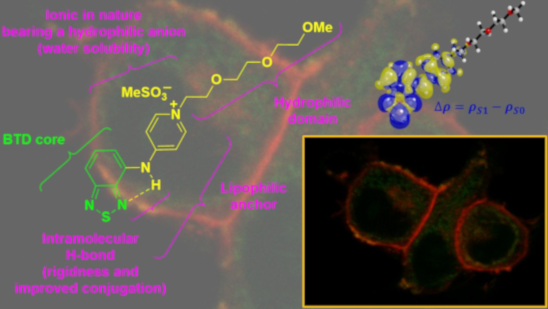
- better conjugation with the 4AP substituent at the C4 carbon of the BTD heterocyclic core. The ionic nature of the structure in combination with a hydrophilic anion (MeSO3−, methanesulfonate) and the presence of the hydrophilic domain (triethylene glycol monomethyl ether) make the dye a water-soluble BTD
- the BTD-4APTEG is twisted by nearly 30° with respect to the NH fragment (see Figure S5 in Supporting Information File 1). Although this torsion diminishes the strength of the H-bond and conjugation, the effect is not strong enough to affect the emissive properties of the designed structure, as noted


Arylisoquinoline-derived organoboron dyes with a triaryl skeleton show dual fluorescence
Beilstein J. Org. Chem. 2019, 15, 2612–2622, doi:10.3762/bjoc.15.254
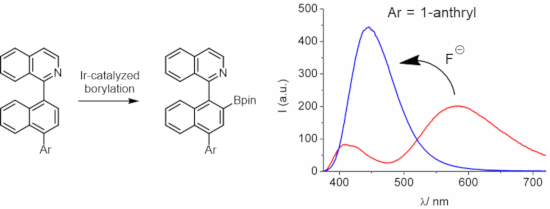
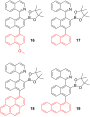
- the verification of the effect of aromatic conjugation (naphthyl, anthryl, pyrenyl) and electron-donor strength (naphthyl versus 4-methoxynaphthyl) on the photophysical properties. Beside the observation of interesting dual emission properties for these dyes, some showed a pronounced ratiometric



Chemical synthesis of the pentasaccharide repeating unit of the O-specific polysaccharide from Escherichia coli O132 in the form of its 2-aminoethyl glycoside
Beilstein J. Org. Chem. 2019, 15, 2563–2568, doi:10.3762/bjoc.15.249
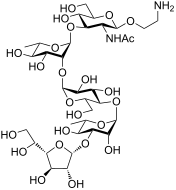
- reducing end of the target pentasaccharide that will allow further conjugation using the terminal amine without affecting the glycosidic stereochemistry. Further retrosynthetic analysis of the target pentasaccharide 1 revealed that a [3 + 2] strategy will be the most suitable one for the total synthesis of
- pentasaccharide repeating unit of the O-specific polysaccharide of Escherichia coli O132 was accomplished through a convergent [3 + 2] strategy. The target pentasaccharide was obtained as its 2-aminoethyl glycoside that offers further possibilities for conjugation with suitable aglycons without hampering the




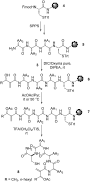
Synthesis of novel sulfide-based cyclic peptidomimetic analogues to solonamides
Beilstein J. Org. Chem. 2019, 15, 2544–2551, doi:10.3762/bjoc.15.247
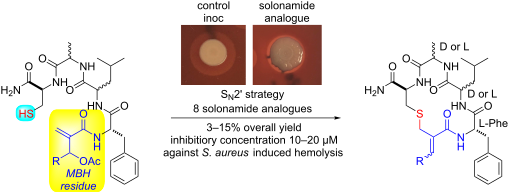
- wavenumber values for the lactone C=O stretch was also observed for bands assigned to the C=C bonds as consequence of their conjugation. Evaluation of the growth inhibition and hemolytic activity of S. aureus for the solonamide analogues Initially, the antibacterial activity of all analogues 9 was tested by




A toolbox of molecular photoswitches to modulate the CXCR3 chemokine receptor with light
Beilstein J. Org. Chem. 2019, 15, 2509–2523, doi:10.3762/bjoc.15.244
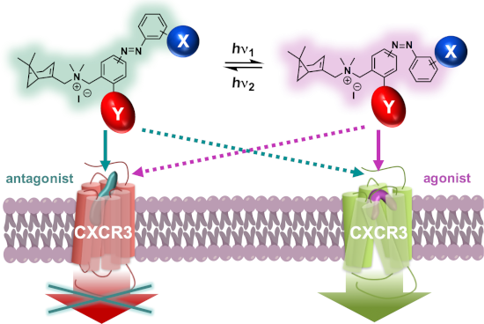
- -isomers are generally assumed to have an intrinsically higher electron density due to the disruption of the conjugation between the two rings of the azobenzene through the N=N bond. Moreover, the electronic properties of the inner substituent Y have been proven to be of strategic use in increasing the



Experimental and computational electrochemistry of quinazolinespirohexadienone molecular switches – differential electrochromic vs photochromic behavior
Beilstein J. Org. Chem. 2019, 15, 2473–2485, doi:10.3762/bjoc.15.240
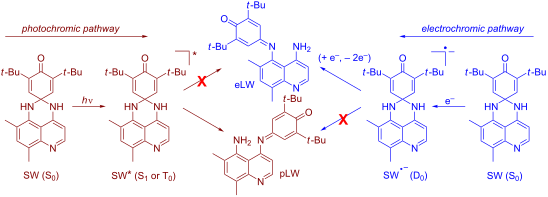
- photochromism results from a spirocyclic ring-opening or other isomerization which results in increased conjugation. Electrochromism is also of increasing materials relevance, e.g., for self-dimming automotive mirror and aircraft window darkening applications [6][7][8]. In electrochromic applications, the color
- attributing the small spectral changes to the presence of electrolyte in the electrolyzed solutions, to an interaction with air, or to a side reaction in solution. The shorter wavelength for electrogenerated 5a,b may result from slightly less planarity and decreased conjugation versus the photogenerated 4a,b




Excited state dynamics for visible-light sensitization of a photochromic benzil-subsituted phenoxyl-imidazolyl radical complex
Beilstein J. Org. Chem. 2019, 15, 2369–2379, doi:10.3762/bjoc.15.229
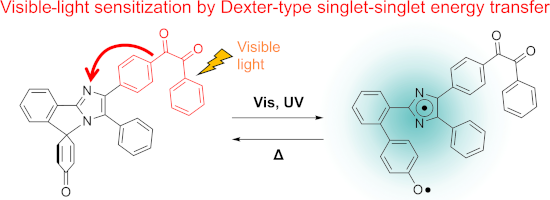
- of the photochromic reactions to visible light are to extend the π-conjugation and to utilize photosensitizers. Especially, triplet photosensitizers, which form the triplet state of a molecule by the triplet–triplet energy transfer, have been frequently used in photoresists, photodynamic therapy, and
- assigned to the transient absorption of the benzil unit of Benzil-PIC. The absorption is slightly shifted to the red as compared to those of benzil probably due to the extended π-conjugation of the benzil unit connected to the PIC unit. The two peaks continuously shift to the shorter wavelength (503 and



Synthesis of a dihalogenated pyridinyl silicon rhodamine for mitochondrial imaging by a halogen dance rearrangement
Beilstein J. Org. Chem. 2019, 15, 2333–2343, doi:10.3762/bjoc.15.226
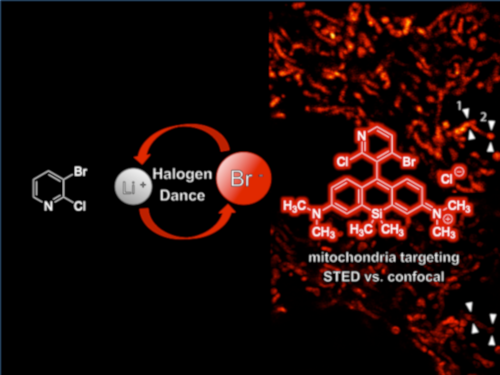
- membranes. Recently, a silicon rhodamine for selective mitochondrial staining was developed by conjugation of the SiR core with ten different amines varying in lipophilicity [46]. The authors showed that the optimal range of clogP values for mitochondrial targeting ranges from 5.50 to 6.33. As mentioned
- pyridinyl motif. In fact, only two pyridinyl silicon rhodamines (13 and 14) are known so far, although halogenated pyridines are highly interesting for further functionalization or vector conjugation by nucleophilic aromatic substitution. For the implementation of the dihalogenated pyridine motif into the