

Search results
Search for "adsorption" in Full Text gives 153 result(s) in Beilstein Journal of Organic Chemistry.
New amphiphilic glycopolymers by click functionalization of random copolymers – application to the colloidal stabilisation of polymer nanoparticles and their interaction with concanavalin A lectin
Beilstein J. Org. Chem. 2010, 6, No. 58, doi:10.3762/bjoc.6.58
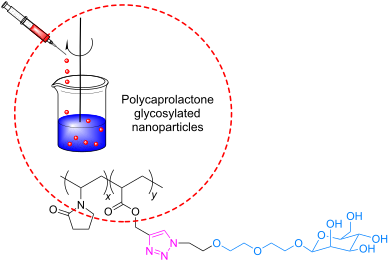
- stability and the biological points of view. In such block copolymers, the hydrophobic part is enhanced in comparison to molecular surfactants, which allows a better adsorption (by reducing the exchange dynamics) and increases the long term stability. This stronger adsorption also reduces the residual
- copolymer and their related syntheses were based on the following criteria: 1 - the monosaccharide must be anchored onto the polymer backbone by the use of a hydrophilic spacer in order to allow more freedom inside the aqueous phase after adsorption onto the polymer particles; 2 - syntheses must be simple


From discovery to production: Scale- out of continuous flow meso reactors
Beilstein J. Org. Chem. 2009, 5, No. 29, doi:10.3762/bjoc.5.29
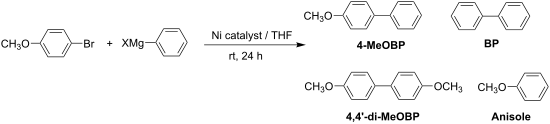
- of whether or not a pre-wash is used. The induction is therefore most likely to be limited by adsorption of the aryl bromide onto the catalyst surface once catalyst activation is achieved. This is consistent with the Langmuir–Hinshelwood mechanism [17] for surface kinetics which depends on adsorption
- become deposited on the catalyst beads on standing between studies and that the initial linear increase in yield was a consequence of the salts being washed off in the continuous flow and adsorption of the organobromide on to the newly freed reactive sites. It is seen from Figure 6 hat the production of
- concentration is necessarily high. If the rate limiting step in the reaction is the adsorption of the organobromide onto the surface of the catalyst, as we have proposed according to the Langmuir–Hinchelwood mechanism [17], then increasing the flow rate does not give sufficient time for adsorption of the aryl


Asymmetric reactions in continuous flow
Beilstein J. Org. Chem. 2009, 5, No. 19, doi:10.3762/bjoc.5.19
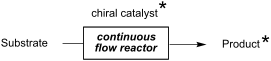
- unmodified silica lowered the activity of the catalyst system, presumably via adsorption of some of the Ru(II) catalyst. Under optimal flow conditions, the transfer hydrogenation of acetophenone in isopropanol (using a flow-reactor consisting of a column packed with a slurry of the immobilized catalyst


Other Beilstein-Institut Open Science Activities