

Search results
Search for "transformations" in Full Text gives 1191 result(s) in Beilstein Journal of Organic Chemistry. Showing first 200.
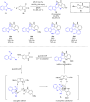
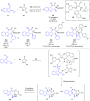
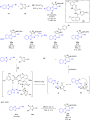
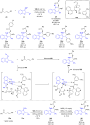
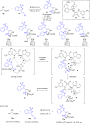
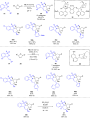
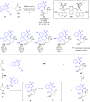
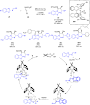
Non-covalent organocatalyzed enantioselective cyclization reactions of α,β-unsaturated imines
Beilstein J. Org. Chem. 2024, 20, 3221–3255, doi:10.3762/bjoc.20.268
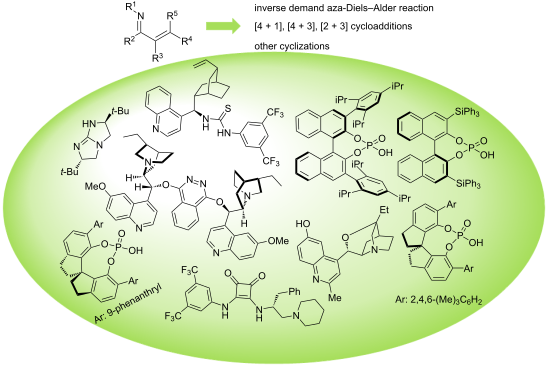
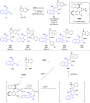
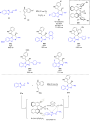
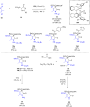
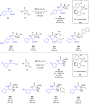
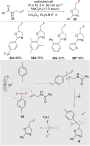
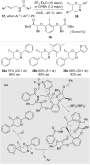
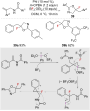
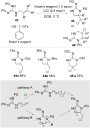
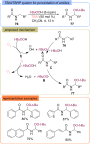
- -raising activation (amine-based catalysis and N-heterocyclic carbenes), and iii) LUMO-lowering and HOMO-raising activation (bifunctional thioureas and squaramides). Due to the ubiquitous nature of non-covalent interactions in organic systems, they can play a decisive role in asymmetric transformations [15
- carbamate group by interaction with the oxygen atom of the phosphoryl group. Although recently Rana and co-workers published a review article covering catalytic asymmetric transformations of azadienes [16], there is still room for this review which only focuses on non-covalent organocatalyzed cyclizations
- reviews [17][18]. Review Hydrogen bond donors: bifunctional thioureas and squaramides The use of bifunctional catalysts is commonplace in organocatalyzed transformations [19][20][21][22][23]. These catalysts are able to activate an electrophile and a nucleophile simultaneously and in IEDADA reactions they











Germanyl triazoles as a platform for CuAAC diversification and chemoselective orthogonal cross-coupling
Beilstein J. Org. Chem. 2024, 20, 3198–3204, doi:10.3762/bjoc.20.265
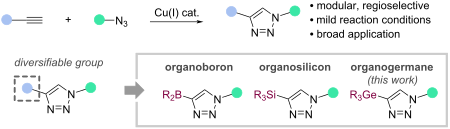
- cross-couplings. Schoenebeck and co-workers have shown that Ge-based compounds are versatile reagents within chemoselective cross-coupling processes for the formation of a variety of C–C and C–X bonds [55][56][57][58][59][60][61][62][63]. Importantly, these transformations can take place in the presence


Synthesis of 2H-azirine-2,2-dicarboxylic acids and their derivatives
Beilstein J. Org. Chem. 2024, 20, 3191–3197, doi:10.3762/bjoc.20.264
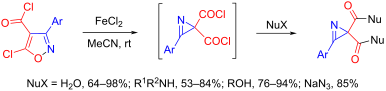
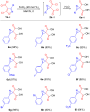
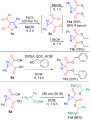
- -2,2-dicarboxylic acids 6. Transformations of 3-(tert-butyl)-5-chloroisoxazole-4-carbonyl chloride (1j). Synthesis of amides 10. aFiltration through celite after reaction with amine (without aqueous workup). bWork up with H2O. Synthesis of esters 11. Synthesis of dicarbonyl azide 12. Synthesis of 5





Direct trifluoroethylation of carbonyl sulfoxonium ylides using hypervalent iodine compounds
Beilstein J. Org. Chem. 2024, 20, 3182–3190, doi:10.3762/bjoc.20.263
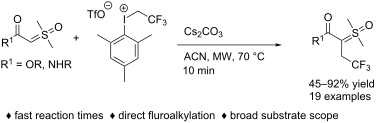
- 10.3762/bjoc.20.263 Abstract A novel study on the hypervalent iodine-mediated polyfluoroalkylation of sulfoxonium ylides was developed. Sulfoxonium ylides, known for their versatility and stability, are promising substrates for numerous transformations in synthetic chemistry. This report demonstrates the
- versatile intermediates in organic synthesis due to their unique reactivity and ability to participate in a wide range of chemical transformations. In this scenario, sulfoxonium ylides are excellent substrates for bifunctionalization reactions, due to the ambiphilic character in their ylidic carbon [16
- ]. This synthetic potential has been demonstrated in a range of insertions into polar bonds [17][18][19][20], C−H activation transformations [21][22][23], and geminal difunctionalizations [24][25]. Within the literature, a broad array of classical methods describes the synthesis of sulfoxonium ylides [26


Multicomponent reactions driving the discovery and optimization of agents targeting central nervous system pathologies
Beilstein J. Org. Chem. 2024, 20, 3151–3173, doi:10.3762/bjoc.20.261
- years, the Ugi reaction has emerged as a highly considered reaction due to its mild conditions, broad applications, and product diversity. It enables the selective assembly of precursors, facilitating various post-reaction transformations such as deprotection cyclization, 1,3-dipolar cycloaddition, and
- -Ugi transformations, it is possible to obtain diverse heterocyclic compounds with tetrazole moieties [65]. In this context, Medda et al. [66] developed a three-step process to access biologically active imidazotetrazolodiazepinones. The first one is the AU-4CRs among ethyl glyoxalate, amines




Controlled oligomerization of [1.1.1]propellane through radical polarity matching: selective synthesis of SF5- and CF3SF4-containing [2]staffanes
Beilstein J. Org. Chem. 2024, 20, 3134–3143, doi:10.3762/bjoc.20.259
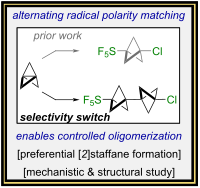
- a single oligomer across a panoply of different transformations typically range from <1% to ≈30% when n > 1 is desired [35]. To the best of our knowledge, the assembly of functionalized [n]staffanes from 1 in high yield/selectivity and in one step via controlled radical oligomerization remains a


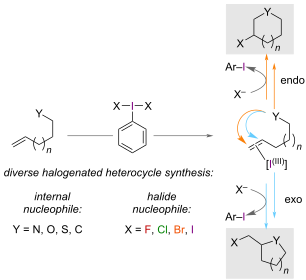
Hypervalent iodine-mediated intramolecular alkene halocyclisation
Beilstein J. Org. Chem. 2024, 20, 3113–3133, doi:10.3762/bjoc.20.258
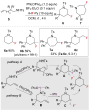
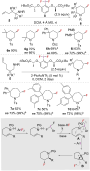
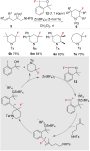
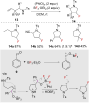
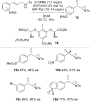
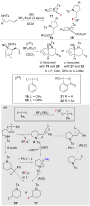
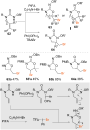
- pyrrolidine intermediates A can undergo further transformations (Scheme 10), depending on their structure and the iodane reagent being used. For example, higher yields of 3-fluoropiperidine products 6 were observed when using cyclic iodane reagents 21 and 22 (Scheme 10), which was suggested to be because a





















Advances in the use of metal-free tetrapyrrolic macrocycles as catalysts
Beilstein J. Org. Chem. 2024, 20, 3085–3112, doi:10.3762/bjoc.20.257
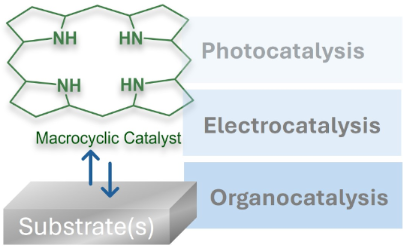
- recognition, and supramolecular assemblies [9][10][11][12][13]. There are numerous examples of using metalloporphyrins as artificial photosynthesis models, enzyme mimics, and catalysts for various organic transformations, where a metal center acts as an active site [14][15][16][17]. However, metal-free (or
- macrocycles, both synthetic and found in nature, and their ability to act as organocatalysts, metal-free porphyrin macrocycles have a potential to be excellent candidates for green, cost-effective catalysts of various organic transformations including asymmetric synthesis. 2 Metal-free tetrapyrrolic
- light irradiation. There are a few reports on red light-mediated transformations using other pyrrolic macrocycles, such as thiaporphyrin [94], phthalocyanine [95], and subphthalocyanine [96]. Porphyrin macrocycles can also absorb red light (Q bands at 518, 553, 592, and 648 nm with extinction


Synthesis of the 1,5-disubstituted tetrazole-methanesulfonylindole hybrid system via high-order multicomponent reaction
Beilstein J. Org. Chem. 2024, 20, 3077–3084, doi:10.3762/bjoc.20.256
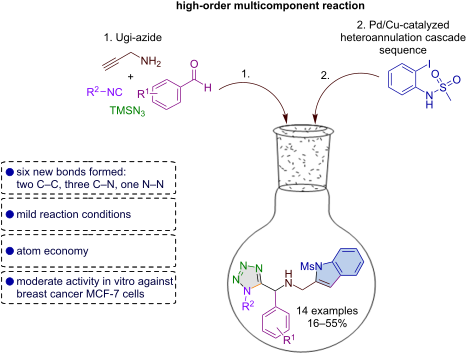
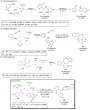
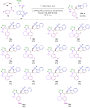
- trifluoroethanol to Et3N for the subsequent catalysis). Thus, this protocol enabled a straightforward and rapid synthesis of highly 2-substituted indoles under mild reaction conditions, highlighting the versatility of propargylamine as a bifunctional reagent in post-Ugi-azide transformations. Our group pioneered



Enantioselective regiospecific addition of propargyltrichlorosilane to aldehydes catalyzed by biisoquinoline N,N’-dioxide
Beilstein J. Org. Chem. 2024, 20, 3069–3076, doi:10.3762/bjoc.20.255
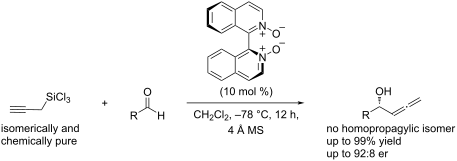
- the two transformations. Studies directed toward a better understanding of possible transition-state structures and the design of new catalysts to improve the results are currently underway in our laboratories. A potential energy surface (PES) for the proposed mechanism for (a) isomerization of


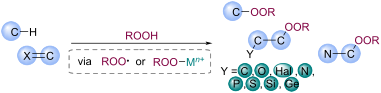
Advances in radical peroxidation with hydroperoxides
Beilstein J. Org. Chem. 2024, 20, 2959–3006, doi:10.3762/bjoc.20.249
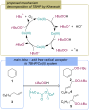
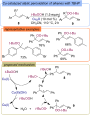
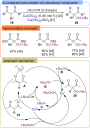
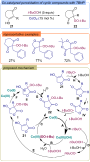
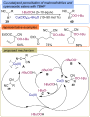
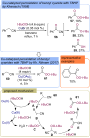
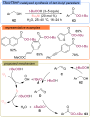
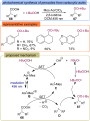
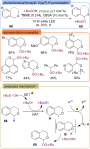
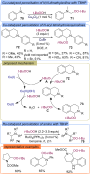
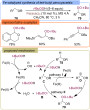
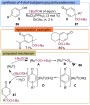
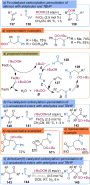
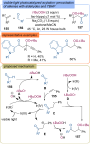
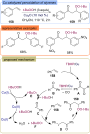
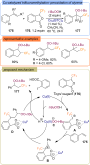
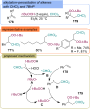
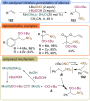
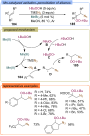
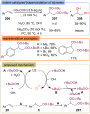
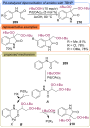
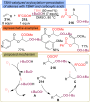
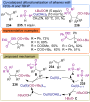
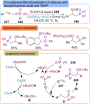
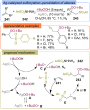
- of allylic peroxidation 2, 4 and 5 were observed (Scheme 4) [24]. Similar transformations were reported later using CuCl as the catalyst [39]. Later, Gade with coauthors demonstrated the allylic peroxidation of cyclohexane with TBHP using the alkylperoxocobalt(III) complexes [Co(BPI)(OAc)(OO-t-Bu





























gem-Difluorovinyl and trifluorovinyl Michael acceptors in the synthesis of α,β-unsaturated fluorinated and nonfluorinated amides
Beilstein J. Org. Chem. 2024, 20, 2946–2953, doi:10.3762/bjoc.20.247
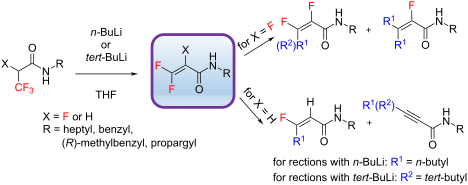
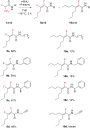
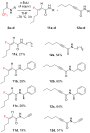
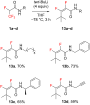
- Poznań, Poland 10.3762/bjoc.20.247 Abstract The incorporation of fluorine atoms within the structure of organic compounds is known to exert a significant impact on their electronic properties, thereby modulating their reactivity in diverse chemical transformations. In the context of our investigation




Recent advances in transition-metal-free arylation reactions involving hypervalent iodine salts
Beilstein J. Org. Chem. 2024, 20, 2891–2920, doi:10.3762/bjoc.20.243

- various useful transformations under mild, eco-friendly reaction conditions [4][5][6][7][8][9][10][11]. Various review articles [12][13][14][15][16][17][18][19][20][21][22][23][24][25][26] and books [27][28] have appeared on the chemistry of hypervalent iodine compounds. In the past two decades
- capability to function as radical initiators. The use of diaryliodonium salts as efficient electrophilic arylating reagents in a wide range of organic transformations is due to their unique features such as solid-state nature, excellent stability, and the presence of a robust leaving group [39][40][41][42
- reductive elimination to produce the desired sulfilimine 99 (Scheme 40) [92]. Synthesizing S-aryl xanthates through transition-metal-catalyzed or SNAr reactions presents challenges due to potential additional transformations occurring under the reaction conditions. However, employing diaryliodonium salts




C–H Trifluoromethylthiolation of aldehyde hydrazones
Beilstein J. Org. Chem. 2024, 20, 2883–2890, doi:10.3762/bjoc.20.242
- . Various reagents and chemical transformations have been elaborated in this context over the years [21][22][23][24][25][26][27][28][29][30][31][32][33][34][35][36][37][38][39][40][41][42][43][44][45][46][47][48][49][50][51]. Despite these recent advances, the design of highly functionalized
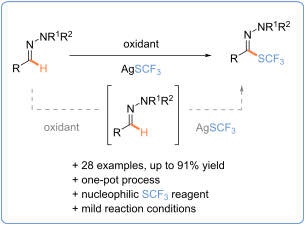
- various transformations [54][55][56][57][58][59][60][61][62][63][64]. In consequence, a large number of transition-metal-catalyzed or radical-mediated processes for C–H functionalization of aldehyde hydrazones has flourished over the years. An ideal scenario for a direct and sustainable synthetic route
- towards trifluoromethylthiolated hydrazones will be the direct C–H functionalization of the corresponding aldehyde hydrazone, an uncharted transformation to date. Forging a C–S bond by the direct C–H-bond functionalization of hydrazones is still underdeveloped. Except for transformations leading to the



Mechanochemical difluoromethylations of ketones
Beilstein J. Org. Chem. 2024, 20, 2799–2805, doi:10.3762/bjoc.20.235
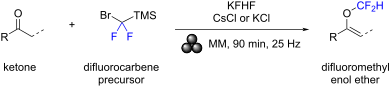
- and 1n were studied. Both gave the expected products in yields of 50% (for 3m) and 44% (for 3n). Besides these successful transformations several ketones proved unsuitable (Scheme S1 in Supporting Information File 1). Additionally, attempted [4 + 1]-type cycloadditions of three 1-arylprop-2-en-1-ones


Computational design for enantioselective CO2 capture: asymmetric frustrated Lewis pairs in epoxide transformations
Beilstein J. Org. Chem. 2024, 20, 2668–2681, doi:10.3762/bjoc.20.224


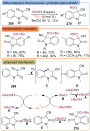
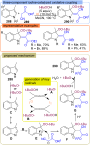
Base-promoted cascade recyclization of allomaltol derivatives containing an amide fragment into substituted 3-(1-hydroxyethylidene)tetronic acids
Beilstein J. Org. Chem. 2024, 20, 2585–2591, doi:10.3762/bjoc.20.217
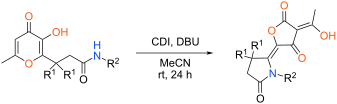
- purification. The synthetic utility of the prepared tetronic acids was demonstrated by further transformations at the hydroxyethylidene fragment. The structures of one obtained tetronic acid and one product of derivatization were confirmed by X-ray analysis. Keywords: allomaltol; base-promoted recyclization
- -hydroxypyran-4-ones these products are widely used in organic synthesis [17][18][19][20][21][22][23]. Among the diverse chemical transformations of allomaltol derivatives the recyclizations of the pyranone ring are of great interest. As a rule, such reactions are realized under action of nitrogen-containing
- nucleophiles and open access to a large array of substituted pyridin-4-ones. Various conditions and reagents employed for these transformations are presented in numerous papers [24][25][26][27][28][29]. Besides that, approaches to the synthesis of pyridazinones and pyrazoles based on the interaction of 3


A review of recent advances in electrochemical and photoelectrochemical late-stage functionalization classified by anodic oxidation, cathodic reduction, and paired electrolysis
Beilstein J. Org. Chem. 2024, 20, 2500–2566, doi:10.3762/bjoc.20.214
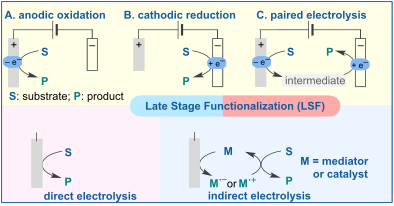
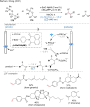
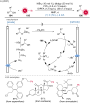
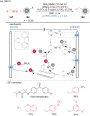
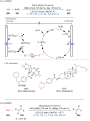
- electrochemical transformations. Detailed reaction conditions, such as electrolyte, electrode material, and the use of constant current or constant voltage, are presented. Additionally, we discuss the mechanisms of some representative reactions and provide selected examples of LSF of relevant bioactive compounds
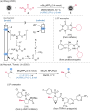
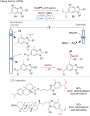
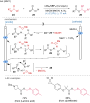
- arenes via palladium-catalyzed electrooxidation, further showcasing the versatility and potential of this approach in organic synthesis (Scheme 42b) [58]. These methodologies underline the expanding role of palladium catalysis in electrochemical transformations, offering robust strategies for the
- into a carbon radical intermediate. The photocatalyst then oxidizes this intermediate, leading to the final product (Scheme 45). This approach underscores the significant potential of combining electro- and photocatalysis to achieve selective and mild transformations in organic synthesis, particularly














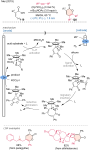


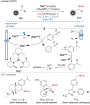


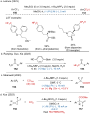


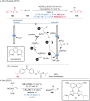






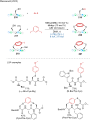


Visible-light-mediated flow protocol for Achmatowicz rearrangement
Beilstein J. Org. Chem. 2024, 20, 2493–2499, doi:10.3762/bjoc.20.213
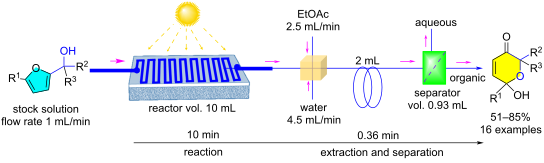
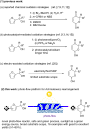
- transformations, then reaction extraction and separation, into a single process, which are typically performed individually/separately in batch methods. This enhances the overall efficiency for obtaining the desired product(s) from the reaction mixture. In continuation to our efforts on developing flow-based


Machine learning-guided strategies for reaction conditions design and optimization
Beilstein J. Org. Chem. 2024, 20, 2476–2492, doi:10.3762/bjoc.20.212
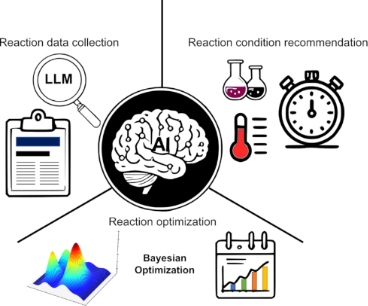
- al. [156]. Moreover, it is unclear whether AAM significantly improves the accuracy of reaction modeling. The AAM-required methods are usually tested on specific reaction types, where the reaction transformations and AAM are clear and correct. However, most large-scale reaction datasets do not have
- related literature, caution is advised as experimental apparatus from different sources could introduce systematic errors in reported yields [46]. Furthermore, BO cannot generalize well from past reactions to unseen reaction transformations, which inherently requires gathering new relevant data for new


Phenylseleno trifluoromethoxylation of alkenes
Beilstein J. Org. Chem. 2024, 20, 2434–2441, doi:10.3762/bjoc.20.207
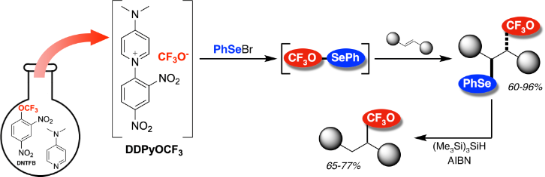
- finally be reopened by trifluoroacetate (Scheme 3). Although the selenylated compounds 2 are of interest, the presence of the PhSe moiety allows other transformations to be considered. First, the oxidative elimination of the selenyl moiety to generate a double bond was first studied. However, regardless



Synthesis, electrochemical properties, and antioxidant activity of sterically hindered catechols with 1,3,4-oxadiazole, 1,2,4-triazole, thiazole or pyridine fragments
Beilstein J. Org. Chem. 2024, 20, 2378–2391, doi:10.3762/bjoc.20.202
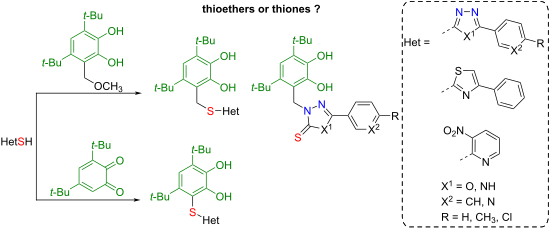
- : antioxidant activity; catechol thioethers; heterocycles; redox-transformations; thiones; Introduction Synthetic derivatives of polyphenols, in particular catechol (hydroquinone), represent a promising group of pharmacologically active substances [1][2]. Catechol-containing compounds demonstrate
- [25]. A feature of mercapto-substituted heterocycles is the possibility of their existence in two tautomeric forms: thiol or thione [26][27]. The ability to tautomeric transformations affects their biological activity and allows the use of these molecular blocks to design compounds with different
- (control) during the incubation for 3, 24, and 48 hours (concentration of compounds in the reaction medium is 0.1 mM). The results are expressed as mean ± standard deviation (* p < 0.001; ** p < 0.01; ***p < 0.05). Synthesis of catechol-containing compounds 1–9. Electrochemical transformations of compounds




Tandem diazotization/cyclization approach for the synthesis of a fused 1,2,3-triazinone-furazan/furoxan heterocyclic system
Beilstein J. Org. Chem. 2024, 20, 2342–2348, doi:10.3762/bjoc.20.200
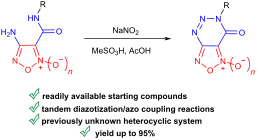
- , whether isolated or generated in situ, may undergo various controlled transformations [42]. However, previously, we failed to introduce amino-1,2,5-oxadiazoles bearing an amide functionality into the diazotization protocol, arguably due to an increased electron-withdrawing effect and elevated instability


Stereoselective mechanochemical synthesis of thiomalonate Michael adducts via iminium catalysis by chiral primary amines
Beilstein J. Org. Chem. 2024, 20, 2313–2322, doi:10.3762/bjoc.20.198
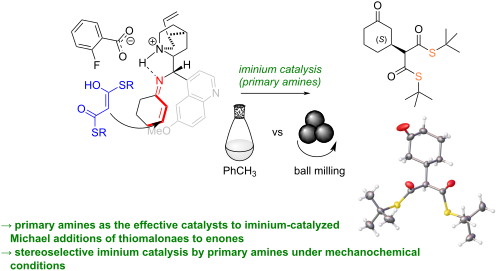
- ][7][8]. Furthermore, the integration of mechanochemistry and organocatalysis leads to the development of more sustainable transformations, characterized by reduced reaction times, decreased catalyst loadings, and significantly diminished solvent usage and waste production [9][10][11]. The pioneering
- studies by Bolm [12][13], and Juaristi et al. [14]. have significantly advanced chiral secondary amine-catalyzed stereoselective reactions under ball milling conditions, representing a widely explored activation mode in mechanochemical-mediated transformations. However, reports on chiral primary iminium
- [15][16] or iminium-ion catalysis [17] under ball-mill conditions are scarce, in contrast to the abundance of transformations catalyzed by such covalent catalysis. Among the numerous organocatalytic reactions facilitated by primary amine-based iminium ions, Michael-type additions deserve special


Hydrogen-bond activation enables aziridination of unactivated olefins with simple iminoiodinanes
Beilstein J. Org. Chem. 2024, 20, 2305–2312, doi:10.3762/bjoc.20.197
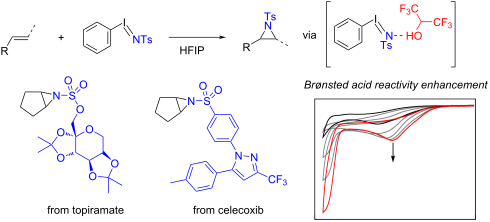
- ), Koser’s reagent (PhI(OH)OTs), Zhdankin’s reagent (C6H4(o-COO)IN3, ABX), and Dess–Martin periodinane (DMP) – and find application in an array of synthetically important transformations including olefin difunctionalization, carbonyl desaturation, alcohol oxidation, and C–H functionalization [3][4