

Search results
Search for "prediction" in Full Text gives 164 result(s) in Beilstein Journal of Organic Chemistry.
Pyridinoacridine alkaloids of marine origin: NMR and MS spectral data, synthesis, biosynthesis and biological activity
Beilstein J. Org. Chem. 2015, 11, 1667–1699, doi:10.3762/bjoc.11.183
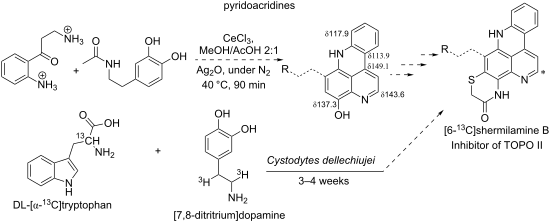
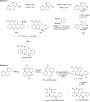
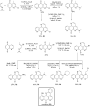
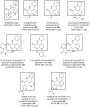
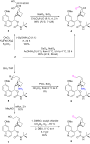
- of the A ring when the B ring is not aromatic. The compilation of this NMR data could be used as a library for a database prediction and could also save time with respect to structure elucidation of related natural congeners. Earlier, successful synthetic figures have also been presented as well as











Why base-catalyzed isomerization of N-propargyl amides yields mostly allenamides rather than ynamides
Beilstein J. Org. Chem. 2015, 11, 1441–1446, doi:10.3762/bjoc.11.156
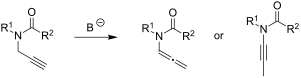
- for the corresponding isomers for a selected combination of starting amides or carbamates and a final urea example (Figure 1) were computed using ab initio and DFT methods. Results and Discussion Computational procedures It is known that ab initio prediction of cumulene–polyynes isomerization energies
- the same system with a ΔH0 value of −1.1 kcal/mol (Table 1). The best performing DFT functional for the prediction of cumulene–polyynes isomerization energies was found by Zhao and Truhlar to be the hybrid meta-GGA M05 functional [9]. Since then, new functionals of the same family have been reported
- energies, providing a suitable computational methodology for the prediction of the result of the isomerization reaction in similar systems. Computational Procedures All reaction energies are reported as enthalpies at zero K (ΔH0 = ΔE + ZPVE). The structures were fully optimized at the reported levels of


Donor–acceptor type co-crystals of arylthio-substituted tetrathiafulvalenes and fullerenes
Beilstein J. Org. Chem. 2015, 11, 1043–1051, doi:10.3762/bjoc.11.117
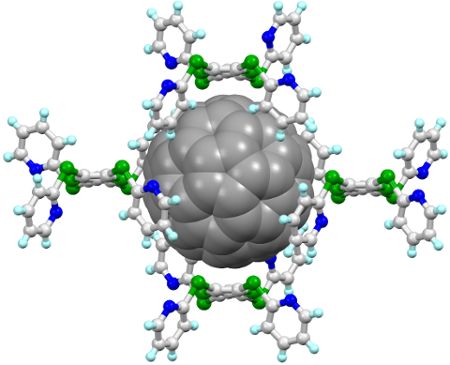
- potentially accommodate the solvent molecules. In a previous report, we have proposed that C70 tends to form co-crystals with a larger acceptor ratio [63]. However, the present results suggest that this prediction would not hold because both C60 and C70 form the type I and type II co-crystals with Ar-S-TTFs


Cross-dehydrogenative coupling for the intermolecular C–O bond formation
Beilstein J. Org. Chem. 2015, 11, 92–146, doi:10.3762/bjoc.11.13
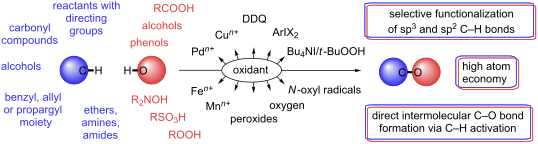
- also of fundamental interest because new aspects of the reactivity of organic compounds have to be found for the performance of these reactions. The prediction of the conditions necessary for the efficient cross-dehydrogenative coupling is an important problem that requires an understanding of the









Come-back of phenanthridine and phenanthridinium derivatives in the 21st century
Beilstein J. Org. Chem. 2014, 10, 2930–2954, doi:10.3762/bjoc.10.312

- mode, depending on the ratio r = [compound]/[polynucleotide]. Moreover, there is no set of rules which will accurately predict the dominant binding site of newly designed phenanthridine/phenanthridinium analogues. All aforementioned also hampers the prediction of the fluorimetric response, which is




Binding mode and free energy prediction of fisetin/β-cyclodextrin inclusion complexes
Beilstein J. Org. Chem. 2014, 10, 2789–2799, doi:10.3762/bjoc.10.296
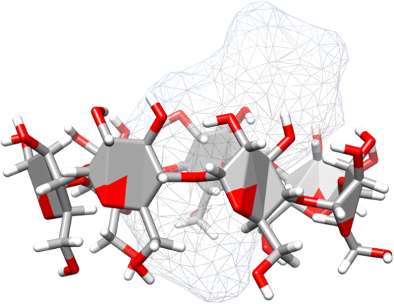
- radial distribution function (RDF). The calculations of MM-PBSA/GBSA binding free energies (∆GMM-PBSA and ∆GMM-GBSA) and their energy components were analyzed using the mm_pbsa module. Free energy prediction The MM-PBSA and MM-GBSA methods have been widely used to estimate the binding free energies of
- is worth to note that in comparison to the QM energy (∆EQM) the MM method was likely found to overestimate the binding interaction by ca. 10 kcal/mol for all snapshots in the three forms of complex (Figure 7). Our results also suggested that for binding free energy prediction, the entropy and


Self-assembled monolayers of shape-persistent macrocycles on graphite: interior design and conformational polymorphism
Beilstein J. Org. Chem. 2014, 10, 2774–2782, doi:10.3762/bjoc.10.294
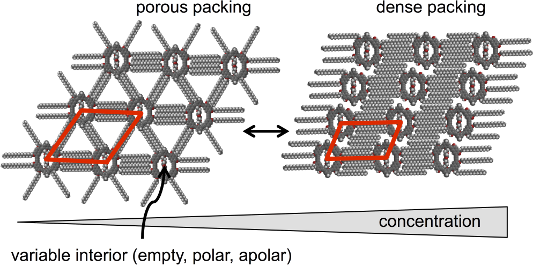
- a prediction of the surface pattern at high concentrations. This should lead to a tailorable structure of both, the porous and dense polymorphs, or – in other words – an alteration between two discrete designable packings, here as an effect of the compound concentration in the supernatant solution



Building complex carbon skeletons with ethynyl[2.2]paracyclophanes
Beilstein J. Org. Chem. 2014, 10, 2013–2020, doi:10.3762/bjoc.10.209

- ago we described the preparation of various ethynyl[2.2]paracyclophanes and suggested that these compounds could be developed into useful building blocks for the construction of larger, stereochemically complex carbon frameworks (scaffolds) [2]. This prediction is clearly becoming reality, as shown by




Pyrrolidine nucleotide analogs with a tunable conformation
Beilstein J. Org. Chem. 2014, 10, 1967–1980, doi:10.3762/bjoc.10.205
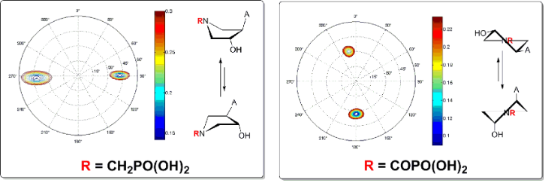
- thereof to an active site of a particular enzyme. The knowledge of the conformation of nucleosides, nucleotides and their analogs is therefore essential for the understanding or even prediction of their biological properties. There are several approaches providing information on the conformation of a five


Supercritical carbon dioxide: a solvent like no other
Beilstein J. Org. Chem. 2014, 10, 1878–1895, doi:10.3762/bjoc.10.196
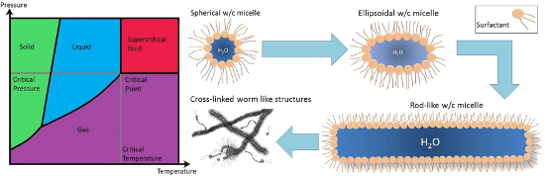
- electrical charge within a molecule that leads to an electric dipole/multipole moment. It is dependent on a difference in electronegativity between the atoms within a compound and the degree of asymmetry in the compound. Point group determination is useful for the prediction of polarity. If individual dipole


Addition of H-phosphonates to quinine-derived carbonyl compounds. An unexpected C9 phosphonate–phosphate rearrangement and tandem intramolecular piperidine elimination
Beilstein J. Org. Chem. 2014, 10, 883–889, doi:10.3762/bjoc.10.85
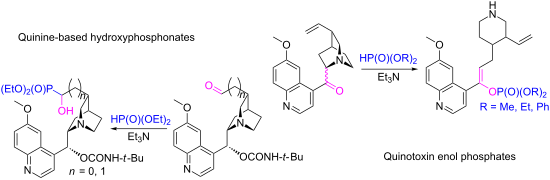
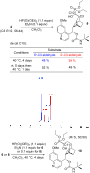
- ’ protons of the quinoline system. This proximity is achievable only in the case of location of vinyl and quinoline protons at the same side of the double bond. Theoretical prediction of the H12 NMR chemical shift provided an additional confirmation [39]. The δ calculated for the Z arrangement (geminal




Self-assembly of 2,3-dihydroxycholestane steroids into supramolecular organogels as a soft template for the in-situ generation of silicate nanomaterials
Beilstein J. Org. Chem. 2013, 9, 1826–1836, doi:10.3762/bjoc.9.213
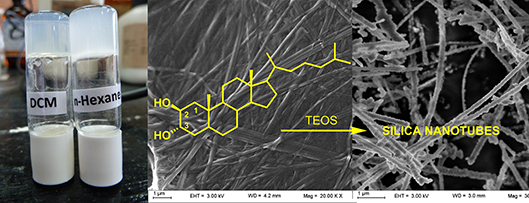
- showing that, although spherical spaces cannot be defined, prediction is possible by selecting solvents with HSP inside the gelation zones. Figure 2 qualitative shows that there is a good correlation between the HSP and the gelated solvents, pyridine and methyl acrylate are the only solvents that visible


Synthesis of the reported structure of piperazirum using a nitro-Mannich reaction as the key stereochemical determining step
Beilstein J. Org. Chem. 2013, 9, 1737–1744, doi:10.3762/bjoc.9.200
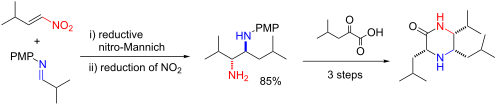
- chemical synthesis, guided by GIAO chemical shift prediction, is currently underway in an effort to elucidate the correct structure for piperazirum. In addition the determination of further biological activity of 2 and its diastereoisomers will be investigated. Experimental Unless otherwise stated, all


Copper(II)-salt-promoted oxidative ring-opening reactions of bicyclic cyclopropanol derivatives via radical pathways
Beilstein J. Org. Chem. 2013, 9, 1397–1406, doi:10.3762/bjoc.9.156
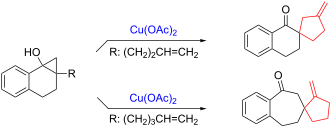
- this prediction, cyclopropanols 1, prepared by SmI2-promoted intramolecular Barbier reaction of the corresponding α-bromomethyl cycloalkanones 6 [28], were subjected to reactions promoted by various copper(II) salts, CuX2 (Scheme 5). The results of the reaction of 1b with Cu(OAc)2 (Scheme 6) are


Host–guest complexes of mixed glycol-bipyridine cryptands: prediction of ion selectivity by quantum chemical calculations, part V
Beilstein J. Org. Chem. 2013, 9, 1252–1268, doi:10.3762/bjoc.9.142
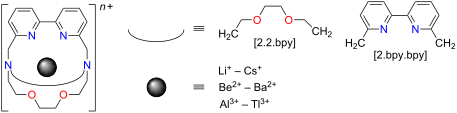
- presented work was initiated with the objective to systematically study the selective complexation of alkali, alkaline-earth and earth metal cations by [2.2.bpy] and [2.bpy.bpy] cryptands. In general, the prediction of a favorable complexation can be made based on two characteristics, viz., bond distances
- systems, the examination of the energy of a model reaction, depicted in Scheme 1, provides valuable results, important for the prediction of the cryptand’s selectivity. All cations were calculated in the six-fold coordination environment, to maintain equal conditions for all studied systems. For the


![[Graphic 2]](/bjoc/content/inline/1860-5397-9-142-i3.png?max-width=637&scale=0.295455) 2.2.bpy]+.
2.2.bpy]+.


Spectroscopic characterization of photoaccumulated radical anions: a litmus test to evaluate the efficiency of photoinduced electron transfer (PET) processes
Beilstein J. Org. Chem. 2013, 9, 800–808, doi:10.3762/bjoc.9.91
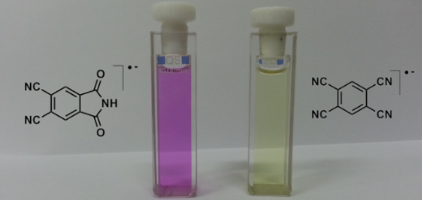
- 3d), reversible with air. These were attributed to the corresponding radical anions, not previously characterized, but fitting with a computational prediction of 559 nm for the radical anion of the unsubstituted N-methylphthalimide [43]. Finally, with both of the aromatic esters investigated, the




Utilizing the σ-complex stability for quantifying reactivity in nucleophilic substitution of aromatic fluorides
Beilstein J. Org. Chem. 2013, 9, 791–799, doi:10.3762/bjoc.9.90
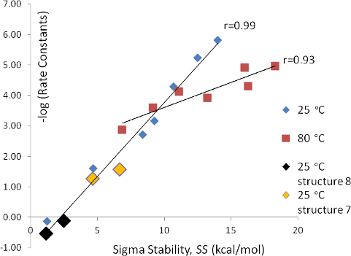
- synthetic routes to a target molecule, e.g., a candidate drug. To this end, efficient models that enable the prediction of product selectivity and relative reaction rates in a quantitative or semiquantitative way would be highly valuable. As a complement to experimental work, the use of such tools can help
- attack of anionic nucleophiles to aromatic fluorides for a great many examples. They found that an approach using F− as model nucleophile without solvent calculations was sufficient to give a good qualitative prediction of the main site of nucleophilic attack. The σ-complex approach failed when the
- preserving an accuracy that in many cases is sufficient for an, at least semiquantitative, prediction of reactivity. Results The performance of the SS concept was examined on the basis of correlations with experimentally determined reaction rate constants (k) of three series of reactions (series A, B and C


NHC-catalysed highly selective aerobic oxidation of nonactivated aldehydes
Beilstein J. Org. Chem. 2013, 9, 602–607, doi:10.3762/bjoc.9.65
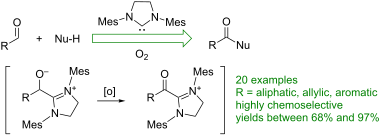
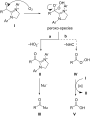
- 83% of the desired ester were achieved. Following path a, a hydroperoxyl anion is formed as a side product. In our experiments we could not detect this anion. We therefore assume that it acts as an additional oxidation agent under formation of water. To fortify this prediction, a test experiment with


Inclusion of the insecticide fenitrothion in dimethylated-β-cyclodextrin: unusual guest disorder in the solid state and efficient retardation of the hydrolysis rate of the complexed guest in alkaline solution
Beilstein J. Org. Chem. 2013, 9, 106–117, doi:10.3762/bjoc.9.14
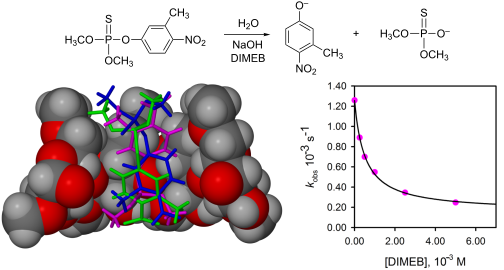
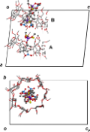
- be consistent with this prediction. This pseudo-translational symmetry was indeed a feature of the structural solution and is illustrated in Figure 3, where it relates the two complex units A and B in the crystal asymmetric unit of DIMEB·1. While the gross structures of the independent complex units






Dipyrazolo[1,5-a:4',3'-c]pyridines – a new heterocyclic system accessed via multicomponent reaction
Beilstein J. Org. Chem. 2012, 8, 2223–2229, doi:10.3762/bjoc.8.251
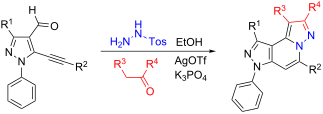
- reliable, unambiguously assigned chemical shift data is important as reference material for NMR prediction programs, such as CSEARCH/NMRPREDICT [34][35] or ACD/C+H predictor [36]. Such programs have become more and more popular in the past few years, particularly for the prediction of 13C NMR chemical


















Design of a novel tryptophan-rich membrane-active antimicrobial peptide from the membrane-proximal region of the HIV glycoprotein, gp41
Beilstein J. Org. Chem. 2012, 8, 1172–1184, doi:10.3762/bjoc.8.130
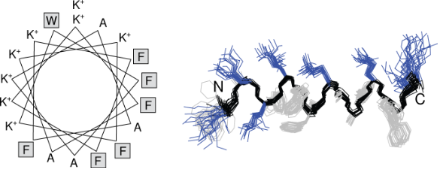
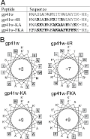
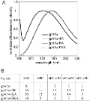
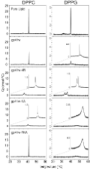
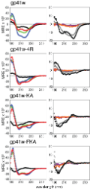
- . Additionally, they would have to disassociate into monomers before they could insert themselves into the bacterial membrane. Recent artificial-neural-network prediction models of antimicrobial peptides have found that peptide aggregation in solution indeed contributes to a low antimicrobial activity [27




Similarity analysis, synthesis, and bioassay of antibacterial cyclic peptidomimetics
Beilstein J. Org. Chem. 2012, 8, 1146–1160, doi:10.3762/bjoc.8.128
- [38]. Clustering of the structures in such a multidimensional space is the natural choice for similarity analysis. Clustering Clustering is a widely used technique that has found application in the selection of compounds for screening, analysis of substructure search output, and the prediction of


Synthesis and in silico screening of a library of β-carboline-containing compounds
Beilstein J. Org. Chem. 2012, 8, 1048–1058, doi:10.3762/bjoc.8.117
- predict potential targets of the newly synthesized library of β-carboline-containing compounds. High-throughput docking studies for protein-target prediction of newly synthesized compounds Molecular docking studies were performed with the 34 newly synthesized compounds, represented by scaffolds 1, 2, 3
- pyrazole group of 6{10}. Ligand-based strategy for target prediction Ligand-based target prediction algorithms have been developed based upon an established medicinal chemistry principle that structurally similar compounds, with comparable physical properties, should convey related biological properties


The use of glycoinformatics in glycochemistry
Beilstein J. Org. Chem. 2012, 8, 915–929, doi:10.3762/bjoc.8.104

- templates in vaccine development [67][68][69][70], and glycomimetics that block specific enzymes or lectins can be used for therapeutic purposes [71][72][73][74][75][76][77]. The Glycan Pathway Prediction (GPP) tool of the RINGS portal [78] can be used to predict glycans that can be obtained with a given
- protein databases. Tools to input, convert, or analyze glycan structures. Tools for prediction and analysis of carbohydrate/glycoprotein 3D structures. Prediction and analysis of glycosylation sites. Tools to support experimental analysis of glycans.