

Search results
Search for "phosphite" in Full Text gives 128 result(s) in Beilstein Journal of Organic Chemistry.
New modification of the Perkow reaction: halocarboxylate anions as leaving groups in 3-acyloxyquinoline- 2,4(1H,3H)-dione compounds
Beilstein J. Org. Chem. 2005, 1, No. 17, doi:10.1186/1860-5397-1-17
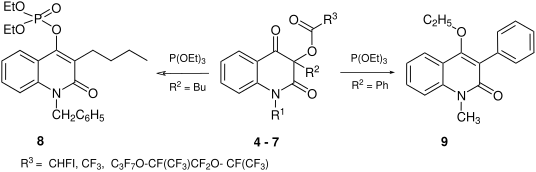
- 72 Zlín, Czech Republic Zentiva, U Kabelovny 130, 10237 Prague 10, Czech Republic 10.1186/1860-5397-1-17 Abstract Substituted 3-(fluoroacyloxy)quinoline-2,4(1H,3H)-diones including 3-(fluoroiodoacetoxy) derivatives react with triethyl phosphite to afford either the product of the Perkow reaction or
- reaction of halocompounds, the observed leaving groups were the halogen anions. However, in the reaction of pentaacetylated D-fructose with trimethyl phosphite the acetyloxy anion as the leaving group was also observed. [10] This rather unusual transformation may be attributed to the structural nature of
- the sugar skeleton and its multiple acetoxy groups. In this communication we would like to report on the ability of halocarboxylate anions to act as leaving groups in the reactions of 3-(haloacyloxy)-quinoline-2,4(1H,3H)-diones with triethyl phosphite to afford 8 and 9, the products of the Perkow




An exceptional P-H phosphonite: Biphenyl- 2,2'-bisfenchylchlorophosphite and derived ligands (BIFOPs) in enantioselective copper- catalyzed 1,4-additions
Beilstein J. Org. Chem. 2005, 1, No. 6, doi:10.1186/1860-5397-1-6
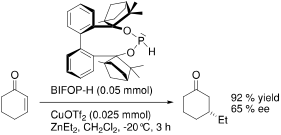
- as well as hydridic and organometallic nucleophiles. Chloride substitution in BIFOP-Cl proceeds only under drastic conditions. New enantiopure, sterically demanding phosphorus ligands such as a phosphoramidite, a phosphite and a P-H phosphonite (BIFOP-H) are hereby accessible. In enantioselective Cu
- -catalyzed 1,4-additions of ZnEt2 to 2-cyclohexen-1-one, this P-H phosphonite (yielding 65% ee) exceeds even the corresponding phosphite and phosphoramidite. Keywords: phosphorus ligands; chirality; biaryls; asymmetric conjugate additions; phosphoramidites; phosphites; phosphonites; X-ray analyses
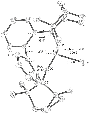
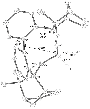
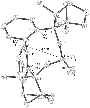
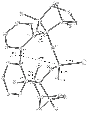
- and LiNEt2. While no hydrolysis of 1 is observed at ambient temperature, only reflux and basic conditions (KOH) yield complete hydrolysis of 1 to BIFOP(O)-H, 8 (98%, Table 1, entry 14, Figure 5). [79][80] The phosphite BIFOP-OPh, 6 (40%, Figure 6) and the phosphoramidite BIFOP-NEt2, 7 (47%, Figure 7









Mixtures of monodentate P-ligands as a means to control the diastereoselectivity in Rh-catalyzed hydrogenation of chiral alkenes
Beilstein J. Org. Chem. 2005, 1, No. 3, doi:10.1186/1860-5397-1-3
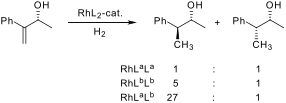
- a diastereoselectivity of only 5:1 (entry 17). Another noteworthy catalyst system is composed of the bulky phosphite P22. This ligand alone delivers a moderate diasteroselectivity of 4:1 (entry 20), whereas various hetero-combinations based on P22 and other P-ligands induce markedly enhanced


Other Beilstein-Institut Open Science Activities