

Search results
Search for "free energy" in Full Text gives 207 result(s) in Beilstein Journal of Organic Chemistry. Showing first 200.
Methylpalladium complexes with pyrimidine-functionalized N-heterocyclic carbene ligands
Beilstein J. Org. Chem. 2016, 12, 1557–1565, doi:10.3762/bjoc.12.150
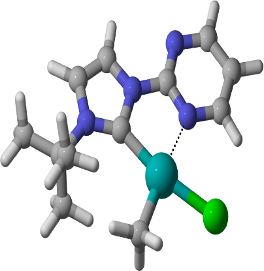
- ) and 12 (in CH3CN). Synthesis of complex 13. Possible pathways of methyl trifluoroacetate formation starting from complex 13. Synthesis of complex 14 by conversion of complex 13 with iodobenzene bistrifluoroacetate. Synthesis of the [((pym)^(NHC-R))PdII(CH3)2] complex 15. Calculated free energy


Ring-whizzing in polyene-PtL2 complexes revisited
Beilstein J. Org. Chem. 2016, 12, 1410–1420, doi:10.3762/bjoc.12.135
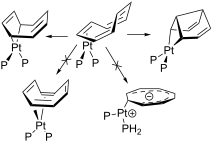
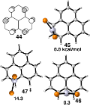
- can be found elsewhere [21]. The Gibbs free energy difference between the two structures is small: 4.1 kcal/mol (2.4 kcal/mol for L = PH3). This is in accord with four structures of (Ph3C3)M(PPh3)2+ X− where M = Ni, Pd, and Pt and X− = ClO4 and PF6, which show a progressive movement of the ML2 unit
- fragment orbital can interact with b2 to form an η3 complex as shown in 13. An η5 geometry, 14, will be favored using the empty e”1 orbital. The computed Gibbs free energy difference between the two is very small, namely 1.5 kcal/mol favoring η3. A recent search of the Cambridge crystallographic database
- point calculations. Analytical frequencies were computed to determinate the nature of the stationary points. The Gaussian 09 software suite [34] was used in all of the calculations. The plots of the molecular structures utilized CYLview [35]. For brevity we will report the structures and Gibbs free






On the mechanism of imine elimination from Fischer tungsten carbene complexes
Beilstein J. Org. Chem. 2016, 12, 1322–1333, doi:10.3762/bjoc.12.125
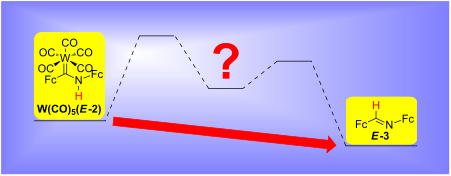
- first-order rate-law with a Gibbs free energy of activation of ΔG‡298K = 112 kJ mol−1. Three proposed mechanistic pathways are taken into account and supported by detailed (time-dependent) densitiy functional theory [(TD)-DFT] calculations. The preferred pathway is initiated by an irreversible CO
- -donating character of the amino substituent vs the alkoxy substituent thus increasing the C(carbene)–X double bond character (X = N, O) [62][63][64] and the loss of some attractive NH…Fe interaction (H…Fe(Fc-C) = 2.98 Å) in W(CO)5(E-2) [27][54][55][56][57][58][59]. The Gibbs free energy of activation for
- between TDTS and TDI is the maximum energy span between a given intermediate and all following transition states of the cycle and can be understood as the overall Gibbs free energy of activation of the whole catalytic cycle [65]. This procedure can be translated to competing reaction paths. For pathways




Scope and mechanism of the highly stereoselective metal-mediated domino aldol reactions of enolates with aldehydes
Beilstein J. Org. Chem. 2016, 12, 813–824, doi:10.3762/bjoc.12.80
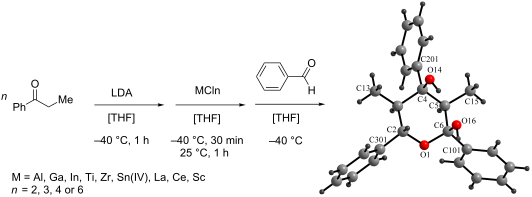
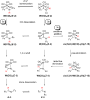
- of 1.22 kcal mol−1 (TS-A2-A3) takes place, which furnishes the metal-bound hemiacetal in a boat conformation (A3) with a relative free energy of −7.49 kcal mol−1. Hydrolysis of A3 provides tetrahydro-2H-pyran-2,4-diol 5a. Computationally predicted A2 has a lower free energy than the hemiacetal A3


From steroids to aqueous supramolecular chemistry: an autobiographical career review
Beilstein J. Org. Chem. 2016, 12, 684–701, doi:10.3762/bjoc.12.69
- sterically hinder dimerization interfere less with an assembly as the angle between the two interfacing surfaces of a pair of cavitands increases from 0° (in a dimer) to ~70.5° (in a regular tetrahedron). This senary assembly many be higher in free energy, but because this container has a volume of four





cis–trans-Amide isomerism of the 3,4-dehydroproline residue, the ‘unpuckered’ proline
Beilstein J. Org. Chem. 2016, 12, 589–593, doi:10.3762/bjoc.12.57
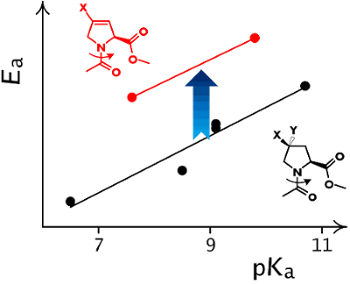
- upon NMR investigations of the conventional methyl esters of the N-acetyl amino acids (Ac-Xaa-OMe) [38]. The equilibrium Ks-trans/s-cis constants in the model compounds were found to be: 5 – 4.97 ± 0.07, 6 – 5.45 ± 0.09, 7 – 4.31 ± 0.05 and 8 – 4.82 ± 0.03 (50 mM, D2O, 296 K). In terms of the free
- energy the 3,4-double bond increased the relative stability of the s-trans conformer by 0.2–0.3 kJ/mol, whereas the 4-CF3-group demonstrated an opposite effect of about 0.3 kJ/mol (standard error ±0.1 kJ/mol). Despite both effects being rather marginal, this indicates that the increase of the


Effective in silico prediction of new oxazolidinone antibiotics: force field simulations of the antibiotic–ribosome complex supervised by experiment and electronic structure methods
Beilstein J. Org. Chem. 2016, 12, 415–428, doi:10.3762/bjoc.12.45
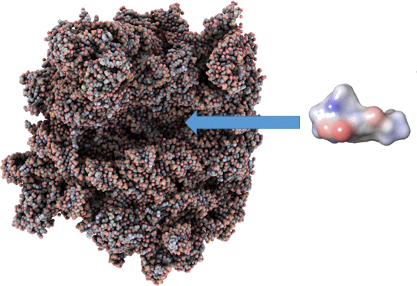
- , based on scoring functions, are able to tread hundred thousands of candidates in a highly approximate (and sometimes erratic) fashion, alchemical-free energy perturbation (FEP) calculations are also error prone. The predictive power of those FEPs depends on many adjustable parameters, even if the
- and promising antibacterial lead agents for treatment of serious Gram-positive infections. Settled right between very fast, but often erratic, virtual screening techniques, on the one side, and alchemical free energy perturbation calculations on the other, our protocol speed (one day per guest on a


Dynamic behavior of rearranging carbocations – implications for terpene biosynthesis
Beilstein J. Org. Chem. 2016, 12, 377–390, doi:10.3762/bjoc.12.41
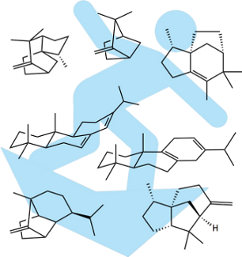
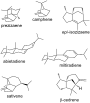
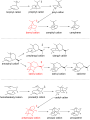
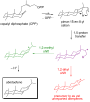
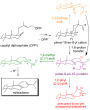
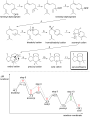
- dynamical behavior of carbocations involved in terpene-forming reactions. In each section, we highlight important take home messages. Dynamical behavior – a brief tutorial The reactivity of a molecule often ties back to a single characteristic: its energy (in particular, its free energy). Computational and



Simple activation by acid of latent Ru-NHC-based metathesis initiators bearing 8-quinolinolate co-ligands
Beilstein J. Org. Chem. 2016, 12, 154–165, doi:10.3762/bjoc.12.17
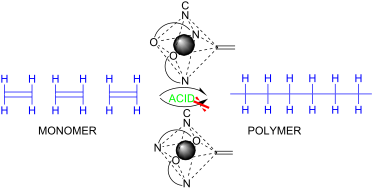
- calculating the energy of the acid–base equilibrium (see Scheme 2), where [Ru] is 2a or 2b, [Ru]H+ is 2a or 2b with a protonated O atom. The energy of [Ru] and [Ru]H+ is calculated in CH2Cl2 using the protocol described in the computational details sections, while for the aqueous solvation free energy of the


Synthesis and reactivity of aliphatic sulfur pentafluorides from substituted (pentafluorosulfanyl)benzenes
Beilstein J. Org. Chem. 2016, 12, 110–116, doi:10.3762/bjoc.12.12
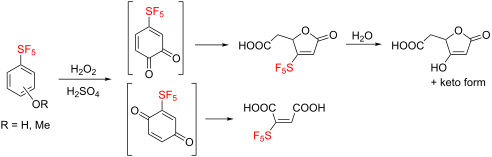
- Diels–Alder products (Table 1). Single-point energies of the transition states suggested that pathway a was preferred over b (difference of ca. 10–20 kJ/mol). This was further supported by comparison of Gibbs free energy values. Boltzmann distribution was used to calculate theoretical endo/exo


Solving the puzzling competition of the thermal C2–C6 vs Myers–Saito cyclization of enyne-carbodiimides
Beilstein J. Org. Chem. 2016, 12, 43–49, doi:10.3762/bjoc.12.6
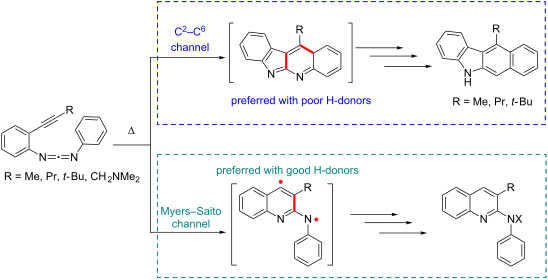
- final products 8a–c thus avoiding a C2–C6 diradical mechanism. As expected due to the strong steric shielding about the tert-butyl group, enyne-carbodiimide 7b exhibits the highest free energy barrier, i.e., 37.8 kcal mol−1 at 138 °C (= the reaction temperature). The free energies of activation for
- steps is disfavored on the free energy surface (ΔΔG‡ = 3.3 and 7.1 kcal mol−1). After the insightful computational analysis of the reaction mechanism of 7a–c, we chose to use computations in search for an enyne-carbodiimide with a preferred Myers–Saito pathway that would not carry hydrogen at the alkyne


Physical properties and biological activities of hesperetin and naringenin in complex with methylated β-cyclodextrin
Beilstein J. Org. Chem. 2015, 11, 2763–2773, doi:10.3762/bjoc.11.297
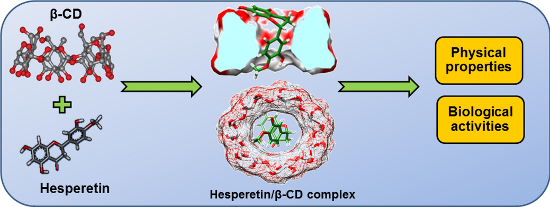
- hesperetin with cyclodextrins (β-CD and DM-β-CD) were theoretically investigated by molecular dynamics simulation. The free energy values obtained suggested a more stable inclusion complex with DM-β-CD. The vdW force is the main guest–host interaction when hesperetin binds with CDs. The phase solubility
- , the cytotoxic activity on CaCo-2, HeLa and MCF-7 carcinoma cell lines of inclusion complexes was also determined. Results and Discussion The binding free energy of inclusion complexes between naringenin with β-CD and DM-β-CD has been previously reported by our group [40]. In the present work, we
- free energy of inclusion complexes Root mean square displacements (RMSDs) for all atoms of the complex, cyclodextrin and hesperetin in respect with those of initial structures (Figure S1, Supporting Information File 1) suggested that the three independent simulations of β-CD (A1–A3) and DM-β-CD (B1–B3


Aggregation behaviour of amphiphilic cyclodextrins: the nucleation stage by atomistic molecular dynamics simulations
Beilstein J. Org. Chem. 2015, 11, 2459–2473, doi:10.3762/bjoc.11.267
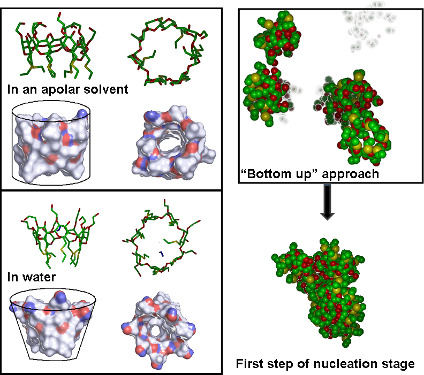
- cannot be ruled out: in fact, in view of the small size of these aggregates and of the simulations carried out in vacuo with four and eight molecules, the present results only describe the embryonic stage of aggregation, separated from later stages by some free energy barrier, mainly due to


Co-solvation effect on the binding mode of the α-mangostin/β-cyclodextrin inclusion complex
Beilstein J. Org. Chem. 2015, 11, 2306–2317, doi:10.3762/bjoc.11.251
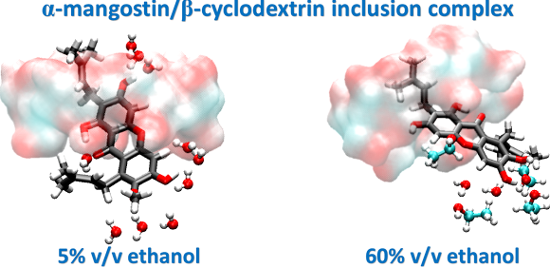
- between the hydrogen donor and acceptor atoms being ≤3.5 Å; and (ii) the angle of the donor-hydrogen-acceptor being ≥120° [36]. Binding free energy calculations Herein, the binding free energies of α-MGS/β-CD complex were calculated as follows. The ΔG is defined by where each free energy is estimated from
- The gas phase energy, ΔEMM, is a summation of bonded and non-bonded (electrostatic and van der Waals (vdW)) energies obtained from molecular mechanics calculation. The ΔGsolv is solvation free energy. In general, there are several methods for ΔGsolv prediction. Some methods calculate the ΔGsolv using
- higher than for electrostatic interactions (ΔEele). Through summation of the solvation free energy (ΔGsolv) and the entropy term (TΔS), the predicted binding free energies (ΔGbind) of the inclusion complexes I and II are similar with values of –8.86 ± 3.25 and –9.06 ± 2.87 kcal/mol, respectively. Thus



Computational study of productive and non-productive cycles in fluoroalkene metathesis
Beilstein J. Org. Chem. 2015, 11, 2150–2157, doi:10.3762/bjoc.11.232
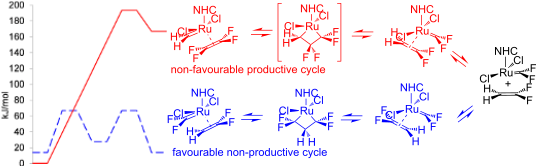
- decoordination of alkoxybenzylidene oxygen (structures 1c and 2c). For ethene (1c) and the anti-coordinated 1,1-difluoroethene (a2c), shallow minima were observed in the Gibbs free energy profile, while for the syn structure (s2c), the minimum obtained by the calculation of electronic energy changed just to




Conformational equilibrium in supramolecular chemistry: Dibutyltriuret case
Beilstein J. Org. Chem. 2015, 11, 2105–2116, doi:10.3762/bjoc.11.227
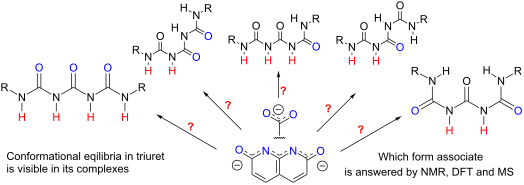
- temperatures below −25 °C the equilibrium is slow enough to observe an asymmetric complex. It is important to keep in mind that these spectra are recorded for a 1:0.1 molar ratio of 1 and 10 to be sure that most of 10 is associated. From VT 1H NMR measurements the Gibb's free energy equal to 66.6 kJ/mol was


Mechanism, kinetics and selectivity of selenocyclization of 5-alkenylhydantoins: an experimental and computational study
Beilstein J. Org. Chem. 2015, 11, 1865–1875, doi:10.3762/bjoc.11.200
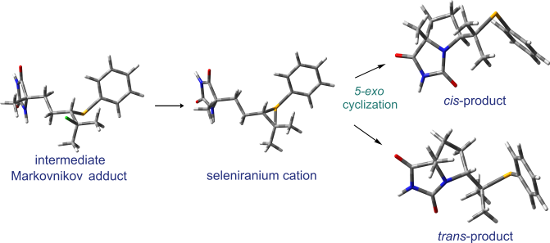
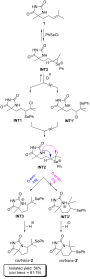
- , whereas that for the formation of (S,S)-INT3’ and (S,S)-INT3 (cis-diastereoisomers) are significantly lower (Table 2). But the free energy of both six-membered imidazolinium cations INT3’ are very similar and match higher than those for five-membered INT3. The facts that six-membered imidazolinium cations
- (Gibbs free energy) difference between transition states and reactants. The 1H NMR spectra of the intermediates and products in acetonitrile were simulated. The geometry of TMS in acetonitrile was optimized using the B3LYP/6-311+G(d,p) and SMD models. We chose to use the B3LYP functional based on
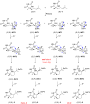
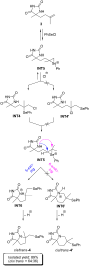
- substrate 1, with relative free energy values indicated in kJ/mol. The crucial bond lengths are given in pm. Energy profile for the proposed mechanism of selenocyclization of model substrate 1. Relative energies are given in kJ/mol. Optimized geometries for seleniranium cations and corresponding transition





Surprisingly facile CO2 insertion into cobalt alkoxide bonds: A theoretical investigation
Beilstein J. Org. Chem. 2015, 11, 1340–1351, doi:10.3762/bjoc.11.144
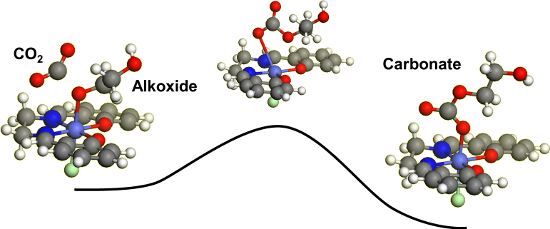
- each L, the precursor state (preS) was 10–20 kJ·mol−1 more stable than the reactant state (RS). Thus, the change in energy was small with respect to the reactant state. Consistent with an associative step, the entropy change was negative and the change in free energy was positive. Consistent with the


Peptide–polymer ligands for a tandem WW-domain, an adaptive multivalent protein–protein interaction: lessons on the thermodynamic fitness of flexible ligands
Beilstein J. Org. Chem. 2015, 11, 837–847, doi:10.3762/bjoc.11.93
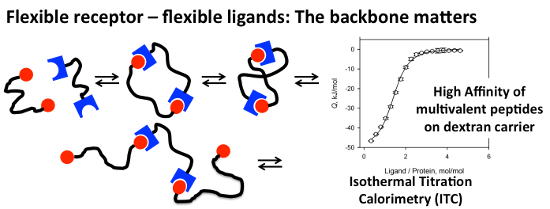
- bivalent binding modes are strongly favoured through enthalpic gain, the free energy gain is limited by the entropy loss, most likely caused by the flexibility of the linker and thus a larger number of alternative conformational states of the protein receptor. Conclusion All three investigated
- upon injection of peptide–polymer conjugates into the protein; bottom part shows integrated and normalized heat of reaction plotted against peptide/protein molar ratio; binding isotherms are fitted with a 1:1 binding model. Enthalpic and entropic contributions to the free energy of binding processes of
- multivalent peptide–polymer conjugate to the tandem WW domain Binding studies with peptide–polymer conjugates were conducted employing isothermal titration calorimetry (ITC). This method enables the determination of the binding affinity of the multivalent ligands and elucidates the composition of the free




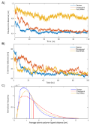

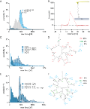
Adsorption mechanism and valency of catechol-functionalized hyperbranched polyglycerols
Beilstein J. Org. Chem. 2015, 11, 828–836, doi:10.3762/bjoc.11.92
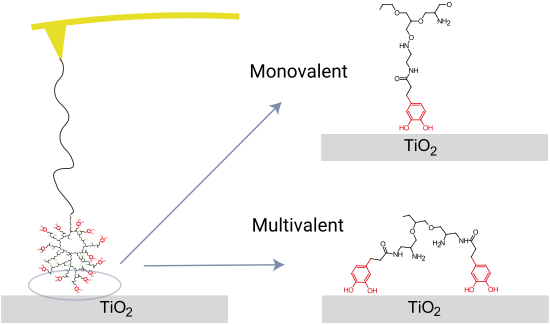
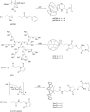
- up/lying down” mechanism [25] or even more likely via “rolling” into minima of the free energy [26]. We anticipate that these results will help improve catecholic hPGs as stable surface coatings in aqueous buffer [22]. Experimental hPGs Hyperbranched polyglycerol (hPG) with Mn ≈5000 g/mol and Mw



Influence of length and flexibility of spacers on the binding affinity of divalent ligands
Beilstein J. Org. Chem. 2015, 11, 804–816, doi:10.3762/bjoc.11.90
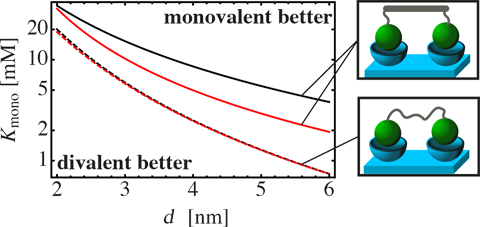
- spacer is on average extended to almost its full length. The fluctuations around its most probable end-to-end distance r0 are assumed to be much smaller than the contour length L. We approximate the free energy F, similar to a harmonic spring, as with k the effective spring constant and d the end-to-end
- relevant average end-to-end distance rete and the variance Δr, we first have to determine the relation between rete and Δr on the one side and k and r0 on the other side. From the free energy F in Equation 4 the average end-to-end distance rete and the variance Δr are obtained as: Note that according to
- effective concentration of flexible polymers is often modeled by a Gaussian chain [11][20][24] with the free energy: using the mean squared end-to-end distance . The end-to-end distance rete and the variance Δr can be expressed in terms of the mean squared end-to-end distance: As a consequence the end-to


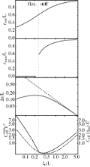

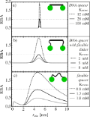

![[Graphic 33]](/bjoc/content/inline/1860-5397-11-90-i83.png?max-width=637&scale=1.18182) is shown for different ligand–spacer constructs. If the monovalent dissociatio...
is shown for different ligand–spacer constructs. If the monovalent dissociatio...
On the strong difference in reactivity of acyclic and cyclic diazodiketones with thioketones: experimental results and quantum-chemical interpretation
Beilstein J. Org. Chem. 2015, 11, 504–513, doi:10.3762/bjoc.11.57
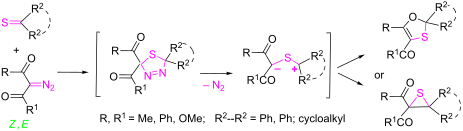
- , carbocyclic diazodiketones are much less reactive under similar conditions due to the locked cyclic structure and are unfavorable for the 1,3-dipolar cycloaddition due to the Z,Z-conformation of the diazo molecule. This structure results in high, positive values of the Gibbs free energy change for the first
- structural formulas and the corresponding, optimized geometry energy for the first and the second reaction steps (cycloaddition of 1 with 2a and decomposition of 1,3,4-thiadiazolines 6) are given in Table 1. The positive values of the Gibbs free energy change for the first stage of the process (Table 1; ΔG1
- ) demonstrate that formation of thiadiazolines 6 from 1a–d and 2a is thermodynamically unfavorable. However, the total value of the Gibbs free energy change for the formation of molecular nitrogen and thiocarbonyl ylide 7 from 1a–d and 2a, ΔG1–7 = ΔG1 + ΔG2, is negative. Therefore, the formation of the


A one-pot multistep cyclization yielding thiadiazoloimidazole derivatives
Beilstein J. Org. Chem. 2014, 10, 2989–2996, doi:10.3762/bjoc.10.317
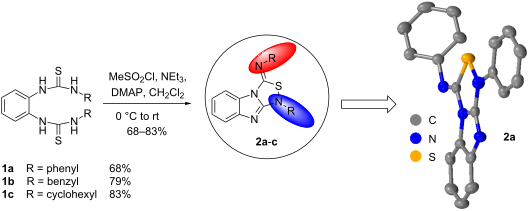
- 14‡. Distances are shown in angstrom (italics). Synthesis of tricyclic 1,2,4-thiadiazoles 2a–c. Possible mechanistic scenarios. DMAP assisted cyclization-I and IIa. Free energies are reported in kcal mol−1 at 25 °C referenced to 8 for cyclization-I and 13 for cyclization-IIa. Free energy values


Binding mode and free energy prediction of fisetin/β-cyclodextrin inclusion complexes
Beilstein J. Org. Chem. 2014, 10, 2789–2799, doi:10.3762/bjoc.10.296
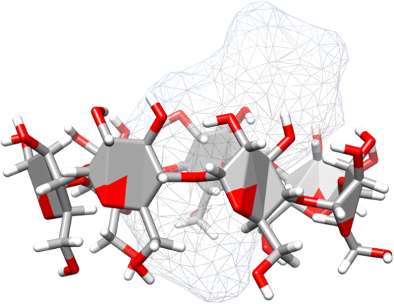
- to investigate the preferential binding mode and encapsulation of the flavonoid fisetin in the nano-pore of β-cyclodextrin (β-CD) at the molecular level using various theoretical approaches: molecular docking, molecular dynamics (MD) simulations and binding free energy calculations. The molecular
- binding or even unbinding preference was observed in the complexes where the larger chromone ring is located in the cavity. All MM- and QM-PBSA/GBSA free energy predictions supported the more stable fisetin/β-CD complex of the bound phenyl ring. Van der Waals interaction is the key force in forming the
- inclusion complex. The ligand binding mode and water accessibility, host–guest interaction, and binding free energy of the inclusion complex were analyzed. The MM-PBSA/GBSA and M06-2X/6-31G(d,p)//MM-PBSA/GBSA approaches were used to predict the binding affinity of fisetin/β-CD complexes. The M06-2X/6-31G(d


Pyrrolidine nucleotide analogs with a tunable conformation
Beilstein J. Org. Chem. 2014, 10, 1967–1980, doi:10.3762/bjoc.10.205
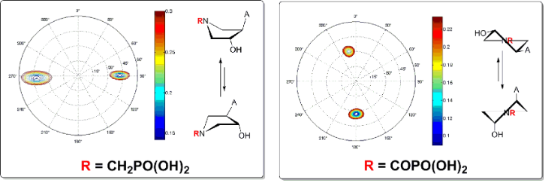
- , exchanging two-site 31P system (Figure 9). This enabled us to obtain the rate constants of the exchange at different temperatures and estimate the activation parameters of the interconversion such as the Gibbs free energy of activation ΔG‡298 = 80.7 kJ/mol; the enthalpy of activation ΔH‡ = 23.8 kJ/mol; and