

Search results
Search for "decarboxylative" in Full Text gives 128 result(s) in Beilstein Journal of Organic Chemistry.
Recent advances in direct C–H arylation: Methodology, selectivity and mechanism in oxazole series
Beilstein J. Org. Chem. 2011, 7, 1584–1601, doi:10.3762/bjoc.7.187
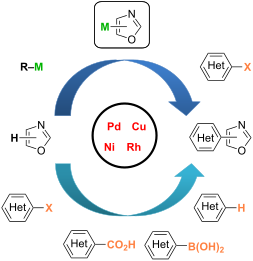
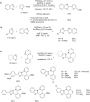
- inexpensive and easily available phenol derivatives (Scheme 23) [71]. More user-friendly sulfamates also proved to be convenient arylating agents in Pd(0)-catalyzed direct substitutive arylation of various oxazole series (Scheme 24) [72]. The first remarkable examples of catalytic, decarboxylative direct
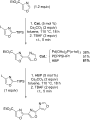
- decarboxylative direct C–H cross-coupling sequence with the residual ester group (Scheme 25a) [73]. Mechanistically, a Cu(II)-catalyzed decarboxylation reaction produces the C4-cuprated azole, which intercepts the arylpalladium acetate complex produced by prior palladation of the substrate at the C2-position, to
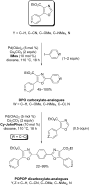
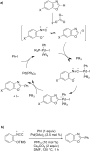
- -free, Pd(II)-based catalyst for direct decarboxylative cross-coupling of azole with various benzoic acids (Scheme 26a). In particular, benzoxazole was successfully coupled with 2,6-dimethoxybenzoic acid in 45% yield. Thus, without the assistance of a strong base, a carbopalladation was proposed as a






Highly efficient gold(I)-catalyzed Overman rearrangement in water
Beilstein J. Org. Chem. 2011, 7, 781–785, doi:10.3762/bjoc.7.88
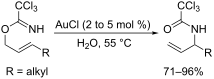
- moderate yields were achieved [25][26][27][28]. Very recently, our group developed an efficient gold(I)-catalyzed decarboxylative aza-Claisen rearrangement of allylic N-tosylcarbamates for the synthesis of N-tosyl allylic amines [29]. This reaction was performed in water and therefore represented an


Pd-catalyzed decarboxylative Heck vinylation of 2-nitrobenzoates in the presence of CuF2
Beilstein J. Org. Chem. 2010, 6, No. 43, doi:10.3762/bjoc.6.43
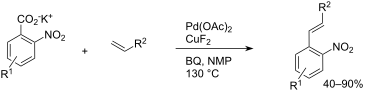
- Lukas J. Goossen Bettina Zimmermann Thomas Knauber Department of Chemistry, Organic Chemistry, Technische Universität Kaiserslautern, Erwin-Schrödinger-Strasse, Geb. 54, D-67663 Kaiserslautern, Germany 10.3762/bjoc.6.43 Abstract A new protocol for the decarboxylative Heck vinylation of benzoic
- and co-workers introduced another version of the Heck reaction in 2002, in which they converted mostly electron-rich aromatic carboxylic acids and alkenes to vinyl arenes with the release of CO2 [21][22][23]. This decarboxylative Heck reaction allows the direct conversion of benzoic acids without
- prior activation, but requires the addition of stoichiometric amounts of both base and an oxidant. In the original protocol, an excess of silver carbonate (3 equiv) was added to fulfil these functions. The work of Myers represents a milestone in the development of palladium-catalyzed decarboxylative


Other Beilstein-Institut Open Science Activities