

Search results
Search for "H-bonding" in Full Text gives 129 result(s) in Beilstein Journal of Organic Chemistry.
Quinoline based receptor in fluorometric discrimination of carboxylic acids
Beilstein J. Org. Chem. 2008, 4, No. 52, doi:10.3762/bjoc.4.52
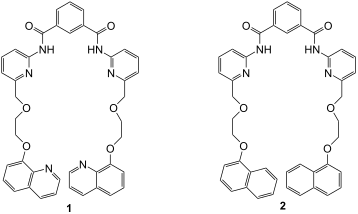
- into the cavity, also moved significantly downfield upon complexation. Among the three types of CH2 protons (a, b and c; see the structure 1), types a and c moved more downfield (Δδ = 0.07–0.20 ppm) indicating a clear-cut case of H-bonding. This significant downfield shift of the CH2 protons (types a
- and c type protons of the ether chains undergo downfield shift upon complexation with citric acid. This subtle change via H-bonding presumably influences the quinoline groups to be close enough for formation of excimer. This is also evidenced by a change in the chemical shift values of the quinoline


The first organocatalytic carbonyl- ene reaction: isomerisation- free C-C bond formations catalysed by H-bonding thio- ureas
Beilstein J. Org. Chem. 2007, 3, No. 24, doi:10.1186/1860-5397-3-24
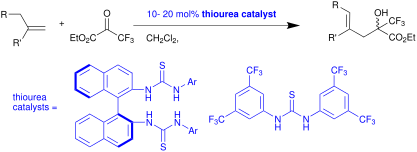
- of highly activated enophiles can be catalysed by H-bonding thio-ureas to give tertiary alcohols in high yields without extensive isomerisation side products. An asymmetric variant of this reaction was realised using a chiral thiourea but was limited by low enantioselectivity (up to 33% e.e.) and low
- interest in hydrogen bond mediated catalysis,[11] we have investigated thioureas as H-bonding additives for organocatalytic carbonyl ene reactions and report these results here. Despite the explosive growth in organocatalytic reactions in recent years, [12][13][14][15][16] this represents, to the best of
- times. Other minor side products were formed from the decomposition of ethyl trifluoropyruvate, but were readily separated from compounds 3 and 4. This decomposition becomes more significant as the reaction is left longer. An investigation into the effect of various H-bonding additives on this reaction


An efficient synthesis of tetramic acid derivatives with extended conjugation from L-Ascorbic Acid
Beilstein J. Org. Chem. 2006, 2, No. 24, doi:10.1186/1860-5397-2-24

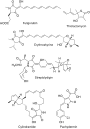
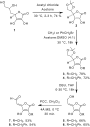
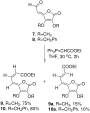
- . Tetramic acid antibiotics from natural sources. H-bonding in tetronolactonyl dienyl esters. Synthesis of tetronolactonyl aldehydes from L-ascorbic acid Synthesis of tetronolactonyl dienyl esters from etronolactonyl aldehydes Synthesis of 5-hydroxy lactams from dienyl tetronic esters Synthesis of dienyl



The oxanorbornene approach to 3-hydroxy, 3,4-dihydroxy and 3,4,5-trihydroxy derivatives of 2-aminocyclohexanecarboxylic acid
Beilstein J. Org. Chem. 2006, 2, No. 9, doi:10.1186/1860-5397-2-9

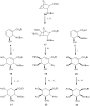
- . Highly selective epoxidations of cycloalkenyl amides have been described[23] and, consistent with a hypothesis that the mixture of 10 and 11 arise through competing H-bonding directing effects of the carbamate and hydroxyl groups, acetylation of the free hydroxyl group prior to oxidation enhanced the




Other Beilstein-Institut Open Science Activities