
Search results
Search for "π-stacking" in Full Text gives 227 result(s) in Beilstein Journal of Organic Chemistry. Showing first 200.
Functionalization of graphene: does the organic chemistry matter?
Beilstein J. Org. Chem. 2018, 14, 2018–2026, doi:10.3762/bjoc.14.177
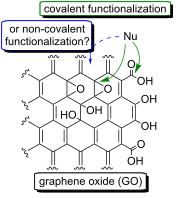
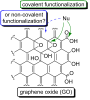
- , was assigned to the stretching vibrations of the alkyl chain (commonly observed at up to 2980 cm−1); this absorption band corresponds to the N–H stretching vibrations of NH3+. The further reaction with amphotericin B, which is a compound containing unsaturated bonds, was most plausibly a result of π–π
- stacking. As mentioned above in the discussion of reaction mechanisms, water molecules significantly lower the reaction rates for the desired nucleophiles. Importantly, water molecules also influence the hydrolysis of the activated carboxyl groups (Figure 2, step d and Figure 3, step f). Water should


A self-assembled photoresponsive gel consisting of chiral nanofibers
Beilstein J. Org. Chem. 2018, 14, 1994–2001, doi:10.3762/bjoc.14.174
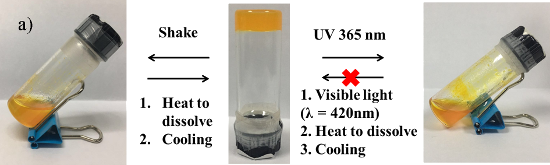
- by three-dimensional networks through self-assembly have drawn significant attention in the past decades. They are normally fabricated by means of noncovalent intermolecular interactions [3], such as π–π stacking, hydrogen bonding, van der Waals forces, hydrophobic, electrostatic, host–guest and
- construct optically controlled systems [17][30][32][33][34][35]. This moiety is also frequently employed as a building block because of its strong π–π stacking in nonpolar solvents. Herein, a novel compound 3 containing both chiral L-glutamic lipid and azobenzene was designed and synthesized (Scheme 1). It
- and π–π stacking in DMSO. However, beautiful acicular fibers could be detected on the surface treated with a chloroform solution, and a dendritic network was observed on the sample made from benzene solution (Figure S9, Supporting Information File 1). The photoresponsiveness of compound 3 was also


Synthesis of new p-tert-butylcalix[4]arene-based polyammonium triazolyl amphiphiles and their binding with nucleoside phosphates
Beilstein J. Org. Chem. 2018, 14, 1980–1993, doi:10.3762/bjoc.14.173
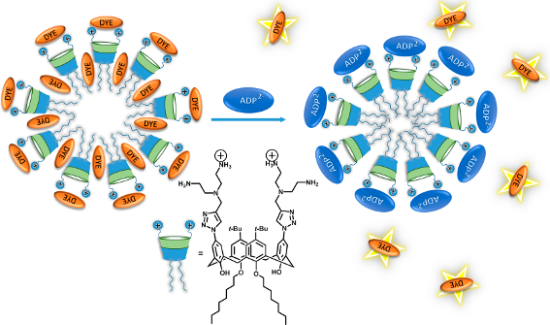
- nucleotides must possess selectivity towards these anions. From this point of view, nucleotide receptors based on polyammonium cations are of great demand because the electrostatic interactions of such polyammonium systems and negatively charged phosphates are strong. Hydrogen bonding [8] and π-stacking


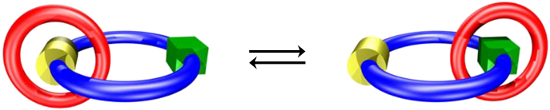
A pyridinium/anilinium [2]catenane that operates as an acid–base driven optical switch
Beilstein J. Org. Chem. 2018, 14, 1908–1916, doi:10.3762/bjoc.14.165
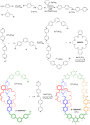
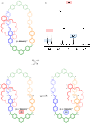
- the crown ether. In addition, π-stacking interactions induce upfield shifts for protons p, q, v and w from 8.48 ppm in 74+ to 8.24 ppm for [8DB24C8]6+. Protons o, x, n and y do not shift appreciably because the crown ether does not extend far enough to interact with these protons. In contrast, the


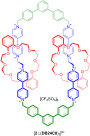
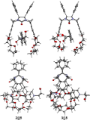
![[Graphic 3]](/bjoc/content/inline/1860-5397-14-165-i4.svg?max-width=637&scale=0.827274) DB24C8]6+ containing benzylanilinium and bis(pyridinium)ethane...
DB24C8]6+ containing benzylanilinium and bis(pyridinium)ethane...


Synthesis of 9-arylalkynyl- and 9-aryl-substituted benzo[b]quinolizinium derivatives by Palladium-mediated cross-coupling reactions
Beilstein J. Org. Chem. 2018, 14, 1871–1884, doi:10.3762/bjoc.14.161
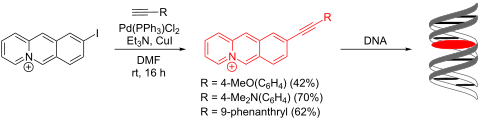
- quadruplex DNA, the derivatives 2a–d show a typical titration signature for ligands that bind to the quadruplex by terminal π-stacking [14]; however, in analogy to the binding to duplex DNA the derivatives 2b–d form aggregates along the DNA backbone at large ligand–DNA ratio, i.e., at the beginning of the


Efficient catenane synthesis by cucurbit[6]uril-mediated azide–alkyne cycloaddition
Beilstein J. Org. Chem. 2018, 14, 1846–1853, doi:10.3762/bjoc.14.158
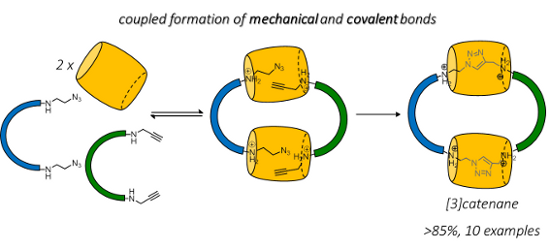
- –ligand coordination, charge transfer, π-stacking and hydrophobic interactions, for the later interlocking of additional macrocycles to give higher-order [n]catenanes. The new building blocks were synthesized following similar procedures as previously described [24]. Catenane synthesis by CBAAC Synthesis



Design, synthesis and structure of novel G-2 melamine-based dendrimers incorporating 4-(n-octyloxy)aniline as a peripheral unit
Beilstein J. Org. Chem. 2018, 14, 1704–1722, doi:10.3762/bjoc.14.145
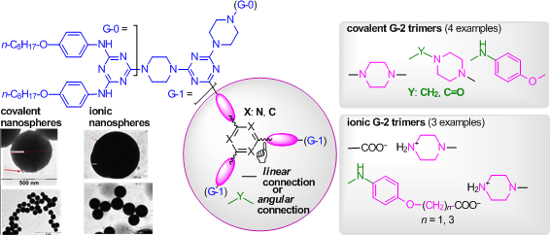
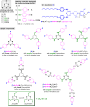
- previously reported nanosystems as polymeric nanoparticles. In covalent series, G-1 dendron D-N
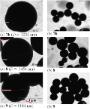
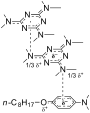
NH itself (as unexpected reference) self-assembled into nanospheres with a high D value (694 nm). We ascribed this packing ability to three basic π stacking interactions [72] associating stratified parallel
- , 8 and 9; the red arrow indicates the nano-particles that aggregate. D is the average diameter of nanospheres.
Proposed π-stacking interactions in compounds D-N
NH and 5–7a. Convergent versus divergent three steps (a–c) synthesis of central building blocks C1 and C3. Synthesis of G-1 dendrons D-Cl



Steric “attraction”: not by dispersion alone
Beilstein J. Org. Chem. 2018, 14, 1482–1490, doi:10.3762/bjoc.14.125
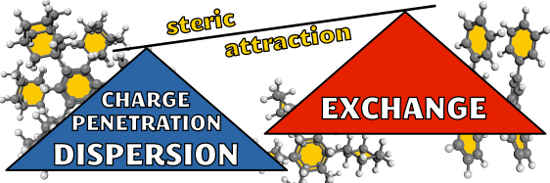
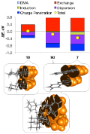
- cages [10]. Intermolecular interactions in hydrocarbons are also subject to significant dispersion contribution. In the unsaturated systems, from benzene dimer to higher acenes and, ultimately, graphenes, dispersion is increasingly the key force behind the π–π stacking interactions [11]. Large and flat
- electrostatic contribution to it [25]. For example, “dispersion dominates and electrostatics commands” is the ‘punch line’ of the 2017 computational study on the σ–σ, σ–π and π–π stacking interactions between benzene, cyclohexane and some of their fluorinated derivatives [26]. The authors show that while



Recent advances in phosphorescent platinum complexes for organic light-emitting diodes
Beilstein J. Org. Chem. 2018, 14, 1459–1481, doi:10.3762/bjoc.14.124
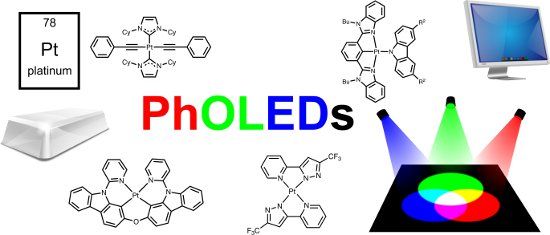
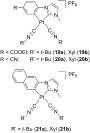
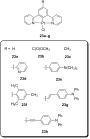
- including formation of metallophilic d8···d8 interactions and/or π–π stacking of the coordinating ligands [67][92] as well as excited-state interactions such as formation of excimers [93][94]. Although they may be usefully employed to shift both absorption and emission spectra






Enantioselective phase-transfer catalyzed alkylation of 1-methyl-7-methoxy-2-tetralone: an effective route to dezocine
Beilstein J. Org. Chem. 2018, 14, 1421–1427, doi:10.3762/bjoc.14.119
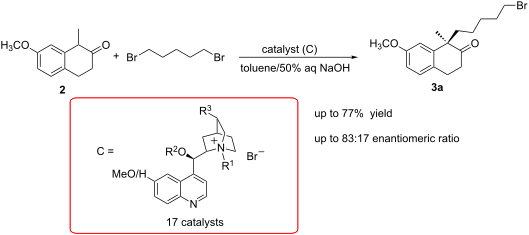
- , then two additional interaction forces in the complex are produced on the same plane, including: 1) the carbonyl of 2 makes a hydrogen bond with the hydroxy group of C7; 2) the phenyl group of 2 forms a face-to-face π-stacking interaction with the benzyl moiety of C7. The complex of 2 with C7 goes to



Are dispersion corrections accurate outside equilibrium? A case study on benzene
Beilstein J. Org. Chem. 2018, 14, 1181–1191, doi:10.3762/bjoc.14.99
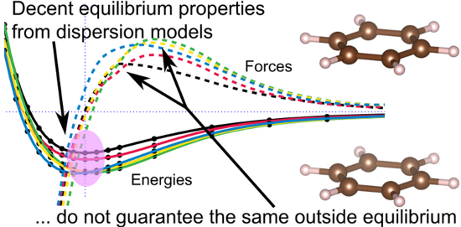
- been increasing interest in utilizing non-covalent π-stacking for synthetic catalysis – and it is notable that most structures shown in a recent review on the topic feature rings that interact at distances greater than the potential minimum [26]. Benzene dimers also feature in the S22 benchmark set [21


An overview of recent advances in duplex DNA recognition by small molecules
Beilstein J. Org. Chem. 2018, 14, 1051–1086, doi:10.3762/bjoc.14.93
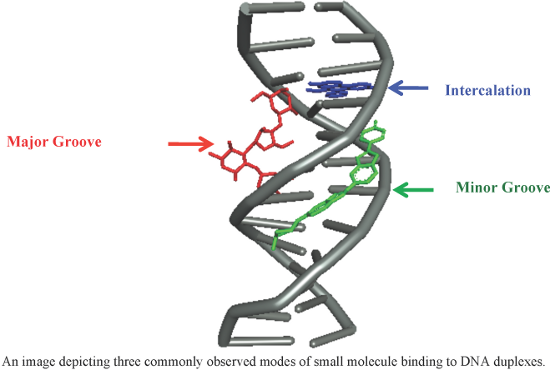
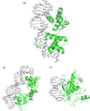
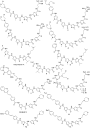
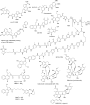
- heterocyclic rings such as furan 62 and 63 [126], thiophene 64 [127] and pyridine 65 (Figure 11) [128]. These conjugates exhibit potent antibacterial and antiprotozoal activity with much reduced toxicity. It was further concluded that π-stacking, H-bonding with the floor of the minor groove along with






An uracil-linked hydroxyflavone probe for the recognition of ATP
Beilstein J. Org. Chem. 2018, 14, 747–755, doi:10.3762/bjoc.14.63
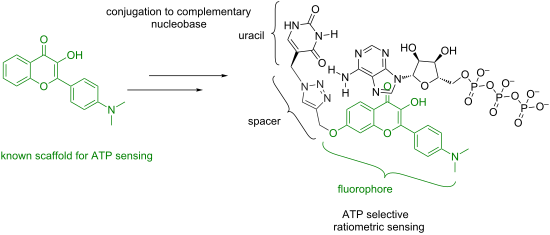
- recognition sites [16][18][19][33], or Zn-dipicolylamine complexes [21][23][24] attracting the negatively charged phosphate units of ATP and by π-stacking between the fluorophores of the sensors and the adenine moiety of ATP [29]. In aqueous solutions at physiological pH, the tetra-charged anionic ATP
- , 4’-dimethylaminohydroxyflavone) was utilized by Pivovarenko and co-workers in ATP sensing in aqueous solution and in mitochondria [34][44]. DMHF was found to form 1:1 and 1:2 complexes with ATP. The two components were held together by π-stacking and by electrostatic interactions of the positively
- [45], however, none of them are the result of rational design. Base pairing is a well-known phenomenon in the double helix structure of DNA since the work of Watson and Crick. It is also known that the cohesion of the double strand is provided by the efficient π-stacking interaction [46]. Adding




Recent advances on organic blue thermally activated delayed fluorescence (TADF) emitters for organic light-emitting diodes (OLEDs)
Beilstein J. Org. Chem. 2018, 14, 282–308, doi:10.3762/bjoc.14.18
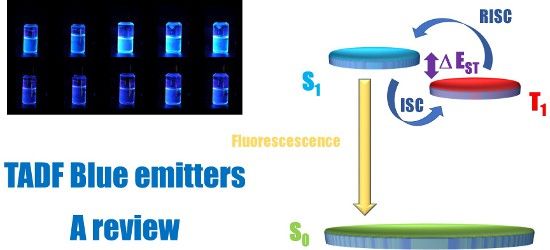
- luminance of 100 cd/m2, slightly red-shifted compared to the emission observed for doped OLEDs. Clearly, the specific design of D6 and its highly twisted structure efficiently weakened the π–π-stacking interactions, providing a general design rule for the elaboration of TADF emitters insensitive to the




Fluorogenic PNA probes
Beilstein J. Org. Chem. 2018, 14, 253–281, doi:10.3762/bjoc.14.17
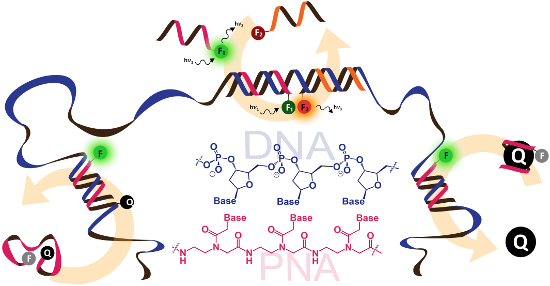
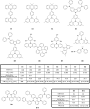
- of the TO label to DNA or RNA duplexes were occasionally observed, this could be suppressed by using a shorter linker (as in FIT PNA probes, vide infra) or by combination with a second dye, such as pyrene, that can interact with TO by π-stacking. Such a combination in a short PNA probe has been used




Synthesis and supramolecular properties of regioisomers of mononaphthylallyl derivatives of γ-cyclodextrin
Beilstein J. Org. Chem. 2017, 13, 2509–2520, doi:10.3762/bjoc.13.248
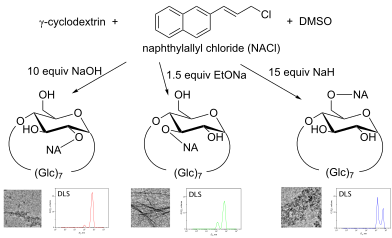
- the shape of peaks, but also in the value of the chemical shifts. For both regioisomers the concentration dependence of chemical shifts in aromatic and allyl areas indicates intermolecular association such as inclusion of the naphthylallyl moiety into the cavity of γ-CD or π stacking of naphthyls. The


One-pot syntheses of blue-luminescent 4-aryl-1H-benzo[f]isoindole-1,3(2H)-diones by T3P® activation of 3-arylpropiolic acids
Beilstein J. Org. Chem. 2017, 13, 2340–2351, doi:10.3762/bjoc.13.231
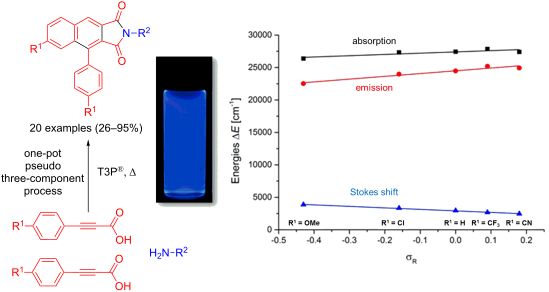
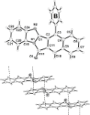
- 5 (left) and a centrosymmetric dimer formation by π–π interactions (right) (ellipsoids are drawn at the 40% probability level). The ORTEP-type plot of the asymmetric unit of the crystal structure 6 (top) and π-stacking interactions (bottom) (ellipsoids are drawn at the 40% probability level




Complexation of molecular clips containing fragments of diphenylglycoluril and benzocrown ethers with paraquat and its derivatives
Beilstein J. Org. Chem. 2017, 13, 2056–2067, doi:10.3762/bjoc.13.203
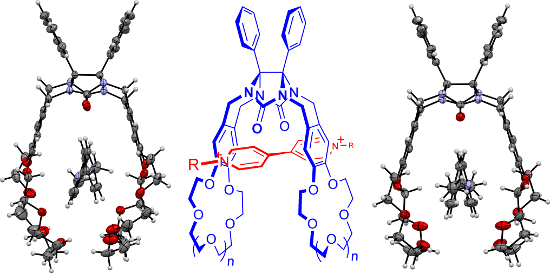
- π–π stacking and C–H∙∙∙X (X = N, O, F ...) interactions. The stability of inclusion complexes based on molecular clips and paraquat derivatives depends on two factors: 1) the value of the positive charge on the dipyridinium fragment of paraquat derivatives, the distribution of which is well
- paraquat, the following moieties may be involved: the glycoluril fragment (hydrogen bonds involving the oxygen atoms of the carbonyl groups), the catechol part of the crown ether fragments (π–π stacking interactions) and the polyether chains of benzocrown ethers (C–H···О interactions). The first two
- complexation constant of the clip 6 with paraquat (7), which was: lgK = 1.46 ± 0.01 (−ΔG = 1.96 ± 0.02 kcal/mol). The complex of clip 6 with paraquat (7) may be stabilized through π–π stacking interactions of the electron-deficient aromatic rings of paraquat and the electron donating veratrol fragments of the



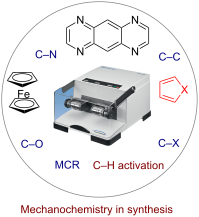
Mechanochemical synthesis of small organic molecules
Beilstein J. Org. Chem. 2017, 13, 1907–1931, doi:10.3762/bjoc.13.186
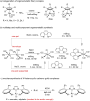
- solvent-free mechanomilling [50]. By varying the electron density on the aromatic aldehydes, it was observed that electron deficient aldehydes provided a better yield with excellent stereo selectivity over electron rich systems. The observed result suggests that a π–π stacking interaction between electron




Sugar-based micro/mesoporous hypercross-linked polymers with in situ embedded silver nanoparticles for catalytic reduction
Beilstein J. Org. Chem. 2017, 13, 1212–1221, doi:10.3762/bjoc.13.120
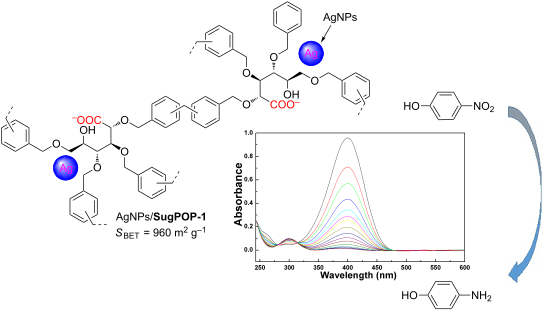
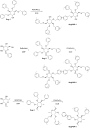
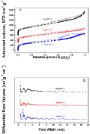
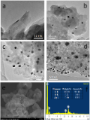
- described as the Langmuir–Freundlich isotherm [47]. The polymer matrix has higher adsorption capacity for 4-NP due to π–π stacking interactions, which can encourage 4-NP molecules to enter the polymer channel to form the adsorbed species [54]. At the same time, the hydrogen atom is introduced onto the




An eco-compatible strategy for the diversity-oriented synthesis of macrocycles exploiting carbohydrate-derived building blocks
Beilstein J. Org. Chem. 2017, 13, 1106–1118, doi:10.3762/bjoc.13.110
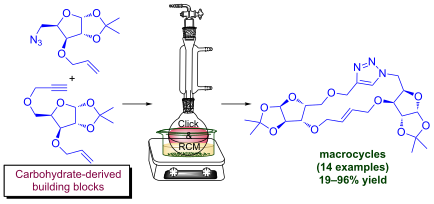
- inherent properties including stability towards acid–base hydrolysis, active participation in H-bonding, dipole–dipole and π-stacking interactions [37][64][65][66]. The reaction would then afford a range of acyclic precursors, which could then undergo the intramolecular cyclization reaction to furnish the


Correlation of surface pressure and hue of planarizable push–pull chromophores at the air/water interface
Beilstein J. Org. Chem. 2017, 13, 1099–1105, doi:10.3762/bjoc.13.109
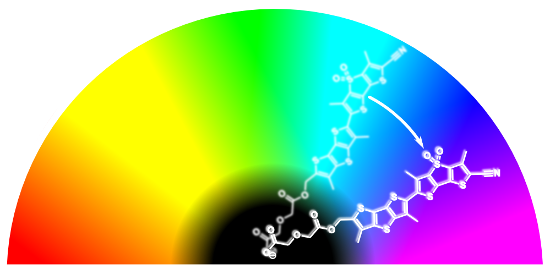
- change is significant and represents the expected red shift. Although contributions from changes in π–π stacking on spectroscopic properties cannot be excluded, the observed red shift in compressed flipper monolayers is consistent with the earlier experiments on the planarization of monomeric flipper


Substitution of fluorine in M[C6F5BF3] with organolithium compounds: distinctions between O- and N-nucleophiles
Beilstein J. Org. Chem. 2017, 13, 703–713, doi:10.3762/bjoc.13.69
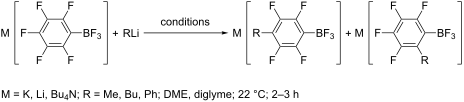
- (Scheme 9) due to the π-stacking interactions between C6H5 and C6F5 moieties (Scheme 10), which is excluded in cases of nucleophilic alkylation. While reactions of K[C6F5BF3] with C-nucleophiles give the significant amount of K[2-NuC6F4BF3] the related isomers are not formed under the action of O
- ). During nucleophilic phenylation the π–stacking interaction between C6H5 and C6F5 moieties can be responsible for increased yield of M[2-PhC6F4BF3]. 4. The formation of M[2-RC6F4BF3] proceeds through the coordination of RLi (polarized C–Li bond) to a fluorine atom of the BF3 moiety and subsequent


Fluorescent carbon dots from mono- and polysaccharides: synthesis, properties and applications
Beilstein J. Org. Chem. 2017, 13, 675–693, doi:10.3762/bjoc.13.67
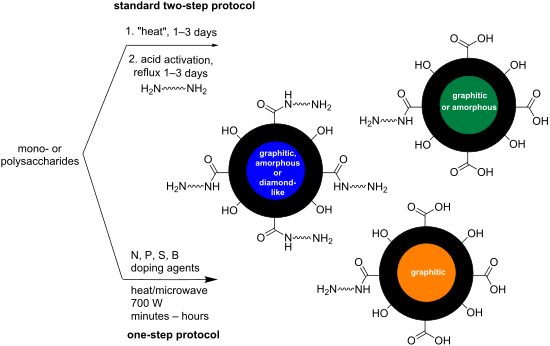
- interaction between the positively charged amino group in DOX and the negatively charged groups on the CD surface can take place. Also van der Waals and π–π stacking interactions were attributed as contributing factors to the DOX loading and DOX incorporation into the hollow CD cavity. Drug release at acidic


A new class of organogelators based on triphenylmethyl derivatives of primary alcohols: hydrophobic interactions alone can mediate gelation
Beilstein J. Org. Chem. 2017, 13, 138–149, doi:10.3762/bjoc.13.17
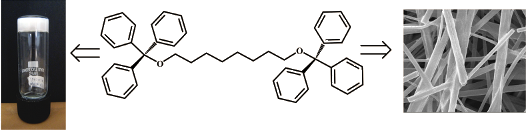
- ][21][22]. As mentioned above, developing a new gelator is still largely a trial and error method. The most widely used design strategy involves the inclusion of structural components favouring intermolecular non-covalent interactions (like H-bonding, π-stacking, donor–acceptor interaction, metal
- ][24]. Similar is the case for π-stacking interaction (seen in naphthalene, anthracene, pyrene, perylene, etc.) which has been mostly used in combination with other types of secondary interactions in the discovery of many gelators [25][26]. This holds true for many other non-covalent interactions as
- geometry (unlike the planar geometry of say anthracene, pyrene, etc.), π–π stacking will be favoured only between benzene units of different trityl groups. A small library of triphenylmethyl derivatives was synthesized from the corresponding primary alcohols employing a single step reaction and detailed