

Search results
Search for "reactions" in Full Text gives 3231 result(s) in Beilstein Journal of Organic Chemistry. Showing first 200.
Halogenated butyrolactones from the biomass-derived synthon levoglucosenone
Beilstein J. Org. Chem. 2025, 21, 2297–2301, doi:10.3762/bjoc.21.175
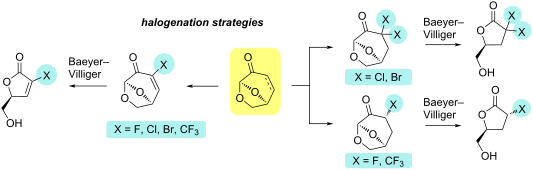
- reactions for 5 to give substrates for the Baeyer–Villiger oxidation resulting in halogenated butyrolactones, which is an unexplored chemical space for this biomass derivative. Results and Discussion The halogenated LGO derivatives 7a and 7b were prepared using literature procedures [22][23]. The reaction
- in 22% yield. Fluorination of α,β-unsaturated ketones is a more challenging transformation than the halogenation reactions presented in Scheme 1 [33]. The previous reports of enamines as suitable substrates led us to prepare and examine enamine 15, which was generated from 5 with 3.0 equivalents of
- electrophilic fluorine in the best case gave 15% conversion for NFSI and less than 8% isolated yield of 7c for SF. The major product in these reactions was 5, due to a β-elimination of the amine. In comparison, the reaction of 15 with NBS afforded 7b in an unoptimized yield of 48% after hydrolysis, which




Enantioselective radical chemistry: a bright future ahead
Beilstein J. Org. Chem. 2025, 21, 2283–2296, doi:10.3762/bjoc.21.174
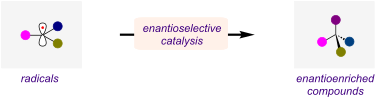
- Anna C. Renner Sagar S. Thorat Hariharaputhiran Subramanian Mukund P. Sibi Department of Chemistry and Biochemistry, North Dakota State University, Fargo, North Dakota, 58105-5516, USA 10.3762/bjoc.21.174 Abstract This perspective is focused on enantioselective free radical reactions. It
- describes several important catalytic asymmetric strategies applied to enantioselective radical reactions, including chiral Lewis acid catalysis, organocatalysis, photoredox catalysis, chiral transition-metal catalysis and photoenzymatic catalysis. The application of electrochemistry to asymmetric radical
- the 1990s. Since then, meticulous research by several research groups has led to significant advances in this area [4][5][6][7][8]. This perspective focuses on several important contributions to the science of asymmetric radical reactions. Pioneering work on chiral Lewis acid catalysis and iminium


Pathway economy in cyclization of 1,n-enynes
Beilstein J. Org. Chem. 2025, 21, 2260–2282, doi:10.3762/bjoc.21.173
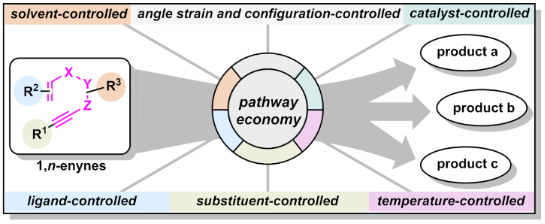
- importance of reducing the time required for reaction processes and conducting multistep reactions within a single pot (Scheme 1a) [6][7]. Contemporary organic synthesis is progressively approaching ideal synthesis – achieving highly functionalized target molecular frameworks in a single step. This paradigm
- components such as solvents, catalysts, ligands and so on. Unlike traditional “one-to-one” reactions, pathway-controlled “one-to-many” transformations synthesize multiple products from single intermediates, dramatically reducing preparation time and reagent requirements (Scheme 1b). As an exceptionally
- could be further derivatized (e.g., via borylation, epoxidation), establishing a versatile platform for accessing fused-ring natural products. Substituent-controlled cyclization of 1,n-enynes In transition metal-catalyzed cyclization reactions, the electronic properties and steric hindrance of


Research towards selective inhibition of the CLK3 kinase
Beilstein J. Org. Chem. 2025, 21, 2250–2259, doi:10.3762/bjoc.21.172
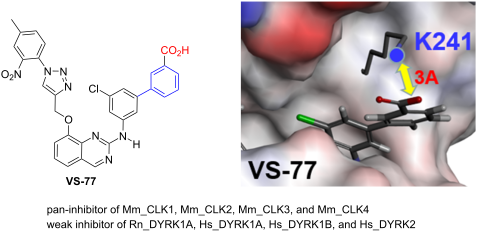
- -bromo-5-chloroaniline (2b). Next, we prepared the final targets by Suzuki-type reactions using the aromatic bromides 7. As indicated before, the acid function designed to interact with the lysine 241 has been introduced both in para and meta positions of the aromatic linker. Further we have prepared two


A chiral LC–MS strategy for stereochemical assignment of natural products sharing a 3-methylpent-4-en-2-ol moiety in their terminal structures
Beilstein J. Org. Chem. 2025, 21, 2243–2249, doi:10.3762/bjoc.21.171
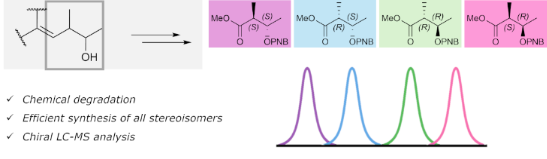
- followed by ozonolysis to generate 3-((4-bromobenzoyl)oxy)-2-methylbutanoic acid. The four stereoisomers of this fragment were prepared through two separate Evans aldol reactions, each affording a pair of diastereomers. The final four stereoisomers were resolved by chiral HPLC (CHIRALPAK IA column with


Pd-catalyzed dehydrogenative arylation of arylhydrazines to access non-symmetric azobenzenes, including tetra-ortho derivatives
Beilstein J. Org. Chem. 2025, 21, 2234–2242, doi:10.3762/bjoc.21.170
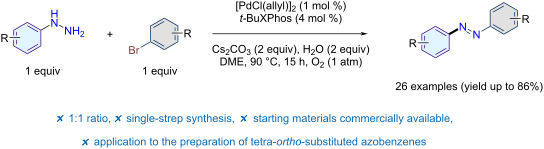
- efficacious but face significant challenges when applied to non-symmetric systems [24], particularly in achieving regioselectivity. These methods frequently require a particular reagent pair or an excess of one reactant, which limits their efficiency and versatility. In contrast, Baeyer–Mills reactions, which
- intricate and inefficient using these standard synthetic protocols. The transition-metal-catalyzed C–N bond formation has emerged as a viable route to access non-symmetric azobenzenes, owing to the broad functional group tolerance of Buchwald–Hartwig amination reactions [34][35][36][37][38][39][40]. Kong
- bromotoluene (Table 1, entries 5–8). For subsequent optimizations, we selected t-BuXPhos for practical reasons, as it is less sensitive to oxidative conditions. Further optimization revealed that Cs2CO3 is more efficient than NaH for this reaction (Table 1, entry 9). However, reactions conducted with a new


Thiadiazino-indole, thiadiazino-carbazole and benzothiadiazino-carbazole dioxides: synthesis, physicochemical and early ADME characterization of representatives of new tri-, tetra- and pentacyclic ring systems and their intermediates
Beilstein J. Org. Chem. 2025, 21, 2220–2233, doi:10.3762/bjoc.21.169
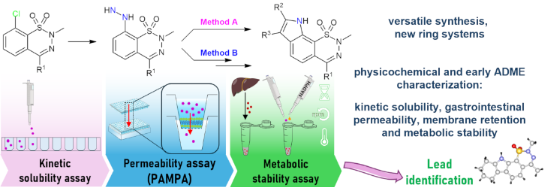
- spectrometer equipped with a Direct Insertion Probe (EI+ ionization) or on a Bruker Q-TOF Maxis Impact mass spectrometer (ESI+ ionization) coupled with a Waters Acquity I-Class UPLC system equipped with a diode array detector. The reactions were followed by analytical thin-layer chromatography on silica gel 60


Synthesis of triazolo- and tetrazolo-fused 1,4-benzodiazepines via one-pot Ugi–azide and Cu-free click reactions
Beilstein J. Org. Chem. 2025, 21, 2202–2210, doi:10.3762/bjoc.21.167
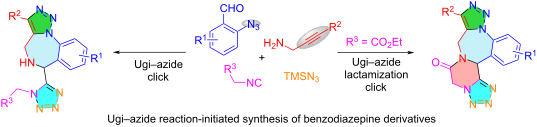
- advantages over traditional copper-catalyzed azide–alkyne cycloaddition (CuAAC) reactions, including operational simplicity and the absence of metal contaminants, which is crucial for pharmaceutical applications. After having identified suitable reaction conditions of the Ugi–azide and click reactions for
- . However, the reaction of 2-azido-5-bromobenzaldehyde (1d) gave only a trace amount of product 8h. Instead, compound 8h', an intermediate without lactamization, was isolated in 59% yield. It is likely that the bromo group on the phenyl ring interfered with the lactamization process. Two control reactions
- of compounds 6a (red) and 8a (blue). Ugi–azide reaction for the synthesis of 1,5-DS-T-containing heterocycles. Proposed Ugi–azide-initiated synthesis of polyheterocyclic scaffolds 7 and 8. 4-CR vs stepwise Ugi–azide reactions for the synthesis of 7a. Synthesis of benzodiazepines 7a–k. Reaction


Electrochemical cyclization of alkynes to construct five-membered nitrogen-heterocyclic rings
Beilstein J. Org. Chem. 2025, 21, 2173–2201, doi:10.3762/bjoc.21.166
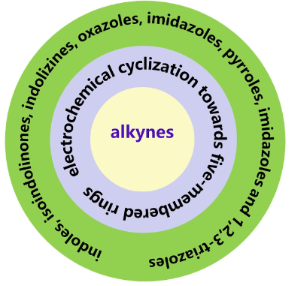
- reactions of alkynes towards five-membered rings are classified and presented in detail. Based on different types of five-membered rings, electrochemical construction of indoles, isoindolinones, indolizines, oxazoles, imidazoles, pyrroles, imidazoles and 1,2,3-triazoles are summarized and the possible
- electricity to promote a reaction grew up gradually [56][57][58][59][60][61][62][63][64][65][66][67][68][69][70][71][72][73][74]. In the past decades, the electrochemical organic reactions [75][76][77][78][79][80][81][82][83][84][85][86][87][88] which utilized an external applied voltage to accelerate
- electrochemical annulation of alkynes with enamides. Electrochemical [3 + 2] cyclization of heteroarylamine was an efficient access towards imidazopyridine. The electrochemical oxidative [3 + 2] cycloaddition of secondary propargyl alcohol produced 1,2,3-triazole. In most of these above reactions, the target








C2 to C6 biobased carbonyl platforms for fine chemistry
Beilstein J. Org. Chem. 2025, 21, 2103–2172, doi:10.3762/bjoc.21.165
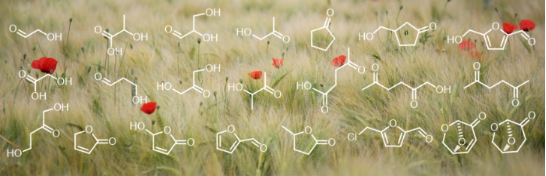
- at illustrating how the chemistry of biobased carbonyl platform molecules with backbones from C2 to C6 offers opportunities to reach all kinds of chemical architectures, sometimes even complex ones benefiting from the ability of the carbonyl group to be involved in multicomponent reactions. Keywords
- synthesis of amines by replacing the current toxic pathway based on ethylene oxide and dichloroethane [29]. Due to the high reactivity of α-hydroxycarbonyls, the main issue in this reductive amination reaction [30] was to control the cascade of consecutive and parallel reactions. The use of methanol as
- avoid side reactions and promoted exclusive transformation of formaldehyde into glycolic acid. The use of E. coli K-12 strains as host cells and paraformaldehyde as the starting material, led to production of GA with high conversion even at rather high concentrations (Scheme 8) [36]. Using a CuII-based


The application of desymmetric enantioselective reduction of cyclic 1,3-dicarbonyl compounds in the total synthesis of terpenoid and alkaloid natural products
Beilstein J. Org. Chem. 2025, 21, 2085–2102, doi:10.3762/bjoc.21.164
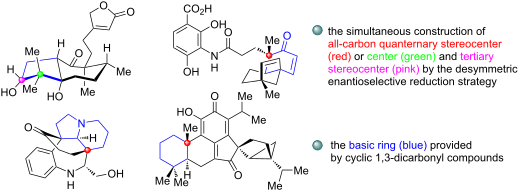
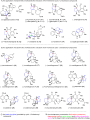
- cyclic prochiral dicarbonyl substrates. In addition, various approaches could be used for the desymmetrization reactions such as enzyme catalytic-, organocatalyst-, and transition-metal-catalyzed reductions [5][6][7]. Advance about the synthesis of several terpenoid and alkaloid natural products (1–5
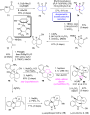
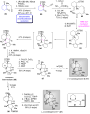
- -cyclopentanedione derivative was adopted as one of the key reactions, which facilitated the construction of the five-membered ring bearing an all-carbon quaternary center as the key chiral building block. Their synthesis began with 1,3-dione 40 (Scheme 2) [31][32], allylation of this substrate with allylic bromide







Multicomponent reactions IV
Beilstein J. Org. Chem. 2025, 21, 2082–2084, doi:10.3762/bjoc.21.163

- National Academy of Sciences of Ukraine, Nauky Av. 60, 61072 Kharkiv, Ukraine, Faculty of Chemistry, V. N. Karazin Kharkiv National University, Svobody Sq. 4, 61077 Kharkiv, Ukraine 10.3762/bjoc.21.163 Keywords: multicomponent reactions; The synthesis of complex molecules is a cornerstone of modern
- optimization of promising lead structures has therefore inspired the development of powerful synthetic strategies. A glance at Web of Science reveals that one-pot methods and multicomponent reactions (MCRs) [1] have attracted steadily increasing attention within the scientific community over the past 25 years
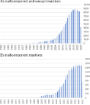
- (Figure 1). According to a quick Web of Science [2] keyword search of "multicomponent reaction" and "one-pot reaction" (Figure 1A) and "multicomponent reaction" (Figure 1B) filtered by publication year, the impressive sum of 136,658 publications on multicomponent (Figure 1A) and one-pot reactions and
Discovery of cytotoxic indolo[1,2-c]quinazoline derivatives through scaffold-based design
Beilstein J. Org. Chem. 2025, 21, 2062–2071, doi:10.3762/bjoc.21.161
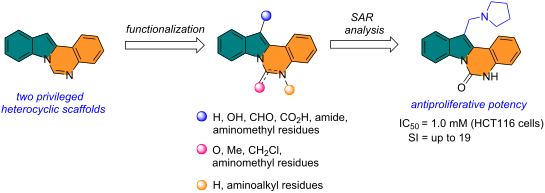
- )-one scaffold 1 was synthesized according to the optimized protocol developed by Bergman et al. [9]. Position 12 of indolo[1,2-c]quinazolin-6(5H)-one (1) (Scheme 1) corresponded to of the indole C3 position, which is typically used as a nucleophilic center for functionalization via reactions with
- introduce the carboxylic acid group a sequence of formylation/oxidation reactions was used. Vilsmeier–Haack reaction of 1 afforded 6-oxoindolo[1,2-c]quinazoline-12-carbaldehyde (2) (Scheme 1). All attempts to oxidize the aldehyde group of 2 to the corresponding carboxylic acid were hampered by the oxidative


Bioinspired total syntheses of natural products: a personal adventure
Beilstein J. Org. Chem. 2025, 21, 2048–2061, doi:10.3762/bjoc.21.160
- capability have been increasing all the time by discovering and inventing a vast number of new organic reactions and methodologies [6]. However, could mankind become really stronger than Mother Nature one day? This question seems to have no answer as future is unpredictable. Maybe, Mother Nature could be our
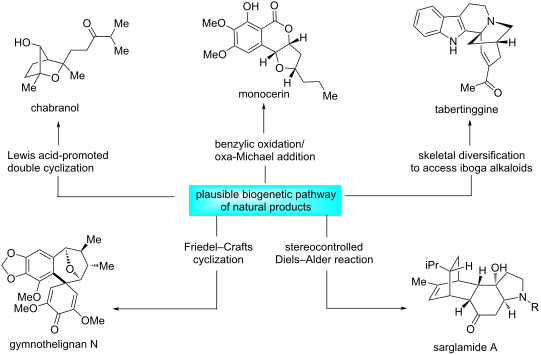
- , monocerin and 12-hydroxymonocerin were presumably generated from their corresponding precursors through similar oxidation and oxa-Michael addition reactions. Given the fact that quinone methides served as a powerful platform for the development of rich useful organic transformations, especially, through
- underwent dehydroxylation protocol involving base-promoted mesylate elimination and catalytic hydrogenation reactions, providing 31a. Reduction of lactam and ester in one pot with LiAlH4 and acid-promoted hydrolysis of ketal protection to ketone furnished 32a. Finally, oxidation of the primary alcohol to



Switchable pathways of multicomponent heterocyclizations of 5-amino-1,2,4-triazoles with salicylaldehydes and pyruvic acid
Beilstein J. Org. Chem. 2025, 21, 2030–2035, doi:10.3762/bjoc.21.158
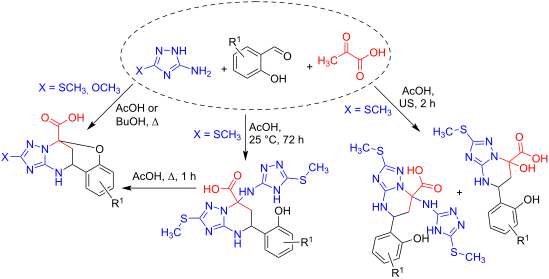
- , 61072, Kharkiv, Ukraine Enamine Ltd., Winston Churchill Street 78, Kyiv 02094, Ukraine Faculty of Chemistry, V. N. Karazin Kharkiv National University, Svobody sq., 4, 61022, Kharkiv, Ukraine 10.3762/bjoc.21.158 Abstract Switchable multicomponent reactions involving 3-substituted-5-amino-1,2,4
- -triazoles, pyruvic acid, and salicylaldehydes were studied under different conditions. Upon conventional heating, benzotriazolooxadiazocine-5-carboxylic acids were formed in the three-component reactions as single reaction products. Upon ultrasonic activation or mechanical stirring at room temperature, the
- multicomponent reaction of the same starting materials led to the formation of only tetrahydrotriazolopyrimidine derivatives. Keywords: 5-amino-1,2,4-triazole; heterocyclization; multicomponent reaction; salicylaldehyde; ultrasonication; Introduction Multicomponent reactions (MCRs) are a powerful tool for the


α-Ketoglutaric acid in Ugi reactions and Ugi/aza-Wittig tandem reactions
Beilstein J. Org. Chem. 2025, 21, 2021–2029, doi:10.3762/bjoc.21.157
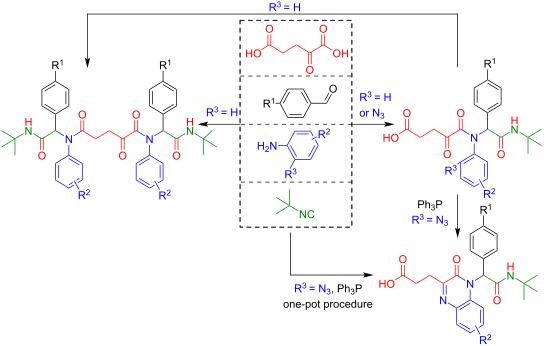
- ; quinoxalinone derivative; Ugi reaction; Introduction Multicomponent reactions are powerful tools in organic chemistry that enable the synthesis of structurally complex and multifunctional compounds from three or more starting materials in a single synthetic step. They are widely used in drug discovery because
- reactions, widely used as a green alternative for the synthesis of active pharmaceutical ingredients [7] and opens up the possibility of creating new compounds from the class of peptidomimetics [8][9][10], which often exhibit diverse biological effects [11] including antidiabetic [12], antiviral [13
- for the preparation of benzodiazepinone derivatives, which showed promising psychotropic effects [20][21][22][23][24], using a tandem combination of Ugi/azide–alkyne cycloaddition reactions. From this point of view, azido amines are promising reagents for use in the Ugi reaction, opening up the


Understanding the origin of stereoselectivity in the photochemical denitrogenation of 2,3-diazabicyclo[2.2.1]heptene and its derivatives with non-adiabatic molecular dynamics
Beilstein J. Org. Chem. 2025, 21, 2007–2020, doi:10.3762/bjoc.21.156
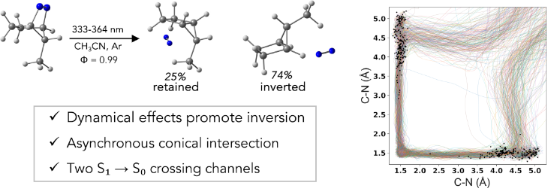
- Leticia A. Gomes Steven A. Lopez Department of Chemistry and Chemical Biology, Northeastern University, Boston, Massachusetts, 02115, United States 10.3762/bjoc.21.156 Abstract Photochemical denitrogenation reactions of bicyclic azoalkanes produce strained bicyclic compounds of interest to
- synthetic organic chemists. We report a computational study on the mechanism of diazabicyclo[2.2.1]heptenes to address long standing mechanistic questions. Indeed, the mechanism of these reactions has been disputed for over six decades. We employed non-adiabatic molecular dynamics (NAMD) simulations
- ; stereoselectivity; Introduction Photochemical reactions utilize light as a sustainable energy source and are considered to be ‘green’ reactions [1][2]. Organic chromophores absorb light, accessing higher-lying excited state(s) that exhibit distinct reactivities, leading to bond breaking and formation, irreversibly


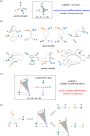
Measuring the stereogenic remoteness in non-central chirality: a stereocontrol connectivity index for asymmetric reactions
Beilstein J. Org. Chem. 2025, 21, 1995–2006, doi:10.3762/bjoc.21.155
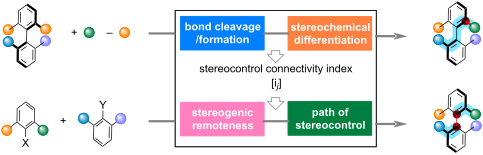
- remained an intuitive and empirical practice, particularly for reactions that create non-central chirality. We put forward a stereocontrol connectivity index to parameterize asymmetric reactions according to the bond connectivity relationships between the prochiral stereogenic elements, the reactive sites
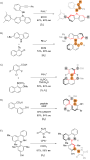
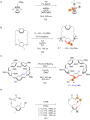
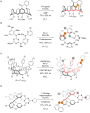
- , and the stereochemical-defining substituents. The indices can be generated based on analysis of the chemical structures of the starting materials and products, without mechanistic insights of the transformation. Representative examples of reactions that establish point chirality, axial chirality
- chiral molecules. Keywords: asymmetric reactions; axial chirality; catalysis; planar chirality; stereocontrol; Introduction Chirality is a ubiquitous and fundamental phenomenon in nature and thus holds an irreplaceable position in organic synthesis. At its most rudimental definition, chirality in a



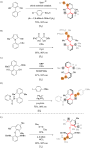

Aryl iodane-induced cascade arylation–1,2-silyl shift–heterocyclization of propargylsilanes under copper catalysis
Beilstein J. Org. Chem. 2025, 21, 1984–1994, doi:10.3762/bjoc.21.154
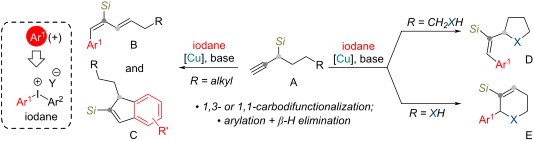
- synthetic potential of iodane-mediated carbofunctionalization under copper catalysis. Keywords: arylation reactions; copper-catalysis; iodanes; propargylsilanes; 1,2-silyl shift; Introduction Highly electrophilic hypervalent iodine(III) reagents are considered as arene electrophilic synthons, making them
- the reagents of choice for arylation reactions, where an umpolung of reactivity is required [1]. Arylations employing diaryl-λ3-iodanes can be performed under metal-free [2] or metal-catalyzed conditions. For alkyne arylations [Cu] [3] or [Pd] catalysis [4][5][6] is typically employed. Internal
- analogs, that needed longer reaction times to reach full conversion (4 h for R = Ph, Me; 20 h for R = 3,5-(NO2)2C6H3). Conclusion In this work we have reported copper-catalyzed arylation reactions of propargylsilanes, using iodanes as the electrophilic aryl synthon equivalents. For internal nucleophile


Photochemical reduction of acylimidazolium salts
Beilstein J. Org. Chem. 2025, 21, 1973–1983, doi:10.3762/bjoc.21.153
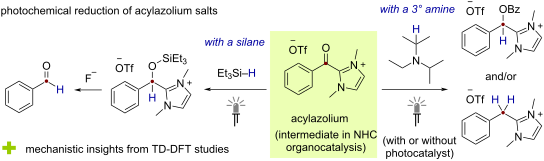
- reactions have been developed. Employing the simple amine, DIPEA, as the terminal reductant, products resulting from overall 2-electron or 4-electron-reduction processes could be obtained using either a photocatalytic approach under blue light irradiation or directly under UV-A light irradiation without an
- suitably electrophilic substrate at the carboxylic acid oxidation level provides an acylazolium species B, which typically reacts directly with nucleophiles or may first be transformed into the corresponding enolate derivative. Regardless of the individual pathway, NHC-catalyzed reactions of this type
- contrast to these numerous reports with carbon-based alkyl radicals, dual NHC/photoredox-mediated coupling processes between carboxylic acid derivatives and other classes of radical are lacking [22][23][24][25][26][27][28][29][30]. In particular, to the best of our knowledge, formal reduction reactions of


Enantioselective desymmetrization strategy of prochiral 1,3-diols in natural product synthesis
Beilstein J. Org. Chem. 2025, 21, 1932–1963, doi:10.3762/bjoc.21.151
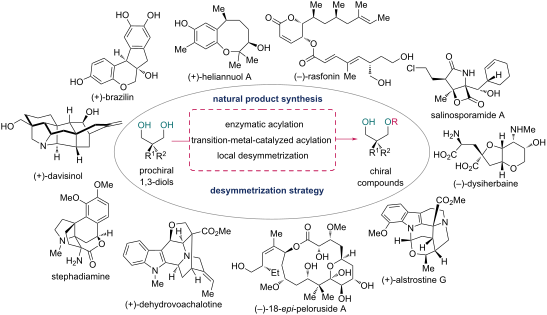
- -catalyzed acylation, and local desymmetrization. In this review, we cover total syntheses that utilize enantioselective desymmetrization of prochiral 1,3-diols. Review Desymmetrization via enzymatic acylation Enzymatic reactions represent one of the most useful tools in total synthesis. Through combination
- with organic reactions, this chemo-enzymatic strategy has been successfully utilized in the synthesis of complex molecules [22][23]. Enzymatic reactions feature a convenient operation due to their relative insensitivity to water and oxygen, as well as a specificity to certain substrates, resulting in
- (125) was obtained through a 12-step sequence from 124. Desymmetrization via transition-metal-catalyzed acylation Although enzymatic acylation reactions are widely employed in total synthesis, certain substrates are incompatible with acylation catalyzed by existing lipases. Inspired by enzymatic












Rhodium-catalysed connective synthesis of diverse reactive probes bearing S(VI) electrophilic warheads
Beilstein J. Org. Chem. 2025, 21, 1924–1931, doi:10.3762/bjoc.21.150
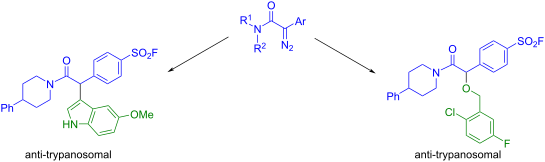
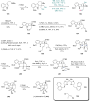
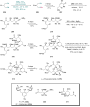
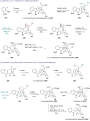
- amino acids [8][9][10]. Sets of reactive probes are generally prepared using robust reactions, most usually amide formation, chosen from the toolkit that currently dominates medicinal chemistry [11] which may, in turn, limit probe structural diversity. We have developed a unified connective approach for
- the reactive probes would be prepared by dirhodium-catalysed reactions between pairs of building blocks: an α-diazoamide 2 bearing a S(VI) electrophile and a suitable co-substrate (→ 3) (Figure 1). Here, metal-catalysed carbenoid chemistry was chosen because of the wide range of potentially reactive
- with, we investigated reactions of the α-diazoamide substrates D1, D2 and D3 with the 16 co-substrates C1–16 catalysed by three diverse [21] dirhodium catalysts (Rh2piv4, Rh2pfb4 and Rh2cap4) i.e., an array of 144 reactions. An α-diazoamide substrate (20 μmol; 16 μL of a 1.25 M solution in CH2Cl2) and


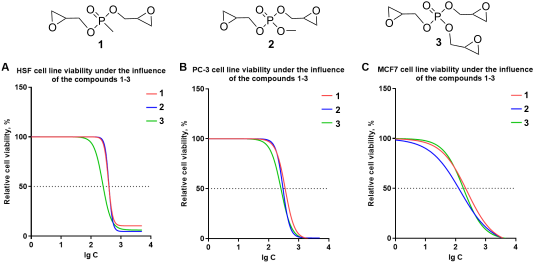
Synthesis, biological and electrochemical evaluation of glycidyl esters of phosphorus acids as potential anticancer drugs
Beilstein J. Org. Chem. 2025, 21, 1909–1916, doi:10.3762/bjoc.21.148
- . Experimental General. All reactions and manipulations were carried out under dry pure N2 in standard Schlenk apparatus. All solvents were distilled from sodium/benzophenone or phosphorus pentoxide and stored under nitrogen before use. The NMR spectra were recorded on a Bruker MSL-400 (1H 400 MHz, 31P 161.7 MHz


Stereoselective electrochemical intramolecular imino-pinacol reaction: a straightforward entry to enantiopure piperazines
Beilstein J. Org. Chem. 2025, 21, 1897–1908, doi:10.3762/bjoc.21.147
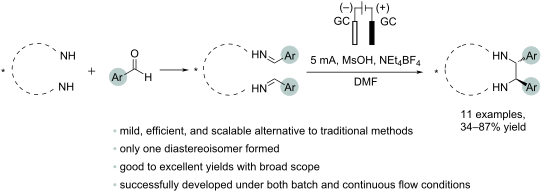
- conditions, the continuous process afforded higher productivities and space-time yields than the batch reactions due to a short residence time. This work provides a mild, efficient, and scalable alternative to traditional methods for the synthesis of tetrasubstituted enantiopure piperazines, with potential
- photochemical and electrochemical methods, have been explored. Over the past two decades a variety of light-promoted imino-pinacol coupling reactions have been developed, involving the use of catalytic transition-metal complexes [35][36], organic dyes [37][38][39], and polyaromatic compounds [40][41] as
- /cm2), total charge 2.2 F/mol, dry DMF (0.125 M). Yields reported are isolated yields. Reactions were performed on a 0.5 mmol scale. Continuous flow synthesis of piperazine 2a. The yield was determined by 1H NMR spectroscopy using 1,3,5-trimethoxybenzene as internal standard. Reactions were performed



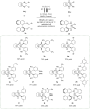


Preparation of spirocyclic oxindoles by cyclisation of an oxime to a nitrone and dipolar cycloaddition
Beilstein J. Org. Chem. 2025, 21, 1890–1896, doi:10.3762/bjoc.21.146
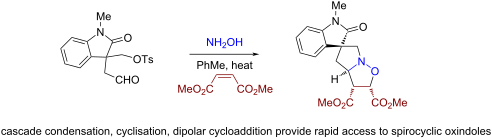
- -containing compounds makes use of intramolecular 1,3-dipolar cycloaddition reactions [15], including examples with nitrone ylides [16][17][18][19][20][21][22]. Our research group has exploited this approach for the synthesis of alkaloids such as myrioxazine A and aspidospermidine [23][24]. With a nitrone 1,3