

Search results
Search for "carbocyclic" in Full Text gives 110 result(s) in Beilstein Journal of Organic Chemistry.
An overview of the key routes to the best selling 5-membered ring heterocyclic pharmaceuticals
Beilstein J. Org. Chem. 2011, 7, 442–495, doi:10.3762/bjoc.7.57
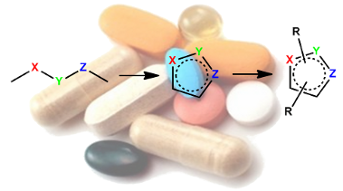
- importantly on the way the heterocyclic components were assembled. Aromatic and non-aromatic heterocyclic rings are a predominant architectural constant of pharmaceuticals and allow for variable interactions with the biological target which are not possible using simpler carbocyclic motifs. Based on our







Highly substituted benzannulated cyclooctanol derivatives by samarium diiodide-induced cyclizations
Beilstein J. Org. Chem. 2010, 6, 1229–1245, doi:10.3762/bjoc.6.141
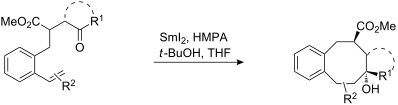
- ]. Among these approaches to carbocyclic compounds, samarium diiodide-mediated reactions play an important role and have been described in a number of excellent review articles [19][20][21] and original publications [22][23][24][25][26][27][28][29][30][31][32][33][34][35]. In our previous reports we have




Carbasugar analogues of galactofuranosides: α-O-linked derivatives
Beilstein J. Org. Chem. 2010, 6, 1127–1131, doi:10.3762/bjoc.6.129

- carbocyclic ring as the β-talo epoxide 4, were opened by nitrogen nucleophiles (nucleobases [18] or azide [19][20]) with generally good regioselectivity for attack at C1. The only precedent for attack at such carbapentafuranose epoxides with an oxygen nucleophile would appear to be the acid-mediated attack of


β-Hydroxy carbocation intermediates in solvolyses of di- and tetra-hydronaphthalene substrates
Beilstein J. Org. Chem. 2010, 6, 1035–1042, doi:10.3762/bjoc.6.118
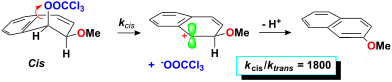
- the carbocyclic substrate in this case shows a rate retardation of 80,000 [16]. This value has been considered exceptionally large and an additional rate-retarding effect has been attributed to ring strain induced by the presence of oxygen in the six-membered ring of the bicyclic carbocation


A thermally-induced, tandem [3,3]-sigmatropic rearrangement/[2 + 2] cycloaddition approach to carbocyclic spirooxindoles
Beilstein J. Org. Chem. 2010, 6, No. 33, doi:10.3762/bjoc.6.33
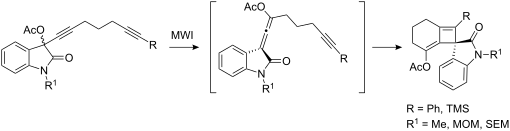
- Kay M. Brummond Joshua M. Osbourn Department of Chemistry, University of Pittsburgh, Pittsburgh, Pennsylvania 15260, U.S.A 10.3762/bjoc.6.33 Abstract The synthesis of C3-carbocyclic spirooxindoles was realized by way of an intramolecular [2 + 2] cycloaddition reaction between a vinylidene indolin
- evidenced by baseline impurities on the TLC. However, the only discernable product in the NMR spectrum is the desired spirooxindole 10f. Conclusion We have developed a concise synthesis to C3-carbocyclic spirooxindoles. One important feature of this thermal tandem [3,3]-sigmatropic rearrangement/[2 + 2
- column. The column was eluted with hexanes (100 mL) and then with 25% ethyl acetate/hexanes. The fractions containing the desired product were concentrated under reduced pressure to provide 18 mg of spirooxindole 10a as a brown oil in 60% yield. Heterocyclic and carbocyclic spirooxindoles. Access to


Fused bicyclic piperidines and dihydropyridines by dearomatising cyclisation of the enolates of nicotinyl-substituted esters and ketones
Beilstein J. Org. Chem. 2010, 6, No. 22, doi:10.3762/bjoc.6.22
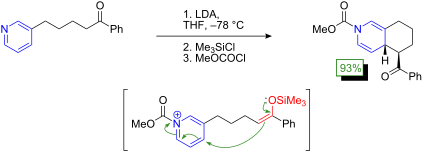
- carbocyclic ring by dearomatising cyclisation The study was initiated with the synthesis of the δ-nicotinyl ketone 7 as illustrated in Scheme 2. Ethyl benzoylacetate was alkylated with 3-(3-iodopropyl)pyridine 5 and the product 6 hydrolysed and decarboxylated to yield the pyridine 7 in moderate yield. On
- corresponding 12.9 Hz coupling to the proton α to the ester group is consistent with adoption of an exo–equatorial orientation by this substituent. Formation of a tetrahydrofuran by dearomatising cyclisation Encouraged by the successful formation of carbocyclic rings in dearomatising cyclisations of nicotinyl


Ring-alkyl connecting group effect on mesogenic properties of p-carborane derivatives and their hydrocarbon analogues
Beilstein J. Org. Chem. 2009, 5, No. 83, doi:10.3762/bjoc.5.83
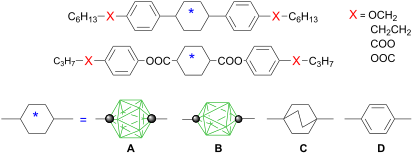
- B) than for carbocyclic derivatives (C and D). Analysis indicates that this effect may have quadrupolar and conformational origin. Keywords: p-carborane; liquid crystals; structure-property relationship; Introduction During the past decade, we have been investigating mesogenic derivatives of p
- exclusively the nematic phase. Similar nematic behavior is observed for carbocycles in series 17–20 with the exception of 19D, which exhibits a SmA phase in addition to a N phase. In contrast, most carbocyclic derivatives in series 14[6]–16[6] display only smectic and soft crystalline polymorphs. The bicyclo
- alkoxyphenyl group) for the carbocyclic compounds. In contrast, the difference in TNI is larger by 10 K for p-carborane A and 18 K for p-carborane B (Figure 5 and Figure 6). These results are consistent with earlier findings for pairs 1/2, 3/4, and 5/6 (Figure 5) in which a particularly large impact of the


Synthesis of chiral cyclohexanes and carbasugars by 6-exo-dig radical cyclisation reactions
Beilstein J. Org. Chem. 2008, 4, No. 43, doi:10.3762/bjoc.4.43
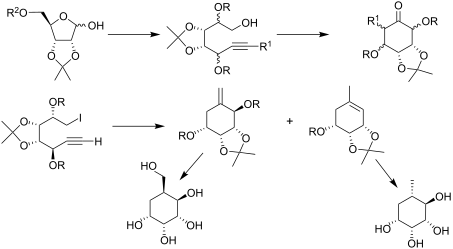
- of carbohydrates as precursors for highly functionalised carbocyclic rings systems has found wide utility in organic synthesis [1][2][3][4][5][6][7][8][9][10][11]. In particular there is a large amount of literature devoted to the synthesis of cyclopentanes [12][13] that employs a 5-exo-dig ring



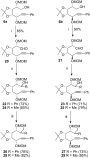


Understanding the mechanism of Pd-catalyzed allylic substitution of the cyclic difluorinated carbonates
Beilstein J. Org. Chem. 2008, 4, No. 18, doi:10.3762/bjoc.4.18
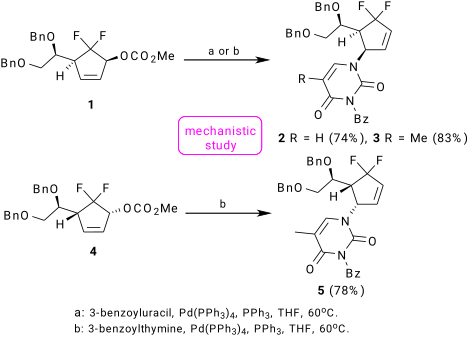
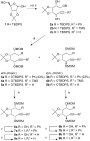
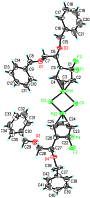
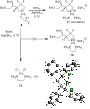
- , Shanghai 201620, China 10.3762/bjoc.4.18 Abstract We present a mechanistic investigation of Pd-catalyzed allylic substitution of cyclic gem-difluorinated carbonates 1 and 4, previously employed in the synthesis of 3',3'-difluoro-2'-hydroxymethyl-4',5'-unsaturated carbocyclic nucleosides in 17 steps. The
- substitution features a reversal of regioselectivity caused by fluorine. Background Carbocyclic nucleosides (CNAs), in which the furanose oxygen atoms of the 4'-oxonucleosides are substituted by CH2, have received considerable attention because they exhibit greater metabolic stability toward nucleoside
- phosphorylases and higher lipophilicity, two properties that are potentially beneficial in terms of increased in vivo half life, oral efficiency and cell wall penetration [1][2]. Based on CNA skeletons, 1,2-disubstituted carbocyclic nucleosides (OTCs) recently attracted more and more attention [3][4][5][6][7][8



Allylsilanes in the synthesis of three to seven membered rings: the silylcuprate strategy
Beilstein J. Org. Chem. 2007, 3, No. 16, doi:10.1186/1860-5397-3-16
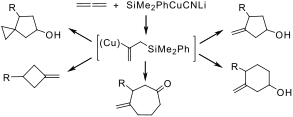
- to a wide range of functionalised allylsilanes, which are valuable intermediates for carbocyclic annulations. Effectively, the former substrates (containing a nucleophilic allylsilane unit and an electrophilic function) undergo "intramolecular allylsilane terminated" cyclizations when treated with







Other Beilstein-Institut Open Science Activities