

Search results
Search for "LEDs" in Full Text gives 102 result(s) in Beilstein Journal of Organic Chemistry.
Novel carbazole–pyridine copolymers by an economical method: synthesis, spectroscopic and thermochemical studies
Beilstein J. Org. Chem. 2011, 7, 638–647, doi:10.3762/bjoc.7.75
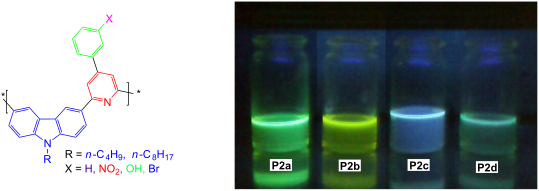
- for employing organic materials as LEDs [7] and carbazole containing polymers are the most studied group amongst the different polymers intended for OLED applications [8][9][10][11][12][13][14][15]. Carbazole containing polymers exhibit excellent electron-donating properties together with intense




The efficient synthesis of dibenzo[d,d′]benzo[1,2-b:4,3-b′]dithiophene and cyclopenta[1,2-b:4,3-b′]bis(benzo[d]thiophen)-6-one
Beilstein J. Org. Chem. 2009, 5, No. 55, doi:10.3762/bjoc.5.55

- fabricate organic field-effect transistors (OFETs) [1][2][3][4][5][6][7], light emitting diodes (LEDs) [8][9], and photovoltaic cells [10]. Various novel π-extended heteroarenes, e.g. dibenzo[d,d′]thieno[3,2-b:4,5-b′]dithiophene [11], pentathienoacene [12], and benzo[1,2-b:4,5-b′]bis[b]benzothiophene [13


Other Beilstein-Institut Open Science Activities