
Search for "mode of action" in Full Text gives 95 result(s) in Beilstein Journal of Organic Chemistry.
Beilstein J. Org. Chem. 2013, 9, 2265–2319, doi:10.3762/bjoc.9.265
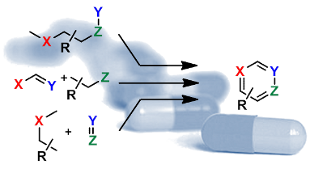
Graphical Abstract
Scheme 1: Scaled industrial processes for the synthesis of simple pyridines.
Scheme 2: Synthesis of nicotinic acid from 2-methyl-5-ethylpyridine (1.11).
Scheme 3: Synthesis of 3-picoline and nicotinic acid.
Scheme 4: Synthesis of 3-picoline from 2-methylglutarodinitrile 1.19.
Scheme 5: Picoline-based synthesis of clarinex (no yields reported).
Scheme 6: Mode of action of proton-pump inhibitors and structures of the API’s.
Scheme 7: Hantzsch-like route towards the pyridine rings in common proton pump inhibitors.
Figure 1: Structures of rosiglitazone (1.40) and pioglitazone (1.41).
Scheme 8: Synthesis of rosiglitazone.
Scheme 9: Syntheses of 2-pyridones.
Scheme 10: Synthesis and mechanism of 2-pyrone from malic acid.
Scheme 11: Polymer-assisted synthesis of rosiglitazone.
Scheme 12: Synthesis of pioglitazone.
Scheme 13: Meerwein arylation reaction towards pioglitazone.
Scheme 14: Route towards pioglitazone utilising tyrosine.
Scheme 15: Route towards pioglitazone via Darzens ester formation.
Scheme 16: Syntheses of the thiazolidinedione moiety.
Scheme 17: Synthesis of etoricoxib utilising Negishi and Stille cross-coupling reactions.
Scheme 18: Synthesis of etoricoxib via vinamidinium condensation.
Figure 2: Structures of nalidixic acid, levofloxacin and moxifloxacin.
Scheme 19: Synthesis of moxifloxacin.
Scheme 20: Synthesis of (S,S)-2,8-diazabicyclo[4.3.0]nonane 1.105.
Scheme 21: Synthesis of levofloxacin.
Scheme 22: Alternative approach to the levofloxacin core 1.125.
Figure 3: Structures of nifedipine, amlodipine and clevidipine.
Scheme 23: Mg3N2-mediated synthesis of nifedipine.
Scheme 24: Synthesis of rac-amlodipine as besylate salt.
Scheme 25: Aza Diels–Alder approach towards amlodipine.
Scheme 26: Routes towards clevidipine.
Figure 4: Examples of piperidine containing drugs.
Figure 5: Discovery of tiagabine based on early leads.
Scheme 27: Synthetic sequences to tiagabine.
Figure 6: Structures of solifenacin (2.57) and muscarine (2.58).
Scheme 28: Enantioselective synthesis of solifenacin.
Figure 7: Structures of DPP-4 inhibitors of the gliptin-type.
Scheme 29: Formation of inactive diketopiperazines from cis-rotameric precursors.
Figure 8: Co-crystal structure of carmegliptin bound in the human DPP-4 active site (PDB 3kwf).
Scheme 30: Improved route to carmegliptin.
Figure 9: Structures of lamivudine and zidovudine.
Scheme 31: Typical routes accessing uracil, thymine and cytosine.
Scheme 32: Coupling between pyrimidones and riboses via the Vorbrüggen nucleosidation.
Scheme 33: Synthesis of lamivudine.
Scheme 34: Synthesis of raltegravir.
Scheme 35: Mechanistic studies on the formation of 3.22.
Figure 10: Structures of selected pyrimidine containing drugs.
Scheme 36: General preparation of pyrimidines and dihydropyrimidones.
Scheme 37: Synthesis of imatinib.
Scheme 38: Flow synthesis of imatinib.
Scheme 39: Syntheses of erlotinib.
Scheme 40: Synthesis of erlotinib proceeding via Dimroth rearrangement.
Scheme 41: Synthesis of lapatinib.
Scheme 42: Synthesis of rosuvastatin.
Scheme 43: Alternative preparation of the key aldehyde towards rosuvastatin.
Figure 11: Structure comparison between nicotinic acetylcholine receptor agonists.
Scheme 44: Syntheses of varenicline and its key building block 4.5.
Scheme 45: Synthetic access to eszopiclone and brimonidine via quinoxaline intermediates.
Figure 12: Bortezomib bound in an active site of the yeast 20S proteasome ([114], pdb 2F16).
Scheme 46: Asymmetric synthesis of bortezomib.
Figure 13: Structures of some prominent piperazine containing drugs.
Figure 14: Structural comparison between the core of aplaviroc (4.35) and a type-1 β-turn (4.36).
Scheme 47: Examplary synthesis of an aplaviroc analogue via the Ugi-MCR.
Scheme 48: Syntheses of azelastine (5.1).
Figure 15: Structures of captopril, enalapril and cilazapril.
Scheme 49: Synthesis of cilazapril.
Figure 16: Structures of lamotrigine, ceftriaxone and azapropazone.
Scheme 50: Synthesis of lamotrigine.
Scheme 51: Alternative synthesis of lamotrigine (no yields reported).
Figure 17: Structural comparison between imiquimod and the related adenosine nucleoside.
Scheme 52: Conventional synthesis of imiquimod (no yields reported).
Scheme 53: Synthesis of imiquimod.
Scheme 54: Synthesis of imiquimod via tetrazole formation (not all yields reported).
Figure 18: Structures of various anti HIV-medications.
Scheme 55: Synthesis of abacavir.
Figure 19: Structures of diazepam compared to modern replacements.
Scheme 56: Synthesis of ocinaplon.
Scheme 57: Access to zaleplon and indiplon.
Scheme 58: Different routes towards the required N-methylpyrazole 6.65 of sildenafil.
Scheme 59: Polymer-supported reagents in the synthesis of key aminopyrazole 6.72.
Scheme 60: Early synthetic route to sildenafil.
Scheme 61: Convergent preparations of sildenafil.
Figure 20: Comparison of the structures of sildenafil, tadalafil and vardenafil.
Scheme 62: Short route to imidazotriazinones.
Scheme 63: Alternative route towards vardenafils core imidazotriazinone (6.95).
Scheme 64: Bayer’s approach to the vardenafil core.
Scheme 65: Large scale synthesis of vardenafil.
Scheme 66: Mode of action of temozolomide (6.105) as methylating agent.
Scheme 67: Different routes to temozolomide.
Scheme 68: Safer route towards temozolomide.
Figure 21: Some unreported heterocyclic scaffolds in top market drugs.
Beilstein J. Org. Chem. 2013, 9, 2194–2201, doi:10.3762/bjoc.9.258
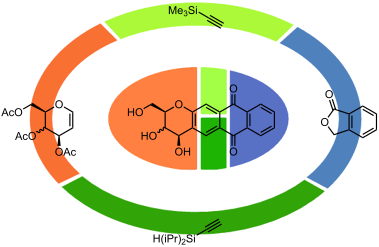
Graphical Abstract
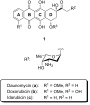
Figure 1: Several natural occurring anthracycline antibiotics.
Scheme 1: Total synthesis of daunomycinone 6 according to Hansen.
Scheme 2: Synthesis of simplified anthracycline derivatives.
Scheme 3: Retrosynthetic analysis of anthracycline aglycone mimics. Si: any silyl group.
Scheme 4: Synthetic route for the synthesis of various dialkynes 16. aSi: TMS, SiMe2Bn (2.0 equiv); Si: SiMe2...
Scheme 5: Silyl ether synthesis and domino carbopalladation reaction. R,R (Glc): isopropylidene. R,R (Gal): b...
Scheme 6: Derivatisation of anthracycline derivatives. aR,R (Glc): isopropylidene. R,R (Gal): benzylidene. Re...
Beilstein J. Org. Chem. 2013, 9, 2048–2078, doi:10.3762/bjoc.9.243
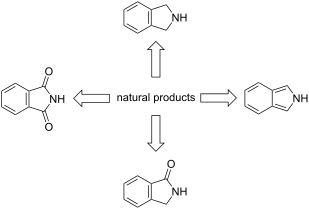
Graphical Abstract
Figure 1: a) Structural features and b) selected examples of non-natural congeners.
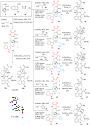
Scheme 1: Synthesis of isoindole 18.
Scheme 2: Staining amines with 1,4-diketone 19 (R = H).
Figure 2: Representative members of the indolocarbazole alkaloid family.
Figure 3: Staurosporine (26) bound to the adenosine-binding pocket [19] (from pdb1stc).
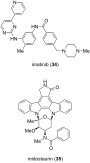
Figure 4: Structure of imatinib (34) and midostaurin (35).
Scheme 3: Biosynthesis of staurosporine (26).
Scheme 4: Wood’s synthesis of K-252a via the common intermediate 48.
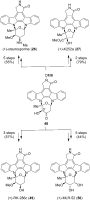
Scheme 5: Synthesis of 26, 27, 49 and 50 diverging from the common intermediate 48.
Figure 5: Selected members of the cytochalasan alkaloid family.
Scheme 6: Biosynthesis of chaetoglobosin A (57) [56].
Scheme 7: Synthesis of cytochalasin D (70) by Thomas [63].
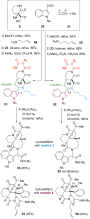
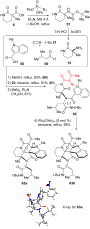
Scheme 8: Synthesis of L-696,474 (78).
Scheme 9: Synthesis of aldehyde 85 (R = TBDPS).
Scheme 10: Synthesis of (+)-aspergillin PZ (79) by Tanis.
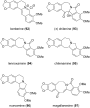
Figure 6: Representative Berberis alkaloids.
Scheme 11: Proposed biosynthetic pathway to chilenine (93).
Scheme 12: Synthesis of magallanesine (97) by Danishefsky [84].
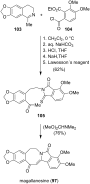
Scheme 13: Kurihara’s synthesis of magallanesine (85).
Scheme 14: Proposed biosynthesis of 113, 117 and 125.
Scheme 15: DNA lesion caused by aristolochic acid I (117) [102].
Scheme 16: Snieckus’ synthesis of piperolactam C (131).
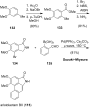
Scheme 17: Synthesis of aristolactam BII (104).
Figure 7: Representative cularine alkaloids.
Scheme 18: Proposed biosynthesis of 136.
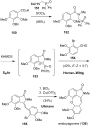
Scheme 19: The syntheses of 136 and 137 reported by Castedo and Suau.
Scheme 20: Synthesis of 136 by Couture.
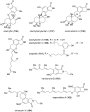
Figure 8: Representative isoindolinone meroterpenoids.
Scheme 21: Postulated biosynthetic pathway for the formation of 156 (adopted from George) [143].
Scheme 22: Synthesis of stachyflin (156) by Katoh [144].
Figure 9: Selected examples of spirodihydrobenzofuranlactams.
Scheme 23: Synthesis of stachybotrylactam I (157).
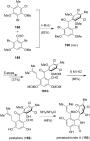
Scheme 24: Synthesis of pestalachloride A (193) by Schmalz.
Scheme 25: Proposed mechanism for the BF3-catalyzed metal-free carbonyl–olefin metathesis [149].
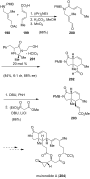
Scheme 26: Preparation of the isoindoline core of muironolide A (204).
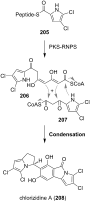
Scheme 27: Proposed biosynthesis of 208.
Scheme 28: Model for the biosynthesis of 215 and 217.
Scheme 29: Synthesis of lactonamycin (215) and lactonamycin Z (217).
Figure 10: Hetisine alkaloids 225–228.
Scheme 30: Biosynthetic proposal for the formation of the hetisine core [167].
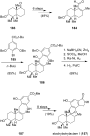
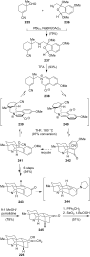
Scheme 31: Synthesis of nominine (225).
Beilstein J. Org. Chem. 2013, 9, 1677–1695, doi:10.3762/bjoc.9.192
Graphical Abstract
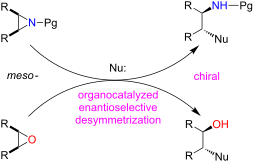
Figure 1: The catalyzed enantioselective desymmetrization.
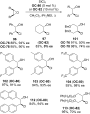
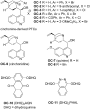
Figure 2: Cinchona alkaloid-derived catalysts OC-1 to OC-11.
Scheme 1: The enantioselective desymmetrization of meso-aziridines in the presence of selected Cinchona alkal...
Figure 3: Cinchona alkaloid-derived catalysts OC-12 to OC-19.
Scheme 2: The enantioselective ring-opening of aziridines in the presence of OC-16.
Scheme 3: OC-16 catalyzed enantioselective ring-opening of aziridines.
Figure 4: The chiral phosphoric acids catalysts OC-20 and OC-21.
Scheme 4: OC-20 and OC-21 catalyzed enantioselective desymmetrization of meso-aziridines.
Figure 5: The proposed mechanism for chiral phosphorous acid-induced enantioselctive desymmetrization of meso...
Scheme 5: OC-21 catalyzed enantioselective desymmetrization of meso-aziridines by Me3SiSPh.
Scheme 6: OC-21 catalyzed the enantioselective desymmetrization of meso-aziridines by Me3SiSePh/PhSeH.
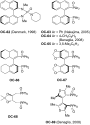
Figure 6: L-Proline and its derivatives OC-22 to OC-27.
Scheme 7: OC-23 catalyzed enantioselective desymmetrization of meso-aziridines.
Figure 7: Proposed bifunctional mode of action of OC-23.
Figure 8: The chiral thioureas OC-28 to OC-44 for the desymmetrization of meso-aziridines.
Scheme 8: Desymmetrization of meso-aziridines with OC-41.
Figure 9: The chiral guanidines (OC-45 to OC-48).
Scheme 9: OC-46 catalyzed desymmetrization of meso-aziridines by arylthiols.
Scheme 10: Desymmetrization of cis-aziridine-2,3-dicarboxylate.
Figure 10: The proposed activation mode of OC-46.
Scheme 11: The enantioselective desymmetrization of meso-aziridines by amine/CS2 in the presence of OC-46.
Figure 11: The chiral 1,2,3-triazolium chlorides OC-49 to OC-55.
Scheme 12: The enantioselective desymmetrization of meso-aziridines by Me3SiX (X = Cl or Br) in the presence o...
Figure 12: Early organocatalysts for enantioselective desymmetrization of meso-epoxides.
Scheme 13: Attempts of enantioselective desymmetrization of meso-epoxides in the presence of OC-58 or OC-60.
Scheme 14: The enantioselective desymmetrization of a meso-epoxide containing one P atom.
Figure 13: Some chiral phosphoramide and chiral phosphine oxides.
Scheme 15: OC-62 catalyzed enantioselective desymmetrization of meso-epoxides by SiCl4.
Figure 14: The proposed mechanism of the chiral HMPA-catalyzed desymmetrization of meso-epoxides.
Scheme 16: The enantioselective desymmetrization of meso-epoxides in the presence of OC-63.
Figure 15: The Chiral phosphine oxides (OC-70 to OC-77) based on an allene backbone.
Scheme 17: OC-73 catalyzed enantioselective desymmetrization of meso-epoxides by SiCl4.
Figure 16: Chiral pyridine N-oxides used in enantioselective desymmetrization of meso-epoxides.
Scheme 18: Catalyzed enantioselective desymmetrization of meso-epoxides in the presence of OC-80 or OC-82.
Figure 17: Chiral pyridine N-oxides OC-85 to OC-94.
Scheme 19: Enantioselective desymmetrization of cis-stilbene oxide by using OC-85 to OC-92 as catalysts.
Figure 18: A novel family of helical chiral pyridine N-oxides OC-95 to OC-97.
Scheme 20: Desymmetrization of meso-epoxides catalyzed by OC-95 to OC-97.
Scheme 21: OC-98 catalyzed enantioselective desymmetrization of meso-epoxides by SiCl4.
Beilstein J. Org. Chem. 2013, 9, 544–556, doi:10.3762/bjoc.9.60
Graphical Abstract
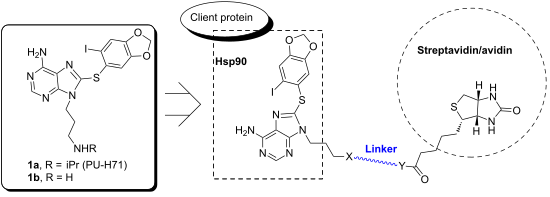
Figure 1: Design of the biotinylated Hsp90 probes based on PU-H71 (1a).
Scheme 1: Reagents and conditions: (a) D-biotin, DCC, DMAP, CH2Cl2, sonicate; (b) EZ-Link® NHS-LC-Biotin, DIE...
Scheme 2: Reagents and conditions: (a) 6-Boc-aminocaproic acid, DCC, DMAP, CH2Cl2, rt; (b) TFA, CH2Cl2, rt; (...
Figure 2: Analysis of the affinity and selectivity of the biotinylated probes for Hsp90. (a) K562 cancer cell...
Figure 3: Use of probe 2g to detect oncogenic Hsp90 by flow cytometry (a) and (b) and by microscopy (c). For ...
Beilstein J. Org. Chem. 2013, 9, 447–452, doi:10.3762/bjoc.9.47
Graphical Abstract
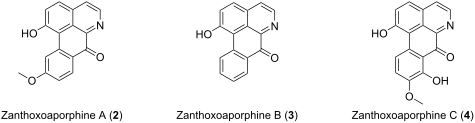
Figure 1: Known compound sesamin (1) isolated from methylene extract of stem bark of Z. paracanthum.
Figure 2: COSY, HMBC and NOE correlations of compounds 2, 3 and 4.
Beilstein J. Org. Chem. 2013, 9, 392–400, doi:10.3762/bjoc.9.40
Graphical Abstract
Scheme 1: Diels–Alder reaction of 2-phosphaindolizines.
Scheme 2: Diels–Alder reaction of 2-phosphaindolizine-η1-P-aluminium(O-menthoxy) dichloride with 2,3-dimethyl...
Scheme 3: Formation of the cationic 1:1 complex of the dienophile and dialkylaluminium.
Scheme 4: Disproportionation of the 1:1 complex of 2-phosphaindolizine and Al(O-menthoxy)Cl2.
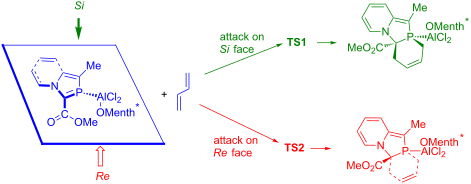
Scheme 5: Attack of 1,3-butadiene on Si and Re faces of >C=P– functionality of 2-phosphaindolizine complex.
Figure 1: Geometries of 2-phosphaindolizine-η1-P-aluminium(O-menthoxy) dichloride, the transition structures,...
Beilstein J. Org. Chem. 2012, 8, 1753–1764, doi:10.3762/bjoc.8.200
Graphical Abstract
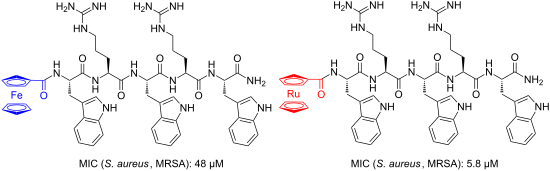
Figure 1: Structures of the most active peptides that have been used in this study. The top row shows two rep...
Figure 2: Bactericidal activity of (RW)3 against S. aureus 133 (panel A and D) or B. megaterium (panel B) and...
Figure 3: Growth kinetics of B. megaterium under the influence of different amounts of synAMP (red: (RW)3; or...
Beilstein J. Org. Chem. 2012, 8, 1265–1270, doi:10.3762/bjoc.8.142
Graphical Abstract
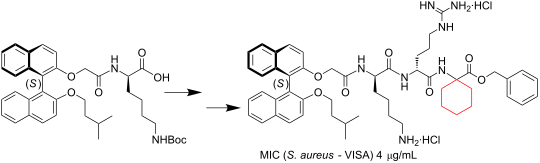
Figure 1: Binaphthyl-anchored tripeptide derivatives 1.
Scheme 1: Synthesis of compounds 2a–g. Reagents and conditions: (i) 2a–b,d–g, BnBr, acetone or THF, K2CO3, re...
Beilstein J. Org. Chem. 2012, 8, 1172–1184, doi:10.3762/bjoc.8.130
Graphical Abstract
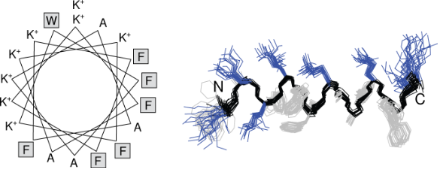
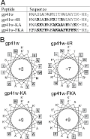
Figure 1: (A) Names and sequences of the gp41w-derived peptides. (B) Helical-wheel projections of gp41w, gp41...
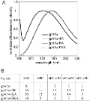
Figure 2: (A) Normalized Trp emission spectra of the gp41w derivatives in buffer. The spectra have been norma...
Figure 3: Relative Ksv values calculated for gp41w, gp41w-4R, gp41w-KA and gp41w-FKA in buffer and in the pre...
Figure 4: Percent calcein leakage induced by the gp41 derivatives. Gp41w (blue), gp41w-4R (orange), gp41w-KA ...
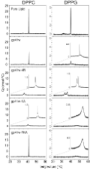
Figure 5: DSC thermograms of pure zwitterionic DPPC (left) and anionic DPPG (right) lipid suspensions compare...
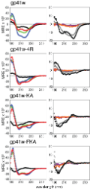
Figure 6: Far-UV CD spectra of gp41w and the three derivative peptides. The panel on the left shows the pepti...
Figure 7: NMR solution structure of gp41w-4R, gp41w-KA and gp41w-FKA in the cosolvent mixture. Overlay of the...
Beilstein J. Org. Chem. 2012, 8, 930–940, doi:10.3762/bjoc.8.105
Graphical Abstract
Figure 1: (a) Biosynthetic outline of aromatic polyketides; (b) structure of indole alkaloids composed of ind...
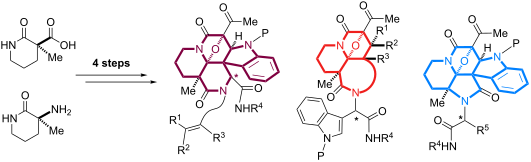
Figure 2: (a) Synthetic plans based on modular assembly and divergent cyclizations leading to fused skeletons...
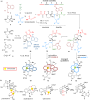
Scheme 1: Four-step synthesis of hexacyclic skeleton 25.
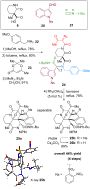
Scheme 2: Four-step synthesis of hexacyclic skeleton 30.
Scheme 3: Parallel and four-step synthesis of tetracyclic skeletons 39–42 and 47–48.
Scheme 4: Synthesis of branched precursors, 51 and 52, using amines 49 and 50, with different methylene lengt...
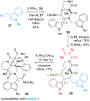
Scheme 5: Four-step synthesis of hexacyclic scaffold 63 employing manifold 15. For details of the synthesis o...
Beilstein J. Org. Chem. 2012, 8, 528–533, doi:10.3762/bjoc.8.60
Graphical Abstract
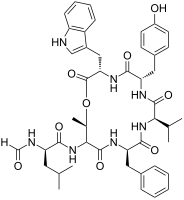
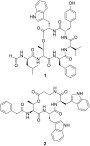
Figure 1: Structure of depsipeptides szentiamide (1) [12] and xenematide (2) [8] identified in Xenorhabdus strains.
Scheme 1: Overview of the synthetic strategy.
Scheme 2: Synthesis of compound 1.
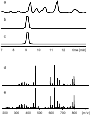
Figure 2: HPLC–MS data of an XAD-extract of X. szentirmaii (a; base-peak chromatogram), the natural 1 (b; ext...
Beilstein J. Org. Chem. 2011, 7, 1562–1569, doi:10.3762/bjoc.7.184
Graphical Abstract
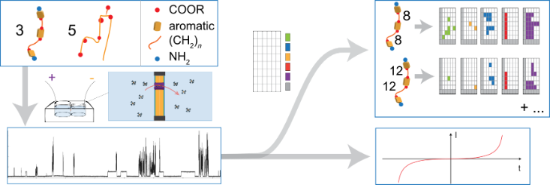
Scheme 1: Compounds studied with the voltage-clamp experiment.
Scheme 2: Synthesis of phthalate compounds.
Figure 1: Channel activities of compound 1. A: Regular “square-top” activity. Conditions: 1 M KCl buffered to...
Figure 2: Channel activities of compound 2. A: Rapid flickering. Conditions: 1 M CsCl, +100 mV; B: Semiregula...
Figure 3: Conversion of a current–time profile of compound 5 (top) into conductance–time profile (bottom) by ...
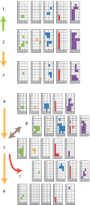
Figure 4: Single-molecule structure–activity relationships for compounds 1–8. Grids are given in the followin...
Figure 5: Voltage-dependent opening of compound 1. Inset: Exponential dependence of the mean current on the p...
Beilstein J. Org. Chem. 2011, 7, 1543–1554, doi:10.3762/bjoc.7.182
Graphical Abstract
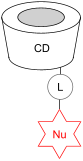
Figure 1: Schematic representation of the general structural design of the investigated cyclodextrin derivati...
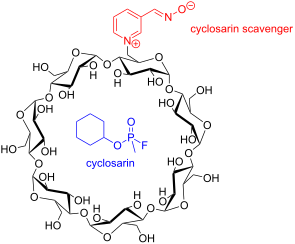
Scheme 1: Structure of cyclosarin (GF).
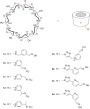
Scheme 2: Cyclodextrin derivatives tested as potential GF scavengers.
Scheme 3: General strategies used for the preparation of the investigated cyclodextrin derivatives.
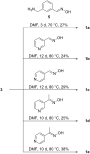
Scheme 4: Reaction conditions used for the preparation of cyclodextrin derivatives 1a–e from tosylate 3.
Scheme 5: Synthesis of 3-(aminomethyl)benzaldehyde oxime (5). Reagents and conditions: i. NaBH4, EtOH, 1 h, 2...
Scheme 6: Synthesis of 3-((hydroxyimino)methyl)-1-(prop-2-ynyl)pyridinium bromide (6). Reagents and condition...
Scheme 7: Syntheses of 6-ethynyl-formylpyridine oximes (7a–c). Reagents and conditions: i. CuI, (PPh3)2PdCl2,...
Scheme 8: Reaction conditions used for the preparation of cyclodextrin derivatives 2a–d from azide 4.
Figure 2: Diagram summarizing the observed Δk1 values for cyclodextrins 1a–e and 2a–d. For comparison, the re...
Figure 3: Time-dependent decrease of GF concentration in the presence of 1b (top row), 1c (middle row), and 2a...
Scheme 9: Schematic protocol for the qualitative assay.
Scheme 10: Schematic protocol of the quantitative assay.
Beilstein J. Org. Chem. 2011, 7, 1504–1507, doi:10.3762/bjoc.7.175
Graphical Abstract
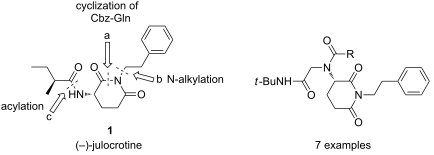
Figure 1: Retrosynthetic scheme for (−)-julocrotine (1).
Scheme 1: Reactions and conditions: (a) DCC, NHS, DMF 80 °C, 18 h, 76%. (b) Ph(CH2)2Br, K2CO3, acetone, r.t.,...
Scheme 2: Reactions and conditions: (a) (CH2O)n, MeOH, r.t., 2 h then, RCOOH and t-BuNC, r.t., 18 h.
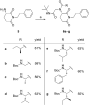
Scheme 3: Reactions and conditions: (a) (CH2O)n, MeOH, r.t., 2 h then, (S)-2-methylbutanoic acid and 7, r.t. ...
Beilstein J. Org. Chem. 2011, 7, 442–495, doi:10.3762/bjoc.7.57
Graphical Abstract
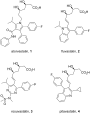
Figure 1: Structures of atorvastatin and other commercial statins.
Figure 2: Structure of compactin.
Scheme 1: Synthesis of pentasubstituted pyrroles.
Scheme 2: [3 + 2] Cycloaddition to prepare 5-isopropylpyrroles.
Scheme 3: Regiospecific [3 + 2] cycloaddition to prepare the pyrrole scaffold.
Scheme 4: Formation of the pyrrole core of atorvastatin via [3 + 2] cycloaddition.
Scheme 5: Formation of pyrrole 33 via the Paal–Knorr reaction.
Scheme 6: Convergent synthesis towards atorvastatin.
Figure 3: Binding pocket of sunitinib in the TRK KIT.
Scheme 7: Synthesis of sunitinib.
Scheme 8: Alternative synthesis of sunitinib.
Scheme 9: Key steps in the syntheses of sumatriptan and zolmitriptan.
Scheme 10: Introduction of the N,N-dimethylaminoethyl side chain.
Scheme 11: Japp–Klingemann reaction in the synthesis of sumatriptan.
Scheme 12: Synthesis of the intermediate sulfonyl chlorides 62 and 63.
Scheme 13: Alternative introduction of the sulfonamide.
Scheme 14: Negishi-type coupling to benzylic sulfonamides.
Scheme 15: Heck reaction used to introduce the sulfonamide side chain of naratriptan.
Scheme 16: Synthesis of the oxazolinone appendage of zolmitriptan.
Scheme 17: Grandberg indole synthesis used in the preparation of rizatriptan.
Scheme 18: Improved synthesis of rizatriptan.
Scheme 19: Larock-type synthesis of rizatriptan.
Scheme 20: Synthesis of eletriptan.
Scheme 21: Heck coupling for the indole system in eletriptan.
Scheme 22: Attempted Fischer indole synthesis of elatriptan.
Scheme 23: Successful Fischer indole synthesis for eletriptan.
Scheme 24: Mechanistic rationale for the Bischler–Möhlau reaction.
Scheme 25: Bischler-type indole synthesis used in the fluvastatin sodium synthesis.
Scheme 26: Palladium-mediated synthesis of ondansetron.
Scheme 27: Fischer indole synthesis of ondansetron.
Scheme 28: Optimised Pictet–Spengler reaction towards tadalafil.
Figure 4: Structures of carvedilol 136 and propranolol 137.
Scheme 29: Synthesis of the carbazole core of carvedilol.
Scheme 30: Alternative syntheses of 4-hydroxy-9H-carbazole.
Scheme 31: Convergent synthesis of etodolac.
Scheme 32: Alternative synthesis of etodolac.
Figure 5: Structures of imidazole-containing drugs.
Scheme 33: Synthesis of functionalised imidazoles towards losartan.
Scheme 34: Direct synthesis of the chlorinated imidazole in losartan.
Scheme 35: Synthesis of trisubstituted imidazoles.
Scheme 36: Preparation of the imidazole ring in olmesartan.
Scheme 37: Synthesis of ondansetron.
Scheme 38: Alternative route to ondansetron and its analogues.
Scheme 39: Proton pump inhibitors and synthesis of esomeprazole.
Scheme 40: Synthesis of benzimidazole core pantoprazole.
Figure 6: Structure of rabeprazole 194.
Scheme 41: Synthesis of candesartan.
Scheme 42: Alternative access to the candesartan key intermediate 216.
Scheme 43: .Medicinal chemistry route to telmisartan.
Scheme 44: Improved synthesis of telmisartan.
Scheme 45: Synthesis of zolpidem.
Scheme 46: Copper-catalysed 3-component coupling towards zolpidem.
Figure 7: Structure of celecoxib.
Scheme 47: Preparation of celecoxib.
Scheme 48: Alternative synthesis of celecoxib.
Scheme 49: Regioselective access to celecoxib.
Scheme 50: Synthesis of pazopanib.
Scheme 51: Syntheses of anastrozole, rizatriptan and letrozole.
Scheme 52: Regioselective synthesis of anastrozole.
Scheme 53: Triazine-mediated triazole formation towards anastrozole.
Scheme 54: Alternative routes to 1,2,4-triazoles.
Scheme 55: Initial synthetic route to sitagliptin.
Figure 8: Binding of sitagliptin within DPP-IV.
Scheme 56: The process route to sitagliptin key intermediate 280.
Scheme 57: Synthesis of maraviroc.
Scheme 58: Synthesis of alprazolam.
Scheme 59: The use of N-nitrosoamidine derivatives in the preparation of fused benzodiazepines.
Figure 9: Structures of itraconazole, ravuconazole and voriconazole.
Scheme 60: Synthesis of itraconazole.
Scheme 61: Synthesis of rufinamide.
Scheme 62: Representative tetrazole formation in valsartan.
Figure 10: Structure of tetrazole containing olmesartan, candesartan and irbesartan.
Scheme 63: Early stage introduction of the tetrazole in losartan.
Scheme 64: Synthesis of cilostazol.
Figure 11: Structure of cefdinir.
Scheme 65: Semi-synthesis of cefdinir.
Scheme 66: Thiazole syntheses towards ritonavir.
Scheme 67: Synthesis towards pramipexole.
Scheme 68: Alternative route to pramipexole.
Scheme 69: Synthesis of famotidine.
Scheme 70: Efficient synthesis of the hyperuricemic febuxostat.
Scheme 71: Synthesis of ziprasidone.
Figure 12: Structure of mometasone.
Scheme 72: Industrial access to 2-furoic acid present in mometasone.
Scheme 73: Synthesis of ranitidine from furfuryl alcohol.
Scheme 74: Synthesis of nitrofurantoin.
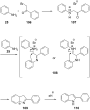
Scheme 75: Synthesis of benzofuran.
Scheme 76: Synthesis of amiodarone.
Scheme 77: Synthesis of raloxifene.
Scheme 78: Alternative access to the benzo[b]thiophene core of raloxifene.
Scheme 79: Gewald reaction in the synthesis of olanzapine.
Scheme 80: Alternative synthesis of olanzapine.
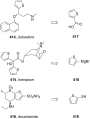
Figure 13: Access to simple thiophene-containing drugs.
Scheme 81: Synthesis of clopidogrel.
Scheme 82: Pictet–Spengler reaction in the preparation of tetrahydrothieno[3,2-c]pyridine (422).
Scheme 83: Alternative synthesis of key intermediate 422.
Figure 14: Co-crystal structures of timolol (left) and carazolol (right) in the β-adrenergic receptor.
Scheme 84: Synthesis of timolol.
Scheme 85: Synthesis of tizanidine 440.
Scheme 86: Synthesis of leflunomide.
Scheme 87: Synthesis of sulfamethoxazole.
Scheme 88: Synthesis of risperidone.
Figure 15: Relative abundance of selected transformations.
Figure 16: The abundance of heterocycles within top 200 drugs (5-membered rings).
Beilstein J. Org. Chem. 2010, 6, 1219–1228, doi:10.3762/bjoc.6.140
Graphical Abstract
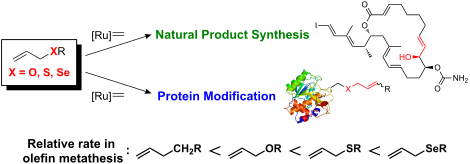
Scheme 1: a) Variation of olefin metathesis: CM = cross-metathesis; RCM = ring-closing metathesis; ROM = ring...
Figure 1: Allylic hydroxy activation in RCM [19].
Figure 2: Possible complexes generated through preassociation of allylic alcohol with ruthenium.
Scheme 2: The influence of different OR groups on ring size-selectivity [21].
Scheme 3: Synthesis of palmerolide A precursors by Nicolaou et al. illustrates enhancement by an allylic hydr...
Scheme 4: a) Acceleration of ring-closing enyne metathesis by the allylic hydroxy group [23]. b) Proposed mode of...
Scheme 5: a) Effect of the hydroxy group on the rate and steroselectivity of ROCM [24]. b) Proposed H-bonded ruth...
Scheme 6: Plausible explanation for chemoselective CM of diene 16 [25].
Scheme 7: a) Efficient cross-metathesis of S-allylcysteine [17]. b) Comparison of relative reactivity between all...
Scheme 8: a) Macrocycle synthesis by carbonyl-relayed RCM. b) Putative complex in carbonyl-relayed RCM [33].
Scheme 9: a) Sulfur assisted cross-metathesis [17]. b) Putative unproductive chelates for larger ring sizes gener...
Scheme 10: Functionalization of Mukaiyama aldol product by CM in aqueous media [37].
Scheme 11: Comparison of reactivity between allyl sulfides and allyl selenides in aqueous cross-metathesis [38].
Scheme 12: Ring-closing metathesis on a protein [18].
Scheme 13: Expanded substrate scope of cross-metathesis on proteins [38].
Beilstein J. Org. Chem. 2010, 6, 1043–1055, doi:10.3762/bjoc.6.119
Graphical Abstract
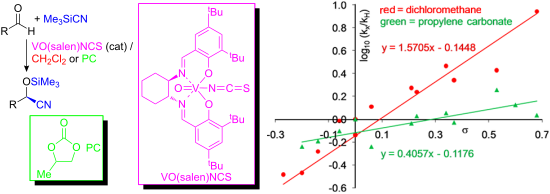
Scheme 1: Synthesis and transformation of nonracemic silyl-protected cyanohydrins.
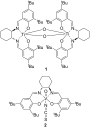
Figure 1: Highly active metal(salen) complexes for asymmetric cyanohydrin synthesis.
Scheme 2: Synthesis of cyclic carbonates.
Scheme 3: Synthesis of cyanohydrin trimethylsilyl ethers and acetates.
Scheme 4: Equilibrium between bimetallic and monometallic Ti(salen) complexes.
Figure 2: Second-order kinetics plot for the addition of TMSCN to benzaldehyde at 0 °C catalysed by complex 2...
Figure 3: Plot of k2obs against [2], showing that the reactions are first order with respect to the concentratio...
Figure 4: Eyring plot to determine the activation parameters for catalyst 2 in propylene carbonate. The red a...
Figure 5: 51V NMR spectra of complex 2 recorded at 50 °C. a) Spectrum in CDCl3; b) spectrum in CDCl3 with 500...
Figure 6: Structures consistent with the 51V NMR spectra.
Figure 7: Bimetallic aluminium(salen) complex for asymmetric cyanohydrin synthesis.
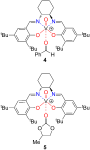
Figure 8: Rate determining transition states for asymmetric cyanohydrin synthesis: a) when Lewis base catalys...
Figure 9: Hammett correlations with catalyst 2 at 0 °C. Data in red are obtained in dichloromethane [52], whilst ...
Beilstein J. Org. Chem. 2009, 5, No. 33, doi:10.3762/bjoc.5.33
Graphical Abstract
Scheme 1: Aziridine containing natural products.
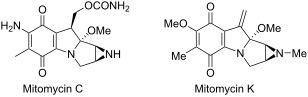
Scheme 2: Mitomycin structures and nomenclature.
Scheme 3: Base catalysed epimerization of mitomycin B.
Scheme 4: Biosynthesis of mitomycin C (MMC) 7.
Scheme 5: Mode of action of mitomycin C.
Scheme 6: The N–C3–C9a disconnection.
Scheme 7: Danishefsky’s Retrosynthesis of mitomycin K.
Scheme 8: Hetero Diels–Alder reaction en route to mitomycins.
Scheme 9: Nitroso Diels–Alder cycloaddition.
Scheme 10: Frank azide cycloadddition.
Scheme 11: Final steps of mitomycin K synthesis. aPDC, DCM; bPhSCH2N3, PhH, 80 °C; cL-selectride, THF, −78 °C; ...
Scheme 12: Naruta–Maruyama retrosynthesis.
Scheme 13: Synthesis of a leucoaziridinomitosane by nitrene cycloaddition. aAlCl3-Et2O; bNaH, ClCH2OMe; cn-BuL...
Scheme 14: Thermal decomposition of azidoquinone 51.
Scheme 15: Diastereoselectivity during the cycloaddition.
Scheme 16: Oxidation with iodo-azide.
Scheme 17: Williams’ approach towards mitomycins.aDEIPSCl, Imidazole, DCM; bPd/C, HCO2NH4, MeOH; cAllocCl, NaH...
Scheme 18: Synthesis of pyrrolidones by homoconjugate addition.
Scheme 19: Homoconjugate addition on the fully functionalized substrate.
Scheme 20: Introduction of the olefin.
Scheme 21: Retrosynthesis of N–C9a, N–C3 bond formation.
Scheme 22: Synthesis of the pyrrolo[1,2]indole 82 using N-PSP activation.aAc2O, Py; bAc2O, Hg(OAc)2, AcOH, 90%...
Scheme 23: Synthesis of an aziridinomitosane. am-CPBA, DCM then iPr2NH, CCl4 reflux; bK2CO3, MeOH; cBnBr, KH; d...
Scheme 24: Oxidation products of a leucoaziridinomitosane obtained from a Polonovski oxidation.
Scheme 25: Polonovski oxidation of an aziridinomitosane. am-CPBA; bPd/C, H2; cDimethoxypropane, PPTS.
Scheme 26: The C1–C9a disconnection.
Scheme 27: Ziegler synthesis of desmethoxymitomycin A.aIm2C=O, THF; bNH3; cTMSOTf, 2,6-di-tert-butylpyridine, ...
Scheme 28: Transformation of sodium erythorbate.aTBDMSCl; bNaN3; cPPh3; d(Boc)2O, DMAP; eTBAF; fTf2O, Pyr.
Scheme 29: Formation of C9,C10-unsaturation in the mitomycins. am-CPBA, DCM; bO3, MeOH; cMe2S; dKHMDS, (EtO)3P...
Scheme 30: Fragmentation mechanism.
Scheme 31: Michael addition-cyclisation.
Scheme 32: SmI2 8-endo-dig cyclisation.
Scheme 33: Synthesis of pyrrolo[1,2-a]indole by 5-exo-dig radical cyclization.
Scheme 34: The C9–C9a disconnection.
Scheme 35: Intramolecular nitrile oxide cycloaddition.
Scheme 36: Regioselectivity of the INOC.
Scheme 37: Fukuyama’s INOC strategy.
Scheme 38: Synthesis of a mitosane core by rearrangement of a 1-(1-pyrrolidinyl)-1,3-butadiene.
Scheme 39: Sulikowski synthesis of an aziridinomitosene. aPd(Tol3P)2Cl2, Bu3SnF, 140; bH2, Pd/C; cTFAA, Et3N; d...
Scheme 40: Enantioselective carbene insertion.
Scheme 41: Parson’s radical cyclization.
Scheme 42: Cha’s mitomycin B core synthesis.
Scheme 43: The N-aromatic disconnection.
Scheme 44: Kishi retrosynthesis.
Scheme 45: Kishi synthesis of a starting material. aallyl bromide, K2CO3, acetone, reflux; bN,N-Dimethylanilin...
Scheme 46: Kishi synthesis of MMC 7. aLDA, THF, −78 °C then PhSeBr, THF, −78 °C; bH2O2, THF-EtOAc; cDIBAL, DCM...
Scheme 47: Acid catalyzed degradation of MMC 7.
Scheme 48: In vivo formation of apomitomycin B.
Scheme 49: Advanced intermediate for apomitomycin B synthesis.
Scheme 50: Remers synthesis of a functionalized mitosene. aTMSCl, Et3N, ZnCl2 then NBS; bAcOK; cNH2OH; dPd/C, H...
Scheme 51: Coleman synthesis of desmethoxymitomycin A. aSnCl2, PhSH, Et3N, CH3CN; bClCO2Bn, Et3N; cPPh3, DIAD,...
Scheme 52: Transition state and pyrrolidine synthesis.
Scheme 53: Air oxidation of mitosanes and aziridinomitosanes.
Scheme 54: The C9-aromatic disconnection.
Scheme 55: Synthesis of the aziridine precursor. aLHMDS, THF; bNaOH; c(s)-α-Me-BnNH2, DCC, HOBT; dDIBAL; eK2CO3...
Scheme 56: Synthesis of 206 via enamine conjugate addition.
Scheme 57: Rapoport synthesis of an aziridinomitosene.
Scheme 58: One pot synthesis of a mitomycin analog.
Scheme 59: Synthesis of compound 218 via intramolecular Heck coupling. aEtMgCl, THF, then 220; bMsCl, Et3N; cN...
Scheme 60: Elaboration of indole 223. aEt3N, Ac2O; bAcOH; cSOCl2, Et3N; dNaN3, DMF; eH2SO4, THF; fK2CO3, MeOH; ...
Scheme 61: C9-C9a functionalization from indole.
Scheme 62: Synthesis of mitomycin K. a2 equiv. MoO5.HMPA, MeOH; bPPh3, Et3N, THF-H2O; cMeOTf, Py, DCM; dMe3SiCH...
Scheme 63: Configurational stability of mitomycin K derivatives.
Scheme 64: Epimerization of carbon C9a in compound 227b.
Scheme 65: Corey–Chaykovsky synthesis of indol 235.
Scheme 66: Cory intramolecular aza-Darzens reaction for the formation of aziridinomitosene 239.
Scheme 67: Jimenez synthesis of aziridinomitosene 242.
Scheme 68: Von Braun opening of indoline 244.
Scheme 69: C9a oxidation of an aziridinomitosane with DDQ/OsO4.
Scheme 70: Synthesis of epi-mitomycin K. aNaH, Me2SO4; bH2, Pd/C; cMitscher reagent [165]; d[(trimethylsilyl)methyl...
Scheme 71: Mitomycins rearrangement.
Scheme 72: Fukuyama’s retrosynthesis.
Scheme 73: [2+3] Cycloaddition en route to isomitomycin A. aToluene, 110 °C; bDIBAL, THF, −78 °C; cAc2O, Py.; d...
Scheme 74: Final steps of Fukuyama’s synthesis.
Scheme 75: “Crisscross annulation”.
Scheme 76: Synthesis of 274; the 8-membered ring 274 was made using a crisscross annulation. a20% Pd(OH)2/C, H2...
Scheme 77: Conformational analysis of compound 273 and 275.
Scheme 78: Synthesis of a mitomycin analog. aNa2S2O4, H2O, DCM; bBnBr (10 equiv), K2CO3, 18-crown-6 (cat.), TH...
Scheme 79: Vedejs retrosynthesis.
Scheme 80: Formation of the azomethine ylide.
Scheme 81: Vedejs second synthesis of an aziridinomitosene. aDIBAL; bTPAP, NMO; c287; dTBSCl, imidazole.
Scheme 82: Trityl deprotection and new aziridine protecting group 300.
Scheme 83: Ene reaction towards benzazocinones.
Scheme 84: Benzazocenols via homo-Brook rearrangement.
Scheme 85: Pt-catalyzed [3+2] cycloaddition.
Scheme 86: Carbonylative lactamization entry to benzazocenols. aZn(OTf)2, (+)-N-methylephedrine, Et3N, TMS-ace...
Scheme 87: 8 membered ring formation by RCM. aBOC2O, NaHCO3; bTBSCl, Imidazole, DMF; callyl bromide, NaH, DMF; ...
Scheme 88: Aziridinomitosene synthesis. aTMSN3; bTFA; cPOCl3, DMF; dNaClO2, NaH2PO4, 2-methyl-2-butene; eMeI, ...
Scheme 89: Metathesis from an indole.
Scheme 90: Synthesis of early biosynthetic intermediates of mitomycins.
Beilstein J. Org. Chem. 2008, 4, No. 31, doi:10.3762/bjoc.4.31
Graphical Abstract
Figure 1: Therapeutic antifungal agents.
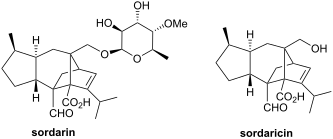
Figure 2: Structure of sordarin (1) and sordaricin (2).
Scheme 1: Kato’s retrosynthetic plan.
Scheme 2: Synthesis of cyclopentadiene 13.
Scheme 3: Synthesis of sordaricin methyl ester.
Scheme 4: Mander’s retrosynthetic plan.
Scheme 5: Synthesis of iodo compound 27.
Scheme 6: Synthesis of sordaricin (2).
Scheme 7: Retrosynthesis of sordarin and sordaricin.
Scheme 8: Synthesis of ketone 43.
Scheme 9: Synthesis of β-keto ethyl ester 45.
Scheme 10: Synthesis of tetracyclic framework 52.
Scheme 11: Synthesis of sordaricin and sordarin.
Figure 3: Modifications of glycosyl part.
Scheme 12: Simplified model of sordarin.
Scheme 13: Synthesis of cyclopentane analog precursors.
Scheme 14: Synthesis of six cyclopentane analogs.
Scheme 15: Retrosynthetic plan of sordarin analog.
Scheme 16: Synthesis of sordarin analog 98.
Scheme 17: Synthesis of sordarin analog 103.