

Search results
Search for "enantiomeric purity" in Full Text gives 79 result(s) in Beilstein Journal of Organic Chemistry.
A convenient allylsilane- N-acyliminium route toward indolizidine and quinolizidine alkaloids
Beilstein J. Org. Chem. 2007, 3, No. 32, doi:10.1186/1860-5397-3-32
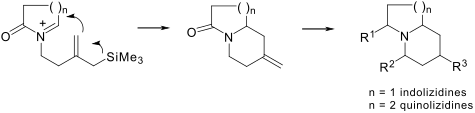
- conditions led to a 7:3 mixture of the two diastereomeric alkaloids (+)-myrtine and (-)-epimyrtine. These alkaloids were obtained in five steps from (S)-2-(2-hydroxypropyl)allylsilane 32 with an overall yield of 23% and a high enantiomeric purity. This synthesis constitutes the first total synthesis of
- cyclisation of N-acyliminium ion (S)-49. (-)-Lasubine I and (-)-lasubine II were obtained in six steps with overall yields of 7 and 14% respectively. (+)-Subcosine was prepared in seven steps with an overall yield of 9%. These three compounds were obtained with high enantiomeric purity. These results


Chiral trimethylsilylated C2- symmetrical diamines as phosphorous derivatizing agents for the determination of the enantiomeric excess of chiral alcohols by 1H NMR
Beilstein J. Org. Chem. 2006, 2, No. 6, doi:10.1186/1860-5397-2-6
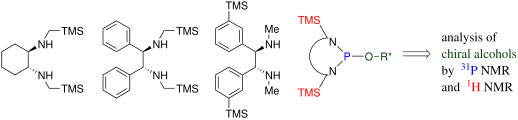
- derivatising agents, prepared from C2 symmetric trimethylsilylated diamines, for the 1H NMR and 31P NMR determination of the enantiomeric composition of chiral alcohols is described. Introduction NMR spectroscopy is one of the most frequently employed methods used for determining the enantiomeric purity of


Stereoselective α-fluoroamide and α-fluoro- γ-lactone synthesis by an asymmetric zwitterionic aza-Claisen rearrangement
Beilstein J. Org. Chem. 2005, 1, No. 13, doi:10.1186/1860-5397-1-13
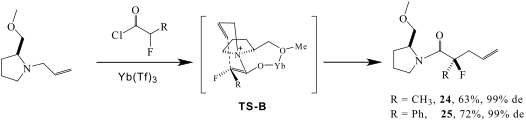
- reagents, either using asymmetric enolates, [3][4] asymmetric fluorinating reagents[5][6] or asymmetric Lewis acids.[7][8][9] Most recently organocatalysis mediated asymmetric fluorinations have been explored[10] and this has resulted in the efficient preparation of α-fluoroaldehydes in high enantiomeric
- purity.[11] Successes in this area has advanced methodology in organofluorine chemistry considerably over the last decade or so.[1][2] In this paper we explore an alternative approach for the preparation of α-fluorocarbonyls using an asymmetric zwitterionic aza-Claisen rearrangement on appropriate


Synthesis of 2,6-trans- disubstituted 5,6-dihydropyrans from (Z)-1,5-syn-endiols
Beilstein J. Org. Chem. 2005, 1, No. 7, doi:10.1186/1860-5397-1-7

- enantiomeric excess of only 25% e.e. while the enantiomeric purity of the starting diol 2a was 91% e.e. This result suggests that the selectivity for displacement of the two hydroxyl groups of 2a is only ca. 2 : 1 under these conditions. Examination of molecular models indicates that in order for the activated


Other Beilstein-Institut Open Science Activities