
Search results
Search for "distribution" in Full Text gives 595 result(s) in Beilstein Journal of Organic Chemistry. Showing first 200.
Catalysing (organo-)catalysis: Trends in the application of machine learning to enantioselective organocatalysis
Beilstein J. Org. Chem. 2024, 20, 2280–2304, doi:10.3762/bjoc.20.196




O,S,Se-containing Biginelli products based on cyclic β-ketosulfone and their postfunctionalization
Beilstein J. Org. Chem. 2024, 20, 2143–2151, doi:10.3762/bjoc.20.184
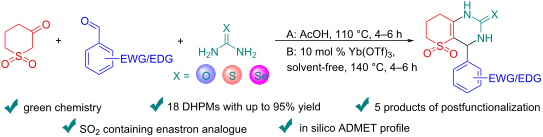
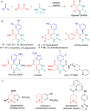
- products and publications as analyzed by Reaxys database. The search was performed using depicted substructures “on all atoms” (May 2024). Distribution of compounds 2a–r, 3–7 (log P (y)–MW (x)) through LLAMA software. The chemical structure of a representative compound 2m is shown. The general Biginelli



Understanding X-ray-induced isomerisation in photoswitchable surfactant assemblies
Beilstein J. Org. Chem. 2024, 20, 2005–2015, doi:10.3762/bjoc.20.176
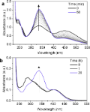
- Gaussian distribution around the (polar) radius to incorporate polydispersity into the model. Data were fitted to the radii (both polar and equatorial for ellipsoidal form factors), shell thickness, scattering length density and length (for cylindrical form factors). The structure factor was fitted using



Allostreptopyrroles A–E, β-alkylpyrrole derivatives from an actinomycete Allostreptomyces sp. RD068384
Beilstein J. Org. Chem. 2024, 20, 1981–1987, doi:10.3762/bjoc.20.174
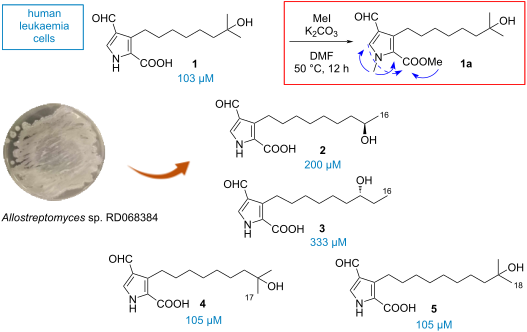
- and 3, their conformational ensembles, datasets of a structure and population of each conformer [25], were determined using a Spartan 24 parallel package conformational search tool (Wavefunction Inc, USA), followed by geometry optimization of the most weighted conformers (Boltzmann distribution weight
- lower to 0.004). Eleven and seven weighted conformers for compounds 2 and 3 were obtained, respectively, each forming equilibrium mixtures. The quantum chemical method for the calculation of conformer distribution was ωB97X-V/6-311+G(2df,2p)[6-311G*] [30]. The CPCM solvation model for methanol was used


Regioselective alkylation of a versatile indazole: Electrophile scope and mechanistic insights from density functional theory calculations
Beilstein J. Org. Chem. 2024, 20, 1940–1954, doi:10.3762/bjoc.20.170
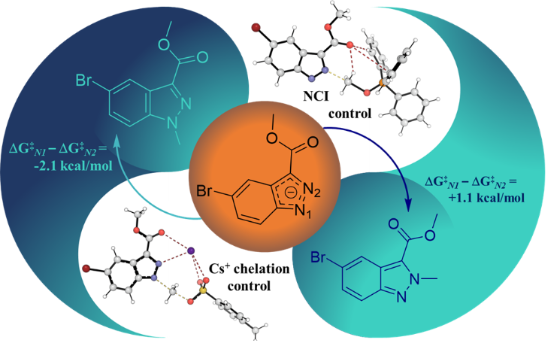
- , implying a 7:1 distribution of isomers in solution. Concerning conditions A, compound 6 + Cs2CO3 was found to favor the deprotonated indazole with a free Cs+ ion by 8.6 kcal/mol (see Figure 3), however, when all ions are discrete (2 × Cs+ and CO32−) the reaction becomes endergonic by 6.9 kcal/mol


Novel oxidative routes to N-arylpyridoindazolium salts
Beilstein J. Org. Chem. 2024, 20, 1906–1913, doi:10.3762/bjoc.20.166
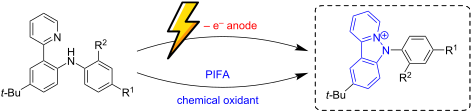
- structures demonstrating the electron density distribution in pyridoindazolium salts. Redox-interconversion between diarylamines A1–A3 and N-arylpyridoindazoliums S1–S3. Electrochemical approach to pyridoindazolium salts. Peak potential values for the reduction of salts S1–S3 (, V) and oxidation of the


Hetero-polycyclic aromatic systems: A data-driven investigation of structure–property relationships
Beilstein J. Org. Chem. 2024, 20, 1817–1830, doi:10.3762/bjoc.20.160
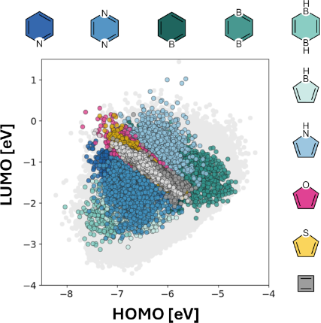
- , and because some of them contain more than one heteroatom, this resulted in an unequal distribution of the heteroatoms themselves. Thus, due to the design of the dataset construction, the relative prevalence is approximately 6:4:1:1 for B:N:O:S. COMPAS-2 comprises two datasets – COMPAS-2x and COMPAS
- demonstrates that increasing the diversity of conjugated cyclic building blocks does not have a notable impact on the relative distribution of molecular shapes. In contrast to their relatively high geometric similarity, the molecular properties of the two datasets vary substantially. We compared the
- distribution of the COMPAS-1 molecules (light blue) is contained within the distribution of the COMPAS-2 molecules (purple). In other words, the expansion of the building block library widens the property distributions towards both higher and lower energies, providing access to functional molecules with



Synthesis of polycyclic aromatic quinones by continuous flow electrochemical oxidation: anodic methoxylation of polycyclic aromatic phenols (PAPs)
Beilstein J. Org. Chem. 2024, 20, 1746–1757, doi:10.3762/bjoc.20.153
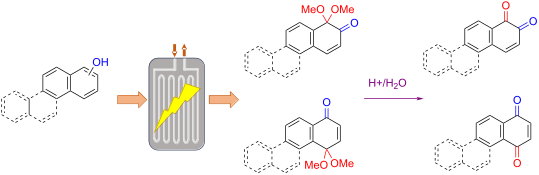
- due to gas bubbles forming at the electrodes, disrupting the even distribution of electric current and potentially affecting the reaction [42][43]. When the size of a bubble is comparable to the width of a microchannel, the bubble tends to remain in the electrochemical cell and inhibits the reaction




A fiber-optic spectroscopic setup for isomerization quantum yield determination
Beilstein J. Org. Chem. 2024, 20, 1684–1692, doi:10.3762/bjoc.20.150
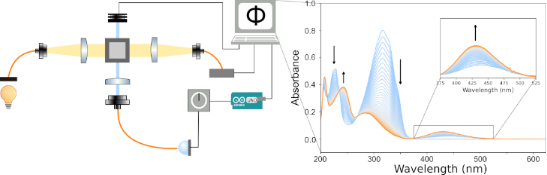
- trans-azobenzene [15]. As the bands of cis- and trans-azobenzene overlap, irradiation results in a photostationary state (PSS) which is a mixture of the isomers. The distribution of the isomers at the PSS differs for irradiations at different wavelengths [16]. Irradiation at 340–350 nm, where the ratio
- with narrow bandwidths, the emission spectrum can be included in the rate equations. This correction is done by multiplying Equation 5 by the spectral distribution f(λ) of the light source and integrating over all wavelengths [45]: where Setup The UV–vis irradiation experiments were performed using a
- we did not find any significant changes between the quantum yields found using the measured emission spectra and the ones provided by the vendor, it is known that small variations in the LED spectral distribution can occur per lot [53]. Conclusion In this work, we report a simple setup for the


Polymer degrading marine Microbulbifer bacteria: an un(der)utilized source of chemical and biocatalytic novelty
Beilstein J. Org. Chem. 2024, 20, 1635–1651, doi:10.3762/bjoc.20.146
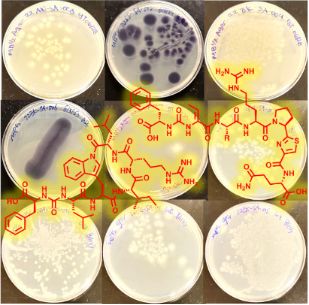
- novelty. In this review, we summarize the distribution of Microbulbifer bacteria, activities of the various polymer degrading enzymes that these bacteria produce, and an up-to-date summary of the natural products that have been isolated from Microbulbifer strains. We argue that these bacteria have been
- between polybrominated phenol biosynthetic enzymes in diverse marine microbial genera will undoubtedly complement the wide distribution of these natural products in the marine metabolome. All marine bacteria discussed in this section are members of commensal or symbiotic microbiomes of marine
- discovery from the Microbulbifer genus. Oceanic distribution and marine holobiont sources of Microbulbifer strains described in the literature. The chemical structure of agarose with the key β-1,4 linkage denoted. The chemical structure of the biopolymer alginate. The chemical structure of chitin. Chemical




Generation of multimillion chemical space based on the parallel Groebke–Blackburn–Bienaymé reaction
Beilstein J. Org. Chem. 2024, 20, 1604–1613, doi:10.3762/bjoc.20.143

- yellow. Distribution of maximal values among pairwise-calculated Tanimoto similarities T (MFP2 fingerprints [46]) of extended Bemis–Murcko scaffolds for the generated chemical space members (5.60 Mln. scaffolds) to the extended Bemis–Murcko scaffolds of A) ChEMBL compounds (v. 33); B) PubChem compounds


Mining raw plant transcriptomic data for new cyclopeptide alkaloids
Beilstein J. Org. Chem. 2024, 20, 1548–1559, doi:10.3762/bjoc.20.138
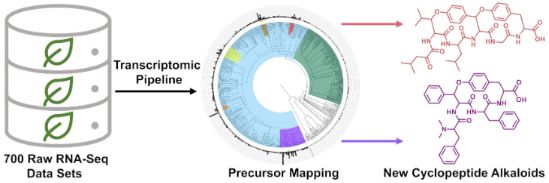
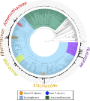
- transcriptomic data sets, we uncover the potential distribution of split burpitide precursor peptides in Streptophyta. Metabolomic analysis of target plants confirms our bioinformatic predictions of new cyclopeptide alkaloids from both known and new sources. Keywords: burpitides; natural products; plants; RiPPs
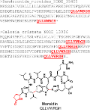
- (HMM) for split burpitide precursor peptides. Using this approach, we assembled 700 transcriptomes and used predicted precursor peptide diversity for target discovery of new cyclopeptide alkaloids. Additionally, metabolomic analysis revealed the tissue distribution of these molecules across select





Bioinformatic prediction of the stereoselectivity of modular polyketide synthase: an update of the sequence motifs in ketoreductase domain
Beilstein J. Org. Chem. 2024, 20, 1476–1485, doi:10.3762/bjoc.20.131
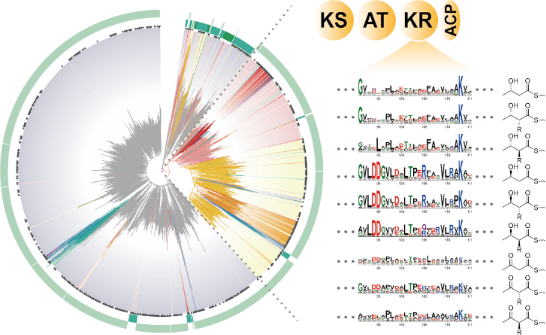
- fingerprint motifs and deduced from product structure identified by chemical methods are shown on the right. (a) Classification and distribution of the collected KR sequences according to host taxonomy, module types, and stereoconfigurations of the product. Here, “EDH” and “ZDH” respectively denote the E


Predicting bond dissociation energies of cyclic hypervalent halogen reagents using DFT calculations and graph attention network model
Beilstein J. Org. Chem. 2024, 20, 1444–1452, doi:10.3762/bjoc.20.127
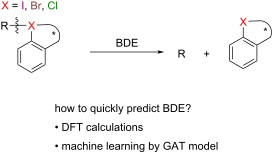
- 209 heterolytic BDE data points. Taking homolytic BDE datasets as an example (Figure 4a), the distribution of this dataset is illustrated with key bond energy values normalized using min–max scaling. This approach ensures both data consistency and improves training efficiency. We used the GAT model as
- halogen skeletons and transfer groups. a) Linear dependence between the homolytic BDEs of cyclic hypervalent halogen reagents; b) linear dependence between the heterolytic BDEs of cyclic hypervalent halogen reagents. a) Composition and distribution of homolytic BDE dataset; b) graph attention network (GAT


Synthesis of cyclic β-1,6-oligosaccharides from glucosamine monomers by electrochemical polyglycosylation
Beilstein J. Org. Chem. 2024, 20, 1421–1427, doi:10.3762/bjoc.20.124
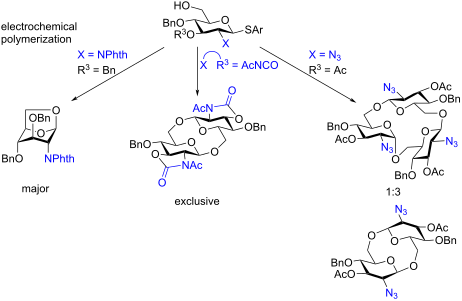
- linear trisaccharide 20b were produced with monomer 17b with a 3,4-di-O-benzyl group (Table 2, entry 2). Although the 3-hydroxy protecting group R3 also affected the product distribution, formation of the corresponding 1,6-anhydrosugars was not observed in both cases. NMR data suggested that cyclic


Synthesis of substituted triazole–pyrazole hybrids using triazenylpyrazole precursors
Beilstein J. Org. Chem. 2024, 20, 1396–1404, doi:10.3762/bjoc.20.121
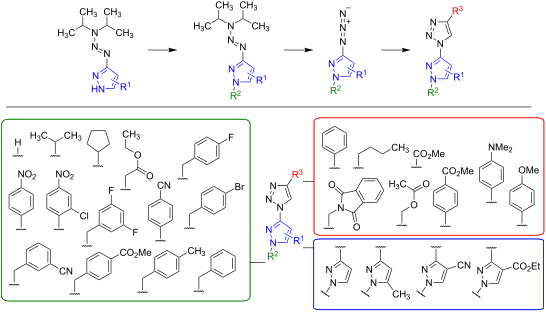
- the pyrazole tautomerism [28], the formation of two possible regioisomers, 17 and 18, was anticipated and could be confirmed experimentally. Depending on the employed halide 16, the distribution of the obtained products varied. A considerable excess of the dominating isomer with yields of up to 70




Computation-guided scaffold exploration of 2E,6E-1,10-trans/cis-eunicellanes
Beilstein J. Org. Chem. 2024, 20, 1320–1326, doi:10.3762/bjoc.20.115

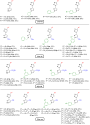
- biosynthetic precursors, the eunicellane skeletons, were identified and isolated. Currently, four different eunicellane skeletons are known: 2E-cis (1), 2E- trans (2), 2Z-cis (3), and 2Z-trans (4). Based on the current distribution of eunicellane diterpenoids isolated, the coral-derived 2Z-cis-eunicellane


Stability trends in carbocation intermediates stemming from germacrene A and hedycaryol
Beilstein J. Org. Chem. 2024, 20, 1189–1197, doi:10.3762/bjoc.20.101
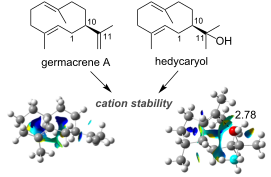
- germacrene A and hedycaryol and how this might affect product distribution in chemical synthesis and biosynthesis. Additionally, we compare the effect of the choice of DFT functional and basis set on the results. Methods The structures of all studied intermediate carbocations originating from germacrene A


Monitoring carbohydrate 3D structure quality with the Privateer database
Beilstein J. Org. Chem. 2024, 20, 931–939, doi:10.3762/bjoc.20.83
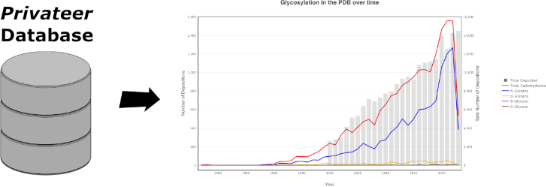
- important facility, especially for novice users. To allow this to happen readily on PDB distribution sites, we present the Privateer database, a freely available, up-to-date collection of validation information for both the PDB and PDB-REDO [21] archives. Results and Discussion Format of the validation


(Bio)isosteres of ortho- and meta-substituted benzenes
Beilstein J. Org. Chem. 2024, 20, 859–890, doi:10.3762/bjoc.20.78
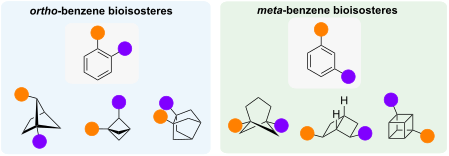
- in exit vector analyses [25]. Here, the geometric relationship between the two substituents is measured and compared to those of the parent benzene. To compare physicochemical properties, the following indicators will generally be used: distribution coefficient (logD, desired range: 1–3 [26]) or
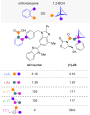
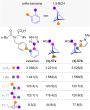
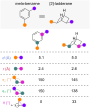
- their physicochemical properties were compared to those of the parent compounds (Figure 3) [26][33]. The reported distribution coefficients (logD) of enantiomeric 1,2-BCPs (+)-21 and (−)-21 are very similar to telmisartan, while the distribution coefficients of the lomitapide isosteres (+)-22 and (−)-22
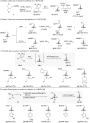
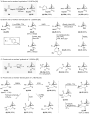
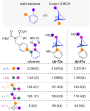
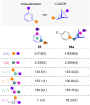
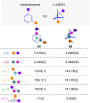
- distribution coefficient (SF logD) and calculated partition coefficient (clogP). This analysis showed while the calculated partition coefficient was reduced by bioisosteric replacement of ortho-benzene the experimental distribution coefficient did not change significantly. However, while aqueous solubility

















Activity assays of NnlA homologs suggest the natural product N-nitroglycine is degraded by diverse bacteria
Beilstein J. Org. Chem. 2024, 20, 830–840, doi:10.3762/bjoc.20.75
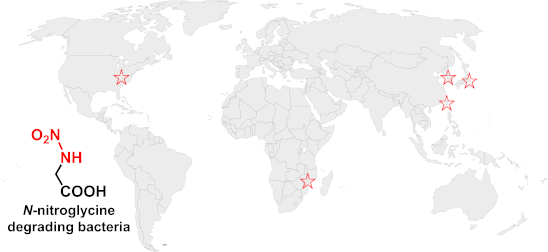
- , the physiological function of its substrate NNG. This compound is one of the few known nitramine natural products and the only one produced by bacteria instead of fungi [22]. Its only known natural sources are strains of Streptomyces bacteria [23][24]. The abundance and distribution of these NNG




Research progress on the pharmacological activity, biosynthetic pathways, and biosynthesis of crocins
Beilstein J. Org. Chem. 2024, 20, 741–752, doi:10.3762/bjoc.20.68
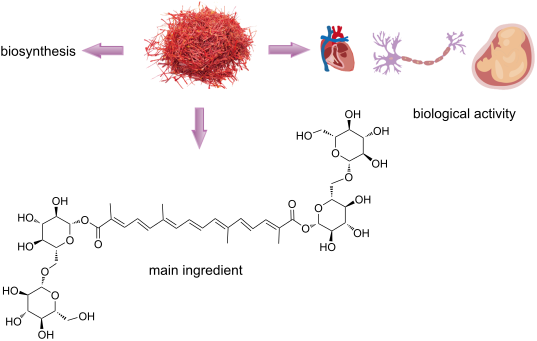
- heterologous production of crocins in microorganisms to break the current bottleneck of a sustainable supply. It provides the basis for the further development of crocins in the food, cosmetic, and pharmaceutical industries. Review Chemical properties and distribution of crocins More than ten crocins have been


Green and sustainable approaches for the Friedel–Crafts reaction between aldehydes and indoles
Beilstein J. Org. Chem. 2024, 20, 379–426, doi:10.3762/bjoc.20.36
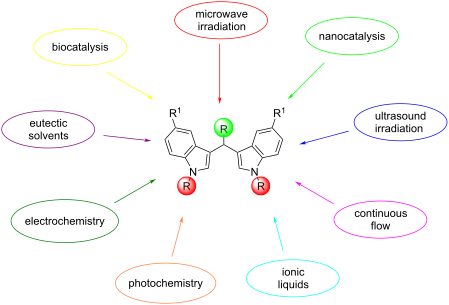
- drugs by halting the growth of brain tumor cells and inhibiting the expression of inflammatory genes [7]. Since they can be administered orally, and they display satisfying distribution to the brain and plasma without leading to serious unwanted side effects, they have entered advanced stages of




Facile approach to N,O,S-heteropentacycles via condensation of sterically crowded 3H-phenoxazin-3-one with ortho-substituted anilines
Beilstein J. Org. Chem. 2024, 20, 336–345, doi:10.3762/bjoc.20.34
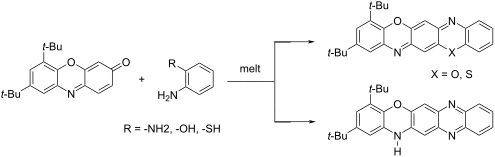
- highly basic amines (Scheme 1) [6]. The choice for one of the other two possible reaction pathways (nucleophilic additions to either the C(1) or C(2) center) critically depends on the electrophilicity. Figure 1 shows the distribution of electronic density in 6,8-di-tert-butyl-3H-phenoxazin-3-one (1
- formation [6]. In turn, without an acidic catalyst, it is driven by the distribution of the electron density (Figure 1), such that the nucleophilic attack occurs at the most electrophilic C(2) center. With this in mind, we presented a convenient procedure for the SNH reaction of aromatic amines with
- -311++G(d,p) level) and distribution of electronic density in 6,8-di-tert-butyl-3H-phenoxazin-3-one (1): Mulliken charges and molecular electrostatic potential (MEP, isovalue = 0.004). Molecular structure of 6,8-di-tert-butyl-2-(o-nitrophenylamino)-3H-phenoxazin-3-one (4f). a) Selected bond distances


Spatial arrangements of cyclodextrin host–guest complexes in solution studied by 13C NMR and molecular modelling
Beilstein J. Org. Chem. 2024, 20, 331–335, doi:10.3762/bjoc.20.33
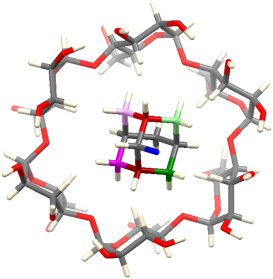
- ten classical molecular dynamics (MD) simulations [16] (each lasting 100 ns, Figure 3). Then, we superimposed α-CD structures from different snapshots of each MD run. Further, the 3D densities, showing the spatial distribution of prochiral atoms of ligands (that rotate and wobble towards α-CD), were
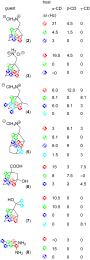
- . The 3D densities show the spatial distribution of prochiral atoms within MD simulations. Studied host–guest complexes and splitting of guests’ prochiral carbons in their 13C NMR spectra. Molecular modelling of the host–guest complexes of compound 4 with α-CD, β-CD and γ-CD. X-ray analysis of the α-CD