

Search results
Search for "diazo compound" in Full Text gives 55 result(s) in Beilstein Journal of Organic Chemistry.
4-Pyridylnitrene and 2-pyrazinylcarbene
Beilstein J. Org. Chem. 2013, 9, 754–760, doi:10.3762/bjoc.9.85
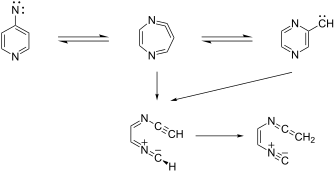
- liquid N2 at −196 °C, or at 2092 cm−1 upon isolation in an Ar matrix at 10 K. The diazo compound is also formed on matrix photolysis of the triazole (Figure 1). Compound 22 can exist as s-Z and s-E conformers. One conformer dominates, absorbing strongly at 2092 cm−1; the other, minor absorption is at
- 2076 cm−1 (Figure 1). Warming the neat diazo compound to ca. −30 °C causes ring closure to triazole 24. Compound 24 can be isolated in up to 20% yield in preparative pyrolysis of 23 [16]. Further FVT of either 23 or 24 at ≥450 °C/10−3 mbar results in the formation of approximately equal amounts of the
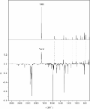
- ) or triazole 24 in an Ar matrix at 7–10 K causes efficient ring expansion to the cyclic seven-membered ring ketenimine 20 as observed by IR spectroscopy (Figure 2). In the case of triazole 24, efficient ring opening to the diazo compound 22 happens first (Figure 1), so the latter is the immediate






Flow photochemistry: Old light through new windows
Beilstein J. Org. Chem. 2012, 8, 2025–2052, doi:10.3762/bjoc.8.229


Continuous flow photolysis of aryl azides: Preparation of 3H-azepinones
Beilstein J. Org. Chem. 2011, 7, 1124–1129, doi:10.3762/bjoc.7.129
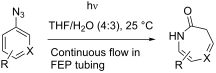
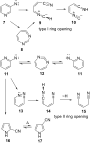
- expansion of 12, via 2H-azirine 3, affords didehydroazepine 4, which can be trapped by variety of nucleophiles to provide the corresponding azepine 5. Alternatively, intersystem crossing (ISC) of 12 gives rise to 32, which can dimerize to form diazo compound 6. Performing the reaction in the presence of


Gold-catalyzed naphthalene functionalization
Beilstein J. Org. Chem. 2011, 7, 653–657, doi:10.3762/bjoc.7.77
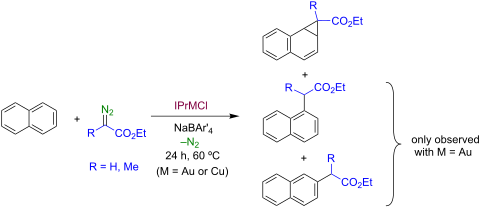
- a 1:1 mixture of IPrMCl (M = Cu, 1a; M = Au, 1b) and NaBAr'4, the diazo compound was consumed after 24 h at 60 °C (no significant reaction was observed at room temperature or at 40 °C). NMR analysis of the crude reaction product revealed that when 1a was used as the catalyst, only one compound was
- selectivity observed is similar to that reported by Müller's group with [Rh2(O2CC3F7)4] (60:22:18) [8]. However, in our case the yield of products (EDA-based) was quantitative: products derived from dimerization of the diazo compound, i.e., diethyl fumarate and maleate, were not detected. The absence of the
- % with respect to the diazo compound). Similarly to the previous results, the fused norcaradiene 3a (Scheme 5) was exclusively and quantitatively formed using the copper catalyst 1a, whilst the use of 1b afforded a mixture of three products in a 60:20:20 ratio. The major product was identified as the 3a


Sequential Au(I)-catalyzed reaction of water with o-acetylenyl-substituted phenyldiazoacetates
Beilstein J. Org. Chem. 2011, 7, 631–637, doi:10.3762/bjoc.7.74
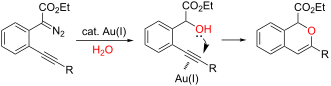
- the reaction of diazo compounds 1e and 1f with water, only 6-endo-dig cyclization products 2e and 2f were isolated as the sole product in yields of 69% and 75%, respectively. Functional groups such as bromo and hydroxy groups were tolerated under the present catalytic systems. When diazo compound 1g
- (R’ = H) was employed as the substrate, none of the cyclization product was detected and the water insertion product 4g was obtained in 81% yield. A tentative mechanism for this gold(I)-catalyzed cascade insertion/cyclization is proposed in Scheme 2. Decomposition of diazo compound 1 by (IPr)AuCl


Other Beilstein-Institut Open Science Activities