

Search results
Search for "carbocycles" in Full Text gives 53 result(s) in Beilstein Journal of Organic Chemistry.
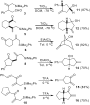
Highly substituted benzannulated cyclooctanol derivatives by samarium diiodide-induced cyclizations
Beilstein J. Org. Chem. 2010, 6, 1229–1245, doi:10.3762/bjoc.6.141
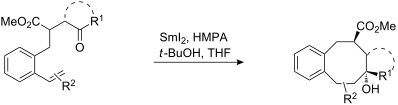
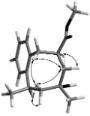
- than those of the analogous eight-membered carbocycles. The configuration of 39 was assigned by using the following arguments: the relative configuration of the unlike-configured precursor should be transferred to the product and the bridgehead hydroxyl group should be in trans-relationship to the




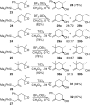
Ring-alkyl connecting group effect on mesogenic properties of p-carborane derivatives and their hydrocarbon analogues
Beilstein J. Org. Chem. 2009, 5, No. 83, doi:10.3762/bjoc.5.83
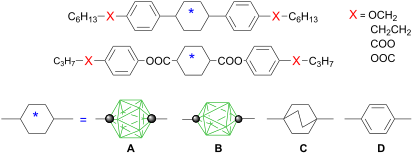
- of structurally related series of mesogens containing rings A–D (Figure 2), it became apparent that the benzene ring–alkyl chain connection has a distinctly different impact on phase stability in derivatives of p-carborane (A) than in their isostructural carbocycles. For instance, a larger
- to analyze the effect of the replacement of an alkoxy in 14[6] with an ester group in 15[6]. The CH2O→OOC exchange dramatically destabilized the nematic phase for the 10- and 12-vertex p-carborane derivatives, while a much smaller effect was observed for the carbocycles [25]. Series 14 and 15 [25
- exclusively the nematic phase. Similar nematic behavior is observed for carbocycles in series 17–20 with the exception of 19D, which exhibits a SmA phase in addition to a N phase. In contrast, most carbocyclic derivatives in series 14[6]–16[6] display only smectic and soft crystalline polymorphs. The bicyclo


Allylsilanes in the synthesis of three to seven membered rings: the silylcuprate strategy
Beilstein J. Org. Chem. 2007, 3, No. 16, doi:10.1186/1860-5397-3-16
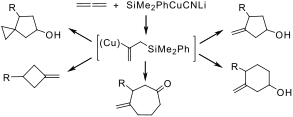
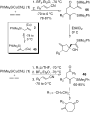
- . Five and Six Membered Carbocycles Phenyldimethylsilylcyanocuprate 1, prepared by mixing one equivalent of phenyldimethylsilyllithium and one equivalent of copper(I) cyanide, reacts with 1,2-propadiene (bubbled from lecture bottles) at -40°C leading to the intermediate copper species 2, which on
- different from that observed for phenyldimethylsilylepoxyallylsilanes of type 23, giving nucleophilic substitution at the most substituted carbon of the epoxide (Scheme 6). [18][19] Three and Four Membered Carbocycles Oxoallylsilanes 4–7, 33 and 34, readily available via silylcuprate addition of 2 to enones
- key step is the syn addition of the tin cuprate to the acetylene, which controls the cis stereochemistry required for cyclization. [23] Seven Membered Carbocycles The use of nitriles and imines as electrophiles in the silylcupration of allene provides new alternatives for carbocyclization. Recently







Other Beilstein-Institut Open Science Activities