

Search results
Search for "azide group" in Full Text gives 55 result(s) in Beilstein Journal of Organic Chemistry.
Functionalization of heterocyclic compounds using polyfunctional magnesium and zinc reagents
Beilstein J. Org. Chem. 2011, 7, 1261–1277, doi:10.3762/bjoc.7.147
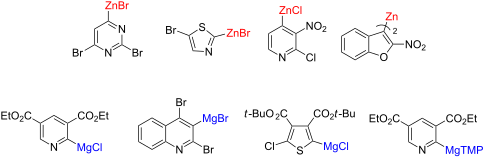
- functionality to an azide group is readily achieved by treating 81 with NaN3/BF3·OEt2-CF3CO2H in CH2Cl2 leading to the aryl azide 82 in 78% yield. Heating of 82 in mesitylene at reflux for 6 h provides ellipticine 83, a potent antitumor agent in 57% yield (Scheme 14) [42]. The structural variations of


Calix[4]arene-click-cyclodextrin and supramolecular structures with watersoluble NIPAAM-copolymers bearing adamantyl units: “Rings on ring on chain”
Beilstein J. Org. Chem. 2010, 6, 784–788, doi:10.3762/bjoc.6.83
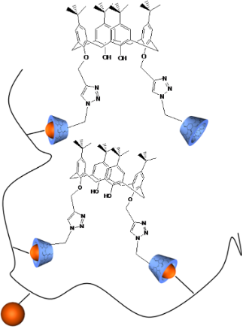
- -dipropargylether-26,28-hydroxy-calix[4]arene (calix[4]arene-1,3-dipropargylether) (2) onto 6I-azido-6I-deoxycyclomaltoheptaose (3) was proven by IR spectroscopy by the disappearance of the bands for the azide group at 2105 cm−1 and for the propargyl group at 2115 cm−1, whilst the formation of the triazole ring was

Synthetic incorporation of Nile Blue into DNA using 2′-deoxyriboside substitutes: Representative comparison of (R)- and (S)-aminopropanediol as an acyclic linker
Beilstein J. Org. Chem. 2010, 6, No. 13, doi:10.3762/bjoc.6.13
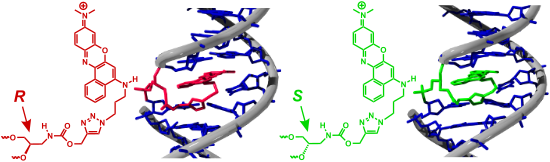
- visible spectrum) for use in “click” conjugation have been reported meanwhile [18]. The dye carrying the azide group was reacted with an alkyne group that was incorporated into the oligonucleotides as a nucleotide substituent. (S)-3-Amino-1,2-propanediol was used as an acyclic linker and substitute for




Functional properties of metallomesogens modulated by molecular and supramolecular exotic arrangements
Beilstein J. Org. Chem. 2009, 5, No. 54, doi:10.3762/bjoc.5.54
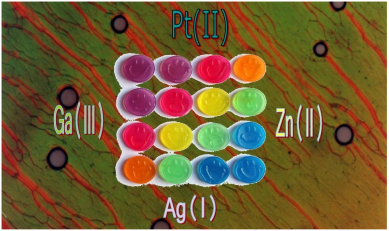
- depend on the size of the X group and on the dipole moment associated with the Pt-X bond, with the sequence, for the clearing points Cl


Acid- mediated reactions under microfluidic conditions: A new strategy for practical synthesis of biofunctional natural products
Beilstein J. Org. Chem. 2009, 5, No. 40, doi:10.3762/bjoc.5.40
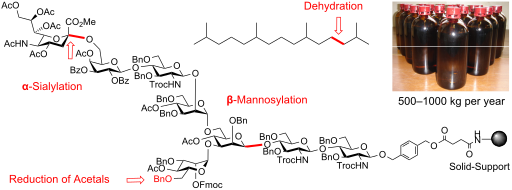
- alternative to the N-phthalyl function, we also employed the C-5 azide group in sialyl donor 1b because this azide group should direct similar “fixed-dipole moment effects”, but should be easier to convert to naturally occurring N-substituents of neuraminic acids, i.e., N-acetyl or N-glycolyl groups (see


Other Beilstein-Institut Open Science Activities