

Search results
Search for "phase-transfer catalysis" in Full Text gives 28 result(s) in Beilstein Journal of Organic Chemistry.
Synthesis of the fluorescent amino acid rac-(7-hydroxycoumarin-4-yl)ethylglycine
Beilstein J. Org. Chem. 2010, 6, No. 69, doi:10.3762/bjoc.6.69
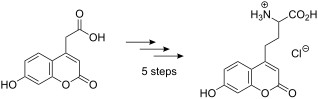
- transfer catalysis [16]. However, only an insignificant enantiomeric excess was observed in the alkylation product 7 when a representative protocol was applied [17]. Finally, the three protecting groups, the tert-butyl ester, the imine, and the silyl ether, were removed in a single step by hydrolysis with
- imine 7 in 67% yield. Under the aprotic conditions of the alkylation protocol, the silyl protecting group turned out to be stable, a fact which facilitated the purification of the imine 7. It is an obvious idea to apply the established protocols for the enantioselective alkylation of ester 6 under phase


Shelf-stable electrophilic trifluoromethylating reagents: A brief historical perspective
Beilstein J. Org. Chem. 2010, 6, No. 65, doi:10.3762/bjoc.6.65
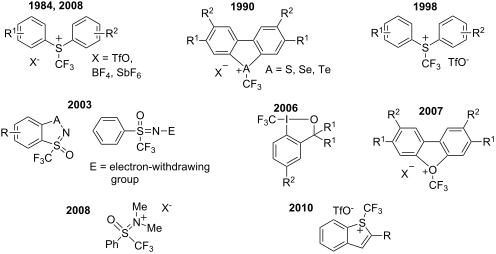
- -nitro esters. In particular, reagent 37 was found to be an effective trifluoromethylating agent. Under phase-transfer catalysis the β-keto esters derived from indanone, tetralone and pentanone in the presence of 37 gave the corresponding trifluoromethylated product in 42–67% yields. The new reagents


Templated versus non-templated synthesis of benzo-21-crown-7 and the influence of substituents on its complexing properties
Beilstein J. Org. Chem. 2010, 6, No. 14, doi:10.3762/bjoc.6.14
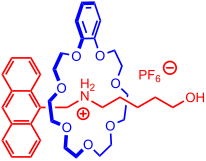
- intramolecular ring closure in the absence of phase-transfer catalysis, we synthesized the monotosylate 1 which is then used in a separate macrocyclization (Scheme 1). Disappointingly, only 24% yield was achieved for the synthesis of C7 from 1. A second fraction of 31% turned out to be a mixture of C7’s bigger


Other Beilstein-Institut Open Science Activities