

Search results
Search for "molecular conformation" in Full Text gives 28 result(s) in Beilstein Journal of Organic Chemistry.
The C–F bond as a conformational tool in organic and biological chemistry
Beilstein J. Org. Chem. 2010, 6, No. 38, doi:10.3762/bjoc.6.38
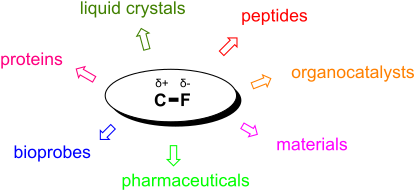
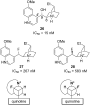
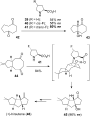
- for medicinal chemists seeking to control the molecular conformation of drugs and bioprobes. This section will show that the C–F bond is also emerging as a useful tool in the field of catalysis. Recent reports have shown that organocatalysts can be conformationally “fine-tuned” by fluorine
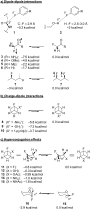
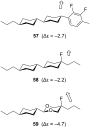
- moment in addition to reinforcing the molecular conformation with two F–C–C–O gauche alignments [41]. With a developing knowledge of the behaviour of multi-vicinal fluoroalkanes it has been possible to develop new liquid crystals containing several fluorine atoms, in which the fluorine atoms affect the
- molecular conformation as well as the molecular dipole moment. The difluoro compound 60 (Figure 15) can be viewed as a conceptual progression from the axially fluorinated liquid crystal 58. NMR and modelling data show that the fluoroalkyl chain of 60 adopts a zigzag conformation in which the two C–F bonds









Trifluoromethyl ethers – synthesis and properties of an unusual substituent
Beilstein J. Org. Chem. 2008, 4, No. 13, doi:10.3762/bjoc.4.13

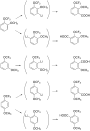
- carbon-oxygen bond may decrease by almost one tenth of an Å (Table 6). A fluorine substituent can lead to a change in the preferred molecular conformation. For example, methoxybenzenes without ortho substituents favor a planar conformation. However, Roche researchers by searching trifluoromethoxybenzenes




Molecular recognition. 1. Crystal structures of hexaazamacrocyclic amines containing p-xylylene spacers and their adducts with acids
Beilstein J. Org. Chem. 2005, 1, No. 16, doi:10.1186/1860-5397-1-16
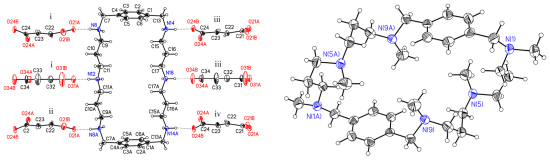
- isolated centrosymmetric molecules. The molecular conformation together with the atom labeling scheme is shown in Figure 4. The overall conformation of the molecule is ellipsoidal with the approximate dimensions of 6.2 and 15.3 Å. All atoms of the molecule (except hydrogens) are within 2.16 Å of the mean
- height of one sheet corresponds to the height of the macrocycle, i.e. about 12 Å. The molecular conformation of 1-N-Me, atom labeling scheme indicated. Displacement parameters are drawn at 50% probability level. The unit cell of 1-N-Me, stacks of molecules are indicated. Formulas of macrocyclic amines, 1


Other Beilstein-Institut Open Science Activities