

Search results
Search for "isoxazolines" in Full Text gives 27 result(s) in Beilstein Journal of Organic Chemistry.
Synthesis of highly functionalized β-aminocyclopentanecarboxylate stereoisomers by reductive ring opening reaction of isoxazolines
Beilstein J. Org. Chem. 2012, 8, 100–106, doi:10.3762/bjoc.8.10
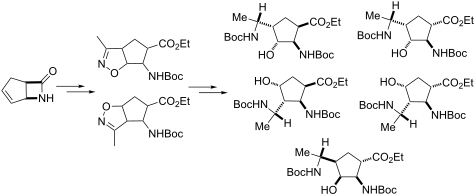
- opening of the isoxazoline reductive ring to the corresponding highly functionalized 2-aminocyclopentanecarboxylates occurred stereoselectively with good yields. Keywords: amino acids; cycloaddition; functionalization; isoxazolines; reduction; Introduction Isoxazoline-fused amino acids are important
- bioactive derivatives in organic and medicinal chemistry (e.g., conformationally restricted aspartate and glutamate analogues) [1][2][3][4][5][6]. As a consequence of their ability to undergo reductive ring opening, isoxazolines are of interest as precursors for the synthesis of highly functionalized


Gold-catalyzed propargylic substitutions: Scope and synthetic developments
Beilstein J. Org. Chem. 2011, 7, 866–877, doi:10.3762/bjoc.7.99

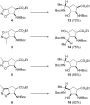
- substitutions on propargylic (allylic, benzylic) alcohols, with various nucleophiles (and bi-nucleophiles) based on the σ- and/or π-acidity of gold(III) complexes. Synthetic developments are also briefly described. Keywords: direct substitutions; gold; isoxazolines; propargylic substitutions; Introduction In
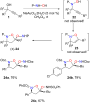
- determination on compound 24b [63]. Efforts to regenerate isoxazolines 23a from 24a by acidic treatment, under various conditions, were unsuccessful in our hands. Notably, in the presence of 37% aqueous HCl in refluxing methanol, the transacetalized product 25 was isolated in 68% yield (Scheme 13). The desired
- isoxazolines cannot be directly obtained from propargylic alcohols 1 in the presence of gold(III) catalysts. From these preliminary experiments, it appears that the addition of hydroxylamine to the isoxazoline double bond is much faster than propargylic substitution. Consequently, the only possibility to




Other Beilstein-Institut Open Science Activities