

Search results
Search for "hydroperoxides" in Full Text gives 29 result(s) in Beilstein Journal of Organic Chemistry.
Copper-catalyzed aerobic aliphatic C–H oxygenation with hydroperoxides
Beilstein J. Org. Chem. 2013, 9, 1217–1225, doi:10.3762/bjoc.9.138

- aerobic oxygenation of aliphatic C–H bonds with hydroperoxides, which proceeds by 1,5-H radical shift of putative oxygen-centered radicals (O-radicals) derived from hydroperoxides followed by trapping of the resulting carbon-centered radicals with molecular oxygen. Keywords: copper; 1,4-diols; free
- radical; 1,5-H radical shift; hydroperoxides; molecular oxygen; Introduction Aliphatic sp3 C–H bonds are ubiquitous components in organic molecules but rather inert towards most of the chemical reactions. It thus remains as one of the most challenging topics in organic synthesis to develop catalytic
- envision employing hydroperoxides as precursors for O-radicals in the presence of Cu salts. The lower valent Cu(I) species could potentially undergo single-electron reduction of hydroperoxides to produce the corresponding O-radicals [10][11][12][13]. Ball recently reported CuCl-catalyzed aliphatic C–H


Triple-channel microreactor for biphasic gas–liquid reactions: Photosensitized oxygenations
Beilstein J. Org. Chem. 2011, 7, 1158–1163, doi:10.3762/bjoc.7.134
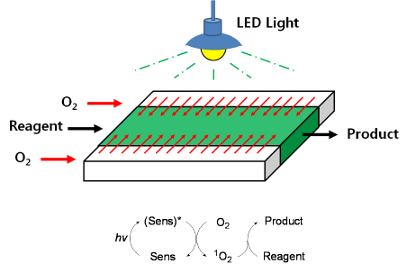
- illumination homogeniety of the microreactor also plays an important role. These factors make the triple-channel microreactor quite promising for photosensitized oxygenation reactions. The ratio of hydroperoxides 2 and 3 were found to be identical (1:1.5 as determined by 1 H NMR) in both the microreactor and


Synthesis of spiroannulated and 3-arylated 1,2,4-trioxanes from mesitylol and methyl 4-hydroxytiglate by photooxygenation and peroxyacetalization
Beilstein J. Org. Chem. 2010, 6, No. 61, doi:10.3762/bjoc.6.61
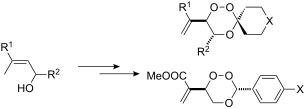
- sensitization of triplet oxygen with meso-tetraphenylporphyrin (TPP) were performed in polystyrene beads under solvent-free conditions (Scheme 1) [18][19]. Numerous applications of the hydroperoxides 4 and 7, that result from the singlet oxygen ene reactions, have already been reported [20][21]. In context with


The Elbs and Boyland- Sims peroxydisulfate oxidations
Beilstein J. Org. Chem. 2006, 2, No. 22, doi:10.1186/1860-5397-2-22
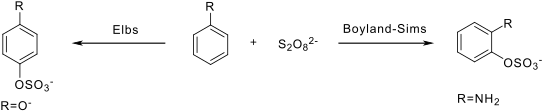
- which depends on the fact that aryl hydroperoxides are rather unstable and decompose rapidly to phenols unless electron-withdrawing elements are present in the structure. Note that the last equation in Scheme 8 is left unbalanced because the oxidized products of Elbs and Boyland-Sims reactions are
- hydroperoxide forms p-nitrophenol on decomposition. Similarly, Malykhin and Shteingarts found naphthols as products from the reaction of potassium peroxide with several nitronaphthalenes. [19] These findings are then consistent with the hypothesis that aryl hydroperoxides formed by reaction of arylphenoxide


Other Beilstein-Institut Open Science Activities