

Search results
Search for "NMR data" in Full Text gives 500 result(s) in Beilstein Journal of Organic Chemistry. Showing first 200.
Studies on the syntheses of β-carboline alkaloids brevicarine and brevicolline
Beilstein J. Org. Chem. 2025, 21, 955–963, doi:10.3762/bjoc.21.79
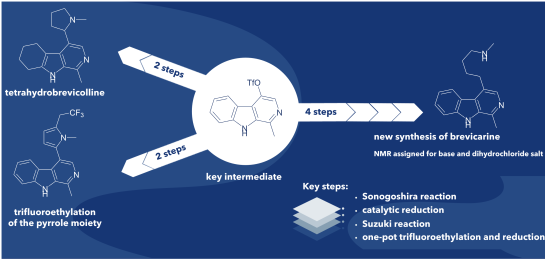
- brevicarine (2, isolated as its dihydrochloride salt). Based on the above results, Eschweiler–Clarke methylation of primary amine 25 was applied for the synthesis of N-methylbrevicarine (27) [39], a close structural analogue of alkaloid 2. The NMR data of our synthesized brevicarine (2) base and
- publications [19][23][24] confirmed the structure with IR and MS data, or by reactivity. Herein, we report the full set of assigned 1H and 13C NMR data for both the base and the dihydrochloride salt. In the course of our efforts devoted to elaborating a new and efficient synthesis of brevicarine (2), we
- has been elaborated rendering the preparation of larger amounts of the target compound possible. NMR data of brevicarine base and dihydrochloride salt were fully assigned for a further confirmation of their structure. In the course of the unsuccessful attempts for a new synthesis of brevicolline, we


Data accessibility in the chemical sciences: an analysis of recent practice in organic chemistry journals
Beilstein J. Org. Chem. 2025, 21, 864–876, doi:10.3762/bjoc.21.70

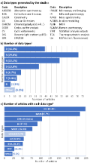
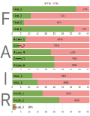
- NMR data by some journals supports author compliance. We find that, although authors meet mandated requirements, there is very limited compliance with data sharing policies that are only recommended by journals. Overall, there is little evidence to suggest that authors’ publishing practice meets FAIR
- identifiers for all reported compounds. Keywords: data availability; FAIR principles; journal guidelines; NMR data; organic chemistry; Introduction Fundamental to science is the ability of researchers to build upon the findings of others. Scientific data are no longer perceived as simply an output of
- ’ deposition in open repositories, and are these data accessible and curated? Is there evidence to suggest that authors apply FAIR data guidance? Does the existence of specific recommendations for FAIR data practice in publishing NMR data by some journals encourage compliance? Finally, we discuss what the





Semisynthetic derivatives of massarilactone D with cytotoxic and nematicidal activities
Beilstein J. Org. Chem. 2025, 21, 607–615, doi:10.3762/bjoc.21.48
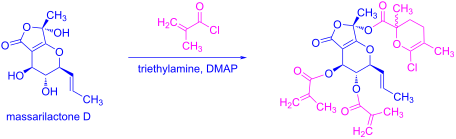
- m/z 347.1098 [M + Na]+ and 671.2314 [2M + Na]+ corresponding to the molecular formula C16H20O7 (calcd. for C16H20O7Na+: 347.1101). The NMR data of compound 6 showed the presence of a trans-2-methyl-2-butenoyl moiety when compared to those of the parent compound [24]. This was revealed by proton


New tandem Ugi/intramolecular Diels–Alder reaction based on vinylfuran and 1,3-butadienylfuran derivatives
Beilstein J. Org. Chem. 2025, 21, 444–450, doi:10.3762/bjoc.21.31
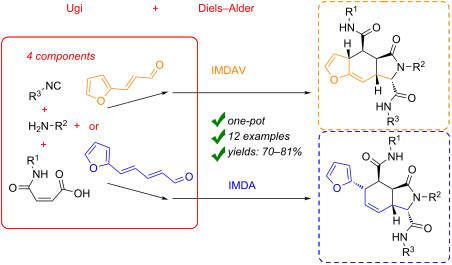
- products were identified via NMR as 4,4a,5,6,7,7a-hexahydro-3aH-furo[2,3-f]isoindoles. The structures of compounds 5 were confirmed by NMR spectroscopy data (for details and discussion see Supporting Information File 1). The NMR data for the obtained furoindole skeleton signals and spin-coupling constants




The effect of neighbouring group participation and possible long range remote group participation in O-glycosylation
Beilstein J. Org. Chem. 2025, 21, 369–406, doi:10.3762/bjoc.21.27
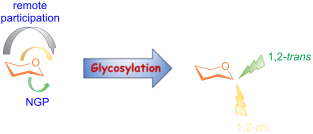
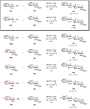
- supported by NMR data showing the formation of the respective intermediates. Previously, this stabilisation of a similar α-glycosyl intermediate had been successfully implemented by Crich et al. leading to high β-selectivity in challenging mannose and rhamnose moieties [37]. The moderate yield and β




Synthesis, structure, ionochromic and cytotoxic properties of new 2-(indolin-2-yl)-1,3-tropolones
Beilstein J. Org. Chem. 2025, 21, 358–368, doi:10.3762/bjoc.21.26
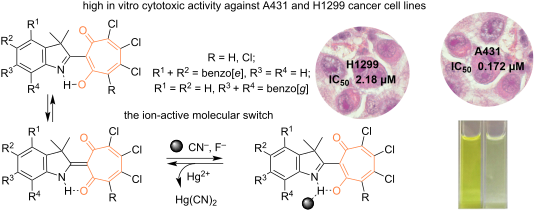
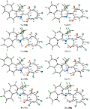
- large Stokes shift values (Table 2, Figure 5). This is consistent with the above conclusion about the existence of tautomeric equilibrium 7,8 (OH)–7,8 (NH) in solutions based on NMR data and DFT quantum chemical calculations (Scheme 2). The emission with a larger Stokes shift appears to correspond to




Antibiofilm and cytotoxic metabolites from the entomopathogenic fungus Samsoniella aurantia
Beilstein J. Org. Chem. 2025, 21, 327–339, doi:10.3762/bjoc.21.23
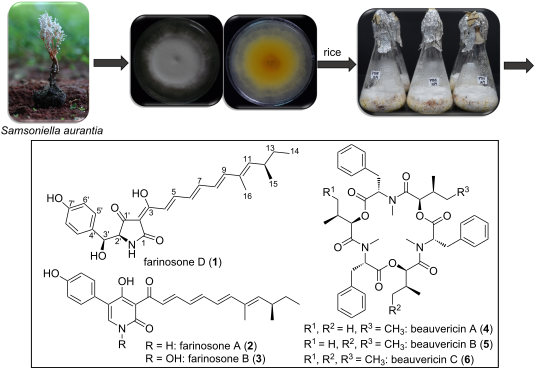
- that it is a related derivative to two yellow pyridone pigments, farinosones A and B, that were previously reported from Cordyceps farinosa syn. Paecilomyces farinosus [8][9]. A detailed comparison of the 1H and 13C NMR data of 1 and farinosones A/B revealed that instead of a deshielded pyridone
- ), 300 (0.5), 265 (0.6) 218 (2.4); NMR data (1H: 500 MHz, 13C: 125 MHz, DMSO-d6) see Table 1; HRESIMS m/z: [M – H2O + H]+ calcd for C25H28NO4+, 406.2026; found, 406.2020; [M + H]+ calcd for C25H30NO5+, 424.2118; found, 424.2126; [M + Na]+ calcd for C25H29NNaO5+, 446.1962; found, 446.1947. Farinosone A (2
- ): Pale yellow amorphous solid; UV–vis (MeOH) λmax: 368, 224, 200 nm; NMR data (1H: 500 MHz, 13C: 125 MHz, acetone-d6) comparable to the previously described spectral data [8]; HRESIMS m/z: [M + H]+ calcd for C25H28NO4+, 406.2103; found, 406.2103. Farinosone B (3): Bright yellow powder; UV–vis (MeOH) λmax


Ceratinadin G, a new psammaplysin derivative possessing a cyano group from a sponge of the genus Pseudoceratina
Beilstein J. Org. Chem. 2024, 20, 3215–3220, doi:10.3762/bjoc.20.267
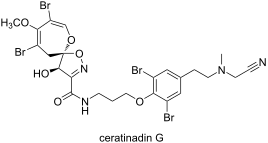
- (partial structures a and b, respectively, in Figure 2), which were characteristic of psammaplysins, in ceratinadin G (1) was suggested by comparison of its 1H and 13C NMR data with those of known psammaplysin derivatives such as psammaplysins A and F (2) [4][5][6][10][11][12]. HMBC correlations (H-1/C-2
- 28138) and 258 (ε 10233); IR (film/KBr) νmax: 3337, 2935, 2878, 2849, 2234 (weak), 1671, 1624, 1595, 1542, 1457, 1257, 1199, 1145, 1119, 1046, 954, 898, 738 cm−1; ECD (MeOH) λmax, nm: 211 (Δε −15.84), 239 (Δε 7.99), 281 (Δε 0.07); 1H and 13C NMR data (Table 1); HRESIMS (m/z): [M + Na]+ calcd for
- of ceratinadin G (1) and psammaplysin F (2). Selected 2D NMR correlations for ceratinadin G (1). ECD spectra of ceratinadin G (1) and psammaplysin F (2) in MeOH. 1H and 13C NMR data of ceratinadin G (1) in methanol-d4. Supporting Information Supporting Information File 46: 1H NMR, 13C NMR, 1H-1H


Discovery of ianthelliformisamines D–G from the sponge Suberea ianthelliformis and the total synthesis of ianthelliformisamine D
Beilstein J. Org. Chem. 2024, 20, 3205–3214, doi:10.3762/bjoc.20.266
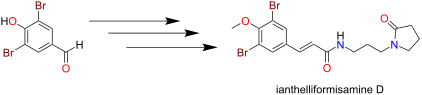
- C17H22Br2N2O4. Ianthelliformisamine F (6) was isolated as a stable brown gum. The LRESIMS of 6 indicated the presence of two bromine atoms due to a 1:2:1 ion cluster at m/z 334/336/338 [M + H]+, whilst the HRESIMS data enabled a molecular formula of C10H9Br2NO2 to be assigned. Comparison of the 1D NMR data of 6
- commercially available primary amine, 1-(3-aminopropyl)pyrrolidin-2-one completed the total synthesis of the natural product in an overall yield of 1.5%. The NMR data comparison of the natural product and our synthetic compound was essentially identical. Due to our interest in the identification of potential
- sufficient quantities of the minor natural products for characterisation and biological assessment with similar recoveries obtained. Ianthelliformisamine D (4): Stable brown gum; UV (MeOH) λmax, nm (log ε): 226 (4.01), 278 (3.86); 1H and 13C NMR data (DMSO-d6), see Table 1; LRESIMS (m/z): 459/461/463 [M + H


![[Graphic 1]](/bjoc/content/inline/1860-5397-20-266-i2.svg?max-width=637&scale=1.18182)
![[Graphic 2]](/bjoc/content/inline/1860-5397-20-266-i3.svg?max-width=637&scale=1.18182)
![[Graphic 3]](/bjoc/content/inline/1860-5397-20-266-i4.svg?max-width=637&scale=1.18182)

![[Graphic 4]](/bjoc/content/inline/1860-5397-20-266-i5.svg?max-width=637&scale=1.18182)
![[Graphic 5]](/bjoc/content/inline/1860-5397-20-266-i6.svg?max-width=637&scale=1.18182)

The scent gland composition of the Mangshan pit viper, Protobothrops mangshanensis
Beilstein J. Org. Chem. 2024, 20, 2644–2654, doi:10.3762/bjoc.20.222
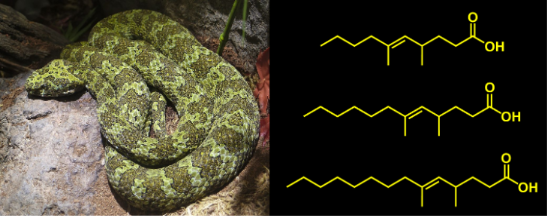
- pentane and diethyl ether (100:2) and obtained as a 1:1 mixture of diastereomers. This was followed by silver nitrate column chromatography using pentane and ethyl acetate (97.5:2.5) to enrich one diastereomer (de(E) = 50%). The NMR data were in agreement with published values [31]. Colorless oil: 15 mg


Synthesis and cytotoxicity studies of novel N-arylbenzo[h]quinazolin-2-amines
Beilstein J. Org. Chem. 2024, 20, 2592–2598, doi:10.3762/bjoc.20.218
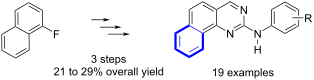
- reduced pressure to afford crude compound 2 as pale-yellow solid (65% yield). Its NMR data are in agreement with literature [5]. 1H NMR (400 MHz, DMSO-d6, δ ppm) 10.49 (s, 1H), 8.26 (d, J = 8.4 Hz, 1H), 8.10 (d, J = 8.0 Hz, 1H), 7.90 (d, J = 8.8 Hz, 1H), 7.84–7.74 (m, 3H). Step 2: Synthesis of benzo[h


Hypervalent iodine-mediated cyclization of bishomoallylamides to prolinols
Beilstein J. Org. Chem. 2024, 20, 2455–2460, doi:10.3762/bjoc.20.209
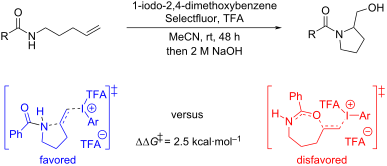
- benzoyl group on the nitrogen atom preventing equilibration to the thermodynamic piperidine product [21]. Basic workup hydrolyzes the trifluoroacetoxy ester in 14 to alcohol 7a. Consideration of the literature NMR data for the three possible isomeric products (i.e., pyrrolidine, piperidine, and


Hydrogen-bond activation enables aziridination of unactivated olefins with simple iminoiodinanes
Beilstein J. Org. Chem. 2024, 20, 2305–2312, doi:10.3762/bjoc.20.197
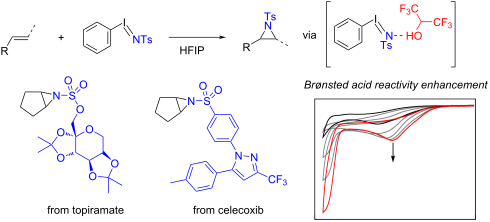
- aliphatic olefins in the absence of transition metal catalysts, the addition of HFIP enables direct aziridination to be observed. The enhanced reactivity is rationalized as resulting from H-bonding between HFIP and the nitrogen center of the iminoiodinane reagents. 1H NMR data are consistent with such an


Natural resorcylic lactones derived from alternariol
Beilstein J. Org. Chem. 2024, 20, 2171–2207, doi:10.3762/bjoc.20.187
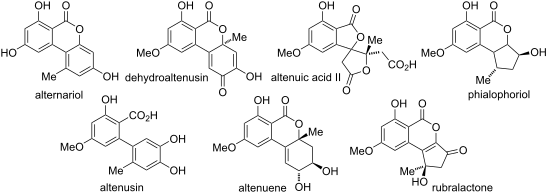
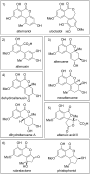
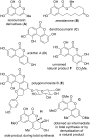
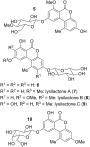
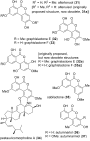
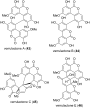
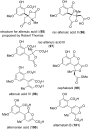
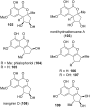
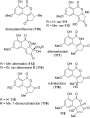
- on NMR-spectroscopic investigations but turned out to be wrong, when the spectroscopic data were compared with those of synthesized material. Re-evaluation of the NMR data and total synthesis of assumed correct structures revealed revised constitutions, which are given in Figure 10 [44]. No
- . alternata) [42][54]. Its structure was proposed based on NMR-spectroscopic investigations [222] and unambiguously confirmed after total syntheses and comparison of NMR data [217][223][224]. Altenusin was further isolated from A. longipes [60] and further non-specified A. spp. [147][216][225][226], from










Allostreptopyrroles A–E, β-alkylpyrrole derivatives from an actinomycete Allostreptomyces sp. RD068384
Beilstein J. Org. Chem. 2024, 20, 1981–1987, doi:10.3762/bjoc.20.174
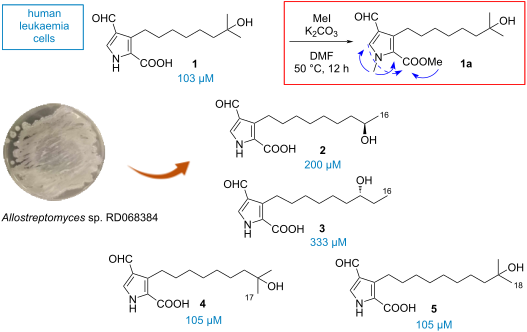
- total 6.5 mg of 1, 3.1 mg of 2, 2.6 mg of 3, 7.2 mg of 4, and 5.6 mg of 5 from 12 L culture. Allostreptopyrrole A (1): greenish yellow amorphous solid; UV (MeOH) λmax nm (log ε) 234 (3.86), 273 sh (3.44); IR (ATR) νmax: 3275, 2964, 2928, 2855, 1658, 1554, 1418 cm−1; 1H and 13C NMR data, see Table 1
- ; HRESITOFMS (m/z): [M – H]– calcd for C15H22NO4, 280.1554; found, 280.1550. Allostreptopyrrole B (2): greenish yellow amorphous solid; +15 (c 0.10, MeOH); UV (MeOH) λmax, nm (log ε): 235 (3.87), 273 sh (3.49); IR (ATR) νmax: 3263, 2964, 2925, 2854, 1658, 1556, 1417 cm−1; 1H and 13C NMR data, see Table 2
- ; HRESITOFMS (m/z): [M – H]– calcd for C15H22NO4, 280.1554; found, 280.1554. Allostreptopyrrole C (3): greenish yellow amorphous solid; −6.1 (c 0.10, MeOH); UV (MeOH) λmax, nm (log ε): 235 (3.82), 276 sh (3.46); IR (ATR) νmax: 3265, 2925, 2856, 1657, 1555, 1417 cm−1; 1H and 13C NMR data, see Table 2


1,2-Difluoroethylene (HFO-1132): synthesis and chemistry
Beilstein J. Org. Chem. 2024, 20, 1955–1966, doi:10.3762/bjoc.20.171
- ], respectively, while reference [68] provides UV-spectral data of both isomers. 1H, 19F, and 13C NMR data [69][70] are given in Table 2. Chemistry of HFO-1132 Isomerization Iodine-catalyzed cis–trans isomerization of 1,2-difluoroethylene and corresponding equilibrium measurements were described in the 1960s [47


Novel oxidative routes to N-arylpyridoindazolium salts
Beilstein J. Org. Chem. 2024, 20, 1906–1913, doi:10.3762/bjoc.20.166
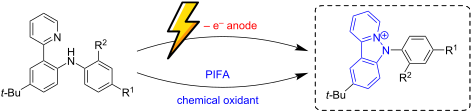
- -arylpyridoindazolium salts S1–S3 was confirmed with HRMS and 1H, 13C and 19F NMR data; the complete assignment of the signals was performed using 2D NMR methods. The N–N bond formation was additionally confirmed via comparison of the 1H spectra for the salts and their diarylamine precursors. The absence of the signals


Towards an asymmetric β-selective addition of azlactones to allenoates
Beilstein J. Org. Chem. 2024, 20, 1504–1509, doi:10.3762/bjoc.20.134
- NMR and δ 77.16 ppm for 13C NMR). NMR data are reported as follows: chemical shift (δ ppm), multiplicity (s = singlet, d = doublet, t = triplet, q = quartet, m = multiplet, dd = doublet of doublet), coupling constants (Hz), relative integration value. High-resolution mass spectra were obtained using a


Synthesis of 2-benzyl N-substituted anilines via imine condensation–isoaromatization of (E)-2-arylidene-3-cyclohexenones and primary amines
Beilstein J. Org. Chem. 2024, 20, 1468–1475, doi:10.3762/bjoc.20.130
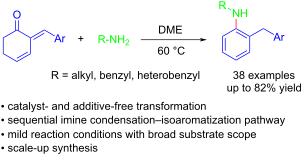
- -cyclohexenone. This is further supported by the 13C NMR spectrum, which contains two peaks at δ = 38.4 and 47.7 indicating the two types of benzylic carbons. The NMR data of known compound 4ab were also in good correlation with previously reported data [19]. The synthetic practicability of the protocol was



Synthesis of cyclic β-1,6-oligosaccharides from glucosamine monomers by electrochemical polyglycosylation
Beilstein J. Org. Chem. 2024, 20, 1421–1427, doi:10.3762/bjoc.20.124
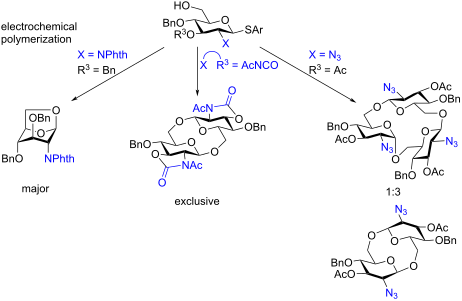
- linear trisaccharide 20b were produced with monomer 17b with a 3,4-di-O-benzyl group (Table 2, entry 2). Although the 3-hydroxy protecting group R3 also affected the product distribution, formation of the corresponding 1,6-anhydrosugars was not observed in both cases. NMR data suggested that cyclic


Computation-guided scaffold exploration of 2E,6E-1,10-trans/cis-eunicellanes
Beilstein J. Org. Chem. 2024, 20, 1320–1326, doi:10.3762/bjoc.20.115

- collected NMR data of 1 in chloroform [5], but when we dissolved 2 in chloroform for NMR, it cyclized into two 6/6/6-tricyclic diterpenes (5 and 6) [7]. We discovered that 2 was much more sensitive to acid than 1 and eventually took advantage of its reactivity to determine its absolute configuration [7


Competing electrophilic substitution and oxidative polymerization of arylamines with selenium dioxide
Beilstein J. Org. Chem. 2024, 20, 1221–1235, doi:10.3762/bjoc.20.105
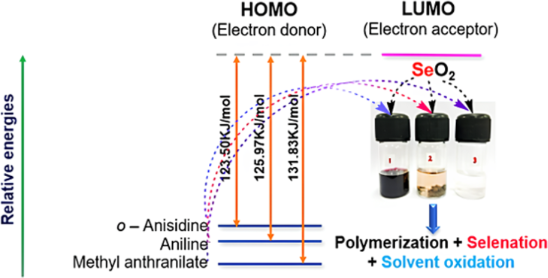
- based on HRMS data. To test whether the isolated black solid was a single compound or an isomeric mixture of compounds 1 and 2, 77Se NMR spectroscopy could be a convenient tool. Unfortunately, 77Se NMR data was not reported in the work of Bhat et al. [37]. With this question in mind, the reaction was


Three-component N-alkenylation of azoles with alkynes and iodine(III) electrophile: synthesis of multisubstituted N-vinylazoles
Beilstein J. Org. Chem. 2024, 20, 891–897, doi:10.3762/bjoc.20.79
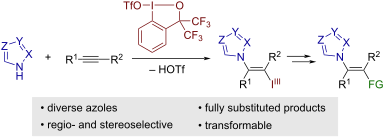
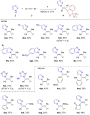
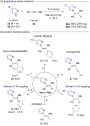
- oxazolidinone-substituted ynamide also proved to undergo iodo(III)azolation in a regio- and stereoselective fashion to give the product 4ai in a moderate yield. Note that terminal alkynes such as phenylacetylene also took part in the reaction, albeit in a much-diminished yield (7% by 1H NMR; data not shown



Discovery and biosynthesis of bacterial drimane-type sesquiterpenoids from Streptomyces clavuligerus
Beilstein J. Org. Chem. 2024, 20, 815–822, doi:10.3762/bjoc.20.73
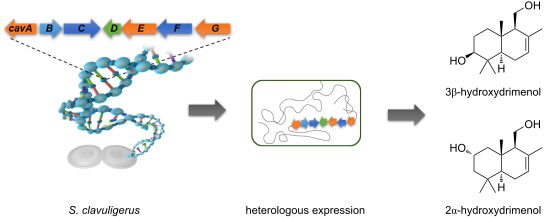
- that the only difference between compounds 3 and 2 is the position of the hydroxy group [28]. Analyses of the NMR data of compound 4 concluded that it is an analogue of 2. In comparison with 2, compound 4 has a ketone carbonyl signal at δC 219.1 and we finally confirmed its structure by comparing it
- comparing the 1H and 13C NMR data with the literature (Figures S11 and S12 in Supporting Information File 1) [41]. Although the chemical structure of compound 8 has been documented, its 1H and 13C NMR data were not fully reported [42]. Therefore, we conducted comprehensive 1D and 2D NMR experiments on it


Isolation and structure determination of a new analog of polycavernosides from marine Okeania sp. cyanobacterium
Beilstein J. Org. Chem. 2024, 20, 645–652, doi:10.3762/bjoc.20.57
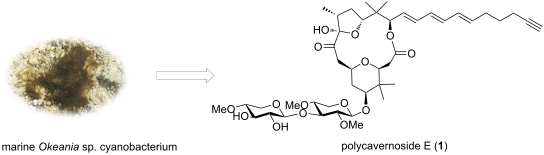
- from a marine Okeania sp. cyanobacterium. The relative configuration was elucidated primarily by analyzing the two dimensional nuclear magnetism resonance (2D NMR) data. The absolute configuration was clarified by comparing the electronic circular dichroism (ECD) data of 1 with those of known analogs
- characteristic UV absorption around 270 nm. The molecular formula of 1 was determined to be C44H66O15 based on the HRESIMS data. The NMR data for 1 are summarized in Table 1. The 1H NMR spectrum of compound 1 was similar to those of known polycavernosides but matched none of them, suggesting that 1 was a new
- analog of polycavernosides [1][3][4][5]. A detailed analysis of the NMR data revealed the planar structure of 1, as shown in Figure 2. COSY and HMQC spectral analyses revealed several partial structures, indicated by the bold bonds in Figure 2. Four HMBC were observed from singlet methyl signals: δH 0.85