

Search results
Search for "1,2-migration" in Full Text gives 27 result(s) in Beilstein Journal of Organic Chemistry.
When cyclopropenes meet gold catalysts
Beilstein J. Org. Chem. 2011, 7, 717–734, doi:10.3762/bjoc.7.82
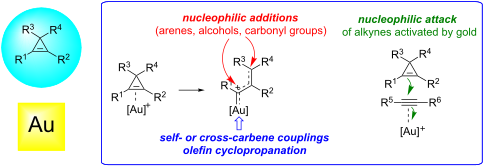
- allylic carbocation 41. Subsequent 1,2-migration of the acetoxy group proceeded via the formation of five-membered intermediates 42 or 42', which then collapsed to the geometric isomers of the corresponding 2-acetoxydiene. For steric reasons, the energy barrier was found to be significantly lower for the




Unusual behavior in the reactivity of 5-substituted-1H-tetrazoles in a resistively heated microreactor
Beilstein J. Org. Chem. 2011, 7, 503–517, doi:10.3762/bjoc.7.59
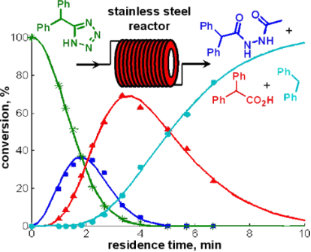
- from the resulting azido group and a subsequent 1,2-migration of the acylimido group from carbon to nitrogen to give the same nitrilimine intermediate was ruled out by Herbst via 15N labeling studies [44]. The degradative acylation of 5-substituted-1H-tetrazoles with acyl halides is in fact an elegant


Other Beilstein-Institut Open Science Activities