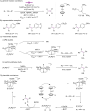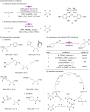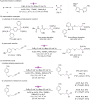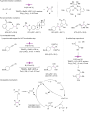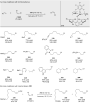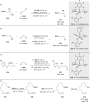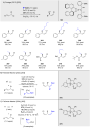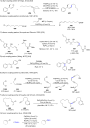

Search for "hydride" in Full Text gives 498 result(s) in Beilstein Journal of Organic Chemistry. Showing first 200.
Beilstein J. Org. Chem. 2026, 22, 495–526, doi:10.3762/bjoc.22.37
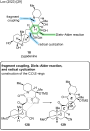
Graphical Abstract
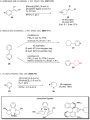
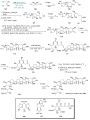
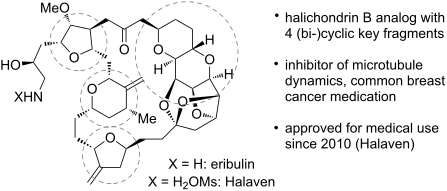
Figure 1: Eribulin with common synthetic precursor fragments and halichondrin B.
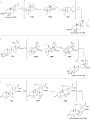
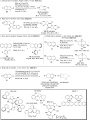
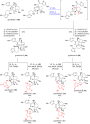
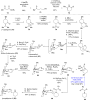
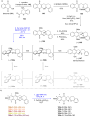
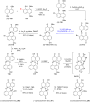
Scheme 1: Overview of the industrial process pathway for the large-scale production of the mesylate salt of 1...
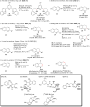
Scheme 2: Synthesis of 22. (a) i. 2,2-dimethoxypropane, p-TsOH, MeOH, 65 °C; ii. NaBH4, MeOH, rt; (b) i. NaH,...
Scheme 3: Synthesis of 27. (a) i. NaH, BnBr, THF, rt; ii. iodobenzoic acid, MeCN, 80 °C; iii. (EtO)2POCH2COOE...
Scheme 4: Synthesis of 31 and 33. (a) i. MMTrCl, iPr2NEt, DCM, rt; ii. K2CO3, MeOH, DCM, rt; iii. TBDMSCl, im...
Scheme 5: Synthesis of 1. (a) CrCl2, 37, 38, 39 (proton sponge), LiCl, Mn, ZrCp2Cl2, MeCN, EtOAc; (b) SrCO3, t...
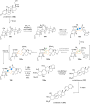
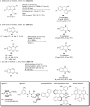
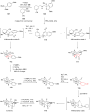
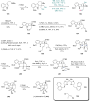
Scheme 6: Synthesis of 45. Above: Reaction conditions: (a) methoxyacetic acid, BF3·OEt2, DCM, −30 °C; (b) Pd(...
Scheme 7: Synthesis of 64. Reaction conditions: (a) i. acetone, I2, rt; ii. vinylmagnesium bromide, THF, −20 ...
Scheme 8: Synthesis of 79. Above: Reaction conditions: (a) i. K2CO3, MeOH, 60 °C; ii. 2,2-dimethoxypropane, H2...
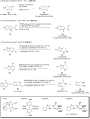
Scheme 9: Synthesis of 92. Reaction conditions: (a) TESCl, imidazole, DCM, 0 °C to rt; (b) i. oxalyl chloride...
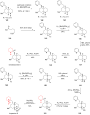
Scheme 10: Synthesis of 104. Above: Reaction conditions: (a) cyclohexanone, p-TsOH, toluene, 110 °C, crystalli...
Scheme 11: Synthesis of 117. (a) i. acetone, CuSO4, rt; ii. H2O2, K2CO3, H2O, rt; iii. EtI, MeCN, 70 °C; (b) i...
Scheme 12: Synthesis of 121. Reaction conditions: (a) i. TBDPSCl, imidazole, DMF, rt; ii. O3, DCM, −78 °C; iii...
Scheme 13: Synthesis of 131. (a) i. 2,2-dimethoxypropane, p-TsOH, MeOH, 60 °C; ii. LiAlH4, THF, 0 °C to rt; (b...
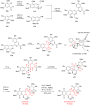
Scheme 14: Synthesis of 143. (a) i. I2, PPh3, imidazole, DCM; ii. HMPA, CuI, vinylmagnesium bromide, THF, −20 ...
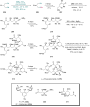
Scheme 15: Modified synthesis of 104. Reaction conditions: (a) (EtO)2POCH2COOEt, KOt-Bu, THF, 15 °C; (b) TBAF,...
Scheme 16: Synthesis of 161. Reaction conditions: (a) crotyl bromide, Sn, TBAI, NaI, DMF/H2O, rt; (b) NaH, BnB...
Scheme 17: Synthesis of 169. Reaction conditions: (a) i. Co2(CO)8, BF3·Et2O, DCM, 23 °C; ii. CAN, acetone, 0 °...
Scheme 18: Synthesis of 181. Reaction conditions: (a) i. Co2(CO)8, BF3·Et2O, DCM, 23 °C; ii. (NH4)2Ce(NO3)6, a...
Scheme 19: Synthesis of 186. Reaction conditions: (a) NEt3, LiCl, MeCN, 0–23 °C; (b) HF·pyridine, MeCN, 23 °C;...
Scheme 20: Modified synthesis of 181. Reaction conditions: (a) i. Ni(cod)2, P(n-Bu)3, Et3SiH, THF, 23 °C; ii. ...
Scheme 21: Synthesis of 200. Reaction conditions: (a) i. Co2(CO)8, DCM, 23 °C; ii. BF3·Et2O, 0 °C; iii. (NH4)2...
Scheme 22: Modified synthesis of 186. Reaction conditions: (a) DDQ, 2,6-di-t-Bu-4-hydroxytoluene, hv, MeCN, 23...
Scheme 23: Synthesis of 1. Reaction conditions: (a) i. CrCl2, NiCl2, 206, NEt3, THF, 23 °C; ii. DBU, toluene, ...
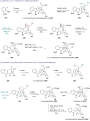
Scheme 24: Synthesis of 217. Above: Reaction conditions: (a) TBDPSCl, imidazole, DCM, 0–5 °C. (b) m-CPBA, DCM,...
Scheme 25: Synthesis of 231. Reaction conditions: (a) i. AcCl, MeOH, 0 °C to rt; ii. TrCl, pyridine, 50 °C; (b...
Scheme 26: Synthesis of 239. Reaction conditions: (a) i. Boc2O, K2CO3, THF, rt; ii. Ru(acac)3, NaBrO3, EtOAc, H...
Scheme 27: Synthesis of 247. Reaction conditions: (a) NCS, 248, MeCN, 0 °C to rt; (b) LDA, 249, THF, −78 °C; (...
Scheme 28: Synthesis of 255. Reaction conditions: (a) i. LiHMDS, THF, −78 °C to rt; ii. m-CPBA, DCM, −78 °C to...
Scheme 29: Synthesis of 261. Reaction conditions: (a) allyltrimethylsilane, TiCl4, DCM −78 °C; (b) LiBH4, EtOH...
Scheme 30: Synthesis of 265. Reaction conditions: (a) (R,R)-Ru-cat (0.2 mol %), DCM, NEt3, HCOOH, rt; (b) TBAF...
Scheme 31: Synthesis of 272. Reaction conditions: (a) LDA, THF, −78 °C; (b) DMP, NaHCO3, DCM, 0 °C to rt; (c) (...
Scheme 32: Synthesis of 292. Reaction conditions: (a) TsCl, NEt3, DCM, rt; (b) K2CO3, MeOH, 45 °C; (c) vinylma...
Scheme 33: Synthesis of 296. Reaction conditions: (a) 171 (see Scheme 17), Cr-cat, CoPc (see Scheme 17), Mn, NEt3·HCl, LiCl, TMS...
Scheme 34: Synthesis of 299. Reaction conditions: (a) 172 (see Scheme 17), CrCl2, NEt3, NiCl2, THF, rt; (b) KHMDS, THF,...
Scheme 35: Synthesis of 305. Reaction conditions: (a) i. p-TsOH, MeOH, 40 °C; ii. MeLi, LiBr, THF, −25 °C; (b)...
Scheme 36: Synthesis of 1. Reaction conditions: (a) i. 41 (see Scheme 6), LDA, THF, −78 °C; ii. DMP, NaHCO3, DCM, rt; ...
Scheme 37: Synthesis of 324. Reaction conditions: (a) i. acetone, CuSO4, rt; ii. H2O2 (30%), K2CO3, rt; iii. E...
Beilstein J. Org. Chem. 2026, 22, 383–389, doi:10.3762/bjoc.22.26
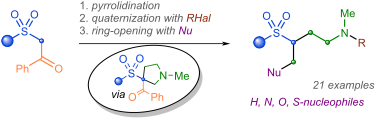
Graphical Abstract
Figure 1: Valuable amino sulfonic acids and aminosulfones.
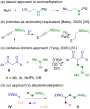
Figure 2: Selected approaches to aminoethylation.
Scheme 1: Pyrrolidination of β-ketosulfones. Reaction conditions: β-ketosulfones (4.0 mmol), sarcosine (1.2 e...
Scheme 2: Scope of the reaction. Reaction conditions: sulfone 1 (1.0 mmol), sarcosine (1.2 equiv), (CH2O)n (2...
Scheme 3: The presumable mechanism of the domino process.
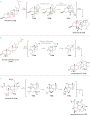
Scheme 4: Reductive elimination of the nucleophiles.
Beilstein J. Org. Chem. 2026, 22, 289–343, doi:10.3762/bjoc.22.21
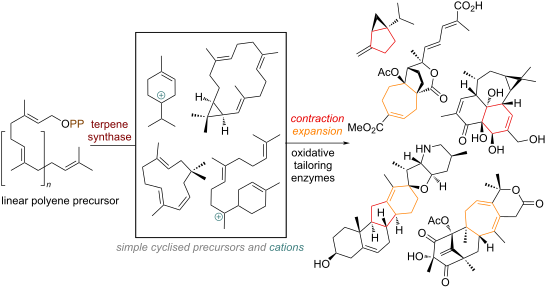
Graphical Abstract
Scheme 1: Mechanistic overview of enzymes involved in ring-size-altering reactions: A: Difference in ionisati...
Scheme 2: A: Ring contraction through involvement of carbocationic intermediates in thujane monoterpene biosy...
Scheme 3: Examples of concerted ring expansions of carbocation intermediates in PxaTPS8-catalysed cyclisation...
Scheme 4: Sequential ring expansions during astellifadiene (17) synthesis reported by Abe and co-workers.
Scheme 5: Cyclobutane ring expansion and sequential ring contractions catalysed by the synthase AITS in the b...
Scheme 6: Ring expansion and transannular ring contraction of a cyclopentane to cyclobutane in the biosynthes...
Scheme 7: Computationally elucidated concerted cyclisations/alkyl/hydride shifts during the biosynthesis of t...
Scheme 8: Cyclisation events and 6→5-ring contraction during the construction of epi-isozizaene (26) catalyse...
Scheme 9: Transannular cyclisations and 4→5-membered ring expansion through dyotropic 1,2-rearrangement of al...
Scheme 10: Ring expansion in presilphiperfolan-8b-ol (31) biosynthesis and ring contraction of the presilphipe...
Scheme 11: Ring contraction via transannular cyclopropanation and opening of cyclopropane in the biosynthesis ...
Scheme 12: The crucial CYP450-catalysed oxidative rearrangement defining the skeleton in gibberellin biosynthe...
Scheme 13: CYP450-mediated oxidation of cyclopentane methylene expanding the 8-membered ring in the biosynthes...
Scheme 14: CYP450-mediated oxidation of an exocyclic methyl group to effect transannular cyclisation across th...
Scheme 15: Non-enzymatic transannular aldol reaction enables the formation of the 5/13/3-tricyclic ring system...
Scheme 16: A: Oxidative ring expansion of a cyclopentane by incorporation of a methyl group in the biosynthesi...
Scheme 17: Rearrangement and ring expansion in the construction of the complex bridged carbon framework of and...
Scheme 18: Ketoglutarate-mediated oxidations of preaustinoid A1 (53) en route to complex meroterpenoids, B-rin...
Scheme 19: Proposed putative biosynthetic formation of the tigliane skeleton from an E,E,Z-triene.
Scheme 20: Photocatalytic tandem ring expansion/contraction of santonin to give photosantonin products and gua...
Scheme 21: A: Proposed biosynthesis of stelleroid B (66) from stelleranoid I (65) by ketol rearrangement; B: o...
Scheme 22: Singular examples of A,B-ring contractions and expansions in the biosynthesis of sesquiterpenoids e...
Scheme 23: A: plausible proposed biosynthetic pathway for the tigliane/ingenane skeletal rearrangement and 1,2...
Scheme 24: A: Multiple ring-size alterations during xenovulene A (90) biosynthesis; B: Ring contraction and re...
Scheme 25: Proposed biosyntheses of the complex, polycyclic terpenoid illisimonin A (97) and the bridged antro...
Scheme 26: Proposed biogenetic origin for the meroterpenoid liphagal (104) via epoxide-mediated ring expansion....
Scheme 27: Proposed biogenetic origin for the ring-contracted members of the taiwaniaquinol family.
Scheme 28: A: Schenck ene/Hock/Aldol cascade effecting B-ring contraction in atheronal B (113); B: Selective C...
Scheme 29: A: D-ring expansion of buxenone (118) via cyclopropanation towards buxaustroine A (119); B: Propose...
Scheme 30: Biosynthetic origin of alstoscholarinoids A (124) and B (125) via cascade oxidative rearrangement c...
Scheme 31: Biogenetic origin of the hedgehog signalling inhibitor cyclopamine (129) by tandem ring contraction...
Scheme 32: Proposed biogenetic origin of the B-ring contracted spirocyclic triterpenoid spirochensilide A (131...
Scheme 33: A: Proposed B-ring contraction during the biosynthesis of holophyllane A (133); B: B-ring contracti...
Scheme 34: Radical and ionic/polar mechanisms for the C-ring-contracted triterpenoids phomopsterone B (139) an...
Scheme 35: A: Plausible mechanism for the formation of schiglautone A (144) from anwuweizic acid (145); B: Pro...
Scheme 36: Reported biosynthetic proposal for the formation of B-ring expanded triterpenoids rhodoterpenoids A...
Scheme 37: A: Final reaction step in the synthesis of euphorikanin A (154), benzilic acid-type ring contractio...
Scheme 38: Tricyclic ring expansion in the Gui synthesis of gibbosterol A (158) and sarocladione (160) via Ru-...
Scheme 39: A: A-ring expansion during the Gui synthesis of rubriflordilactone B (161); B: Mechanism for the bi...
Scheme 40: Photosantonin rearrangement effects A/B ring contraction/expansion in Li’s synthesis of the complex...
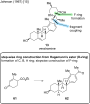
Scheme 41: Tandem A/B ring expansion/contraction of an ergosterol derivative via pinacol rearrangement in the ...
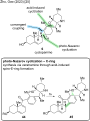
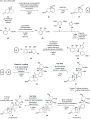
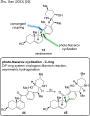
Scheme 42: Synthetic studies towards cyclocitrinol (179) by A) the semisynthetic approach by Gui et al. using ...
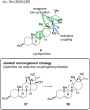
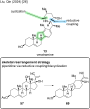
Scheme 43: A: Bioinspired synthesis of spirochensilide A (131) by the Heretsch group via selective 8,9-epoxida...
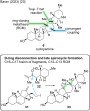
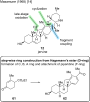
Scheme 44: Baran’s synthesis of cortistatin A (191), expanding the B-ring through a cyclopropane fragmentation....
Scheme 45: Ding’s total synthesis of retigeranic acid (198) showcasing sequential 6→5 ring contractions.
Scheme 46: A: Oxa-di-π-methane (ODPM) rearrangement of a bicyclic ketone en route to silphiperfolenone (203); ...
Scheme 47: Biomimetic synthesis of liphagal (104) from sclareolide (221) by George and co-workers.
Scheme 48: Wu’s bioinspired synthesis of cucurbalsaminones B (224) and C (225) by photocatalytic oxa-di-π-meth...
Scheme 49: Baran’s total synthesis of maoecrystal V (230) featuring a pinacol rearrangement for ring expansion...
Scheme 50: A: Ketol rearrangement leading to ring contraction in the total synthesis of preaustinoid B; B: Ben...
Scheme 51: A: Scheidt’s synthesis of isovelleral (251) by pinacol rearrangement triggered by Mitsunobu conditi...
Scheme 52: Biomimetic transformations of simplified test substrates related to Euphorbia diterpenoids.
Scheme 53: A: First generation synthesis of taiwaniaquinones by benzilic acid-type rearrangement of the B-ring...
Scheme 54: A: Norrish type 1 radical recombination leading to ring contraction en route to cuparenone (272): 1...
Scheme 55: Ring contraction of a bridged D-ring system in the total synthesis of andrastatin D (280), terrenoi...
Scheme 56: Biomimetic synthesis of hyperjapone A (284) and hyperjaponol C (285) by George et al.
Scheme 57: Heretsch’ synthesis of dankastarones A (288) and B (289), swinhoeisterol A (290), and periconiaston...
Scheme 58: A: Zhang’s ring contraction during the synthesis of stemar-13-ene (295) by pinacol rearrangement; B...
Scheme 59: Trauner’s biomimetic synthesis of preuisolactone A (307) featuring a ring contraction via benzilic ...
Scheme 60: Bioinspired approaches for ring contraction/expansion reactions in the synthesis of alstoscholarino...
Scheme 61: A: Sarpong and Li, Wang and co-workers’ ring expansion of cephanolide A (313) to reach harringtonol...
Beilstein J. Org. Chem. 2026, 22, 88–122, doi:10.3762/bjoc.22.4
Graphical Abstract
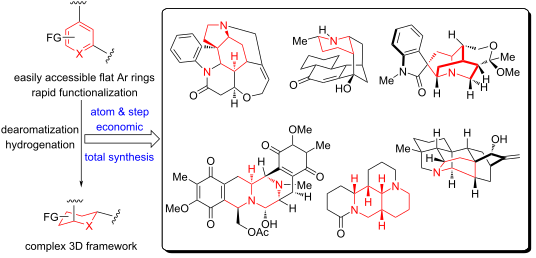
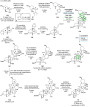
Scheme 1: The association between dearomatization and natural product synthesis.
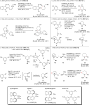
Scheme 2: Key challenges in hydrogenation of aromatic rings.
Scheme 3: Hydrogenation of heterocyclic aromatic rings.
Scheme 4: Hydrogenation of the carbocyclic aromatic rings.
Scheme 5: Hydrogenation of the heterocycle part in bicyclic aromatic rings.
Scheme 6: Hydrogenation of the heterocycle part in bicyclic aromatic rings.
Scheme 7: Hydrogenation of benzofuran, indole, and their analogues.
Scheme 8: Hydrogenation of benzofuran, indole, and their analogues.
Scheme 9: Total synthesis of (±)-keramaphidin B by Baldwin and co-workers.
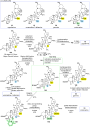
Scheme 10: Total synthesis of (±)-LSD by Vollhardt and co-workers.
Scheme 11: Total synthesis of (±)-dihydrolysergic acid by Boger and co-workers.
Scheme 12: Total synthesis of (±)-lysergic acid by Smith and co-workers.
Scheme 13: Hydrogenation of (−)-tabersonine to (−)-decahydrotabersonine by Catherine Dacquet and co-workers.
Scheme 14: Total synthesis of (±)-nominine by Natsume and co-workers.
Scheme 15: Total synthesis of (+)-nominine by Gin and co-workers.
Scheme 16: Total synthesis of (±)-lemonomycinone and (±)-renieramycin by Magnus.
Scheme 17: Total synthesis of GB13 by Sarpong and co-workers.
Scheme 18: Total synthesis of GB13 by Shenvi and co-workers.
Scheme 19: Total synthesis of (±)-corynoxine and (±)-corynoxine B by Xia and co-workers.
Scheme 20: Total synthesis of (+)-serratezomine E and the putative structure of huperzine N by Bonjoch and co-...
Scheme 21: Total synthesis of (±)-serralongamine A and the revised structure of huperzine N and N-epi-huperzin...
Scheme 22: Early attempts to indenopiperidine core.
Scheme 23: Homogeneous hydrogenation and completion of the synthesis.
Scheme 24: Total synthesis of jorunnamycin A and jorumycin by Stoltz and co-workers.
Scheme 25: Early attempt towards (−)-finerenone by Aggarwal and co-workers.
Scheme 26: Enantioselective synthesis towards (−)-finerenone.
Scheme 27: Total synthesis of (+)-N-methylaspidospermidine by Smith, Grigolo and co-workers.
Scheme 28: Dearomatization approach towards matrine-type alkaloids.
Scheme 29: Asymmetric total synthesis to (−)-senepodine F via an asymmetric hydrogenation of pyridine.
Scheme 30: Selective hydrogenation of indole derivatives and application.
Scheme 31: Synthetic approaches to the oxindole alkaloids by Qi and co-workers.
Scheme 32: Total synthesis of annotinolide B by Smith and co-workers.
Beilstein J. Org. Chem. 2026, 22, 64–70, doi:10.3762/bjoc.22.2
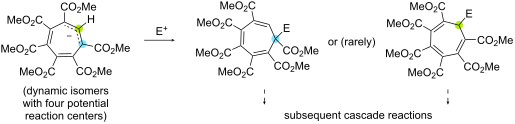
Graphical Abstract
Figure 1: The expected and the unexpected in selected synthetic strategies.
Figure 2: Distortion in antiaromatic hepta- and hexa(methoxycarbonyl)cycloheptatrienyl anions 1 and 2. HOMO (...
Scheme 1: Reactions of anion 2 generated from cycloheptatriene 3 with halogens and alkyl halides.
Scheme 2: Reactions of anion 2 generated from cycloheptatriene 3 with diazonium salts.
Figure 3: Two conformers of hexa(methoxycarbonyl)cycloheptatrienyl anion 2 and 2'. The energies were obtained...
Scheme 3: Radical mechanism for reactions of anion 2 with halogens, suggested structure of trapped product. T...
Beilstein J. Org. Chem. 2026, 22, 1–63, doi:10.3762/bjoc.22.1
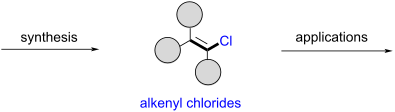
Graphical Abstract
Figure 1: Representative alkenyl chloride motifs in natural products. References: Pinnaic acid [8], haterumalide ...
Figure 2: Representative alkenyl chloride motifs in pharmaceuticals and pesticides. References: clomifene [25], e...
Figure 3: Graphical overview of previously published reviews addressing the synthesis of alkenyl chlorides.
Figure 4: Classification of synthetic approaches to alkenyl chlorides.
Scheme 1: Early works by Friedel, Henry, and Favorsky.
Scheme 2: Product distribution obtained by H NMR integration of crude compound as observed by Kagan and co-wo...
Scheme 3: Side reactions observed for the reaction of 14 with PCl5.
Scheme 4: Only compounds 15 and 18 were observed in the presence of Hünig’s base.
Scheme 5: Efficient synthesis of dichloride 15 at low temperatures.
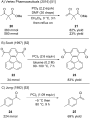
Scheme 6: Various syntheses of alkenyl chlorides on larger scale.
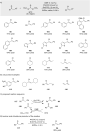
Scheme 7: Scope of the reaction of ketones with PCl5 in boiling cyclohexane.
Scheme 8: Side reactions occur when using excess amounts of PCl5.
Scheme 9: Formation of versatile β-chlorovinyl ketones.
Scheme 10: Mixture of PCl5 and PCl3 used for the synthesis of 49.
Scheme 11: Catechol–PCl3 reagents for the synthesis of alkenyl chlorides.
Scheme 12: (PhO)3P–halogen-based reagents for the synthesis of alkenyl halides.
Scheme 13: Preparation of alkenyl chlorides from alkenyl phosphates.
Scheme 14: Preparation of alkenyl chlorides by treatment of ketones with the Vilsmeier reagent.
Scheme 15: Preparation of electron-rich alkenyl chlorides by treatment of ketones with the Vilsmeier reagent.
Scheme 16: Cu-promoted synthesis of alkenyl chlorides from ketones and POCl3.
Figure 5: GC yield of 9 depending on time and reaction temperature.
Figure 6: Broken reaction flask after attempts to clean the polymerized residue.
Figure 7: GC yield of 9 depending on the amount of CuCl and time.
Scheme 17: Treatment of 4-chromanones with PCl3.
Scheme 18: Synthesis of alkenyl chlorides from the reaction of ketones with acyl chlorides.
Scheme 19: ZnCl2-promoted alkenyl chloride synthesis.
Scheme 20: Regeneration of acid chlorides by triphosgene.
Scheme 21: Alkenyl chlorides from ketones and triphosgene.
Scheme 22: Various substitution reactions.
Scheme 23: Vinylic Finkelstein reactions reported by Evano and co-workers.
Scheme 24: Challenge of selective monohydrochlorination of alkynes.
Scheme 25: Sterically encumbered internal alkynes furnish the hydrochlorination products in high yield.
Scheme 26: Recent work by Kropp with HCl absorbed on alumina.
Scheme 27: High selectivities for monhydrochlorination with nitromethane/acetic acid as solvent.
Figure 8: Functionalized alkynes which typically afford the monhydrochlorinated products.
Scheme 28: Related chorosulfonylation and chloroamination reactions.
Scheme 29: Reaction of organometallic reagents with chlorine electrophiles.
Scheme 30: Elimination reactions of dichlorides to furnish alkenyl chlorides.
Scheme 31: Elimination reactions of allyl chloride 182 to furnish alkenyl chloride 183.
Scheme 32: Detailed studies by Schlosser on the elimination of dichloro compounds.
Scheme 33: Stereoselective variation caused by change of solvent.
Scheme 34: Elimination of gem-dichloride 189 to afford alkene 190.
Scheme 35: Oxidation of enones to dichlorides and in situ elimination thereof.
Scheme 36: Oxidation of allylic alcohols to dichlorides and in situ elimination thereof.
Scheme 37: Chlorination of styrenes with SOCl2 and elimination thereof.
Scheme 38: Chlorination of styrenes with SOCl2 and elimination thereof.
Scheme 39: Fluorine–chlorine exchange followed by elimination.
Scheme 40: Intercepting cations with alkynes and trapping of the alkenyl cation intermediate with chloride.
Scheme 41: Investigations by Mayr and co-workers.
Scheme 42: In situ activation of benzyl alcohol 230 with BCl3.
Scheme 43: In situ activation of benzylic alcohols with TiCl4.
Scheme 44: In situ activation of benzylic alcohols with FeCl3.
Scheme 45: In situ activation of benzylic alcohols with FeCl3.
Scheme 46: In situ activation of aliphatic chlorides and alcohols with ZnCl2, InCl3, and FeCl3.
Scheme 47: In situ generation of benzylic cations and trapping thereof with alkynes.
Scheme 48: Intramolecular trapping reactions affording alkenyl halides.
Scheme 49: Intramolecular trapping reactions affording alkenyl chlorides.
Scheme 50: Intramolecular trapping reactions of oxonium and iminium ions affording alkenyl chlorides.
Scheme 51: Palladium and nickel-catalyzed coupling reactions to afford alkenyl chlorides.
Scheme 52: Rhodium-catalyzed couplings of 1,2-trans-dichloroethene with arylboronic esters.
Scheme 53: First report on monoselective coupling reactions for 1,1-dichloroalkenes.
Scheme 54: Negishi’s and Barluenga’s contributions.
Scheme 55: First mechanistic investigation by Johnson and co-workers.
Scheme 56: First successful cross-metathesis with choroalkene 260.
Scheme 57: Subsequent studies by Johnson.
Scheme 58: Hoveyda and Schrock’s work on stereoretentive cross-metathesis with molybdenum-based catalysts.
Scheme 59: Related work with (Z)-dichloroethene.
Scheme 60: Further ligand refinement and traceless protection of functional groups with HBpin.
Scheme 61: Alkenyl chloride synthesis by Wittig reaction.
Scheme 62: Alkenyl chloride synthesis by Julia olefination.
Scheme 63: Alkenyl chloride synthesis by reaction of ketones with Mg/TiCl4 mixture.
Scheme 64: Frequently used allylic substitution reactions which lead to alkenyl chlorides.
Scheme 65: Enantioselective allylic substitutions.
Scheme 66: Synthesis of alkenyl chlorides bearing an electron-withdrawing group.
Scheme 67: Synthesis of α-nitroalkenyl chlorides from aldehydes.
Scheme 68: Synthesis of alkenyl chlorides via elimination of an in situ generated geminal dihalide.
Scheme 69: Carbenoid approach reported by Pace.
Scheme 70: Carbenoid approach reported by Pace.
Scheme 71: Ring opening of cyclopropenes in the presence of MgCl2.
Scheme 72: Electrophilic chlorination of alkenyl MIDA boronates to Z- or E-alkenyl chlorides.
Scheme 73: Hydroalumination and hydroboration of alkynyl chlorides.
Scheme 74: Carbolithiation of chloroalkynes.
Scheme 75: Chlorination of enamine 420.
Scheme 76: Alkyne synthesis by elimination of alkenyl chlorides.
Scheme 77: Reductive lithiation of akenyl chlorides.
Scheme 78: Reactions of alkenyl chlorides with organolithium reagents.
Scheme 79: Reactions of alkenyl chlorides with organolithium reagents.
Scheme 80: Addition–elimination reaction of alkenyl chloride 9 with organolithium reagents.
Scheme 81: C–H insertions of lithiumcarbenoids.
Scheme 82: Pd-catalyzed coupling reactions with alkenyl chlorides as coupling partner.
Scheme 83: Ni-catalyzed coupling of alkenylcopper reagent with alkenyl chloride 183.
Scheme 84: Ni-catalyzed coupling of heterocycle 472 with alkenyl chloride 473.
Scheme 85: Synthesis of α-chloroketones by oxidation of alkenyl chlorides.
Scheme 86: Tetrahalogenoferrate(III)-promoted oxidation of alkenyl chlorides.
Scheme 87: Chlorine–deuterium exchange promoted by a palladium catalyst.
Scheme 88: Reaction of alkenyl chlorides with thiols in the presence of AIBN (azobisisobutyronitrile).
Scheme 89: Chloroalkene annulation.
Beilstein J. Org. Chem. 2025, 21, 2755–2760, doi:10.3762/bjoc.21.212
Graphical Abstract
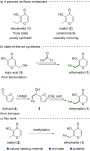
Scheme 1: Importance and synthetic approaches to ethylmaltol (1). (a) Ethylmaltol (1) is widely used as a fla...
Scheme 2: Optimized one-pot procedure to access ethylmaltol (1) via a transient protecting group strategy.
Beilstein J. Org. Chem. 2025, 21, 2657–2693, doi:10.3762/bjoc.21.206
Graphical Abstract
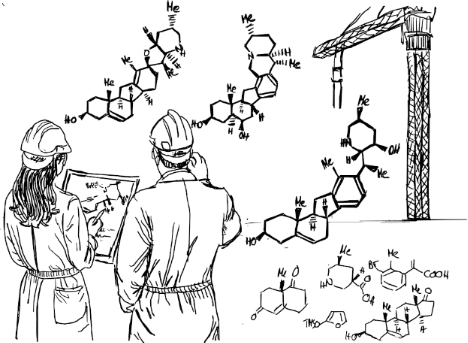
Scheme 1: Representatives of steroid alkaloid classes. Marked in blue is the steroidal cholestane framework, ...
Scheme 2: Subclasses of Veratrum alkaloids: jervanine, veratramine and cevanine-type [8].
Scheme 3: Flow chart presentation of the synthesis of (−)-englerin A developed by the Christmann group [10].
Scheme 4: Structures and year of synthesis of the three types of Veratrum alkaloids reported in the literatur...
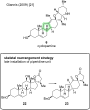
Scheme 5: Key step in the synthesis of cyclopamine (6) by the Giannis group [21].
Scheme 6: Overview of the semisynthesis of cyclopamine (6) reported by the Giannis group in 2009 [21].
Scheme 7: Key steps in the synthesis of cyclopamine (6) by the Baran group [23].
Scheme 8: Overview of the total synthesis of cyclopamine (6) by the Baran group in 2023 [23].
Scheme 9: Key steps in the synthesis of cyclopamine (6) by the Zhu/Gao group [25].
Scheme 10: Overview of the total synthesis of cyclopamine (6) by the group of Zhao/Gao in 2023 [25].
Scheme 11: Key steps in the synthesis of cyclopamine (6) by the Liu/Qin group [26].
Scheme 12: Overview of the semisynthesis of cyclopamine (6) by the Liu/Qin group in 2024 [26].
Scheme 13: Key steps in the synthesis of jervine (12) by the Masamune group [14].
Scheme 14: Overview of the total synthesis of jervine (12) by the Masamune group in 1968 [14].
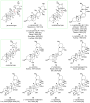
Scheme 15: Color-coded schemes of the presented cyclopamine (6) syntheses by Giannis, Baran, Zhu/Gao, and Liu/...
Scheme 16: Key steps in the total synthesis of veratramine (13) by the Johnson group [15].
Scheme 17: Overview of the total synthesis of veratramine (13) by the Johnson group in 1967 [15].
Scheme 18: Key steps in the synthesis of veratramine (13) by the Zhu/Gao group [25].
Scheme 19: Shortened overview of the total synthesis of veratramine (13) by the Zhu/Gao group in 2023 [25].
Scheme 20: Key steps in the synthesis of veratramine by the Liu/Qin group [26].
Scheme 21: Overview of the semisynthesis of veratramine (13) by the Liu/Qin group in 2024 [26].
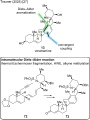
Scheme 22: Key steps in the synthesis of veratramine (13) by the Trauner group [27].
Scheme 23: Overview of the total synthesis of veratramine (13) by the Trauner group in 2025 [27].
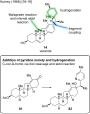
Scheme 24: Key steps in the synthesis of verarine (14) by the Kutney group [16-19].
Scheme 25: Overview of the total synthesis of verarine (14) by the Kutney group reported 1962–1968 [16-19].
Scheme 26: Color-coded schemes of the presented veratramine-type alkaloid synthesis of Zhu/Gao, Liu/Qin and Tr...
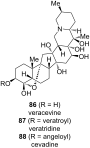
Scheme 27: Structures of veracevine (86), veratridine (87), and cevadine (88).
Scheme 28: Key step in the semisynthesis of verticine (15) by the Kutney group (1977) [20,46].
Scheme 29: Overview of the semisynthesis of verticine (15) by the Kutney group (1977) [20,46].
Scheme 30: Key step of the total synthesis of (±)-4-methylenegermine (17) by the Stork group (2017) [22].
Scheme 31: Overview of the total synthesis of (±)-4-methylenegermine (17) by the Stork group (2017) [22].
Scheme 32: Key step of the total synthesis of heilonine (16) by Cassaidy and Rawal (2021) [24].
Scheme 33: Overview of the total synthesis of heilonine (16) by Cassaidy and Rawal (2021) [24]. FGI: functional gr...
Scheme 34: Key steps of the synthesis of heilonine (16) by Dai and co-workers (2024) [28].
Scheme 35: Overview of the total synthesis of heilonine (16) by Dai and co-workers (2024) [28].
Scheme 36: Key steps of the total synthesis of zygadenine (18) reported by Luo and co-workers [29].
Scheme 37: Overview of the total synthesis of zygadenine (18) by Luo and co-workers (2023) [29].
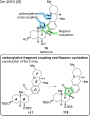
Scheme 38: Key step of the divergent total syntheses of highly oxidized cevanine-type alkaloids by Luo and co-...
Scheme 39: Divergent syntheses of highly oxidized cevanine-type alkaloids by Luo and co-workers (2024) [30].
Scheme 40: Color-coded overview of the presented cevanine-type alkaloid syntheses [10,20,22,24,28-30,46]. LLS: longest linear sequen...
Beilstein J. Org. Chem. 2025, 21, 2489–2497, doi:10.3762/bjoc.21.191
Graphical Abstract
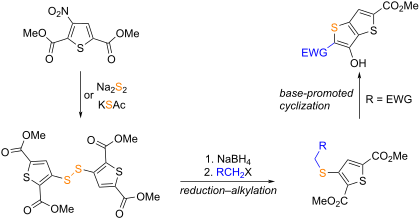
Scheme 1: The synthetic routes to 3-hydroxy-substituted TT derivatives.
Scheme 2: The present retrosynthetic plan for constructing TT molecules.
Scheme 3: An attempt to nucleophilically substitute the NO2 group in ester 1.
Scheme 4: The reaction of ester 1 with potassium thioacetate.
Scheme 5: A probable mechanism for the formation of compounds 2 and 3.
Scheme 6: The synthesis of 3-(alkylthio)thiophene-2,5-dicarboxylates 4–6, yields, and scope of products. *Fro...
Scheme 7: The synthesis of TT derivatives, yields, and scope of products. Conditions: i) LiH (5 equiv), DMF, ...
Beilstein J. Org. Chem. 2025, 21, 2315–2333, doi:10.3762/bjoc.21.177
Graphical Abstract
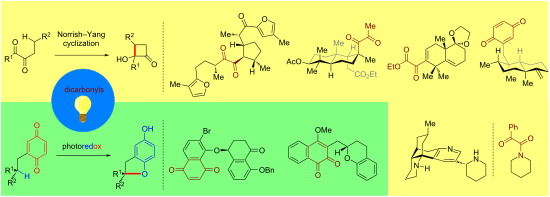
Scheme 1: a) The mechanism of Norrish type II reaction and Norrish–Yang cyclization; b) The mechanism of the ...
Scheme 2: Total synthesis of (+)-cyclobutastellettolide B.
Scheme 3: Norrish–Yang cyclization and 1,2-methyl migration.
Scheme 4: Synthetic study toward phainanoids.
Scheme 5: a) Mitsunobu reaction of the C9 ketal; b) Norrish–Yang cyclization of the saturated C5–C6; c) calcu...
Scheme 6: Total synthesis of avarane-type meroterpenoids.
Scheme 7: Total synthesis of gracilisoid A.
Scheme 8: Divergent total synthesis of gracilisoids B–I.
Scheme 9: Mechanism of the late-stage biomimetic photooxidation.
Scheme 10: Asymmetric total synthesis of lycoplatyrine A.
Scheme 11: Photoreaction of pyrrolidine-derived phenyl keto amide.
Scheme 12: Photoredox reactions of naphthoquinones.
Scheme 13: Synthetic study toward γ-rubromycin.
Scheme 14: Substituent-dependent conformational preferences.
Scheme 15: Total synthesis of preussomerins EG1, EG2, and EG3.
Beilstein J. Org. Chem. 2025, 21, 2283–2296, doi:10.3762/bjoc.21.174
Graphical Abstract
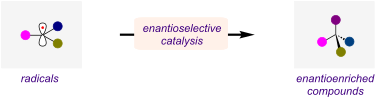
Figure 1: Methods of radical generation (A) and general types of radical reactions (B).
Figure 2: Chiral catalysis in enantioselective radical chemistry [13-37].
Scheme 1: Diastereo- and enantioselective additions of nucleophilic radicals to N-enoyloxazolidinone and pyrr...
Scheme 2: Organocatalyzed formal [3 + 2] cycloadditions affording substituted pyrrolidines.
Scheme 3: Synthesis of a hexacyclic compound via an organocatalyzed enantioselective polyene cyclization.
Scheme 4: Nickel-catalyzed asymmetric cross-coupling reactions.
Scheme 5: Chiral cobalt–porphyrin metalloradical-catalyzed radical cyclization reactions.
Scheme 6: Enantioselective radical chaperone catalysis.
Scheme 7: Enantioselective radical addition by decatungstate/iminium catalysis.
Scheme 8: An ene-reductase-catalyzed photoenzymatic enantioselective radical cyclization/enantioselective HAT...
Scheme 9: Photoenzymatic oxidative C(sp3)–C(sp3) coupling reactions between organoboron compounds and amino a...
Scheme 10: Electrochemical α-alkenylation reactions of 2-acylimidazoles catalyzed by a chiral-at-rhodium Lewis...
Scheme 11: Regio- and enantioselective electrochemical reactions of silyl polyenolates catalyzed by a chiral n...
Beilstein J. Org. Chem. 2025, 21, 2260–2282, doi:10.3762/bjoc.21.173
Graphical Abstract
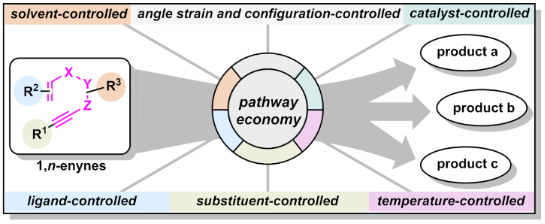
Scheme 1: Economical synthesis and pathway economy.
Scheme 2: Au(I)-catalyzed cascade cyclization paths of 1,5-enynes.
Scheme 3: Au(I)-catalyzed cyclization paths of 1,7-enynes.
Scheme 4: I2/TBHP-mediated radical cycloisomerization paths of 1,n-enyne.
Scheme 5: Au(I)-catalyzed cycloisomerization paths of 3-allyloxy-1,6-diynes.
Scheme 6: Pd(II)-catalyzed cycloisomerization paths of 2-alkynylbenzoate-cyclohexadienone.
Scheme 7: Stereoselective cyclization of 1,5-enynes.
Scheme 8: Substituent-controlled cycloisomerization of propargyl vinyl ethers.
Scheme 9: Au(I)-catalyzed pathway-controlled domino cyclization of 1,2-diphenylethynes.
Scheme 10: Au(I)-catalyzed tandem cyclo-isomerization of tryptamine-N-ethynylpropiolamide.
Scheme 11: Au(I)-catalyzed tunable cyclization of 1,6-cyclohexenylalkyne.
Scheme 12: Substituent-controlled 7-exo- and 8-endo-dig-selective cyclization of 2-propargylaminobiphenyl deri...
Scheme 13: BiCl3-catalyzed cycloisomerization of tryptamine-ynamide derivatives.
Scheme 14: Au(I)-mediated substituent-controlled cycloisomerization of 1,6-enynes.
Scheme 15: Ligand-controlled regioselective cyclization of 1,6-enynes.
Scheme 16: Ligand-dependent cycloisomerization of 1,7-enyne esters.
Scheme 17: Ligand-controlled cycloisomerization of 1,5-enynes.
Scheme 18: Ligand-controlled cyclization strategy of alkynylamide tethered alkylidenecyclopropanes.
Scheme 19: Ag(I)-mediated pathway-controlled cycloisomerization of tryptamine-ynamides.
Scheme 20: Gold-catalyzed cycloisomerization of indoles with alkynes.
Scheme 21: Catalyst-dependent cycloisomerization of dienol silyl ethers.
Scheme 22: Cycloisomerization of aromatic enynes governed by catalyst.
Scheme 23: Catalyst-dependent 1,2-migration in cyclization of 1-(indol-2-yl)-3-alkyn-1-ols.
Scheme 24: Gold-catalyzed cycloisomerization of N-propargyl-N-vinyl sulfonamides.
Scheme 25: Gold(I)-mediated enantioselective cycloisomerizations of ortho-(alkynyl)styrenes.
Scheme 26: Catalyst-controlled intramolecular cyclization of 1,7-enynes.
Scheme 27: Brønsted acid-catalyzed cycloisomerizations of tryptamine ynamides.
Scheme 28: Catalyst-controlled cyclization of indolyl homopropargyl amides.
Scheme 29: Angle strain-dominated 6-endo-trig cyclization of propargyl vinyl ethers.
Scheme 30: Angle strain-controlled cycloisomerization of alkyn-tethered indoles.
Scheme 31: Geometrical isomeration-dependent cycloisomerization of 1,3-dien-5-ynes.
Scheme 32: Temperature-controlled cyclization of 1,7-enynes.
Scheme 33: Cycloisomerizations of n-(o-ethynylaryl)acrylamides through temperature modulation.
Scheme 34: Temperature-controlled boracyclization of biphenyl-embedded 1,3,5-trien-7-ynes.
Beilstein J. Org. Chem. 2025, 21, 1984–1994, doi:10.3762/bjoc.21.154
Graphical Abstract
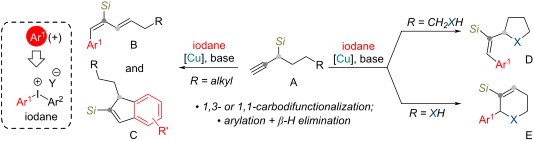
Scheme 1: Alkyne arylation with diaryl-λ3-iodanes in the context of 1,2-silyl shift and potential cyclization....
Scheme 2: Competing mechanistic pathways for diene 10 and indene 11 formation.
Scheme 3: Reaction scope for the synthesis of arylated tetrahydrofurans 8. Conditions: All reactions were per...
Scheme 4: Synthesis of lactone and pyrrolidine derivatives. Conditions: ac7e = 0.1 mmol/mL. bReaction conditi...
Scheme 5: Proposed arylation–heterocyclization mechanism for internal nucleophile-containing silanes 7.
Scheme 6: Arylation of C5-chain containing acylamides 16a–c. aThe reaction was performed under modified condi...
Beilstein J. Org. Chem. 2025, 21, 1973–1983, doi:10.3762/bjoc.21.153
Graphical Abstract
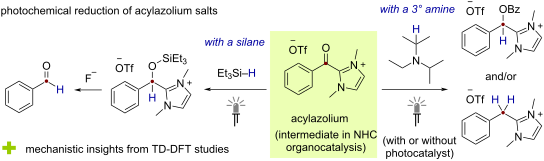
Figure 1: (a) Combining N-heterocyclic carbene (NHC) organocatalysis with photoredox catalysis for radical–ra...
Figure 2: Initial test reaction employing [Ir(dF(CF3)ppy)2(dtbpy)]PF6 as a photocatalyst in the presence of D...
Scheme 1: Plausible mechanism for the photocatalytic reduction of benzoylimidazolium salt 1 with DIPEA. [PC] ...
Scheme 2: Plausible mechanism for the photocatalyst-free reduction of benzoylimidazolium salt 1 into O-benzoy...
Figure 3: Reduction of 2-benzoylimidazolium triflate (1) under photocatalyst-free conditions monitored over 4...
Scheme 3: (a) Reduction of 2-benzoylimidazolium triflate (1) under photocatalyst-free conditions with DIPEA a...
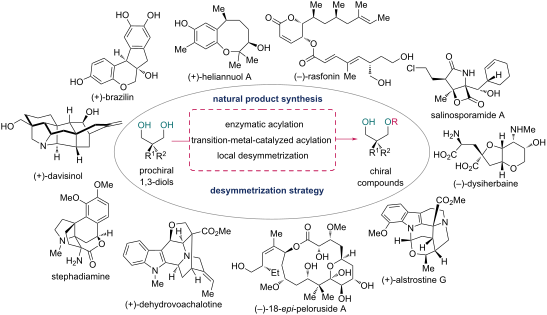
Beilstein J. Org. Chem. 2025, 21, 1932–1963, doi:10.3762/bjoc.21.151
Graphical Abstract
Scheme 1: General mechanism of a lipase-catalyzed esterification.
Scheme 2: Shishido’s synthesis of (−)-xanthorrhizol (4) and (+)-heliannuol D (8).
Scheme 3: Shishido’s synthesis of a) (−)-heliannuol A (15) and b) heliannuol G (20) and heliannuol H (21).
Scheme 4: Deska’s synthesis of hyperione A (30) and ent-hyperione B (31).
Scheme 5: Huang’s synthesis of (+)-brazilin (37).
Scheme 6: Shishido’s synthesis of (−)-heliannuol D (42) and (+)-heliannuol A (43).
Scheme 7: Chênevert’s synthesis of (S)-α-tocotrienol (49).
Scheme 8: Kita’s synthesis of monoester 53.
Scheme 9: Kita’s synthesis of fredericamycin A (60).
Scheme 10: Takabe’s synthesis of (E)-3,7-dimethyl-2-octene-1,8-diol (64).
Scheme 11: Takabe’s synthesis of (18S)-variabilin (70).
Scheme 12: Kawasaki’s synthesis of (S)-Rosaphen (74) and (R)-Rosaphen (75).
Scheme 13: Tokuyama’s synthesis of a) (−)-petrosin (84) and b) (+)-petrosin (86).
Scheme 14: Fukuyama’s synthesis of leustroducsin B (96).
Scheme 15: Nanda’s synthesis of a) fragment 100, b) fragment 106 and c) (−)-rasfonin (109).
Scheme 16: Davies’ synthesis of (+)-pilocarpine (115) and (+)-isopilocarpine (116).
Scheme 17: Ōmura’s synthesis of salinosporamide A (125).
Scheme 18: Kang’s synthesis of ʟ-cladinose (124) and its derivative.
Scheme 19: Kang’s preparation of fragment 139.
Scheme 20: Kang’s synthesis of azithromycin (149).
Scheme 21: Kang’s synthesis of (−)-dysiherbaine (156).
Scheme 22: Kang’s synthesis of (−)-kaitocephalin (166).
Scheme 23: Kang’s synthesis of laidlomycin (180).
Scheme 24: Snyder’s synthesis of arboridinine (190).
Scheme 25: Ma’s synthesis of (+)-alstrostine G (203).
Scheme 26: Trost’s synthesis of (−)-18-epi-peloruside A (215).
Scheme 27: Lindel’s synthesis of (–)-dihydroraputindole (223).
Scheme 28: Iwata’s synthesis of a) (−)-talaromycin B (232) and b) (+)-talaromycin A (235).
Scheme 29: Cook’s synthesis of a) (−)-vincamajinine (240) and b) (−)-11-methoxy-17-epivincamajine (245).
Scheme 30: Cook’s synthesis of (+)-dehydrovoachalotine (249) and voachalotine (250).
Scheme 31: Cook’s synthesis of a) (−)-12-methoxy-Nb-methylvoachalotine (257) and b) (+)-polyneuridine, macusin...
Scheme 32: Trauner’s synthesis of stephadiamine (273).
Scheme 33: Garg’s synthesis of (–)-ψ-akuammigine (285).
Scheme 34: Ding’s synthesis of (+)-18-benzoyldavisinol (293) and (+)-davisinol (294).
Beilstein J. Org. Chem. 2025, 21, 1730–1736, doi:10.3762/bjoc.21.135
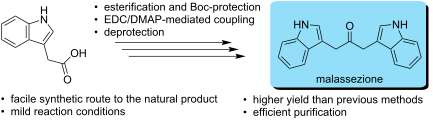
Graphical Abstract
Figure 1: Various natural indole-containing compounds isolated from Malassezia furfur.
Scheme 1: Synthetic routes to malassezione (1) from either A) an isonitrile precursor [18] or B) indole-3-acetic ...
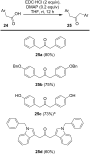
Scheme 2: Various bis-substituted ketones prepared. a25c prepared from 25b.
Beilstein J. Org. Chem. 2025, 21, 1489–1495, doi:10.3762/bjoc.21.111
Graphical Abstract
Figure 1: Selected fusicoccane diterpenoids and overview of this study. (a) Representative members of the fus...
Figure 2: Heterologous production of brassicicene I in an engineered A. oryzae strain. (a) Biosynthesis of fu...
Figure 3: Synthesis of cotylenol (3). (a) Synthesis of Nakada’s intermediate 10 from 5. (b) Orf7 catalyzes th...
Scheme 1: Synthesis of alterbrassicicene E (6) and brassicicenes A (7) and R (8) from brassicicene I (5).
Beilstein J. Org. Chem. 2025, 21, 1477–1479, doi:10.3762/bjoc.21.109
Beilstein J. Org. Chem. 2025, 21, 1324–1373, doi:10.3762/bjoc.21.101
Graphical Abstract
Figure 1: Bond lengths and bond angles in oxetane at 140 K [2].
Figure 2: Analogy of 3-substituted oxetanes to carbonyl and gem-dimethyl groups [12].
Figure 3: Use of oxetanes in drug design – selected examples.
Figure 4: Examples of oxetane-containing natural products.
Scheme 1: Synthetic strategies towards construction of the oxetane ring.
Scheme 2: Overview of intramolecular Williamson etherification and competing Grob fragmentation.
Scheme 3: Synthesis of spiro-oxetanes via 1,4-C–H insertion and Williamson etherification.
Scheme 4: Use of phenyl vinyl selenone in the synthesis of spirooxindole oxetanes.
Scheme 5: Synthesis of bicyclic 3,5-anhydrofuranoses via double epoxide opening/etherification.
Scheme 6: Preparation of spirooxetanes by cycloisomerisation via MHAT/RPC.
Scheme 7: Oxetane synthesis via alcohol C–H functionalisation.
Scheme 8: Access to oxetanes 38 from α-acetyloxy iodides.
Scheme 9: The kilogram-scale synthesis of oxetane intermediate 41.
Scheme 10: Overview of the intramolecular opening of 3-membered rings.
Scheme 11: Synthesis of 4,7-dioxatricyclo[3.2.1.03,6]octane skeletons.
Scheme 12: Silicon-directed electrophilic cyclisation of homoallylic alcohols.
Scheme 13: Hydrosilylation–iodocyclisation of homopropargylic alcohols.
Scheme 14: Cu-catalysed intramolecular O-vinylation of γ-bromohomoallylic alcohols.
Scheme 15: Cu-catalysed intramolecular cross-coupling of hydroxyvinylstannanes.
Scheme 16: Isomerisation of oxiranyl ethers containing weakly carbanion-stabilising groups.
Scheme 17: Cyclisation of diethyl haloalkoxymalonates.
Scheme 18: Synthesis of oxetanes through a 1,5-HAT/radical recombination sequence.
Scheme 19: General approach to oxetanes via [2 + 2] cycloadditions.
Scheme 20: Synthesis of tricyclic 4:4:4 oxetanes through a photochemical triple cascade reaction.
Scheme 21: Iridium-catalysed Paternò–Büchi reaction between α-ketoesters and simple alkenes.
Scheme 22: Three-step synthesis of spirocyclic oxetanes 83 via Paternò–Büchi reaction, nucleophilic ring openi...
Scheme 23: Enantioselective Paternò–Büchi reaction catalysed by a chiral iridium photocatalyst.
Scheme 24: Synthesis of polysubstituted oxetanes 92 via Cu(II)-mediated formal [2 + 2] cycloadditions.
Scheme 25: Synthesis of alkylideneoxetanes via NHC- and DBU-mediated formal [2 + 2] cycloadditions.
Scheme 26: Use of sulphur-stabilised carbanions in ring expansions.
Scheme 27: Synthesis of α,α-difluoro(arylthio)methyl oxetanes.
Scheme 28: Ring expansion in an industrial synthesis of PF-06878031.
Scheme 29: Ring contraction of triflated 2-hydroxy-γ-lactones.
Scheme 30: Ring contraction in an industrial synthesis of PF-06878031.
Scheme 31: Photochemical ring contraction of 2,5-dihydrofurans by aryldiazoacetic acid esters.
Scheme 32: Synthesis of 3-oxetanones via O-H insertion of carbenes.
Scheme 33: Synthesis of phosphonate oxetanones via gold-mediated alkyne oxidation/O–H insertion.
Scheme 34: Syntheses and common derivatisations of 3-oxetanone.
Scheme 35: SN1 substitution of 3-aryloxetan-3-ols by thiols and alcohols.
Scheme 36: Fe–Ni dual-catalytic olefin hydroarylation towards 3-alkyl-3-(hetero)aryloxetanes.
Scheme 37: Synthesis of 3-aryloxetan-3-carboxylic acids.
Scheme 38: Decarboxylative alkylation of 3-aryloxetan-3-carboxylic acids.
Scheme 39: Synthesis of 3-amino-3-aryloxetanes via photoredox/nickel cross-coupling catalysis.
Scheme 40: Intermolecular cross-selective [2 + 2] photocycloaddition towards spirooxetanes.
Scheme 41: Synthesis of 3-aryl-3-aminooxetanes via defluorosulphonylative coupling.
Scheme 42: Two-step synthesis of amide bioisosteres via benzotriazolyl Mannich adducts 170.
Scheme 43: Functionalisation of oxetanyl trichloroacetimidates 172.
Scheme 44: Synthesis of oxetane-amino esters 176.
Scheme 45: Tandem Friedel–Crafts alkylation/intramolecular ring opening of 3-aryloxetan-3-ols.
Scheme 46: Synthesis of polysubstituted furans and pyrroles.
Scheme 47: Synthesis of oxazolines and bisoxazolines.
Scheme 48: Tandem, one-pot syntheses of various polycyclic heterocycles.
Scheme 49: Synthesis of 1,2-dihydroquinolines via skeletal reorganisation of oxetanes.
Scheme 50: Synthesis of benzoindolines and 2,3-dihydrobenzofurans and their derivatisations.
Scheme 51: Synthesis of polysubstituted 1,4-dioxanes.
Scheme 52: Preparation of various lactones via ring opening of oxetane-carboxylic acids 219.
Scheme 53: Tsuji-Trost allylation/ring opening of 3-aminooxetanes.
Scheme 54: Arylative skeletal rearrangement of 3-vinyloxetan-3-ols to 2,5-dihydrofurans.
Scheme 55: Reductive opening of oxetanes using catalytic Mg–H species.
Scheme 56: Opening of oxetanes by silyl ketene acetals.
Scheme 57: Rhodium-catalysed hydroacylation of oxetanes.
Scheme 58: Generation of radicals from oxetanes mediated by a vitamin B12-derived cobalt catalyst.
Scheme 59: Reductive opening of oxetanes by B–Si frustrated Lewis pairs.
Scheme 60: Zirconocene-mediated reductive opening of oxetanes.
Scheme 61: Enantioselective syntheses of small and medium-size rings using chiral phosphoric acids.
Scheme 62: Asymmetric synthesis of 2,3-dihydrobenzo[b]oxepines catalysed by a chiral scandium complex.
Scheme 63: Enantioselective synthesis of 1,3-bromohydrins under a chiral squaramide catalysis.
Scheme 64: Enantioselective opening of 2-aryl-2-ethynyloxetanes by anilines.
Scheme 65: Ru-catalysed insertion of diazocarbonyls into oxetanes.
Scheme 66: Ring expansion of oxetanes by stabilised carbenes generated under blue light irradiation.
Scheme 67: Expansion of oxetanes via nickel-catalysed insertion of alkynyltrifluoroborates.
Scheme 68: Nickel-catalysed expansion of oxetanes into ε-caprolactones.
Scheme 69: Expansion of oxetanes via cobalt-catalysed carbonyl insertion.
Scheme 70: Gold-catalysed intramolecular 1,1-carboalkoxylation of oxetane-ynamides.
Scheme 71: Expansion of oxetanes by stabilised sulphoxonium ylides.
Scheme 72: Cu-catalysed ring expansion of 2-vinyloxetanes by diazoesters.
Scheme 73: Total synthesis of (+)-oxetin.
Scheme 74: Total synthesis of racemic oxetanocin A.
Scheme 75: Total synthesis of (−)-merrilactone A.
Scheme 76: Total synthesis of (+)-dictyoxetane.
Scheme 77: Total synthesis of ent-dichrocephone B.
Scheme 78: Total synthesis of (−)-mitrephorone A.
Scheme 79: Total synthesis of (−)-taxol.
Beilstein J. Org. Chem. 2025, 21, 1207–1271, doi:10.3762/bjoc.21.98
Graphical Abstract
Scheme 1: DTBP-mediated oxidative alkylarylation of activated alkenes.
Scheme 2: Iron-catalyzed oxidative 1,2-alkylarylation.
Scheme 3: Possible mechanism for the iron-catalyzed oxidative 1,2-alkylation of activated alkenes.
Scheme 4: A metal-free strategy for synthesizing 3,3-disubstituted oxindoles.
Scheme 5: Iminoxyl radical-promoted cascade oxyalkylation/alkylarylation of alkenes.
Scheme 6: Proposed mechanism for the iminoxyl radical-promoted cascade oxyalkylation/alkylarylation of alkene...
Scheme 7: Bicyclization of 1,n-enynes with alkyl nitriles.
Scheme 8: Possible reaction mechanism for the bicyclization of 1,n-enynes with alkyl nitriles.
Scheme 9: Radical cyclization of N-arylacrylamides with isocyanides.
Scheme 10: Plausible mechanism for the radical cyclization of N-arylacrylamides with isocyanides.
Scheme 11: Electrochemical dehydrogenative cyclization of 1,3-dicarbonyl compounds.
Scheme 12: Plausible mechanism for the dehydrogenative cyclization of 1,3-dicarbonyl compounds.
Scheme 13: Photocatalyzed cyclization of N-arylacrylamide and N,N-dimethylaniline.
Scheme 14: Proposed mechanism for the photocatalyzed cyclization of N-arylacrylamides and N,N-dimethylanilines....
Scheme 15: Electrochemical monofluoroalkylation cyclization of N-arylacrylamides with dimethyl 2-fluoromalonat...
Scheme 16: Proposed mechanism for the electrochemical radical cyclization of N-arylacrylamides with dimethyl 2...
Scheme 17: Photoelectrocatalytic carbocyclization of unactivated alkenes using simple malonates.
Scheme 18: Plausible mechanism for the photoelectrocatalytic carbocyclization of unactivated alkenes with simp...
Scheme 19: Bromide-catalyzed electrochemical trifluoromethylation/cyclization of N-arylacrylamides.
Scheme 20: Proposed mechanism for the electrochemical trifluoromethylation/cyclization of N-arylacrylamides.
Scheme 21: Visible light-mediated trifluoromethylarylation of N-arylacrylamides.
Scheme 22: Plausible reaction mechanism for the visible light-mediated trifluoromethylarylation of N-arylacryl...
Scheme 23: Electrochemical difluoroethylation cyclization of N-arylacrylamides with sodium difluoroethylsulfin...
Scheme 24: Electrochemical difluoroethylation cyclization of N-methyacryloyl-N-alkylbenzamides with sodium dif...
Scheme 25: Photoredox-catalyzed radical aryldifluoromethylation of N-arylacrylamides with S-(difluoromethyl)su...
Scheme 26: Proposed mechanism for the photoredox-catalyzed radical aryldifluoromethylation of N-arylacrylamide...
Scheme 27: Visible-light-induced domino difluoroalkylation/cyclization of N-cyanamide alkenes.
Scheme 28: Proposed mechanism of photoredox-catalyzed radical domino difluoroalkylation/cyclization of N-cyana...
Scheme 29: Palladium-catalyzed oxidative difunctionalization of alkenes.
Scheme 30: Two possible mechanisms of palladium-catalyzed oxidative difunctionalization.
Scheme 31: Silver-catalyzed oxidative 1,2-alkyletherification of unactivated alkenes with α-bromoalkylcarbonyl...
Scheme 32: Photochemical radical cascade cyclization of dienes.
Scheme 33: Proposed mechanism for the photochemical radical cascade 6-endo cyclization of dienes with α-carbon...
Scheme 34: Photocatalyzed radical coupling/cyclization of N-arylacrylamides and.
Scheme 35: Photocatalyzed radical-type couplings/cyclization of N-arylacrylamides with sulfoxonium ylides.
Scheme 36: Possible mechanism of visible-light-induced radical-type couplings/cyclization of N-arylacrylamides...
Scheme 37: Visible-light-promoted difluoroalkylated oxindoles systhesis via EDA complexes.
Scheme 38: Possible mechanism for the visible-light-promoted radical cyclization of N-arylacrylamides with bro...
Scheme 39: A dicumyl peroxide-initiated radical cascade reaction of N-arylacrylamide with DCM.
Scheme 40: Possible mechanism of radical cyclization of N-arylacrylamides with DCM.
Scheme 41: An AIBN-mediated radical cascade reaction of N-arylacrylamides with perfluoroalkyl iodides.
Scheme 42: Possible mechanism for the reaction with perfluoroalkyl iodides.
Scheme 43: Photoinduced palladium-catalyzed radical annulation of N-arylacrylamides with alkyl halides.
Scheme 44: Radical alkylation/cyclization of N-Alkyl-N-methacryloylbenzamides with alkyl halides.
Scheme 45: Possible mechanism for the alkylation/cyclization with unactivated alkyl chlorides.
Scheme 46: Visible-light-driven palladium-catalyzed radical cascade cyclization of N-arylacrylamides with unac...
Scheme 47: NHC-catalyzed radical cascade cyclization of N-arylacrylamides with alkyl bromides.
Scheme 48: Possible mechanism of NHC-catalyzed radical cascade cyclization.
Scheme 49: Electrochemically mediated radical cyclization reaction of N-arylacrylamides with freon-type methan...
Scheme 50: Proposed mechanistic pathway of electrochemically induced radical cyclization reaction.
Scheme 51: Redox-neutral photoinduced radical cascade cylization of N-arylacrylamides with unactivated alkyl c...
Scheme 52: Proposed mechanistic hypothesis of redox-neutral radical cascade cyclization.
Scheme 53: Thiol-mediated photochemical radical cascade cylization of N-arylacrylamides with aryl halides.
Scheme 54: Proposed possible mechanism of thiol-mediated photochemical radical cascade cyclization.
Scheme 55: Visible-light-induced radical cascade bromocyclization of N-arylacrylamides with NBS.
Scheme 56: Possible mechanism of visible-light-induced radical cascade cyclization.
Scheme 57: Decarboxylation/radical C–H functionalization by visible-light photoredox catalysis.
Scheme 58: Plausible mechanism of visible-light photoredox-catalyzed radical cascade cyclization.
Scheme 59: Visible-light-promoted tandem radical cyclization of N-arylacrylamides with N-(acyloxy)phthalimides....
Scheme 60: Plausible mechanism for the tandem radical cyclization reaction.
Scheme 61: Visible-light-induced aerobic radical cascade alkylation/cyclization of N-arylacrylamides with alde...
Scheme 62: Plausible mechanism for the aerobic radical alkylarylation of electron-deficient amides.
Scheme 63: Oxidative decarbonylative [3 + 2]/[5 + 2] annulation of N-arylacrylamide with vinyl acids.
Scheme 64: Plausible mechanism for the decarboxylative (3 + 2)/(5 + 2) annulation between N-arylacrylamides an...
Scheme 65: Rhenium-catalyzed alkylarylation of alkenes with PhI(O2CR)2.
Scheme 66: Plausible mechanism for the rhenium-catalyzed decarboxylative annulation of N-arylacrylamides with ...
Scheme 67: Visible-light-induced one-pot tandem reaction of N-arylacrylamides.
Scheme 68: Plausible mechanism for the visible-light-initiated tandem synthesis of difluoromethylated oxindole...
Scheme 69: Copper-catalyzed redox-neutral cyanoalkylarylation of activated alkenes with cyclobutanone oxime es...
Scheme 70: Plausible mechanism for the copper-catalyzed cyanoalkylarylation of activated alkenes.
Scheme 71: Photoinduced alkyl/aryl radical cascade for the synthesis of quaternary CF3-attached oxindoles.
Scheme 72: Plausible photoinduced electron-transfer (PET) mechanism.
Scheme 73: Photoinduced cerium-mediated decarboxylative alkylation cascade cyclization.
Scheme 74: Plausible reaction mechanism for the decarboxylative radical-cascade alkylation/cyclization.
Scheme 75: Metal-free oxidative tandem coupling of activated alkenes.
Scheme 76: Control experiments and possible mechanism for 1,2-carbonylarylation of alkenes with carbonyl C(sp2...
Scheme 77: Silver-catalyzed acyl-arylation of activated alkenes with α-oxocarboxylic acids.
Scheme 78: Proposed mechanism for the decarboxylative acylarylation of acrylamides.
Scheme 79: Visible-light-mediated tandem acylarylation of olefines with carboxylic acids.
Scheme 80: Proposed mechanism for the radical cascade cyclization with acyl radical via visible-light photored...
Scheme 81: Erythrosine B-catalyzed visible-light photoredox arylation-cyclization of N-arylacrylamides with ar...
Scheme 82: Electrochemical cobalt-catalyzed radical cyclization of N-arylacrylamides with arylhydrazines or po...
Scheme 83: Proposed mechanism of radical cascade cyclization via electrochemical cobalt catalysis.
Scheme 84: Copper-catalyzed oxidative tandem carbamoylation/cyclization of N-arylacrylamides with hydrazinecar...
Scheme 85: Proposed reaction mechanism for the radical cascade cyclization by copper catalysis.
Scheme 86: Visible-light-driven radical cascade cyclization reaction of N-arylacrylamides with α-keto acids.
Scheme 87: Proposed mechanism of visible-light-driven cascade cyclization reaction.
Scheme 88: Peroxide-induced radical carbonylation of N-(2-methylallyl)benzamides with methyl formate.
Scheme 89: Proposed cyclization mechanism of peroxide-induced radical carbonylation with N-(2-methylallyl)benz...
Scheme 90: Persulfate promoted carbamoylation of N-arylacrylamides and N-arylcinnamamides.
Scheme 91: Proposed mechanism for the persulfate promoted radical cascade cyclization reaction of N-arylacryla...
Scheme 92: Photocatalyzed carboacylation with N-arylpropiolamides/N-alkyl acrylamides.
Scheme 93: Plausible mechanism for the photoinduced carboacylation of N-arylpropiolamides/N-alkyl acrylamides.
Scheme 94: Electrochemical Fe-catalyzed radical cyclization with N-arylacrylamides.
Scheme 95: Plausible mechanism for the electrochemical Fe-catalysed radical cyclization of N-phenylacrylamide.
Scheme 96: Substrate scope of the selective functionalization of various α-ketoalkylsilyl peroxides with metha...
Scheme 97: Proposed reaction mechanism for the Fe-catalyzed reaction of alkylsilyl peroxides with methacrylami...
Scheme 98: EDA-complex mediated C(sp2)–C(sp3) cross-coupling of TTs and N-methyl-N-phenylmethacrylamides.
Scheme 99: Proposed mechanism for the synthesis of oxindoles via EDA complex.
Beilstein J. Org. Chem. 2025, 21, 1104–1115, doi:10.3762/bjoc.21.88
Graphical Abstract
Scheme 1: ᴅ-2-Aminoadipic acid (1) can be used to generate C6 aryl and alkynyl-modified pipecolic acid deriva...
Scheme 2: Methyl ester formation, followed by cyclization, N-formylation, as well as bromination under Vilsme...
Scheme 3: Suzuki–Miyaura cross-coupling reaction between bromide 2 and a variety of boronic acids 8.
Scheme 4: Reaction of 3a to (2R,6S)-9a and (2R,6R)-9a. The chromatograms prove the simple diastereoselection.
Figure 1: The minor diastereomer of the catalytic hydrogenation was assigned as (2R,6R)-9, based on the analy...
Figure 2: 1H NMR spectra with both signal sets for the chair and half-chair configuration as well as Newman p...
Figure 3: 1H NMR spectra with signal set for the chair configuration as well as Newman projection for both pr...
Scheme 5: a) Sonogashira–Hagihara cross-coupling reaction followed by b) NaBH3CN reduction of the N-acylimini...
Figure 4: 1H NMR with Newman projection for both protons H2 and H6 with corresponding dihedral angles ϕ for a...
Scheme 6: Overview of reduction and deprotection to the final pipecolic acid derivatives (2R,6S)-5.
Beilstein J. Org. Chem. 2025, 21, 1031–1086, doi:10.3762/bjoc.21.85
Graphical Abstract
Figure 1: Biologically active cinnamic acid derivatives.
Scheme 1: General synthetic strategies for cinnamic acid derivatizations.
Scheme 2: Cinnamic acid coupling via isobutyl anhydride formation.
Scheme 3: Amidation reaction via O/N-pivaloyl activation.
Scheme 4: Cinnamic acid amidation using TCCA/PPh3 reagent.
Scheme 5: Cinnamic acid amidation using triazine-based reagents.
Scheme 6: Cinnamic acid amidation using continuous flow mechanochemistry.
Scheme 7: Cinnamic acid amidation using COMU as coupling reagent.
Scheme 8: Cinnamic acid amidation using allenone coupling reagent.
Scheme 9: Cinnamic acid amidation using 4-acetamidophenyl triflimide as reagent.
Scheme 10: Cinnamic acid amidation using methyltrimethoxysilane (MTM).
Scheme 11: Cinnamic acid amidation utilizing amine–borane reagent.
Scheme 12: Cinnamic acid amidation using TCCA/PPh3 reagent.
Scheme 13: Cinnamic acid amidation using PPh3/I2 reagent.
Scheme 14: Cinnamic acid amidation using PCl3 reagent.
Scheme 15: Cinnamic acid amidation utilizing pentafluoropyridine (PFP) as reagent.
Scheme 16: Cinnamic acid amidation using hypervalent iodine(III).
Scheme 17: Mechanochemical amidation using 1,1,2,2-tetrafluoroethyl-N,N-dimethylamine (TFEDMA) reagent.
Scheme 18: Methyl ester preparation using tris(2,4,6-trimethoxyphenyl)phosphine (TMPP).
Scheme 19: N-Trifluoromethyl amide preparation using isothiocyanate and AgF.
Scheme 20: POCl3-mediated amide coupling of carboxylic acid and DMF.
Scheme 21: O-Alkylation of cinnamic acid using alkylating agents.
Scheme 22: Glycoside preparation via Mitsunobu reaction.
Scheme 23: O/N-Acylation via rearrangement reactions.
Scheme 24: Amidation reactions using sulfur-based alkylating agents.
Scheme 25: Amidation reaction catalyzed by Pd0 via C–N cleavage.
Scheme 26: Amidation reaction catalyzed by CuCl/PPh3.
Scheme 27: Cu(II) triflate-catalyzed N-difluoroethylimide synthesis.
Scheme 28: Cu/Selectfluor-catalyzed transamidation reaction.
Scheme 29: CuO–CaCO3-catalyzed amidation reaction.
Scheme 30: Ni-catalyzed reductive amidation.
Scheme 31: Lewis acidic transition-metal-catalyzed O/N-acylations.
Scheme 32: Visible-light-promoted amidation of cinnamic acid.
Scheme 33: Sunlight/LED-promoted amidation of cinnamic acid.
Scheme 34: Organophotocatalyst-promoted N–O cleavage of Weinreb amides to synthesize primary amides.
Scheme 35: Cinnamamide synthesis through [Ir] photocatalyst-promoted C–N-bond cleavage of tertiary amines.
Scheme 36: Blue LED-promoted FeCl3-catalyzed reductive transamidation.
Scheme 37: FPyr/TCT-catalyzed amidation of cinnamic acid derivative 121.
Scheme 38: Cs2CO3/DMAP-mediated esterification.
Scheme 39: HBTM organocatalyzed atroposelective N-acylation.
Scheme 40: BH3-catalyzed N-acylation reactions.
Scheme 41: Borane-catalyzed N-acylation reactions.
Scheme 42: Catalytic N-acylation reactions via H/F bonding activation.
Scheme 43: Brønsted base-catalyzed synthesis of cinnamic acid esters.
Scheme 44: DABCO/Fe3O4-catalyzed N-methyl amidation of cinnamic acid 122.
Scheme 45: Catalytic oxidation reactions of acylating agents.
Scheme 46: Preparation of cinnamamide-substituted benzocyclooctene using I(I)/I(III) catalysis.
Scheme 47: Pd-colloids-catalyzed oxidative esterification of cinnamyl alcohol.
Scheme 48: Graphene-supported Pd/Au alloy-catalyzed oxidative esterification via hemiacetal intermediate.
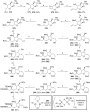
Scheme 49: Au-supported on A) carbon nanotubes (CNT) and B) on porous boron nitride (pBN) as catalyst for the ...
Scheme 50: Cr-based catalyzed oxidative esterification of cinnamyl alcohols with H2O2 as the oxidant.
Scheme 51: Co-based catalysts used for oxidative esterification of cinnamyl alcohol.
Scheme 52: Iron (A) and copper (B)-catalyzed oxidative esterification of cinnamaldehyde.
Scheme 53: NiHPMA-catalyzed oxidative esterification of cinnamaldehyde.
Scheme 54: Synthesis of cinammic acid esters through NHC-catalyzed oxidative esterification via intermolecular...
Scheme 55: Redox-active NHC-catalyzed esterification via intramolecular oxidation.
Scheme 56: Electrochemical conversion of cinnamaldehyde to methyl cinnamate.
Scheme 57: Bu4NI/TBHP-catalyzed synthesis of bisamides from cinnamalaldehyde N-tosylhydrazone.
Scheme 58: Zn/NC-950-catalyzed oxidative esterification of ketone 182.
Scheme 59: Ru-catalyzed oxidative carboxylation of terminal alkenes.
Scheme 60: Direct carboxylation of alkenes using CO2.
Scheme 61: Carboxylation of alkenylboronic acid/ester.
Scheme 62: Carboxylation of gem-difluoroalkenes with CO2.
Scheme 63: Photoredox-catalyzed carboxylation of difluoroalkenes.
Scheme 64: Ru-catalyzed carboxylation of alkenyl halide.
Scheme 65: Carboxylation of alkenyl halides under flow conditions.
Scheme 66: Cinnamic acid ester syntheses through carboxylation of alkenyl sulfides/sulfones.
Scheme 67: Cinnamic acid derivatives synthesis through a Ag-catalyzed decarboxylative cross-coupling proceedin...
Scheme 68: Pd-catalyzed alkyne hydrocarbonylation.
Scheme 69: Fe-catalyzed alkyne hydrocarbonylation.
Scheme 70: Alkyne hydrocarboxylation using CO2.
Scheme 71: Alkyne hydrocarboxylation using HCO2H as CO surrogate.
Scheme 72: Co/AlMe3-catalyzed alkyne hydrocarboxylation using DMF.
Scheme 73: Au-catalyzed oxidation of Au–allenylidenes.
Scheme 74: Pd-catalyzed C–C-bond activation of cyclopropenones to synthesize unsaturated esters and amides.
Scheme 75: Ag-catalyzed C–C-bond activation of diphenylcyclopropenone.
Scheme 76: Cu-catalyzed C–C bond activation of diphenylcyclopropenone.
Scheme 77: PPh3-catalyzed C–C-bond activation of diphenylcyclopropenone.
Scheme 78: Catalyst-free C–C-bond activation of diphenylcyclopropenone.
Scheme 79: Cu-catalyzed dioxolane cleavage.
Scheme 80: Multicomponent coupling reactions.
Scheme 81: Pd-catalyzed partial hydrogenation of electrophilic alkynes.
Scheme 82: Nickel and cobalt as earth-abundant transition metals used as catalysts for the partial hydrogenati...
Scheme 83: Metal-free-catalyzed partial hydrogenation of conjugated alkynes.
Scheme 84: Horner–Wadsworth–Emmons reaction between triethyl 2-fluoro-2-phosphonoacetate and aldehydes with ei...
Scheme 85: Preparation of E/Z-cinnamates using thiouronium ylides.
Scheme 86: Transition-metal-catalyzed ylide reactions.
Scheme 87: Redox-driven ylide reactions.
Scheme 88: Noble transition-metal-catalyzed olefination via carbenoid species.
Scheme 89: TrBF4-catalyzed olefination via carbene species.
Scheme 90: Grubbs catalyst (cat 7)/photocatalyst-mediated metathesis reactions.
Scheme 91: Elemental I2-catalyzed carbonyl-olefin metathesis.
Scheme 92: Cu-photocatalyzed E-to-Z isomerization of cinnamic acid derivatives.
Scheme 93: Ni-catalyzed E-to-Z isomerization.
Scheme 94: Dehydration of β-hydroxy esters via an E1cB mechanism to access (E)-cinnamic acid esters.
Scheme 95: Domino ring-opening reaction induced by a base.
Scheme 96: Dehydroamination of α-aminoester derivatives.
Scheme 97: Accessing methyl cinnamate (44) via metal-free deamination or decarboxylation.
Scheme 98: The core–shell magnetic nanosupport-catalyzed condensation reaction.
Scheme 99: Accessing cinnamic acid derivatives from acetic acid esters/amides through α-olefination.
Scheme 100: Accessing cinnamic acid derivatives via acceptorless α,β-dehydrogenation.
Scheme 101: Cu-catalyzed formal [3 + 2] cycloaddition.
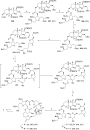
Scheme 102: Pd-catalyzed C–C bond formation via 1,4-Pd-shift.
Scheme 103: NHC-catalyzed Rauhut–Currier reactions.
Scheme 104: Heck-type reaction for Cα arylation.
Scheme 105: Cu-catalyzed trifluoromethylation of cinnamamide.
Scheme 106: Ru-catalyzed alkenylation of arenes using directing groups.
Scheme 107: Earth-abundant transition-metal-catalyzed hydroarylation of α,β-alkynyl ester 374.
Scheme 108: Precious transition-metal-catalyzed β-arylation of cinnamic acid amide/ester.
Scheme 109: Pd-catalyzed β-amination of cinnamamide.
Scheme 110: S8-mediated β-amination of methyl cinnamate (44).
Scheme 111: Pd-catalyzed cross-coupling reaction of alkynyl esters with phenylsilanes.
Scheme 112: Pd-catalyzed β-cyanation of alkynyl amide/ester.
Scheme 113: Au-catalyzed β-amination of alkynyl ester 374.
Scheme 114: Metal-free-catalyzed Cβ-functionalizations of alkynyl esters.
Scheme 115: Heck-type reactions.
Scheme 116: Mizoroki–Heck coupling reactions using unconventional functionalized arenes.
Scheme 117: Functional group-directed Mizoroki–Heck coupling reactions.
Scheme 118: Pd nanoparticles-catalyzed Mizoroki–Heck coupling reactions.
Scheme 119: Catellani-type reactions to access methyl cinnamate with multifunctionalized arene.
Scheme 120: Multicomponent coupling reactions.
Scheme 121: Single atom Pt-catalyzed Heck coupling reaction.
Scheme 122: Earth-abundant transition metal-catalyzed Heck coupling reactions.
Scheme 123: Polymer-coated earth-abundant transition metals-catalyzed Heck coupling reactions.
Scheme 124: Earth-abundant transition-metal-based nanoparticles as catalysts for Heck coupling reactions.
Scheme 125: CN- and Si-based directing groups to access o-selective cinnamic acid derivatives.
Scheme 126: Amide-based directing group to access o-selective cinnamic acid derivatives.
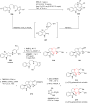
Scheme 127: Carbonyl-based directing group to access o-selective cinnamic acid derivatives.
Scheme 128: Stereoselective preparation of atropisomers via o-selective C(sp2)–H functionalization.
Scheme 129: meta-Selective C(sp2)–H functionalization using directing group-tethered arenes.
Scheme 130: para-Selective C(sp2)–H functionalization using directing group-tethered arenes.
Scheme 131: Non-directed C(sp2)–H functionalization via electrooxidative Fujiwara–Moritani reaction.
Scheme 132: Interconversion of functional groups attached to cinnamic acid.
Scheme 133: meta-Selective C(sp2)–H functionalization of cinnamate ester.
Scheme 134: C(sp2)–F arylation using Grignard reagents.
Scheme 135: Truce–Smiles rearrangement of N-aryl metacrylamides.
Scheme 136: Phosphine-catalyzed cyclization of γ-vinyl allenoate with enamino esters.
Beilstein J. Org. Chem. 2025, 21, 926–934, doi:10.3762/bjoc.21.75
Graphical Abstract
Figure 1: Representative limonoid triterpenes.
Scheme 1: Structures and retrosynthetic analysis of krishnolides A (7) and C (8).
Scheme 2: Construction of α-iodoenone 13.
Scheme 3: Construction of aldehyde 14.
Scheme 4: Synthesis of the advanced intermediate 10 (in the X ray structure of 10 solvent molecule is omitted...
Beilstein J. Org. Chem. 2025, 21, 800–806, doi:10.3762/bjoc.21.63
Graphical Abstract
Scheme 1: Synthesis of acyclic nitrile-substituted quaternary carbon centers from allenes.
Scheme 2: Hydrocyanation of allene 1a with tosyl cyanide.
Scheme 3: Hydrocyanation with various di- or trisubstituted allenes. Reaction conditions: allene 1 (0.3 mmol)...
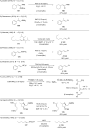
Scheme 4: Hydrocyanation with various monosubstituted allenes. Reaction conditions: allene 4 (0.3 mmol), (iBu)...
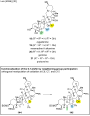
Scheme 5: Gram scale reaction.
Scheme 6: Synthetic applications.
Scheme 7: Proposed mechanism.
Beilstein J. Org. Chem. 2025, 21, 659–669, doi:10.3762/bjoc.21.52
Graphical Abstract
Scheme 1: Previous work for obtaining different fluorinated amino acids and target fluorinated amino acids de...
Scheme 2: Synthesis of fluorinated aromatic amino acids 2 and 3.
Scheme 3: a) Gram-scale synthesis of fluorinated alkyl iodide precursor 10; b) Synthesis of trifluorinated le...