
Search results
Search for "decomposition" in Full Text gives 824 result(s) in Beilstein Journal of Organic Chemistry. Showing first 200.
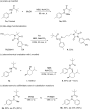
Semisynthesis, characterisation, and antibacterial evaluation of a novel lecanoric acid-derived amide library
Beilstein J. Org. Chem. 2026, 22, 1023–1032, doi:10.3762/bjoc.22.81
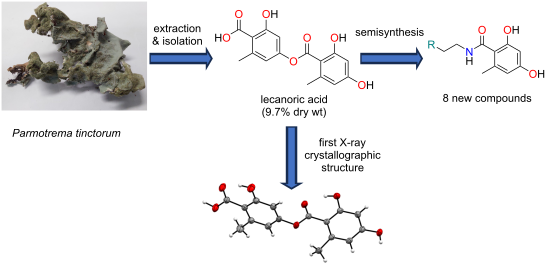
- in decomposition to orsellinic acid (4) [24]. Recognising the reactivity of the scaffold’s ester group, we sought to exploit this by reacting 1 with a series of commercially available primary amines to generate a series of chemically unique amides. Prior to the reaction of scaffold 1 with the eight


Synthesis of sterically shielded piperidine nitroxides via acid-catalyzed heterocyclization of β-aminoketone derivatives with ketones
Beilstein J. Org. Chem. 2026, 22, 948–954, doi:10.3762/bjoc.22.74
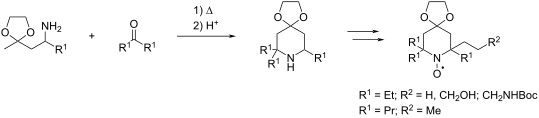
- using a sodium tungstate/hydrogen peroxide system. Attempted purification led to decomposition; therefore, crude 6a and 6b were used directly in the next step. It is known that the reaction of sterically hindered nitrones may lead to metalation or deoxygenation of the alkylnitrone group instead of


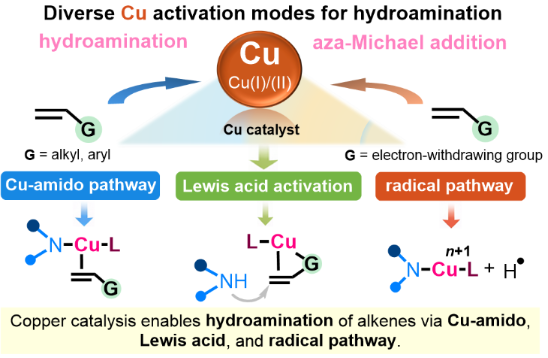
Recent advances in copper-catalyzed direct hydroamination of alkenes with (hetero)aromatic amines
Beilstein J. Org. Chem. 2026, 22, 925–947, doi:10.3762/bjoc.22.73
- CuCo2O4 catalyst was prepared via an oxalate decomposition method and extensively characterized using powder X-ray diffraction, field-emission scanning electron microscopy, and energy dispersive X-ray spectroscopy. Structural analysis revealed the formation of microsheet-like architectures with high







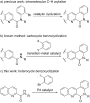
Palladium-catalyzed benzocyclization reactions of quinoline-2-carboxamides via sequential C–H/N–H functionalization
Beilstein J. Org. Chem. 2026, 22, 905–914, doi:10.3762/bjoc.22.71
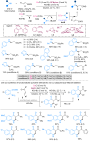
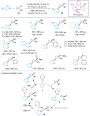
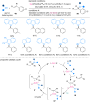
- , whereas the use of bromo(iodo)benzenes with low electron density leads to their decomposition, which results in decreased yields of product 3. Finally, the coupling reactions with heteroarenes, such as 2,3-dibromobenzothiophene (2j) and 2,3-dibromopyridine (2k), afforded the corresponding products in




Cascade transformation of 2-(diazoacetyl)-2H-azirines to 2-aroyl-3-hydroxy-1H-pyrroles via condensation with aromatic aldehydes
Beilstein J. Org. Chem. 2026, 22, 897–904, doi:10.3762/bjoc.22.70
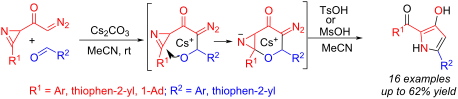
- (probably 4a; Scheme 1, R = Ph, Ar = 4-FC6H4) turned out to be extremely unstable and could not be isolated either by crystallization or by chromatography on silica gel or alumina, which led to its complete decomposition. Fortunately, the corresponding product of the reaction of 2-(2-diazoacetyl)-3-(3
- uncontrolled decomposition upon chromatographic isolation. Although theoretically, the reaction of azirine 1 and aldehyde 2 can form four racemic diastereoisomers, in reality in the case of the bicyclic (3,6) system 2-oxa-7-azabicyclo[4.1.0]heptane, only two racemic diastereoisomers can form due to the


The trans-influence in gold chemistry from a catalytic perspective
Beilstein J. Org. Chem. 2026, 22, 838–856, doi:10.3762/bjoc.22.66
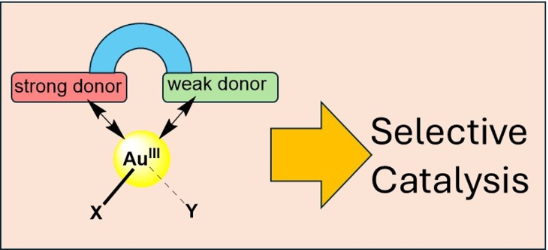
- ^C)AuH2] [50]. Goldberg’s complex 13, on the other hand, which is stabilised by two strongly donating P(t-Bu)2 moieties, is stable at room temperature and could be crystallographically characterised [53]. A gold hydride of type 12 has been postulated as an intermediate in the thermal decomposition of
- chemical reactivity. For example, 8a proved stable to air, water and acetic acid, although stronger acids like trifluoroacetic lead to decomposition due to protolytic cleavage of one of the Au–phenyl bonds [31][32]. The stabilising effect of the N-donor in C^N^C ligands is seen quite generally and leads to
- decomposition products of [(C^P)Aun-Bu]+ and the reaction of [(C^P)AuMe]NTf2 with ethylene under pressure demonstrate alkene insertion/β-H elimination and chain walking sequences (Scheme 18) [90]. These reactions contrast with those of the benzoquinolinato complex [(C^N)Aun-Bu]SbF6, which was thermally stable


Knoevenagel condensation of 4,5- and 1,8-diazafluorenes
Beilstein J. Org. Chem. 2026, 22, 803–812, doi:10.3762/bjoc.22.62
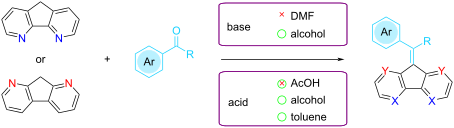
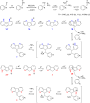
- iminium cation. Additionally, the nitrogen positions in 1,8-diazafluorenylidenes facilitate their decomposition in acidic media. Moreover, the reactivity of diazafluorenes under basic conditions also demonstrated to be improved via solvation of the ion pair by a protic solvent. Finally, the unique di




Synthetic study of vic-bromination of diarylacetylenes, easy purification and separation
Beilstein J. Org. Chem. 2026, 22, 795–802, doi:10.3762/bjoc.22.61
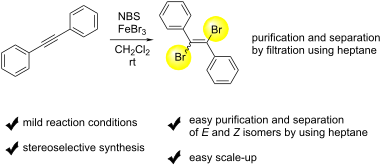
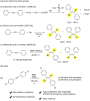
- ]. Among Table 1, entries 5–11, the addition of n-Bu4NBr did not seem to have any effect. Instead of CH2Cl2, C2H8Cl2 (1,2-dichloroethane) was used as the solvent, but the yield of E-2a was decreased (Table 1, entries 11 and 12). Generally, decomposition of the product or over reaction was not observed by



Halogenated azobenzene acrylates: from efficient solution photoswitching to stable solid-state photochromic materials
Beilstein J. Org. Chem. 2026, 22, 782–794, doi:10.3762/bjoc.22.60
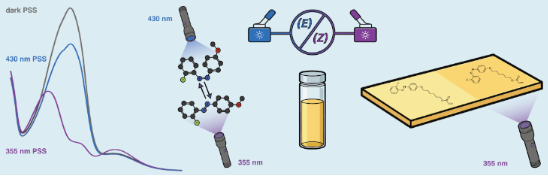
- (Tg), and temperatures of thermal decomposition (Td). All measured values are summarized in Table 1, while representative thermograms are depicted in Figure 2. Thermograms of all target compounds are listed in Supporting Information File 1, Figures S1–12. The final molecules were isolated as highly
- of evaporation, and final decomposition is observed at 231–236 °C as indicated by a broad exothermic peak within the DSC curve. The first weight loss for the viscous liquids 1d–f was found from 134 to 170 °C (Ti), pointing to a low-volatility of their liquid phase, while the thermal decomposition


Rongalite addition to dienones: diastereoselectivity in cyclic sulfone synthesis; stereochemical rationalization and prospects as a general conjugate nucleophile
Beilstein J. Org. Chem. 2026, 22, 742–752, doi:10.3762/bjoc.22.56

- unidentifiable mixtures. This is most likely due to decomposition processes initiated by reduction. Rongalite has been reported to react in this manner with other electron-poor aromatics [39]. Substrate 16 [40], in contrast, is very electron-rich. This produced sluggish reactivity, incomplete conversion and




Hydrogen production from formic acid catalyzed by NHC–Cu complexes
Beilstein J. Org. Chem. 2026, 22, 620–627, doi:10.3762/bjoc.22.48
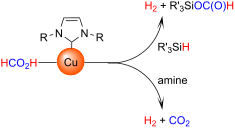
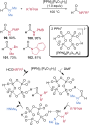
- 289, 9000 Gent, Belgium 10.3762/bjoc.22.48 Abstract The first NHC–Cu-catalyzed decomposition of formic acid (FA) is reported. In the presence of PhSiH3, only hydrogen is generated while CO2 is captured by a silane species. The decomposition of an equimolar mixture of FA and an amine provided an
- have also been explored. Beller and co-workers reported the first Fe catalyst bearing a phosphine ligand able to produce H2 with a TON of 1942 in the absence of additives [32]. A well-defined pincer–Fe complex allowing FA decomposition was reported by Milstein and co-workers [33]. While high TONs (up
- decomposition of its corresponding hydride species with respect to the IPr-based analogues. Remarkably, catalyst loadings as low as 1 mol % with complex 1a proved to promote the reaction, albeit at a slower rate (Figure 2d). Finally, at 40 °C and with only 0.1 mol % of 1a and 1 equivalent of PhSiH3 (Figure 2e



Kinetic resolution of racemic planar-chiral vinylcymantrenes by molybdenum-catalyzed asymmetric metathesis dimerization
Beilstein J. Org. Chem. 2026, 22, 568–574, doi:10.3762/bjoc.22.42
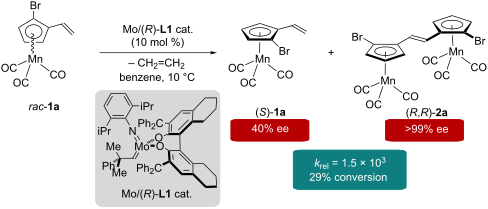
- of rac-1a giving (R,R)-2a of 99% ee and (S)-1a of 45% ee with 37% conversion (krel = 754; Table 1, entry 4). The lower catalyst loading (5 mol %) led to an unsatisfactory conversion (18%) probably due to the decomposition of the molybdenum catalyst prior to the completion of the reaction (Table 1


Melifoliox B, a novel phloroglucin derivative isolated from Melicope barbigera (Rutaceae) and synthesis of new oxidation products from melifoliones A and B
Beilstein J. Org. Chem. 2026, 22, 535–546, doi:10.3762/bjoc.22.39
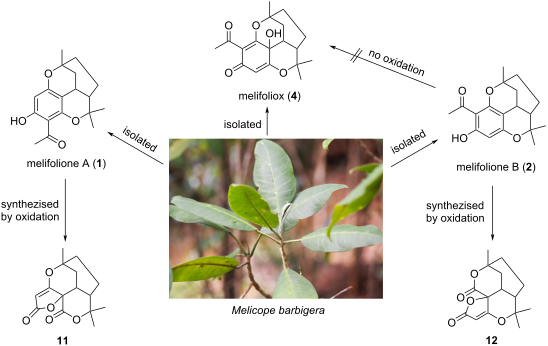
- dichromate in acidic solution or with potassium permanganate in acidic or alkaline solution led to complete decomposition of the melifoliones. A solution of the melifoliones in methanol with addition of methylene blue decomposed completely into undefined products within 24 hours when exposed to sunlight and



Get a better glimpse on sequential photoreactions of trisnorbornadienes with 19F NMR spectroscopy
Beilstein J. Org. Chem. 2026, 22, 527–534, doi:10.3762/bjoc.22.38
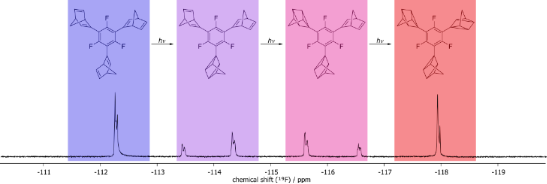
- mass, indicating decomposition above this temperature (see Supporting Information File 1, Figure S3). The cycloreversion of trisquadricyclane 2f0,3 was also initiated in a ground-state reaction with magic blue (5), which has already been shown to be an effective catalyst for this reaction [46][47][48
- be considered an improved property, the energy density of this compound is lower than that of the parent compound 2b because of the higher molecular mass. The experimental results showed a decomposition of trisquadricyclane 2f0,3 at higher temperature, which is accompanied by significant loss of mass
- photocatalysts. However, these key parameters do not match the better ones of the parent norbornadiene 1b. Furthermore, the fluoro-substituted derivative 2f0,3 appears to be prone towards thermal decomposition. Thus, even though this compound serves as an ideal probe for the investigation of the photoreaction by


Recent advances in the cleavage of non-activated amides
Beilstein J. Org. Chem. 2026, 22, 352–369, doi:10.3762/bjoc.22.23
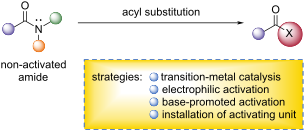
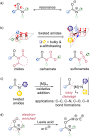
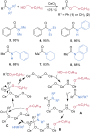
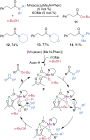
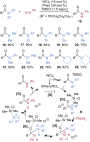
- intermediate anion X via the activated transition state W. Subsequent reorganization of hydrogen bonding toward the nitrogen center promotes C–N bond cleavage to give the ester product and intermediate Y. Decomposition of Y regenerates V and produces NH2Br, which is reduced at the cathode back to bromide










Configuration–packing synergy enabling integrated crystalline-state RTP and amorphous-state TADF
Beilstein J. Org. Chem. 2026, 22, 224–236, doi:10.3762/bjoc.22.16
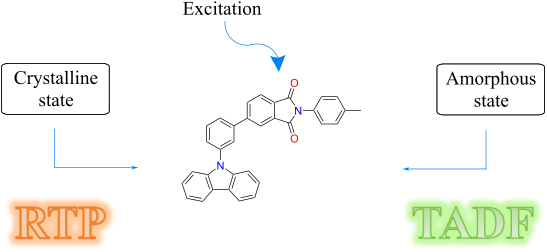
- differential scanning calorimetry (DSC). The results show that 1 exhibits excellent thermal stability. As shown in Figure 8, TGA measurements indicate a 5% weight-loss temperature of 354 °C, suggesting that the material undergoes significant decomposition at temperatures much higher than those typically


Base-promoted deacylation of 2-acetyl-2,5-dihydrothiophenes and their oxygen-mediated hydroxylation
Beilstein J. Org. Chem. 2026, 22, 192–204, doi:10.3762/bjoc.22.13
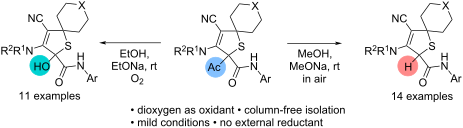
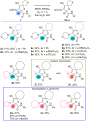
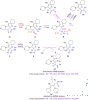
- ethanol (Scheme 5, VII). However, under these conditions only decomposition of 4g was observed, and neither deacetylated nor hydroxylated products were isolated. Interestingly, chromatography of 4g on neutral alumina resulted in elimination of the sulfonylimine group to give compounds 5g. Therefore, the




Circumventing Mukaiyama oxidation: selective S–O bond formation via sulfenamide–alcohol coupling
Beilstein J. Org. Chem. 2026, 22, 158–166, doi:10.3762/bjoc.22.9
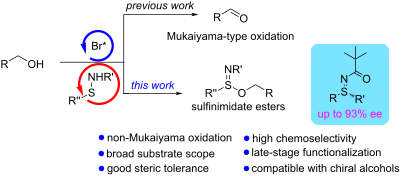
- species and in increased competitive decomposition. In contrast, the more strongly oxidizing TCCA tends to promote non-productive overoxidation pathways, thus also failing to match the efficiency of NBS. These results underscore the critical role of halogen source and oxidative strength in modulating the


Symmetrical D–π–A–π–D indanone dyes: a new design for nonlinear optics and cyanide detection
Beilstein J. Org. Chem. 2026, 22, 131–142, doi:10.3762/bjoc.22.6
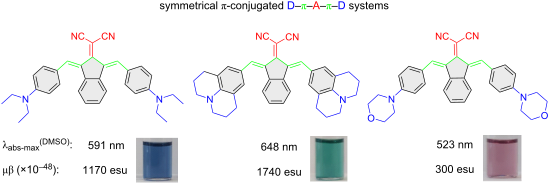
- functional theory (DFT) and time-dependent DFT (TD-DFT) calculations, which were consistent with experimental results. NLO properties of the compounds were experimentally determined using the EFISH method and calculated using theoretical methods. Additionally, the thermal decomposition temperatures, an
- , especially those with potential for use in optical systems, must be stable up to certain temperatures depending on the systems [34][35][36]. The percentage mass loss versus temperature graph is shown in Figure 8. The decomposition temperatures (Td) of the dyes are given in Table 5. Results show that the dyes


One-pot synthesis of ethylmaltol from maltol
Beilstein J. Org. Chem. 2025, 21, 2755–2760, doi:10.3762/bjoc.21.212

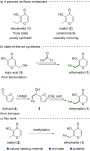
- hypothesized that decomposition pathways including potential instability of dianion I were responsible for the low overall recovered mass balance. This could be improved by lowering the temperature to −20 °C, which increased the yield of ethylmaltol (1) to 46% along with 1% putative 6 and 10% recovered maltol


Silica gel with covalently attached bambusuril macrocycle for dicyanoaurate sorption from water
Beilstein J. Org. Chem. 2025, 21, 2604–2611, doi:10.3762/bjoc.21.201
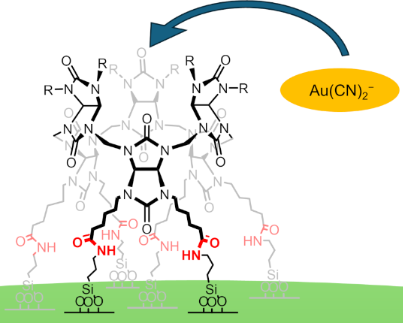
- minimal decomposition at temperatures below 800 °C as confirmed by the analysis. In contrast, a-SG, SG-NHCO-BU1, and SG-BU1 exhibited reduced thermal stability due to the presence of organic substituents (Figure 1A and Supporting Information File 1, Figure S1C). A weight loss of 10% for BU1, SG-NHCO-BU1


Assembly strategy for thieno[3,2-b]thiophenes via a disulfide intermediate derived from 3-nitrothiophene-2,5-dicarboxylate
Beilstein J. Org. Chem. 2025, 21, 2489–2497, doi:10.3762/bjoc.21.191
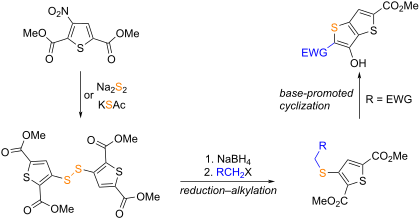
- of sulfide 2. Simultaneously, thiolate B reacts with acetyl nitrite to form the S-nitrosothiol intermediate C and the acetate anion. S-Nitrosothiol C subsequently undergoes decomposition, losing nitrogen oxide to give disulfide 3 (Scheme 5). This proposed mechanism, in particular the conversion of
- via attack by the disulfide anion, wherein each sulfur atom reacts with one molecule 1, resulting in the formation of product 3. The minor presence of sulfide 2 in the product mixture can be attributed to partial decomposition of an intermediate aryl disulfide anion, which can fragment under the
- , entry 1). However, methanol proved to be an ineffective solvent due to the rapid decomposition of NaBH4 and poor solubility of substrate 3. Most of the starting material was recovered unchanged after complete decomposing NaBH4. In contrast, when ethanol (Table 2, entry 2) or isopropanol (Table 2, entry



Synthesis of the tetracyclic skeleton of Aspidosperma alkaloids via PET-initiated cationic radical-derived interrupted [2 + 2]/retro-Mannich reaction
Beilstein J. Org. Chem. 2025, 21, 2470–2478, doi:10.3762/bjoc.21.189
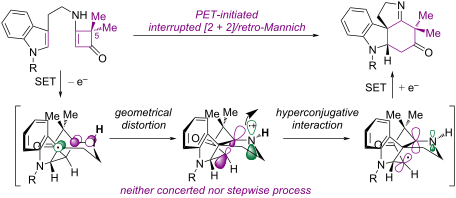
- intense substrate decomposition (Table 1, entries 6–8). These results showed that MeCN is the best solvent for the reaction. Finally, we investigated the effects of an alternative N-substituent in the indole moiety, and the reaction time and temperature on the photocyclization results. Boc-substituted


Ex-situ generation of gaseous nitriles in two-chamber glassware for facile haloacetimidate synthesis
Beilstein J. Org. Chem. 2025, 21, 2465–2469, doi:10.3762/bjoc.21.188
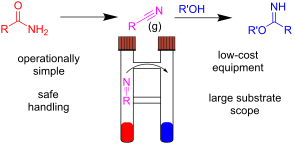
- of difluoroacetimidates was therefore attempted, but in our hands, these proved even more unstable than the trifluoroacetimidates and were not possible to isolate by chromatography due to decomposition. However, the purity of these compounds, after filtration through a block of silica gel, was
- was the p-methoxy derivative 11 which, as expected, was more reactive and hence more difficult to purify due to decomposition on silica gel. The p-methoxybenzyl trifluoroacetimidate (9) has been shown to be an effective regent for the acid-catalyzed benzylation of alcohols [12][30]. Conclusion In


An Fe(II)-catalyzed synthesis of spiro[indoline-3,2'-pyrrolidine] derivatives
Beilstein J. Org. Chem. 2025, 21, 2383–2388, doi:10.3762/bjoc.21.183
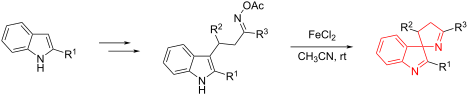
- resulted in extensive decomposition and tarring, a common issue with α-unsubstituted pyrroles under acidic conditions. These results indicate that substrates featuring strongly electron-withdrawing groups or acid-sensitive motifs are not compatible with the developed protocol. Next, we synthesized the